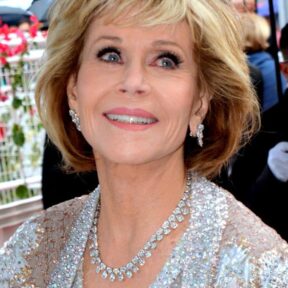
Jane Fonda
: Photo from Wikimedia Commons / Author of Photo: Georges BiardOverview
* Film actress
* Visited Hanoi during the Vietnam War, at which time she accused American soldiers of acting as “war criminals”
* “If you understood what communism was, you would hope, you would pray on your knees that we would some day become communist. . . . I, a socialist, think that we should strive toward a socialist society, all the way to communism.”
* Married Tom Hayden and Ted Turner
* Co-founded (with Tom Hayden) the Indochina Peace Campaign, which worked tirelessly to cut American aid to the governments in Saigon and Phnom Penh and help the North Vietnamese Communists and the Cambodian Khmer Rouge overthrow them
* Longtime supporter of Democrats and radical environmentalism
Background
Born Jane Seymour Fonda on December 21, 1937 in New York City, Jane Fonda is the daughter of actor Henry Fonda and the sister of actor Peter Fonda. She was named after Lady Jane Seymour, the third wife of King Henry VIII. Her father was an outspoken opponent of the House Un-American Activities Committee. When Jane was 12 years old, her mother, Frances Seymour Brokaw, slit her own throat with a razor while she was confined to a mental institution. Young Jane, told falsely that her mother had died of a heart attack, found out about her mother’s graphic suicide a year later from a story in a movie magazine.
As a young adult, Fonda attended Vassar College and struggled with bulimia. Following her graduation, she moved to New York City and studied acting at Lee Strasberg’s Actors’ Studio. After doing some stage work, she made her big-screen debut in the 1960 film Tall Story. She went on to have a highly successful acting career, with seven Academy Award nominations and two Oscar wins. Her movie credits include Cat Ballou (1965), Barefoot in the Park (1967), Barbarella (1968), They Shoot Horses, Don’t They? (1969), Klute (1971), Julia (1977), Coming Home (1978), The China Syndrome (1979), 9 to 5 (1980), and On Golden Pond (1981). In the 1980s Fonda launched a new and highly successful career as the star and producer of exercise videos and books.
Introduction to Radical Politics
Fonda was married to French director Roger Vadim from 1965 to 1973, and it was while living in France that she was introduced to French communists who would initiate her into political activism. Together she and Vadim had a daughter, Vanessa, so named because Fonda admired actress Vanessa Redgrave’s radical politics. Fonda became pregnant by activist Tom Hayden in 1972, and the two were married in 1973 (they would divorce in 1990). Fonda and Hayden named their newborn son Troy (originally spelled “Troi”) after a Viet Cong hero, Nguyen Van Troi, who was executed by the South Vietnamese government after attempting to assassinate U.S. Secretary of Defense Robert McNamara in 1963.
Fonda the Marxist
Fonda’s affinity for communism served as a backdrop for her intense anti-Vietnam War activities. By 1970 she was telling American college students: “If you understood what communism was, you would hope, you would pray on your knees that we would some day become communist. . . . I, a socialist, think that we should strive toward a socialist society, all the way to communism.”
In an interview that same year, Fonda was asked: “You have a two-year-old daughter, Vanessa. In what kind of a society do you think that she’d be living in, let’s say about 18 or 15 years fom now?” The actress replied: “Well, I would hope that she would be living in an unpolluted, Marxist, socialist country. Uh, I don’t think it’s gonna happen that fast, to tell you the truth.”
In that same 1970 interview, Fonda said: “I was brought up with a lot of concern about money. Uh, if one didn’t have enough, one was very nervous. It was sort of, as with most Americans, something that is quite sacred. Possessions were very important in the kind of milieu in which I grew up in. Um, I have overcome that, and I will not lay that kind of myth on my child at all.
Anti-American, Anti-Vietnam-War Activism
The dual villains of Southeast Asian conflicts were, in Fonda’s view, “U.S. imperialism” and “a white man’s racist aggression.”
In April 1970, Fonda and actor Donald Sutherland formed “FTA” (which meant, depending upon the source, either “Free the Army” or “Fuck the Army”), an anti-war, quasi-USO road show billed as “political vaudeville” that toured military towns along the West Coast and throughout the Pacific.
Fonda also worked with Vietnam Veterans Against the War (VVAW), serving as Honorary National Coordinator for a 1970 rally which that group organized in Valley Forge, Pennsylvania. Vietnam veteran and future Democratic presidential nominee John Kerry was also involved in organizing the rally (he and Fonda were photographed sitting near each other at the event).
On November 3, 1970 Fonda began a tour of college campuses to raise funds for VVAW. (On that same date, Fonda was arrested for allegedly kicking a U.S. Customs agent; charges were later dropped. In the police mug shot, her raised left hand was clenched in a “Black Power” or “Power to the People” salute).
In 1971 Fonda was the chief financier of VVAW’s Winter Soldier Investigation (WSI), which took place in Detroit from January 31 through February 2 of that year. The largest war crimes tribunal held in the U.S. during the Vietnam War, WSI featured a host of VVAW members who related gruesome stories of atrocities they claimed to have participated in or witnessed in Vietnam. They claimed, among other things, that rape, torture and murder were standard practices for the American military. In reality, WSI was a continuation of the anti-U.S. war crimes propaganda campaign which had begun in Europe with KGB-sponsored events that were organized before the first American ground troops ever arrived in Vietnam. Several of the WSI discussion-panel moderators were radical leaders who had previously met with top North Vietnamese and Vietcong representatives in Hanoi and Paris. Also present were leftist psychiatrists, psychoanalysts and clinicians, who pressured the witnesses to help end the war by publicly confessing their “crimes.”
In July-August 1972 Fonda made her infamous trip to North Vietnam. By this time, over 50,000 Americans had been killed in the war. While there, she posed for pictures on an anti-aircraft gun that had been used to shoot down American planes, and she volunteered to do a radio broadcast from Hanoi. She made approximately eight radio addresses, during which she told American pilots in the area:
“Use of these bombs or condoning the use of these bombs makes one a war criminal … Examine the reasons given to justify the murder you are being paid to commit … I don’t know what your officers tell you … but [your] weapons are illegal and that’s not just rhetoric … The men who are ordering you to use these weapons are war criminals according to international law, and in the past, in Germany and Japan, men who committed these kinds of crimes were tried and executed.”
Fonda also quoted Ho Chi Minh during some of these broadcasts. She referred to President Richard Nixon as a “new-type Hitler,” and advised South Vietnamese soldiers to desert, saying: “You are being used as cannon fodder for U.S. imperialism.”
These radio addresses were aired repeatedly by the North Vietnamese Communists, for whom propaganda was a key tool of psychological warfare; they used the broacasts not only to hearten their own citizens, but also to undermine the American public’s will to go forward with the war, and to crush the morale of U.S. and allied forces.
Most of what Fonda said was of a highly political nature. Many of the statements had been scripted for her by the North Vietnamese. Among her statements were the following (as catalogued by Henry Mark Holzer):
- “I want to publicly accuse Nixon here of being a new-type Hitler whose crimes are being unveiled.”
- “The Vietnamese people will win.”
- “Nixon is continuing to risk your [American pilots’] lives and the lives of the American prisoners of war . . . in a last desperate gamble to keep his office come November. How does it feel to be used as pawns? You may be shot down, you may perhaps even be killed, but for what, and for whom?”
- “[President Nixon] defiles our flag and all that it stands for in the eyes of the entire world.”
- “Knowing who was doing the lying, should you then allow these same people and some liars to define for you who your enemy is?”
- “The only way to end the war is for the United States to withdraw all its troops, all its airplanes, its bombs, its generals, its CIA advisors and to stop the support of the . . . regime in Saigon . . . .”
- “There is only one way to stop Richard Nixon from committing mass genocide in the Democratic Republic of Vietnam, and that is for a mass protest . . . to expose his crimes . . . .”
- “In 1969-1970 the desertions in the American army tripled. The desertions of the U.S. soldiers almost equaled the desertions from the ARVN army . . . .”
- “Perhaps the soldiers . . . who have suffered the most . . . [are] the black soldiers, the brown soldiers, and the red and Asian soldiers.”
- “Should we be fighting on the side of the people who are, who are murdering innocent people, should we be trying to defend a government in Saigon which is putting in jail tens of thousands of people into the tiger cages, beating them, torturing them . . . . And I don’t think . . . that we should be risking our lives or fighting to defend that kind of government.”
- “We . . . have a common enemy—U. S. imperialism.”
- “We thank you [the Viet Cong and North Vietnamese] for your brave and heroic fight.”
- “Nixon’s aggression against Vietnam is a racist aggression [and] the American war in Vietnam is a racist war, a white man’s war.”
- “I heard horrifying stories about the treatment of women in the U.S. military. So many women said to me that one of the first things that happens to them when they enter the service is that they are taken to see the company psychiatrist and they are given a little lecture which is made very clear to them that they are there to service the men.”
- “The POWs appear to be healthy and fit. . . . All of them have called publicly for an end to the war and signed a powerful antiwar letter . . . .”
- “A few of them [the POWs] tell me they, too, are against the war and want Nixon to be defeated in the upcoming elections. They express their fear that if he is reelected, the war will go on and on . . . and that bombs might land on their prison.”
- “I am asked to convey their [the POWs’] hopes that their families will vote for George McGovern.”
- “I ask them [POWs] if they feel they have been brainwashed or tortured, and they laugh.”
- “We read with interest about the growing numbers of you [South Vietnam Army troops] who are understanding the truth and joining with your fellow countrymen to fight for freedom and independence and democracy [i.e., with the Communists]. . . . We think that this is an example of the fact that the democratic, peace-loving, patriotic Vietnamese people want to embrace all Vietnamese people in forgiveness, open their arms to all people who are willing to fight against the foreign intruder.”
In addition to the foregoing statements, Fonda also said that:
- the Vietnamese people were peasants—leading a peaceful, bucolic life before the Americans came to destroy Vietnam;
- the Vietnamese were seeking only “freedom and independence” — which the United States wanted to prevent them from having;
- the million infantry troops which the United States put into Vietnam, and the Vietnamization program, had failed;
- Patrick Henry’s slogan “liberty or death” was not very different from Ho Chi Minh’s assertion that “Nothing is more valuable than independence and freedom”;
- President Nixon had violated the 1954 Geneva Accords;
- the United States must get out of South Vietnam and “cease its support for the . . . Thieu regime”;
- American troops were fighting for ESSO, Shell and Coca-Cola;
- the soldiers of the South Vietnamese army were “being sent to fight a war that is not in [their] interests but is in the interests of the small handful of people who have gotten rich and hope to get richer off this war and the turning of [their] country into a neocolony of the United States”;
- American soldiers in Vietnam had discovered “that their officers were incompetent, usually drunk”; and
- she had recently talked to “a great many of these guys [black American soldiers] and they all expressed their recognition of the fact that this is a white man’s war, a white businessman’s war, that they don’t feel it’s their place to kill other people of color when at home they themselves are oppressed and prevented from determining their own lives.”
Such statements could have had only one purpose: to provide aid and comfort to America’s Communist enemy. Fonda’s propaganda efforts played a major role in prolonging the war and increasing the death toll. As North Vietnamese Colonel Bui Tin explained in a postwar interview with The Wall Street Journal, the American antiwar movement “was essential to our strategy. Support for the war from our rear [China] was completely secure while the American rear was vulnerable. Every day our leadership would listen to world news over the radio at 9 a.m. to follow the growth of the American antiwar movement. Visits to Hanoi by people like Jane Fonda . . . gave us confidence that we should hold on in the face of battlefield reverses.”
Henry Mark Holzer explains that Fonda, while in Hanoi, also spent time doing the following:
- touring such North Vietnamese sites as the so-called “War Crimes” museum, a hospital, a textile center, and numerous populated areas — always in the company of North Vietnamese civilian and military officials as well as members of the international press — and there making pro-Communist and anti-American propaganda statements;
- making pro-Communist, anti-American propaganda statements to a French journalist, to reporters at a press conference in Hanoi, and to North Vietnamese Vice Premier Nguyen Duy Trinh;
- posing — in the company of Communist civilian and military officials and members of the international press — in the control seat of a North Vietnamese anti-aircraft gun, pretending to take aim on an imaginary American aircraft
In stark contrast to Fonda’s claims about American prisoners-of-war and the treatment they received from the North Vietnamese, consider the following account by Michael Benge, a civilian advisor captured by North Vietnam’s National Liberation Front (NLF) in 1968 and held as a POW for five years, who wrote:
“When Jane Fonda was in Hanoi, I was asked by the camp communist political officer if I would be willing to meet with her. I said yes, for I would like to tell her about the real treatment we POWs were receiving, which was far different from the treatment purported by the North Vietnamese, and parroted by Jane Fonda, as ‘humane and lenient.’ Because of this, I spent three days on a rocky floor on my knees with outstretched arms with a piece of steel re-bar placed on my hands, and beaten with a bamboo cane every time my arms dipped.”
Former POW David Hoffman, whose plane had been down over North Vietnam in 1971, also said that he had been tortured — and left with a permanently disfigured arm as a result of the brutal treatment he received from communist guards at his POW camp — because of Fonda’s visit to Hanoi:
“The torture resulted in a permanent injury that plagues me to this day. When Jane Fonda turned up, she asked that some of us come out and talk with her. No one wanted to. The guards got very upset, because they sensed the propaganda value of a famous American war protestor proving how well they were treating us. A couple of guards came to my cell and ordered me out. I resisted, and they got violently angry. My arm had been broken when I was shot down, and the Vietnamese broke it a second time. It had not healed well, and they knew it caused me great pain. They twisted it. Excruciating pain ripped through my body. Still I resisted and they got more violent, hitting me and shouting, ‘You must go!’…I was dragged out to see Fonda. I decided to play the role. I knew if I didn’t, not only would I suffer — but the other guys would be tortured or beaten or worse.”
When Fonda returned to the U.S., she told college students, “I bring greetings from our Vietnamese brothers and sisters,” and she lamented the war damage that she had seen in North Vietnam — inflicted, she said, by U.S. forces. She also sported a necklace given to her by the North Vietnamese Communists, made from the melted parts of a U.S. aircraft they had shot down.
Whenever stories about POWs getting tortured emerged, Fonda called them lies. When the POWs began coming home in 1973 and their accounts of torture began to gain credence, Fonda called the returning soldiers “liars, hypocrites, and pawns.” “Tortured men do not march smartly off planes, salute the flag, and kiss their wives,” she said. “They are liars. I also want to say that these men are not heroes.”
On another occasion — in April 1973 — Fonda said: “I’m quite sure that there were incidents of torture. I think probably some of these professional pilots were probably beaten to death by the people whose homes and families they were bombing and napalming. But the pilots who are saying it was the policy of the Vietnamese and that it was systematic, I believe that that’s a lie. These men were bombing and strafing and napalming the country. If a prisoner tried to escape, it is quite understandable that he would probably be beaten and tortured.”
Even when the U.S. pulled its troops almost entirely out of Vietnam in 1973, Fonda and her new husband, Tom Hayden, were not satisfied; together they formed the Indochina Peace Campaign (IPC), which continued to mobilize radicals across the United States after the 1973 Paris Peace Agreement, at a time when most antiwar organizations had either closed down or moved on to other causes. The IPC worked tirelessly to cut American aid to the governments in Saigon and Phnom Penh and help the North Vietnamese Communists and the Cambodian Khmer Rouge overthrow them.
In July 1973, Fonda gave birth to a son, Troy Garity Hayden, whom she and her husband named after a Viet Cong bomber, Nguyen Van Troi.
Fonda and Hayden returned to Hanoi in 1974 and went on to the “liberated zones” of South Vietnam (areas the Communists had conquered) to shoot the documentary Introduction to the Enemy, a propaganda piece depicting the North Vietnamese as peaceful patriots who, despite years of war and bloodshed, did not hate Americans and planned to create an ideal new society based on justice and equality.
Notably, Fonda would neither express regrets nor utter a word of protest when more than two million Indochinese peasants were slaughtered after American aid was cut off and the communists took complete control of South Vietnam and Cambodia in 1975. In fact, she refused to join folk singer and fellow antiwar activist Joan Baez in her protest against North Vietnam’s incarceration of more than 100,000 South Vietnamese because, as she told the National Press Club on September 26, 1979, she was unable to prove the veracity of the charges against the new communist regime.
Fonda Later Addresses Her Infamous Visit to Hanoi During the Vietnam War
In an effort to explain why she had made her propaganda broadcasts over Radio Hanoi in the 1970s, Fonda wrote in her 2005 autobiography, titled My Life So Far, that she had mainly wanted to educate U.S. pilots about the great harm their bombing campaigns were inflicting on innocent people. In an interview to promote the book, Fonda acknowledged that her visit with the Viet Cong had been a “betrayal” of American forces and of the “country that gave me privilege.” She called it the “largest lapse of judgment that I can even imagine.” However, she also said that she did not regret having met with American POWs in North Vietnam or having made propaganda broadcasts on Radio Hanoi. “Our government was lying to us and men were dying because of it, and I felt I had to do anything that I could to expose the lies and help end the war,” Fonda explained.
In 2012, Fonda acknowledged that she had used bad judgment in posing for the 1972 photos aboard the North Vietnamese anti-aircraft gun — though she was careful to defend her decision to visit Hanoi: “I did not, have not, and will not say that going to North Vietnam was a mistake. I have apologized only for some of the things that I did there, but I am proud that I went.”
In an October 2017 interview, Fonda was asked if she felt a “sense of regret” for her 1972 visit to North Vietnam. She answered: “I don’t regret going to Vietnam. The United States was bombing the dikes in North Vietnam — earthen dikes in the Red River Delta. If the dikes had given way, according to Henry Kissinger, somewhere around 2 million people could have died of famine and drowning. And we were bombing, and it wasn’t being talked about. And I thought, ‘I’m a celebrity. Maybe if I go, and I bring back evidence.’ And it did stop two months after I got back, so I’m proud that I went. It changed my life all for the good.” By contrast, Fonda said she did regret her infamous photo on the anti-aircraft gun which, as she put it, made her appear to be “siding with the enemy.” “The thing that I regret is that on my last day there, I made the mistake of going to a ceremony at an anti-aircraft gun,” she explained. “It wasn’t being used. There were no airplanes or anything like that. There was a ceremony. I was asked to sing and people were laughing and so forth and I was led, and I sat down. And then I got up and as I walked away, I realized, ‘Oh my gosh. It’s going to look like I am against my own country’s soldiers and siding with the enemy, which is the last thing in the world that was true.”
Supporting the American Indian Movement & the Black Power Movement
Fonda’s activism was not limited to protests against American military involvement in Southeast Asia. She was also immersed in radical chic causes like the American Indian Movement and Black Power. When Alcatraz Island was taken over by 79 American Indians on November 20, 1969, Fonda visited the site to show her solidarity with their occupation.
Fonda was also a strong supporter of Huey Newton and the Black Panthers, calling the latter “our revolutionary vanguard.” “We must support them with love, money, propaganda and risk,” she said. Fonda claimed that Newton was the only man she would trust to lead America (a claim she would later recant as having been “naïve and utterly wrong”), and also campaigned for the incarcerated Angela Davis and other black “political prisoners.”
Proclaiming Herself “A Revolutionary Woman”
Fonda spoke frequently and proudly about her radicalism, saying in 1970: “Revolution is an act of love; we are the children of revolution, born to be rebels. It runs in our blood.” In 1972 she declared, “I am not a do-gooder. I am a revolutionary. A revolutionary woman.”
“My Biggest Regret Is I Never Got to Fu** Che Guevara”
In a 2011 biography of Jane Fonda, author Patricia Bosworth revealed that the actress had confided during an early-1970s feminist consciousness-raising session: “My biggest regret is I never got to fuck Che Guevara,” the late Communist henchman of Fidel Castro.
Admirer of the Communist Death-Cult Leader, Rev. Jim Jones
In the 1970s, Fonda was a passionate admirer of the Rev. Jim Jones, a committed, pro-Soviet communist who had gained considerable fame as a faith healer and cult leader of the People’s Temple, a jungle-based commune in Jonestown, Guyana. In a 1977 statement, Fonda — along with husband Tom Hayden and a number of other progressives — proudly affirmed: “We are familiar with the work of Reverend Jones and Peoples Temple and have no hesitancy in commending them for their example in setting a high standard of ethics and morality in the community and also for providing enormous material assistance to poor, minority and disadvantaged people in every area of human need.” After a visit to the People’s Temple, Fonda wrote Jones a letter in which she said: “I also recommit myself to your congregation as an active full participant—not only for myself, but because I want my two children to have the experience.”
- On May 18, 1978, Jones led the some 914 inhabitants of Jonestown — including nearly 300 children — in committing mass suicide by drinking a grape-flavored beverage laced with cyanide. The FBI later recovered a 45-minute audio recording of the suicide in progress. On that tape, Jones could be heard telling Temple members that the Soviet Union, with whom the Temple had been negotiating a potential exodus for months, had decided not to accept them. Moreover, he told them that agents of intelligence organizations would soon “parachute in here on us,” “shoot some of our innocent babies” and “they’ll torture our children, they’ll torture some of our people here, they’ll torture our seniors.” To avoid the suffering that such a catastrophe would inevitably bring, Jones explained, it was vital for everyone to commit “revolutionary suicide” by drinking the poison. When some members cried out in distress and fear, Jones counseled: “Stop these hysterics. This is not the way for people who are Socialists or Communists to die. No way for us to die.” At the end of the tape, Jones concluded: “We didn’t commit suicide; we committed an act of revolutionary suicide protesting the conditions of an inhumane world.”
- Just before ending her own life, one woman member of the People’s Temple said: “Everything we could have ever done, most loving thing all of us could have done, and it’s been a pleasure walking with all of you in this revolutionary struggle. No other way I would rather go to give my life for socialism, communism, and I thank Dad [Jones] very, very much.” Similarly, another woman said: “Right. Yes. Dad — Dad’s love and nursing, goodness and kindness, and he bring us to this land of freedom. His love — his mother was the advance — the advance guard for socialism. And his love and his principles (unintelligible) will go on forever unto the fields …”
Anti-Nuclear Power Activism
Two weeks after the opening of her 1979 movie The China Syndrome (which depicted an accident at a nuclear energy plant), there was a real nuclear accident at Three Mile Island causing small amounts of radioactivity to escape into the atmosphere. Fonda called this “the most shocking synchronicity between real life catastrophe and movie fiction ever to have occurred,” and took off with her husband, Tom Hayden, on a 52-city anti-nuclear tour. Joining Fonda and Hayden on tour were leftwing stalwarts Bonnie Raitt and Jackson Brown.
Marriage to Ted Turner
In 1991 Fonda married her third husband, the billionaire television mogul Ted Turner. Their marriage would last for 10 years before they divorced in 2001.
Activist for Abortion Rights & Population Control
One of Fonda’s pet causes was population control. Fonda served as President Bill Clinton’s special “good-will” ambassador to the United Nations Population Fund, and in 1993 she gave a speech at the UN where she complained: “Our species alone co-opts, consumes or eliminates 40% of the Earth’s … energy … We must fight to ensure universal access to family planning … backed up with safe abortion.”
In 2000, Fonda donated more than $12 million to help fund an advertising and get-out-the-vote initiative to help political candidates supporting legalized abortion.
In 2003 Fonda received the Planned Parenthood Federation of America’s Margaret Sanger Award for her work to promote population control and taxpayer-funded abortion-on-demand. At the time, Fonda was a member of Planned Parenthood’s advisory board. The following year, Fonda’s husband, Ted Turner, won the same award. Fonda and Turner also shared a passionate devotion to the tenets of radical environmentalism. For example, Fonda was an avid supporter of the Environmental Media Association.
One of the “100 Most Important Women in the 20th Century”
In 1999 Fonda was named one of the “100 Most Important Women in the 20th Century” by ABC News and Ladies Home Journal. It was later revealed that four of the seven women who had placed Fonda on the list had also worked to prevent President Clinton from being impeached.
Fonda’s Views Regarding Israel, the Palestinians, & Islamic Terrorism
Just days after al-Qaeda terrorists had killed some 3,000 people in the U.S. on 9/11, Fonda said that instead of retaliation, the U.S. should try to understand the “underlying reasons” behind the murderous attacks.
In December 2002, Fonda visited a Palestinian refugee camp in the West Bank and was scheduled to meet with Yasser Arafat, though the meeting never occurred.
Opponent of the Iraq War (2003)
In 2003 Fonda made clear her opposition to the U.S. War in Iraq, stating: “What’s it going to mean for [U.S.] stability as a nation, for terrorism, for the economy I can’t imagine. I think the entire world is going to be united against us.” She was also critical of her fellow American citizens: “I don’t know if a country where the people are so ignorant of reality and of history, if you can [call] that a free world.”
Supporter of Not In Our Name, a Project of the Revolutionary Communist Party
To express her opposition to the war, Fonda signed on to the “Not in Our Name” campaign, which was directed by C. Clark Kissinger, a longtime Maoist activist and member of the Revolutionary Communist Party.
The “Vaginas Vote” Campaign in Support of John Kerry’s Presidential Bid (2004)
In 2004 Fonda, in a joint effort with Vagina Monologues playwright Eve Ensler, initiated “Vaginas Vote,” a pro-John Kerry get-out-the-vote campaign that sponsored events in more than 30 states. A Fonda press release promoting a September 13th “Vaginas Vote” rally in New York stated, “Vaginas Vote, Chicks Rock. … [O]rganizers are using the power of arts and activism to motivate and inspire all women — especially young women — to raise their voices and get out the vote to end violence against women and girls.”
The “Vaginas Vote” event was aimed at persuading young women to vote in favor of John Kerry in the 2004 presidential election, the implication being that another George W. Bush term would mean higher levels of violence against women than would a Kerry presidency. At the aforementioned New York rally, Ms. Ensler said to the attendees: “Are there are any registered vaginas in the house? . . . Step into your vaginas and get the vagina vote out.” Among those in the audience were Susan Sarandon, Gloria Steinem, Democratic Rep. Jan Schakowsky, and Jesse Jackson.
Fonda’s Anti-American Speaking Tour with George Galloway
In September 2005 Fonda made two appearances with British Member of Parliament George Galloway (who had been on Saddam Hussein‘s payroll and had illegally received about $585,000 in annual profits from Iraq’s exports under the Oil-For-Food program) during his twelve-city speaking tour of the U.S., where he condemned America’s war efforts in Iraq as both illegal and immoral. (Fonda was originally scheduled to make eight appearances with Galloway, but changed her plans so as to avoid drawing attention away from Cindy Sheehan‘s anti-war tour that was in progress at the time.)
Fonda’s Views on Christianity & Religion
In December 2014, Fonda spoke about her thoughts regarding Christianity and the meaning of Christmas: “Personally, I like to concentrate more on his [Jesus’] life but I guess that’s why I’m a small ‘c’ christian who’s fascinated by the Gnostic Gospels and dips into Buddhism as often possible.”
Asserting That “Patriarchy” Poses the Biggest Threat to Civilization
In March 2015, Fonda told the Associated Press that patriarchy, not terrorism, was the most serious issue facing the modern world. “The most intractable problem that humanity faces is the problem of patriarchy,” she said. Explaining that male quest for power is a consequence of having a “wounded” spirit, Fonda added: “[T]here’s nothing more dangerous than a wounded beast, thrashing about, flailing its tail with the barbs on it, and a lot of people are really getting hurt badly.” “There’s a lot of guys who won’t stand for [women’s equality],” including terrorists, she declared. “You need women elected to office, you need movements in the streets, you need social media, you need every single form of social protest and speaking truth to power that’s possible.”
On November 7, 2015 in Los Angeles, Fonda was honored at the LGBT Center’s 46th Anniversary Gala Vanguard Awards. While accepting her honor, she said: “As I see it, trans women are the frontline warriors in the battle against patriarchy. Because you better believe that any person who gives up penis privilege voluntarily is going to be a threat to the patriarchy.”
Fonda’s Contempt for Donald Trump & His Supporters
In January 2016, Fonda was one of dozens of celebrities and activists to join the so-called “Stop Hate Dump Trump” (SHDT) campaign designed to thwart the presidential prospects of Republican frontrunner Donald Trump. Asserting that Trump represented “a grave threat to democracy, freedom, human rights, equality, and the welfare of our country and all our people,” a statement on the SHDT website said: “We have witnessed Trump inciting hatred against Muslims, immigrants, women, the disabled. We have seen him evidencing dangerous tendencies that threaten the bedrock of democracy: unleashing a lynch mob mentality against protesters, calling for the expulsion of Muslims from the country, bullying, and fear-mongering. History has shown us what happens when people refuse to stand against hate-filled leaders. We pledge ourselves to speak out in every way possible against the politics of hate and exclusion he represents.” Other notables who signed on to the SHDT initiative included Michael Moore, Rosie O’Donnell, Harry Belafonte, Lily Tomlin, Noam Chomsky, Reza Aslan, Danny Glover, and Eve Ensler.
Speaking at the Women’s Equality and ERA Coalition’s “Night of Comedy” in New York City on February 8, 2016, Fonda accused Republican presidential frontrunner Donald Trump “fanning the flames of people’s anxieties and racism.” “It’s terrible and it’s dangerous,” she said. “Even if he doesn’t make it [as the Republican nominee] which I don’t think he will, the fact that he’s said the things he’s said about Muslims for example, the damage has been done. All those young Muslims now can say, ‘Yeah I guess they really are waging a war against us.’ It will draw them closer to the terrorists. I think it’s really, really dangerous.”
During President Donald Trump’s inauguration on January 20, 2017, Fonda and a number of other celebrities participated in a three-hour “Love-a-thon” telethon that aired on Facebook Live. The event was conceived by 23-year-old tech entrepreneur Alex Godin, who explained: “I woke up like a lot of Americans feeling pretty crappy on November 10,” the day after Election Day, and “I looked for an opportunity to do something.” One of the telethon’s organizers was Sam Koppelman, digital content strategist at Hillary for America. The goal was to raise at least $500,000 for Planned Parenthood, the ACLU, and Earthjustice.
On the January 20, 2017 broadcast of HBO’s “Real Time,” Fonda announced that she would not refer to President Donald Trump “by his name. I call him the predator-in-chief.”
At one point during the 69th annual Emmy Awards in September 2017, Fonda took the stage with Dolly Parton and Lily Tomlin to the theme music of their popular 1980 movie “9 to 5,” as the trio were slated to present the next award. Fonda declared that in 1980 she and her two co-stars had refused “to be controlled by a sexist, egotistical, lying hypocritical bigot” — a reference to the character who was their boss in the film, played by Dabney Coleman. Tomlin then quickly added, “In 2017 we still refuse to be controlled by a sexist, egotistical, lying hypocritical bigot” — a reference to Trump.
In September 2018, Fonda told a crowd in New York City that if President Trump were to fire Robert Mueller, the special counselor examining allegations that the Trump campaign had colluded with Russian operatives in an effort to rig the 2016 election: “We have to get in the streets–nobody should work. We should shut down the country. Shut it down!” Added Fonda: “People always say, ‘Was it worse in the ’60s and ’70s?’ It was not! This is the worst! This is an existential crisis. And if we don’t do what needs to be done–in terms of making our voices heard, and our votes heard–that’s it! We don’t have time.”
In an October 2018 interview, Fonda stated that the upcoming midterms were the “most important elections of my lifetime,” and that “it’s hard for me to breathe right now.” She also said that she was no longer speaking to some of her friends from Georgia because of political differences.
Likening Trump to Hitler
On November 1, 2018 — a few days before Election Day — Fonda, regarding President Trump’s recent criticism of what he viewed as false reportage by the establishment media, said in an interview with Variety magazine: “If you have read anything about the rise of the Third Reich and Adolf Hitler you will see the parallels. Attacking the media is the first step and move toward fascism. The cornerstone of democracy is an independent, democratic media. And it’s under attack in a major way because bad guys [like Trump] are running it all [the government]. We have to make sure it doesn’t continue.”
Supporting Hillary Clinton & Bernie Sanders
Fonda supported Hillary Clinton in the Democratic presidential primary of 2016. She also spoke highly of socialist Senator Bernie Sanders, who was challenging Mrs. Clinton for the Democrat nomination. “I think he’s great,” Fonda said of Sanders on February 8, 2016. “He’s great at describing what one of the main problems is, which is wealth equality. [Hillary is] good at saying how we’re going to solve problems and she’s going to get it done.”
Fonda & Gun Control
On May 4, 2016, Fonda served on the Honorary Host Committee for The Brady Campaign to Prevent Gun Violence awards gala at the Four Seasons Hotel in Beverly Hills. Named after Jim “Bear” Brady, former press secretary for President Ronald Reagan, the awards honor people who advocate for increased gun-control restrictions on American citizens.
Supporting Athletes Who Kneel During the National Anthem to Protest Racism
In an October 2017 interview, HARDTalk host Stephen Sackur asked Fonda if she was ultimately proud of her country, to which she immediately answered “No.” Fonda then explained what she was proud of: “I’m proud of the resistance. I’m proud of the people who are turning out in unprecedented numbers and continue over and over and over again to protest what [President Donald] Trump is doing. I’m very proud of that core.” Sackur then raised the issue of the recent actions of National Football League players who — following the lead of former San Francisco 49ers quarterback Colin Kaepernick — had chosen to kneel during the playing of the national anthem before their games, as a symbol of protest against America’s racial injustice. When Sakur asked Fonda how she herself would act in a similar circumstance, she replied: “I would take a knee. I would take two knees. I’d get on all fours if necessary to get attention. And Trump is manipulating it to make it to have something to do with the military. It has nothing to do with patriotism, it has nothing to do with the military, it has to do with racism that is so alive and well in the United States.”
At the ACLU of Southern California’s annual Bill of Rights Dinner on December 3, 2017, Fonda took the stage and praised Colin Kaepernick — who was scheduled to receive the Liberty, Justice & Equality award — telling him: “Colin, You Are Woke!”
Fonda Claims That the Confirmation of Supreme Court Nominee Brett Kavanaugh Would Be a “Catastrophe”
At a July 2018 press conference at the coalition of “Unstoppable Women Workers,” Fonda said that the confirmation of Judge Brett Kavanaugh, nominated for the Supreme Court by President Trump, would have disastrous consequences that would last for generations to come. “I think it will be a catastrophe, frankly, if this nomination goes through, for everyone and our children and unfortunately our grandchildren,” she stated. “Look, women’s rights, worker’s rights, will be shunted to the side and that’s just the beginning. It will be a catastrophe.”
Climate Change Activism & Calls for “Systemic” Economic Change
On Friday, October 11, 2019, Fonda was arrested along with 16 other activists for unlawfully demonstrating in a “Fire Drill Friday” rally on the steps of the U.S. Capitol building in support of an organization called Oil Change International, whose stated mission is to fight anthropogenic climate change. The day prior to that of the protest, Fonda had written: “I will be on the Capitol every Friday, rain or shine, inspired and emboldened by the incredible movement our youth have created. I can no longer stand by and let our elected officials ignore — and even worse — empower — the industries that are destroying our planet for profit. We cannot continue to stand for this.” Fonda also had recently told ABC News: “11:00 o’clock every Friday morning come get arrested with me or choose not to it doesn’t matter.” She was subsequently arrested again at the Capitol on each of the next seven consecutive Fridays.
After that, Fonda continued to lead numerous additional weekly Friday protests where she demonstrated in favor of the Green New Deal but was not arrested. At one of those events — on January 3, 2020 — Fonda demanded that fossil-fuel energy companies like ExxonMobil be required to pay steep financial penalties for the climate crisis that she claimed they had created and tried to cover up. In a video posted to Twitter, Fonda said: “Today we’re focusing on who is to blame and who should pay for the climate crisis. In other words, we want to hold the fossil fuel industry accountable for what they’ve done to us.” Praising the young people who had gotten involved in the anti-climate-change crusade, Fonda added: “The young climate strikers have been very, very instrumental in making this shift to where we’re talking about fossil fuels. We should be very grateful to the young people and the students who are sacrificing so much to call our attention to it. You know, you can’t solve a problem if you’re not naming it. And so today we want to name it in a big way. Because to slow down and stop the climate crisis, we must stop burning fossil fuels.”
Speaking at a luncheon at the National Press Club in Washington, D.C. on December 17, 2019, Fonda accused the U.S. energy industry of committing “crimes against humanity and the earth.” Among her additional remarks were the following:
- “Because we didn’t act 40 years ago, we don’t stand a chance of changing course in time without profound, systemic economic and systemic change.”
- “And they [climate scientists] say we have at best 11 years before the tipping point is reached. Eleven years to reduce fossil fuel emissions roughly in half. And then continue to reduce them to net-zero by 2050.”
- “Yes, we are facing a climate crisis. But we’re also facing an empathy crisis. An inequality crisis. It isn’t only the earth’s life support system that are unraveling. The fabric of our society is unraveling.”
- “This is going to take an all-out war on drilling, and fracking, and de-regulation, and racism, and misogyny, and colonialism, and despair, all at the same time.”
On February 7, 2020 in Los Angeles, Fonda participated in a star-studded “Fire Drill” rally on climate change, where she and the others chanted: “Hey hey, ho ho, fossil fuels have got to go.” When she addressed the crowd, Fonda said: “We have to act like the house is on fire. Millions of young people and students have stood up. Now older people are joining them.”
In a gesture intended to draw attention to the danger of climate change, Fonda, at the 92nd Academy Awards in February 2020, wore the same gown she had worn to the Cannes Film Festival six years earlier. She explained that by re-using that gown, she was being true to the promise she had made in 2019 when she had told a crowd during a climate change protest: “You see this coat? I needed something red and I went out and found this coat on sale. This is the last article of clothing that I’m gonna ever buy.” “I grew up when consumerism didn’t have such a stranglehold over us,” Fonda had said on yet another occasion. “So, when I talk to people and say, ‘We don’t really need to keep shopping. We shouldn’t look to shopping for our identity. We just don’t need more stuff,’ I have to walk the talk. So, I’m not buying any more clothes.”
Also at the Academy Awards ceremony in February 2020, Fonda celebrated the fact that she was wearing jewelry created by the Italian company Pomellato, which, by Fonda’s telling, “only uses responsible, ethically harvested gold and sustainable diamonds.” The Pomellato brand is owned by the Paris-based corporation Kering, which also owns such luxury brands as Gucci, Yves Saint Laurent, and Balenciaga.
Just before leading a March 6, 2020 environmental demonstration in Southern California, Fonda endorsed Senator Bernie Sanders for U.S. president, calling him the “climate candidate.” Said Fonda: “We have to get a climate president in office, and there’s only one right now, and that’s Bernie Sanders. So, I’m indirectly saying I believe you have to support the climate candidate.” “There’s a small bunch of white men getting really rich while they’re destroying the health of the people like the people you heard from. And this is just the tip of the iceberg. And guess what: it’s happening all across the country and all across the world. We have to say no more fossil fuels. Windmills are great, and solar panels are great, and Priuses are great. And we have to do all of that. But it’s not going to matter if we don’t stop the drilling and the fracking and the exporting and the refining of fossil fuels. […] We’re protesting an existential threat that could determine the future of human life on the planet, basically.”
In May 2020, Fonda signed her name to an editorial published in France’s largest newspaper, Le Monde, claiming that climate change and environmental catastrophe could be averted only if governments around the world were to embrace a complete overhaul of free-market-based economies and the rapacious greed that allegedly lay at their core. Titled “No to a Return to Normal,” the editorial was co-authored by actress Juliette Binoche and astrophysicist Aurélien Barrau. Other signatories included such notables as Robert De Niro, Madonna, Barbra Streisand, Joaquin Phoenix, Adam Driver, Cate Blanchett, Rooney Mara, Penelope Cruz, Javier Bardem, Jeremy Irons, Willem Dafoe, Alfonso Cuaron, Spike Jonze, Pedro Almodovar, and Alejandro G. Inarritu. Some key excerpts from the piece:
- “The Covid-19 pandemic is a tragedy. This crisis, however, has an upside in giving us the chance to examine what is essential. The ongoing ecological catastrophe is a ‘meta-crisis’: the massive extinction of life on Earth is no longer in doubt, and all indicators point to a direct existential threat. Unlike a pandemic, however serious it may be, it’s a question of a global ecological collapse whose effects will be immeasurable.”
- “Consumerism has led us to deny the value of life itself: that of plants, that of animals, and that of a large number of human beings. Pollution, climate change, and the destruction of natural spaces has brought the world to a breaking point. For these reasons, along with growing social inequalities, we believe it is unthinkable to ‘go back to normal.’”
Fonda was one of scores of celebrities and environmental activists who signed a February 8, 2021 letter to the President Joe Biden and Vice President Kamala Harris, urging them to close down the Dakota Access Oil Pipeline. Other notable signatories to the letter included Leonardo DiCaprio, Cher, Linda Sarsour, and Naomi Klein. The letter began by saying:
“Thank you for your administration’s early focus on climate change, tribal sovereignty, and racial justice and equity, including your decision to stop the Keystone XL pipeline. We are also grateful for your critical efforts to save lives and address the COVID-19 pandemic that is disproportionately impacting BIPOC communities across our country. As your Administration takes action to address the climate crisis and strengthen relationships with Indigenous communities, we respectfully urge you to reverse another harmful Trump Administration decision and immediately shut down the Dakota Access Pipeline (DAPL) during its court-ordered environmental review. to address the climate crisis and strengthen relationships with Indigenous communities.”
Fonda was angered by the Joe Biden Administration’s June 2021 decision not to cancel federal permits for Enbridge’s Energy’s Line 3 pipeline, which carries oil from western Canada to Wisconsin. “I am sickened and deeply disappointed that President Biden has given the go-ahead to Enbridge Line 3 in Minnesota,” she said. “This belies his promises on the campaign trail to follow science and stop new fossil fuel development and cut our carbon emissions in half by 2030.”
In July 2021, Fonda was one of more than 200 celebrities, Democratic donors, and activists to sign a letter to President Biden, asking him to “stop construction of Line 3 immediately” and “end the era of fossil fuel expansion decisively.” The letter said, in part: “Your presidency is a watershed in human history, the last chance to turn the tide before climate disruption spirals out of control. We worked hard for your election in part because you embraced that challenge as a defining strength of your candidacy. And we are encouraged and grateful that you clearly signaled your resolve by rejecting the Keystone XL pipeline on day 1. The ‘climate test’ for the KXL decision was clear and compelling. We ask you to apply it now to the Enbridge Line 3 pipeline. […] This pipeline is virtually identical to KXL in both substantive climate impact and symbolic importance. Construction of the project is an unfolding human rights crisis. Operating it over its lifetime would significantly exacerbate the climate crisis. It fails any reasonable test of climate justice.” Among the other signatories were actors Leonardo DiCaprio and Danny Glover.
In a January 2023 interview on NBC’s The Kelly Clarkson Show, Fonda offered up her theory about the interplay between climate and race. “Well, you know, you can take anything -– sexism, racism, misogyny, homophobia, whatever, the war, and if you really get into it, and study it and learn about it and the history of it and — everything’s connected,” she said. “There’d be no climate crisis if it wasn’t for racism.” When asked to elaborate upon that assertion, Fonda replied: “Where would they put the shit? Where would they put the poison and the pollution? They’re not gonna put it in Bel Air. They’ve got to find some place where poor people or indigenous people or people of color are living. Put it there. They can’t fight back. And that’s why a big part of the climate movement now has to do with climate justice.”
From June 21-24, 2023, Fonda and a wide array of fellow film-and-television personalities met in Los Angeles for a Hollywood Climate Summit. The purpose of this event was to discuss how movies and TV shows could influence the collective American worldview by subtly injecting their scripts with words and phrases promoting the notion of an anthropogenic “climate crisis.” Shortly before the summit, a Norman Lear Center/Good Energy study had found that since 2016, fewer than 3 percent of approximately 37,000 newly written TV and film scripts mentioned any keywords related to climate, while just 0.6 percent of such scripts specifically used the words “climate change.” Summit co-founder Heather Fipps said: “We see this as a huge problem because, for the most part, people on average spend more time with television and film characters than they do with their own families. It is really important for us to steep our fictional worlds in our reality.”
Fonda Views the COVID-19 Pandemic As a “Teachable Moment” and “God’s Gift to the Left”
In a March 31, 2020 piece titled “COVID-19 Has Created a Pivotal Time When the Future May Be Decided,” Fonda wrote that the coronavirus pandemic whose deadly effects were being increasingly felt around the world, could serve as a “teachable moment” where humanity might finally understand the necessity of rejecting capitalism and the fossil fuel industry, and of embracing big government as the solution to mankind’s problems:
“I am reminded of the 1940s, during WWII. […] We rationed food and didn’t complain. It was for the ‘greater good.’ Many Hollywood celebrities sold war bonds. People felt united in their desire to pull together in the country’s interests.
“Now is the time to recreate that sentiment and make it last beyond this pandemic. It won’t be easy. Since the 1980s under Reaganism and Thatcherism, individualism has been carefully fostered while the notion of a strong federal government has been vilified.
“That was when the idea of the ‘public good’ began to play second fiddle to the corporate good. In California, Reagan said, ‘The government can’t solve your problems. The government is your problem’ and he shuttered most of the state’s mental hospitals. That’s when the crisis of homelessness began. Margaret Thatcher said, ‘There is no such thing as society.’ Their administrations did a good job making people believe that big government is bad, especially the very people who most need a robust federal government to protect their rights to a union, to collective bargaining, to health care, to healthy food, to a free press, to voting.
“But as these and future administrations, Republican and Democratic alike (it’s called neo-liberalism), took money from corporations and geared their policies to favor corporations, especially the fossil fuel industry, the government naturally began working for them and less for its citizens and the notion of individualism took hold in our national psyche. […]
“My hope is that the COVID-19 pandemic will allow us to change this trajectory. In fact, we have to make certain it does. Just as the canals in Venice, Italy that are seeing fish and birds return must be maintained post-COVID along with the clean skies over American cities, the apparent return of civility evidenced by the outpouring of volunteerism, of caring for each other, must remain. This will require a major shift in our mindset, and this requires intentionality. We’ll need to work on it. Let’s expose individuality for what it is: a tool of the corporate elite.
“Will this pandemic teach us how interdependent we are, not just with each other, but with the natural world? With climate change, shorter, warmer winters, earlier springs, deforestation and other clearing of wild areas for human use guarantees that disease-baring animals and insects come in contact with people who lack resistance. This is how all the recent pandemics—AIDS, SARS, MERS, Ebola and now COVID-19 originated. The melting of the Arctic ice sheet is releasing untold pathogens to which humans are not immune. Climate change guarantees that COVID-19 will not be the last pandemic we will see.
“To be prepared we need to care for each other. Realize that this collective, existential crisis cannot be dealt with individually, or by a small, under-funded, under-staffed government that caters to the fossil fuel industry. We are seeing that the health of the most vulnerable people among us is a determining factor for the health of all of us.
“Let this be a teachable moment.”
In an October 2020 interview, Fonda said that the coronavirus pandemic was “God’s gift to the left,” because the economic and health-related crises it created had increased the likelihood that American voters would not re-elect President Trump in November. Said Fonda: “I just think COVID is God’s gift to the left (she laughs). That’s a terrible thing to say. I mean, I think it was a very difficult thing to send down to us, but it has ripped the Band-Aid off who he [Trump] is and what he stands for and what is being done to average people and working people in this country. We can see it now, people who couldn’t see it before, you know, they see it now and we have a chance to harness that anger and make a difference. So, I feel so blessed to be alive right now.”
Supporting the Black Lives Matter Movement
In late May 2020, while scores of American cities were being ravaged by violent Black Lives Matter– and Antifa-led riots in the aftermath of the infamous police-involved death of a black Minneapolis man named George Floyd, Fonda claimed that most of the protests were non-violent. “I think it’s important for us to recognize that the media cameras may be focused on the breaking of windows and the burnings and the fires, but the vast majority of people at least in the cities where I talked to people and from what I have seen on tv, it’s non-violent,” she told CNN’s Don Lemon on May 31. “These are people who are white. They are Latino. They are old. They are young. They are in wheelchairs, they have children with them. They have dogs with them. And it’s organized. Black Lives Matter, Color of Change, they don’t want violence. I don’t know who the people are that are doing the violence, but I think what matters is that more and more white people are getting it.”
In October 2020, Black Lives Matter co-founder Patrisse Khan-Cullors interviewed Fonda for Harper’s Bazaar magazine. During their conversation, the two repeatedly expressed deep admiration for one another. Some noteworthy quotes by Fonda:
- “[A]s you probably know, once you begin to study one issue, everything else—race, imperialism, capitalism—everything starts to come into question: economic issues, the fact that we don’t have that economic democracy. But it was when I read your book, When They Call You A Terrorist—when Trump was elected—that I realized that white supremacy is closer to the surface than I had ever realized, and I thought, ‘Man, I better understand this more.’ You think you know, you think you understand, but if you’re white, you don’t really. And so I very deliberately have been studying, and I read your book, and it really moved me, and I called you up.”
- “One of the things that is so potent about Black Lives Matter, is that it’s women-led.”
- “I was just a bougie whitie back then [in the 1960s], but, you know, we’re developing a real friendship. I don’t feel like you’re judging me, although there’s a lot to judge. I mean, it’s hard when you’ve been privileged all your life to really understand, to try to understand what it means to go through what people of color go through. I feel that you welcomed me into that journey, that I can turn to you for help, and I didn’t feel that back in the ’60s and the ’70s.”
- “Between Ava Duvernay’s documentary, 13th, and Michelle Alexander’s book The New Jim Crow, and other books that I’ve been reading, I’ve realized that mass incarceration today is the way that the leaders, the rulers, the powerful white folk have of getting rid of black people: putting them in jails, marking them as felons, so that they can’t get public housing, they can’t even vote, they can’t get food stamps. It’s very difficult to get a job when you have to check the felon mark, so it’s something that destroys their lives forever. Then, while they’re in the jail, they’re working just like slaves making clothes that we wear, and we don’t even know where they come from, but often they come from prisons, from people of color in prisons making these things, working like slaves.”
Supporting Joe Biden for President (2020)
On August 6, 2020, Fonda and actress Lily Tomlin co-hosted a “Women for Biden” fundraiser for Democratic presidential nominee Joe Biden, in an event billed as a “Women for Biden Virtual Conversation.” Women for Biden promoted the event by saying: “As a strong and steady leader, Joe Biden will restore the soul of this nation. He will rebuild the backbone of the middle class, so that this time everyone comes along. And, he will unite our country to deliver results for women and families.”
Urging Biden to Name Elizabeth Warren As His VP Running Mate
In June 2020, Fonda was one of 100+ leftwing activists who signed a letter urging Democrat presidential candidate Joe Biden to select Senator Elizabeth Warren as his running mate.
Demanding That Democrats Prevent Trump from Replacing the Deceased Ruth Bader Ginsburg on the Supreme Court
On September 18, 2020, Fonda told HBO’s Real Time host Bill Maher that she was “reeling” from the news that Supreme Court Justice Ruth Bader Ginsburg had died, thereby leaving an opening on the Court just weeks before the November presidential and congressional elections. Emphasizing the importance of not allowing President Trump to name a replacement for Ginsburg prior to Election Day, Fonda said: “We have to be as tough as [Republican Senate Majority Leader] Mitch McConnell and not allow them to do one freakin’ thing until the election is over. We have to rise up and not allow them to do it. If Mitch McConnell can do it, let’s grow some balls and ovaries. Oh, my God.”
Launching the Jane Fonda Climate PAC
On March 16, 2022, Fonda released a video message announcing the launch of her new political action committee, the Jane Fonda Climate PAC, dedicated to promoting a 50% reduction in carbon fuel emissions by the year 2030. Said Fonda in the video:
“I’ve never been afraid to stand up to politicians who ignore the realities of what’s at stake. Scientists have been very clear: We have to cut our fossil fuel emissions in half by 2030. We have eight years — that’s just four election cycles — before the point of no return. And there is no question that the obstacle between saving the planet and not is the money that has a stranglehold on our politicians. […] And this money has real consequences. The Green New Deal. Build Back Better. Clean Energy Investments. Ending billions of dollars in tax subsidies to the fossil fuel industry every year. All because of politicians backed by Big Oil. […] We [the new PAC] have pne goal: Do whatever it takes to defeat the political allies of the fossil fuel industry […] Let’s send a message to the politicians who are bankrolled: You should be as scared for your careers as we are by the climate spinning out of our control. We will not back down.”
The new PAC, for its part, stated that it would support “support climate champions and work to defeat the allies of the fossil fuel industry in both primary and general elections at the local, state, and federal levels through grassroots organizing and investments in paid media campaigns.”
Fonda Blames “Climate Crisis” on “Racism” & “Misogyny”
During the December 2, 2022 broadcast of MSNBC’s The Beat, anchor Ari Melber said to Fonda: “I mention women’s rights because so much we know came out of some of what you were doing, where you start out at the Vietnam protest, and then it is all of the guys, and all of the speakers are guys, and you start to say, wait, there is a lot more change even within the protest movement. You were part of that. What do you think about the progress made, and the progress being unwound, when you look at the [Supreme] [C]ourt’s [June 2022] decision [to strike down Roe v. Wade], which we know turned out a lot of voters in the midterms?”
Fonda replied:
“Yeah, it did. We’ve experienced having the right to control our bodies. That is not going to go away. We’re not going to give that up. So while it is absolutely unconscionable what the Supreme Court did, I believe that we’re going to fight and win to get those rights back. But, you know, as I learn more about climate, and as I dig deep, as I have for the last four or five years, what you realize is if there were no racism, there would be no climate crisis. If there was no misogyny, there would be to the climate crisis. It is a part of a mindset. It is the mindset that looks at a woman and says, ‘nice tits,’ or she could work in the fields. It is the same mindset as the person who looks at the tree and said floors, that could make good flooring. Everything is transactional and hierarchy, and certain things matter more than other things. So what has to happen is we not only have to stop new fossil fuel development, we have to change our mindsets.”
Suggesting the “Murder” of Anti-Abortion Politicians & Activists
During a March 10, 2023 appearance on The View, Fonda said: “We have experienced many decades now of having agency over our body, of being able to determine when and how many children to have. We know what that feels like. We know what that’s done for our lives. We’re not going back. I don’t care what the laws are. We’re not going back.”
One of the program’s hosts, Sunny Hostin, then responded to Fonda’s defiance by saying, “That’s the activist speaking, and then — and, she probably will get a Nobel Prize very, very, very soon.” Fonda, in turn, said: “But it’s the truth! It, it is the truth. We’re not gonna do it. We’re gonna fight.”
At that point, a second co-host, Joy Behar, asked Fonda: “Besides marching and, and protesting, what else do you suggest?”
Fonda replied: “Well, I’ve thought of murder.” This prompted a third co-host, Lily Tomlin, who was uncertain as to what Fonda had said, to ask: “What did you say?” And Fondam with a firmly serious expression on her face, responded unequivocally: “Murder.”
Some members of the panel laughed, but Behar — alarmed and aware of the criticisms that such a remark could spark — quickly interjected: “She’s kidding. Wait a second, she’s just kidding.” And while Tomlin told Fonda, “Don’t say that,” Behar continued: “Oh, you don’t know. They’ll [Conservatives will] pick up on that and just run with it.” Tomlin agreed: “Yeah, that’s the worst.” But as Behar repeated the phrase “She’s just kidding,” Fonda gave her a sharp, stern look. Hostin then tried to change the topic by saying: “Let’s move on and talk about Jane’s activism, which is legendary.”
Fonda’s Political Donations
Over the years, Fonda has given campaign contributions to such political figures as Tammy Baldwin, Joe Biden, Barbara Boxer, Max Cleland, Hillary Clinton, Tom Daschle, Tammy Duckworth, Andrew Gillum, Al Gore, Kamala Harris, Pramila Jayapal, Amy Klobuchar, John Lewis, Cynthia McKinney, Patty Murray, Barack Obama, Jon Osoff, Nancy Pelosi, Tom Steyer, Rashida Tlaib, Raphael Warnock, and Elizabeth Warren. She also gave money the Congressional Black Caucus, Iraq Veterans for Progress, the MoveOn political action committee, NARAL Pro-Choice America, Priorities USA PAC, Progressive Majority, and various state, local, and national Democratic Party entities.
Fonda’s Immense Wealth
As of May 2024, Fonda had a net worth of approximately $200 million.