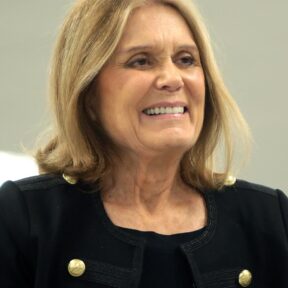
Gloria Steinem
: Photo from Wikimedia Commons / Author of Photo: Gage SkidmoreOverview
* Founded National Women’s Political Caucus
* Co-founded Ms. Magazine
* Co-founded Ms. Foundation for Women
* Member of the Democratic Socialists of America
* Advisory Board member of Fairness and Accuracy in Reporting
* Supports the unfettered right to taxpayer-funded abortion-on-demand
* Views America as a racist, sexist nation
Gloria Steinem was a feminist activist, a journalist, and the founder of Ms. Magazine. She was a member of the Democratic Socialists of America, and sat on the Advisory Board of Fairness and Accuracy in Reporting.
Steinem was born in Toledo, Ohio on March 25, 1934. She spent the early part of her life on the East Side of that city, which she once referred to as a pathologically violent and racist place where white citizens actively looked for blacks to assault. Her father abandoned the family in 1944, and for the next seven years Gloria took care of her emotionally disturbed mother and attended school only irregularly. The girl largely blamed her father for her mother’s nervous breakdown and the decades of mental illness that she suffered thereafter. In her 1983 “Ruth’s Song (Because She Could Not Sing It),” Gloria wondered whether the mother might have been able to live a normal, happy life if only she could have left her marriage without fear of the shame and stigma that accompanied divorce during her young adulthood. And, by logical extension, Gloria increasingly viewed the nuclear family as an institution rooted in the oppression of females. She wrote:
“I began to think about the many pressures that might have led up to that first nervous breakdown: leaving my sister whom she loved very much with a grandmother whose values my mother didn’t share; trying to hold on to a job she loved but was being asked to leave by her husband; wanting very much to go with a woman friend to pursue their own dreams in New York; falling in love with a co-worker at the newspaper who frightened her by being more sexually attractive, more supportive of her work than my father, and perhaps the man she should have married.”
Steinem entered Smith College in 1952; she worked for Democrat Adlai Stevenson’s presidential campaign that year.
After graduating from Smith, Steinem moved to England, where she became pregnant. Abortion was at that time illegal in England except in cases where the pregnancy was considered a health risk to the mother. Steinem was able to locate a sufficiently unprincipled physician who made that determination in her case, and she underwent an abortion.
Steinem then spent two years in India on a Chester Bowles Asian Fellowship. During this period she researched and wrote her first book, A Thousand Indias, a travel guidebook that the Indian government commissioned in hopes of to persuading American academics and students to visit that country.
After returning to the United States, Steinem worked for the Independent Research Service, a group that financed trips by American students to Soviet-backed World Youth Festivals. She also worked as an assistant editor of Help! magazine and began freelancing for other journals as well.
In 1963, the 28-year-old Steinem posed as a 24-year-old “Marie Catherine Ochs” and secured a job at Hugh Hefner’s Playboy Club in New York City, where she worked for nearly three weeks in order to gather information for “A Bunny’s Tale,” a double-feature exposé she published in the May and June 1963 issues of Show magazine. Writer and former English professor Janice Fiamengo describes Steinem’s article as follows:
“Steinem had clearly hoped, and expected, to discover horrors at the Playboy Club: women pressured to have sex with club members, women verbally abused and shabbily treated by crude, contemptuous men. The article was set up to mock and revile Hefner’s establishment.
“In fact, Steinem’s experience at the Playboy Club was quite mundane. The work was highly regulated, as one would expect from a position in which image was everything, and the shifts were tiring: long hours spent on painful, swelling feet in a too-tight outfit, regulation 3-inch heels, and a stuffed bodice.
“But there was no sex with club members—they weren’t allowed even to touch the servers—and aside from offers of dates from the mostly paunchy and balding men who came to the club, there was nothing at all unpleasant. The pay was not quite as good as advertised, and there were demerit points for having a tear in one’s stockings or a bedraggled puff tail, but the worst that could be said of the job was that it was no more glamorous than waitressing.
Nevertheless, Steinem wrote as if there were horrors, telling readers how dehumanizing it was, for example, to have to memorize scripted phrases (“Good evening, sir, I am your Bunny, Marie. May I see the member’s key, please?” and so on). This became her running theme …: that the Bunnies were treated as objects little better than prostitutes. One evening while working in the coat check, she noted that ‘There were a few customers, a very few […] who looked at us not as objects but […] as if we might be human beings.’
“Then, while walking home one night, Steinem purportedly exchanged a glance with a prostitute she passed on the street, noting that ‘Of the two of us, she seemed the more honest.’” The self-pity was nestled behind the allegedly searing insight into women’s degraded lives.
Ultimately, what Steinem decided to emphasize about the story—and the meaning accepted ever since—was that the techniques taught and interactions between male club members and female servers were typical of relationships between men and women in general. As she said in her conclusion, she came to the realization that ‘all women are Bunnies,’ i.e., all women are taught to please men, given lines to learn, tutored to make men feel listened to, wear degrading outfits, and are essentially no more than props to male self-esteem.”
Steinem remained active as a freelancer for the next several years; she wrote articles on birth control and a profile of Jackie Kennedy for Esquire. In 1968 she joined the staff of the nascent New York magazine, writing the “City Politic” column. She was an early supporter of leftists like Cesar Chavez, John Lindsay, and George McGovern.
In 1971 Steinem co-founded — along with Bella Abzug, Shirley Chisholm, Betty Friedan, and Eleanor Smeal — the National Women’s Political Caucus.
In 1972 Steinem created the American feminist magazine Ms. That same year, she founded — along with Patricia Carbine, Marlo Thomas, and Letty Cottin Pogrebin — the Ms. Foundation for Women. In the pages of Ms. magazine, Steinem gave voice to feminism’s anti-family, anti-male worldview, as expressed in the feminist slogan which she helped popularize: “A woman without a man is like a fish without a bicycle.”
As Janice Fiamengo writes: “Like all radical feminists, Steinem portrayed the history of the United States as a patriarchal plot designed by powerful white men to control women and racial minorities for white men’s profit and pleasure.” In her 1972 essay “Sisterhood,” she writes that the only significant differences between men and women are not biological but cultural — i.e., Western culture’s relentless effort to make women subservient to men:
“Women are human beings first, with minor differences from men that apply largely to the single act of reproduction. We share the dreams, capabilities, and weaknesses of all human beings, but our occasional pregnancies and other visible differences have been used—even more pervasively, if less brutally, than racial differences have been used—to create an ‘inferior’ group and an elaborate division of labor. The division is continued for a clear if often unconscious reason: the economic and social profit of males as a group.”
In 1974 Steinem co-founded the Coalition of Labor Union Women, whose mission was “to promote affirmative action in the workplace; to strengthen the role of women in unions; to organize the unorganized women; and to increase the involvement of women in the political and legislative process.”
A few years later, Steinem allegedly played a role in the politically motivated coverup of the rape of feminist Phyllis Chesler. In her memoir, A Politically Incorrect Feminist, Chesler recalls that in 1979-80 she took a position at the United Nations working for Davidson Nicol, a black dignitary from Sierra Leone, who brought her in to organize an international women’s conference under UN auspices. The plan was to subsequently publish an account of the conference proceedings, and to have Chesler write the Introduction. Though Nicol was married when Chesler came aboard, he soon began pursuing the latter. When Chesler rebuffed his advances, Nicol raped her. Around the same time, the international women’s conference took place in Oslo, and though Chesler had invited Steinem, a surrogate was sent instead, Robin Morgan. Morgan refused to stand up for Chesler against Nicol. In fact, she positioned herself to usurp the UN report and then wrote the introduction herself. With that, she brought ‘international feminism’ firmly into the Ms. orbit – all under the watchful eye of Steinem, whom she represented. Chesler begged Morgan and Steinem to help her confront her rapist, even long after the conference, but they refused. Morgan maintained it would be a bad idea for Ms. to accuse a black man of such a crime, because that might make Ms. vulnerable to charges of racism.
Until the demise of Ms. magazine in 1987 (it would re-emerge in 1991), Steinem wrote extensively on women’s rights issues, invariably in favor of abortion-on-demand, in support of the Equal Rights Amendment (ERA), and in sharp criticism of marriage and the traditional family. (She declared that traditional marriage was a form of imprisonment for women.)
Steinem’s influence waned with the collapse of Ms., and when the magazine was reborn Steinem was only a consulting editor.
Steinem withdrew further from the public spotlight in the 1990s after she was diagnosed with trigeminal neuralgia.
In the midst of the Bill Clinton sex scandals of the 1990s, Steinem wrote in the op-ed section of the New York Times that the President could not be accused of having sexually harassed women during his political career, because, Steinem reasoned, he “took no for an answer.”
In 1995 Steinem was a signatory to a New York Times ad voicing support for the convicted cop-killer Mumia Abu-Jamal, a former Black Panther. Other notables who signed the letter included Noam Chomsky, Roger Ebert, Mike Farrell, Danny Glover, bell Hooks, Spike Lee, Norman Mailer, Michael Moore, Charles Rangel, Susan Sarandon, and Cornel West.
Five years later, Steinem endorsed the “Emergency National Conference to Save Mumia Abu Jamal,” organized by the Center for Constitutional Rights. Among the co-endorsers of this initiative were the American Friends Service Committee, Amnesty International, the International Action Center, the National Coalition to Abolish the Death Penalty, the National Council of Churches, the National Lawyers Guild, Refuse and Resist, the Women’s International League for Peace and Freedom, Z Magazine, Ed Asner, Ramsey Clark, Ossie Davis, Susan Sarandon, Al Sharpton, Desmond Tutu, and Howard Zinn.
Eight days after 9/11, Steinem lent her name to a statement titled “Justice not Vengeance,” which said that “a military response [by the U.S.] would not end the terror” but rather “would spark a cycle of escalating violence,” and that bringing the perptrators “to justice under the rule of law — not military action — is the way to end the violence.” Other notable signatories included Harry Belafonte, Medea Benjamin, John Cavanagh, Ruby Dee, Ossie Davis, Barbara Ehrenreich, Mike Farrell, Margaret Gage, Danny Glover, Randy Hayes, Michael Klare, Michael Lerner, Bonnie Raitt, Michael Ratner, Edward Said, Martin Sheen, and Cora Weiss.
In a 2002 appearance at the YWCA of Palm Beach, Steinem blamed “white male patriarchy” for the Catholic Church’s pedophilia scandals and the 9/11 attacks. She also drew a comparison between the Church and Adolph Hitler, claiming that both were products of strong patriarchal structures. In fact, according to Steinem, “the cult of masculinity is the basis of every violent regime,” and she urged that boys be raised more like girls.
In 2002 as well, Steinem was a signatory to the “Statement of Conscience” crafted by Not In Our Name, a project of C. Clark Kissinger’s Revolutionary Communist Party. This document condemned not only the Bush administration’s “stark new measures of repression,” but also its “unjust, immoral, illegitimate, [and] openly imperial policy towards the world.”
In 2004 Steinem supported Democrat presidential candidate John Kerry and was a signatory to a “Pledge of Action to Stop a Stolen Election.” “I remember the stolen presidential election of 2000,” the statement said, “and I am willing to take action [by protesting] in 2004 if the election is stolen again.” Other signers included Medea Benjamin, Julian Bond, Leslie Cagan, Barbara Ehrenreich, Jesse Jackson, Michael Lerner, Barbara Lubin, Michael Moore, Eleanor Smeal, and Howard Zinn. This “Pledge” campaign was a joint project of Code Pink, Global Exchange, The Liberty Tree Foundation for the Democratic Revolution, and United for Peace & Justice.
In July 2005, Steinem joined a coalition that included individuals and organizations such as the Center for Constitutional Rights, the Culture Project, Code Pink, Eve Ensler, Not In Our Name, and United For Peace and Justice, who together demanded the closure of the Guantánamo Bay prison camp and an “immediate independent investigation into the widespread allegations of abuse taking place there.”
Steinem also has weighed in on the Middle East conflict, lending her name to an online petition titled “A Call to Bring the Settlers Home to Israel,” which asked the U.S. government “to provide generous foreign assistance” and financial incentives to those Israeli settlers willing to evacuate settlements in the Occupied Territories. Drafted by the Jewish Alliance for Justice and Peace, the petition — which was also signed by such notables as Eric Alterman, Ed Asner, Gordon Fellman, Morton Halperin, Stanley Hoffman, Michael Lerner, and Eli Pariser — called for $3 billion in cash incentives to be given to 16,000 settler families as a payoff for moving back inside Israel’s pre-1967 border.
In January 2008, Steinem penned an op-ed for the New York Times supporting Hillary Clinton’s presidential campaign and claiming that “gender is probably the most restricting force in American life.”
Campaigning on behalf of Mrs. Clinton in March 2008, Steinem used the topic of Republican candidate John McCain’s Vietnam War-era imprisonment as a springboard for charging that the American media were guilty of gender-based bias against Mrs. Clinton. Said Steinem: “Suppose John McCain had been Joan McCain, and Joan McCain had got captured, shot down and been a POW for eight years. [The media would ask], ‘What did you do wrong to get captured? What terrible things did you do while you were there as a captive for eight years?’”
Asserting that the media were too eager to fawn over not only McCain’s military background, but militarism generally, Steinem said:
“I am so grateful that she [Mrs. Clinton] hasn’t been trained to kill anybody. And she probably didn’t even play war games as a kid. It’s a great relief from Bush in his jump suit and from [John] Kerry saluting.” Steinem added that “from George Washington to Jack Kennedy and PT-109 we [Americans] have behaved as if killing people is a qualification for ruling people.”
Stating that she “would like very much to see [Barack Obama] be President for eight years after Hillary has been President for eight years,” Steinem said that “a majority of Americans want redemption for racism, for our terrible destructive racist past and so see a vote for Obama as redemptive. I don’t think as many want redemption for the gynocide” [America’s alleged mass killing of women]. “They [Americans] acknowledge racism — not enough, but somewhat,” added Steinem. ”They would probably be less likely to acknowledge that the most likely way [for] a pregnant woman … to die is murder from her male partner. There are six million female lives lost in the world every year simply because they are female.”
In June 2008, after Mrs. Clinton had been defeated by Obama in the Democratic primaries, Steinem stated: “I never thought that a progressive woman could win the top spot in my lifetime, and I never thought she could win, which was all the more reason it was important to support her. We [Americans] have a very bad record in this regard.”
That same week, Steinem announced her endorsement of Barack Obama for the presidency.
Steinem has authored such books as a biography of Marilyn Monroe titled Marilyn: Norma Jean (1986); Revolution from Within: A Book of Self-Esteem (1993); Outrageous Acts and Everyday Rebellions (1995); and Moving Beyond Words: Age, Race, Sex, Power, Money, Muscles: Breaking the Boundaries of Gender (1995).
Between 1979 and 2008, Steinem made close to $50,000 in political contributions. Some three-fourths of this went to Democrat candidates for public office, and one-fourth went to leftwing special-interest groups. Among the recipients of Steinem’s donations were Bill Clinton, Hillary Clinton, Jesse Jackson, John Kerry, Jim McGovern, Cynthia McKinney, Eleanor Holmes Norton, Nydia Velazquez, the National Organization for Women PAC, the Progressive Politics Network, and Voters for Choice.
In November 2013, Steinem was presented with a Medal of Freedom by President Barack Obama. Speaking at the National Press Club in Washington, DC shortly before receiving the award, she expressed her reverence the work of the late Margaret Sanger, the founder of Planned Parenthood:
“I hope this [award] is retroactive in honoring the work of Margaret Sanger. I hope that she would celebrate this recognition that reproductive freedom is a human right at least as crucial as freedom of speech and that no government should dictate whether or when we have children.”
Also in her Press Club remarks, Steinem praised President Obama for his unrivaled understanding of the importance of “reproductive freedom.” “There’s no president in history from whose hand I would be more honored to receive this medal,” Steinem said.
On August 10, 2017, Steinem appeared as a special guest on Michael Moore’s one-man Broadway show, The Tems of My Surrender, a production depicting President Donald Trump as a madman. In a discussion segment with Moore, Steinem said:
“I don’t have the answers, but you have to remember though, I’m a hope-aholic. Though it’s incredibly dangerous what happened — and it is, as you pointed out, the result of a perfect storm — we are woke now. We are seriously woke. … It’s a thousand times more because it’s all age groups and the anti-Vietnam movement was largely young people, and it’s geographically everywhere where the civil rights movement was not as much in the whole country as it should have been. It’s just huge. It is the majority, it’s people just doing whatever we can, which is the key.”
Some noteworthy statements Steinem has made over the years include the following:
- “America is an enormous frosted cupcake in the middle of millions of starving people.”
- “A liberated woman is one who has sex before marriage and a job after.”
- “Most women are one man away from welfare.”
- “I have yet to hear a man ask for advice on how to combine marriage and a career.”
- “If women are supposed to be less rational and more emotional at the beginning of our menstrual cycle when the female hormone is at its lowest level, then why isn’t it logical to say that, in those few days, women behave the most like the way men behave all month long?”
- “We’ve begun to raise daughters more like sons… but few have the courage to raise our sons more like our daughters.”
- “Women have two choices: Either she’s a feminist or a masochist.”
- “Women’s total instinct for gambling is satisfied by marriage”
Steinem died at her home in New York City on September 2, 2026.