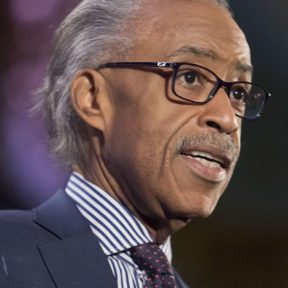
Overview
* Founder of the National Action Network
* Views America as a nation infested with systemic racism
* Helped incite anti-Jewish riots in Crown Heights, New York in 1991
* Was convicted of libel for his role in the racially charged Tawana Brawley hoax
* Incited black anti-Semites against a Jewish business establishment in Harlem in 1995
Background
Alfred Charles Sharpton was born in the Brownsville section of Brooklyn, New York on October 3, 1954, to relatively prosperous parents. He demonstrated considerable verbal dexterity at an early age and began preaching when he was four years old. He was touted as “the wonder-boy preacher” by age 7, when he toured with gospel singer Mahalia Jackson and Pentecostal minister F.D. Washington. Washington personally ordained Sharpton, who idolized Adam Clayton Powell, as a Pentecostal minister when the boy was 10. That same year, Sharpton’s parents divorced, leaving the youngster and his mother impoverished and reliant on welfare.
In the late 1960s, Sharpton joined the Southern Christian Leadership Conference (SCLC). In 1969 he was appointed as youth director of SCLC’s “Operation Breadbasket,” an initiative headed by Jesse Jackson which boycotted businesses accused of failing to hire enough black employees. Jackson, moreover, became a mentor to Sharpton.
Supporting a Communist Front and Angela Davis
In the February 9, 1971 edition of the Communist Party USA newspaper Daily World, CPUSA member Stephanie Allan wrote about a pair of recent rallies (in Chicago and in White Plains, New York) which had been held to support a CPUSA front called The Committee To Free Angela Davis. At the time, Davis was in prison for her role in abetting the murder of a California judge. Eliseo Medina was one of the speakers at the Chicago event, while Sharpton addressed the New York rally. According to Stephanie Allan, Sharpton and fellow speaker J.L. Scott “exposed the connection between [the] A&P [Corporation], U.S. monopoly capitalism, racism and imperialism, and related these to the Angela Davis case and the threat to the vital rights of the Black people.”
1971-1978
Also in 1971, Sharpton established the National Youth Movement, an organization that sought to organize young African Americans to push for increased voter registration, cultural awareness, and job-training programs. He would lead the group for the next 17 years.
On December 24, 1971, the New York Times quoted Sharpton praising Kwanzaa, the race-centered winter holiday that Maulana Karenga had recently established, as a new tradition that would perform the valuable service of “de-whitizing” Christmas.
After attending Brooklyn College for two years, Sharpton dropped out and had no additional higher education or formal seminary training. He soon began working (as a tour manager) for the entertainer James Brown and, later, for boxing promoter Don King. In 1978, Sharpton made an unsuccessful run for the New York State Senate.
Cocaine, Money-Laundering, and the FBI
In early 1983 the FBI was trying to nail boxing promoter Don King on cocaine-dealing charges. Toward that end, an undercover FBI agent—using the name Victor Quintana—arranged a meeting with King on the pretext of discussing a prospective boxing match in the Bahamas. But King, wary of this individual, persuaded his close friend, Al Sharpton, to meet with Quintana instead—i.e., to take Quintana to dinner at a restaurant and try to ascertain what type of person he was. Sharpton did so, accompanied by a friend.
At one point during the meal, Quintana, posing as a former South American druglord who was now seeking to launder money through boxing promotions, told Sharpton: “I know where 10 kilos of cocaine are and we can make some big money on this.” Sharpton’s companion, wary of the implications of getting involved in such criminal activity, immediately told Sharpton that this line of discussion was unacceptable and persuaded Sharpton to leave the restaurant with him. Sharpton, intrigued by Quintana’s proposition, was hesitant to walk away but ultimately did.
Soon thereafter, Sharpton and his companion met with Quintana a second time, in a hotel room. But when Quintana again raised the subject of cocaine, Sharpton’s friend once more called off the meeting.
After that, Sharpton and Quintana set up a third meeting that would take place in March 1983 without Sharpton’s companion, though the reputed mobster Danny Pagano of the Genovese crime family would also be present. At this meeting—which, unbeknownst to Sharpton, was being secretly videotaped by FBI surveillance cameras—Quintana told Sharpton that he could procure cocaine for $35,000 per kilo. Sharpton, wearing a cowboy hat and chomping on an unlit cigar, nodded his head and said, “I hear you.” When Quintana promised Sharpton a 10% finder’s fee if he could arrange the purchase of several kilos, Sharpton referred to an unnamed buyer and said, “If he’s gonna do it, he’ll do it much more than that.”
According to a comprehensive report by TheSmokingGun.com (TSG):
“While Sharpton did not explicitly offer to arrange a drug deal, some investigators thought his interaction with the undercover agent could be construed as a violation of federal conspiracy laws. Though an actual prosecution, an ex-FBI agent acknowledged, would have been ‘a reach,’ agents decided to approach Sharpton and attempt to ‘flip’ the activist…. In light of Sharpton’s relationship with Don King, FBI agents wanted his help in connection with the bureau’s three-year-old boxing investigation.”
Thus, one Thursday afternoon in June 1983—three months after his third meeting with Quintana—Sharpton arrived at a Manhattan apartment expecting to meet with him again. Instead he was confronted by men identifying themselves as FBI agents. They showed Sharpton the “cocaine” videotape and warned that he could face criminal charges as a result of that recording. Panicked, Sharpton immediately agreed to cooperate with the FBI by serving as a wired, undercover agent for the Bureau.
In that capacity, Sharpton became known by the FBI as “CI-7”—short for confidential informant No. 7—and began having numerous face-to-face meetings, all recorded, with mob figures from the Gambino and Genovese crime families. TSG reports that “[t]he resulting surreptitious recordings were eventually used to help convict an assortment of Mafia members and associates.”
Sharpton’s undercover work with the FBI continued until 1987, when his involvement with the infamous Tawana Brawley case (see below) put an end to his relationship with the Bureau. For comprehensive details of Sharpton’s FBI work during the mid-1980s, click here.
The Tawana Brawley Racial Hoax
Sharpton first entered America’s national consciousness on a large scale in November 1987, when he injected himself into the case of a 15-year-old black girl named Tawana Brawley, who claimed that she had been abducted and raped by a gang of six whites in Dutchess County, New York. Despite a complete absence of any credible evidence to support Miss Brawley’s story, Sharpton assumed the role of special adviser to the girl and thereafter worked closely with her attorneys, C. Vernon Mason (who, later in his career, would be convicted of 66 counts of professional misconduct and disbarred from the legal profession) and Alton Maddox (who has publicly expressed his profound hatred for white people).
Lamenting that their client had fallen prey to “certain elements that have constantly antagonized the black community, including the Ku Klux Klan and law-enforcement personnel,” Sharpton and the Brawley lawyers demanded that New York Governor Mario Cuomo appoint a special prosecutor to the case and publicly charged that “high-level” local law-enforcement officials were involved in the crime—an allegation that led to numerous death threats against members of the Dutchess County police department. Sharpton further demanded that New York Attorney General Robert Abrams be removed from the case because of an alleged “relationship” between Abrams and the Dutchess County sheriff who was, according to Sharpton, “a suspect in this case.” Sharpton insisted that there was “absolutely no way” that his client would talk to Abrams. “That’s like asking someone who watched someone killed in the gas chamber to sit down with Mr. Hitler,” he said.
The case dragged on, week after week, with Brawley refusing to speak to even a single investigator—ostensibly because she feared that as an African American she would be unable to get a fair hearing.
Then at a March 1988 news conference, Sharpton and the attorneys fingered Stephen Pagones, Dutchess County’s assistant district attorney, as one of their client’s attackers. When Sharpton was criticized for accusing Pagones without offering a shred of proof, he retorted: “We stated openly that Steven Pagones did it. If we’re lying, sue us, so we can go into court with you and prove you did it. Sue us — sue us right now.”
Further accusing district attorney William Grady of trying to cover up Pagones’ involvement in the crime, Sharpton, Mason, and Maddox demanded that Governor Mario Cuomo immediately arrest the two “suspects.” When asked what evidence they could provide to substantiate their charges, Sharpton and his cohorts were evasive, saying only that they would reveal the facts when the time was right.
In a speech he delivered when the Brawley case was dominating news headlines, Sharpton derided his white critics as racists: “They looked up and they saw Maddox, Mason, and Sharpton. What’s wrong with them? What was wrong with us was [that] crackers didn’t choose us!”
On another occasion, Sharpton appeared on the late Morton Downey’s television program and publicly used an anti-gay slur. The incident occurred when Sharpton got into a shouting match with an audience member and yelled, while gesturing to that individual to come up to the stage and fight: “You ain’t nothing! You a punk faggot! Now come on and do something!”
In June 1988, a Sharpton aide named Perry McKinnon stepped forward to make a remarkable series of disclosures. A former police officer, private investigator, and director of security at a Brooklyn Hospital, McKinnon revealed that: “Sharpton acknowledged to me early on that ‘The [Brawley] story do sound like bull—t, but it don’t matter. We’re building a movement. This is the perfect issue. Because you’ve got whites on blacks. That’s an easy way to stir up all the deprived people, who would want to believe and who would believe—and all [you’ve] got to do is convince them—that all white people are bad. Then you’ve got a movement.” Explaining that Sharpton was methodically “building an atmosphere” for a race war, McKinnon continued: “Sharpton told me it don’t matter whether any whites did it or not. Something happened to her…even if Tawana done it to herself.” To prove his truthfulness, McKinnon submitted to a lie-detector test administered on camera and passed all questions.
In the autumn of 1988, after conducting an exhaustive review of the facts, a grand jury released its report showing beyond any doubt that the entire Tawana Brawley story had been fabricated, and that at least $1 million of New York taxpayers’ money had been spent to investigate a colossal hoax.
Sharpton, however, would concede nothing. He continued to reiterate his claim that Brawley had been brutalized by a gang of whites. In February 1989, he told a Spin magazine interviewer, without the barest shred of proof, that Stephen Pagones had privately confessed to the crime. Sharpton further asserted, falsely, that Brawley’s gang-rape allegations had been confirmed by medical tests whose results were in C. Vernon Mason’s exclusive possession. And finally, for good measure, he lamented that Miss Brawley had tragically fallen prey to a barbaric “white supremist [sic] cult ritual.”
When Stephen Pagones in 1997 sued Sharpton (as well as Maddox and Mason) for defamation of character, Sharpton, under oath, said he could “no longer recall” having made a number of his slanderous accusations against Pagones and other law-enforcement officials years earlier. When asked whether he had made even the slightest attempt to verify Brawley’s allegations about Pagones before going public with them, Sharpton retorted, “I would not engage in sex talk with a 15-year-old girl.”
Pagones won a $345,000 court judgment against Sharpton and his two accomplices, of which Sharpton was responsible for $65,000. But Sharpton, claiming poverty, never paid his debt. When asked in a deposition how he could afford the expensive suits he wore, he replied that he did not own the garments but was merely granted “access” to them as needed. The same, he said, applied to all his other belongings. Ultimately, Sharpton’s $65,000 debt was paid (along with $22,000 in interest) in 2001 by a group of wealthy Sharpton supporters (one of whom was the trial lawyer Johnnie Cochran, who famously defended murder suspect O.J. Simpson in 1995).
It should be noted that during the decade prior to Pagones’ long-awaited vindication in court, the former prosecutor had suffered constant stress and anxiety (exacerbated by numerous death threats from Sharpton’s credulous followers) that contributed heavily to the devastating dissolution of Pagones’ marriage and the virtual ruination of his life.
Notably, Sharpton has never apologized for the way he conducted himself throughout the Brawley hoax, because to apologize, he explains, would be “all about submission” to white people eager to “forc[e] a black man coming out of the hardcore ghetto to his knees.” Reflecting on the Brawley case 12 years after it first made headlines, Sharpton said: “If I had to do it again, I’d do it in the same way.”
In October 2013, Sharpton appeared on MSNBC’s Morning Joe program to promote his new book, The Rejected Stone. When MSNBC’s Mika Brzezinski raised the issue of the Brawley case, Sharpton replied:
“I think that what I learned in Brawley, and it’s a case where if I was called today by a young lady who made those claims, I would respond the same way, but what I wouldn’t do is get into a back and forth with name calling with the prosecutor, and go for the quick from the hip kind of flippant attitude with the press. You learn to do what you do better….Whereas 25 years ago, it was ‘I don’t care what you think, I feel I’m right, I feel I’ve gotta do what I’ve gotta do,’ now I’m not talking to the prosecutor.”
Asked if he regretted the anguish he caused for the innocent Stephen Pagones, Sharpton answered:
“… Why would I say that I should not come to the defense of someone who had made a claim and those who had accused never would have come forth in the grand jury at that time that we got involved…. Any of the cases we get involved with, we’re not the investigators, but we have the basis of coming in based on we feel there has been a civil rights violation.”
Pressed again on whether he would have acted similarly if he had known then what he knew now, Sharpton became animated:
“Well, what do I know now? A grand jury didn’t believe her?… You’ve got to remember the same prosecutor came after me on situations I knew was wrong. Why would I believe the jury that he used there?….Why wouldn’t civil rights leaders respond? That’s what we’re about… I believe that the basis of our involvement, of saying that this prosecutor should have moved forward and brought this into court was absolutely the right position to take, and that’s the position we took.”
The Central Park Jogger Case
In April 1989, a 28-year-old white woman, dubbed the “Central Park jogger,” was brutally gang-raped and nearly beaten to death in New York’s Central Park by a group of black teenagers. Despite the defendants’ graphic and detailed confessions, which were captured on videotape and delivered in the presence of their parents or guardians, Sharpton insisted that the boys were innocent victims of “a fit of racial hysteria” that was sweeping the criminal-justice system and all of American society. Charging that the jogger’s boyfriend was the real rapist in the case, Sharpton organized protests outside the courthouse where the five suspects were being tried, chanting, “The boyfriend did it!” and smearing the victim as a “whore!” Further, Sharpton appealed for a psychiatrist to examine the victim, saying: “It doesn’t even have to be a black psychiatrist.” All five suspects were convicted for their involvement in the crime and were sentenced to prison terms ranging from 5 to 15 years apiece. Their convictions would later be overturned in 2002 when another man, Matias Reyes, who was already serving a life prison sentence, confessed to having committed the 1989 rape alone. For explicit details about the confessions of the five youths in question — and about their obvious involvement in the 1989 assault — click here.
Arrested for Stealing Funds from the National Youth Movement
On June 29, 1989, Sharpton was arrested and indicted on charges of stealing at least $250,000 from the National Youth Movement, an organization he had established 18 years earlier. The indictment against Sharpton listed 67 counts of grand larceny, falsifying business records, and scheming to defraud. In July 2002, Sharpton was acquitted on all charges.
The Yusuf Hawkins Case
On the evening of August 23, 1989, a large group of young white males in Bensonhurst, New York gathered outdoors to inform a local female acquaintance, who was of Italian heritage, that they were displeased about the fact that she was dating a black man. In response, the girl angrily stated that she would arrange for her boyfriend and several of his friends to come to the neighborhood that evening and beat up the whites.
A few blocks away around that same time, a 16-year-old African American named Yusuf Hawkins and three black male friends, who were in the area responding to a used-car ad, had just gotten off a subway but were unsure whether they had disembarked at the correct stop. Unfamiliar with the neighborhood, they decided to seek out their intended destination on foot. But when the aforementioned group of white males saw them, they (the whites) mistakenly thought that the blacks were those of whom the white girl had spoken. Thus the whites approached the blacks, threatened them, and began swinging baseball bats at them. The conflict eventually escalated to a point where one of the whites drew a handgun and fatally shot Hawkins in the heart.
Al Sharpton spoke at Hawkins’s funeral service a few days later and said, “I don’t know who shot Yusuf, but the system loaded the gun.” Exhorting the black community to put aside factional differences “and protect our own,” Sharpton vowed that someone would be punished for what had happened: “I want you to know, Yusuf, we’re not going to let you down. They’re going to pay this time.” “Never Again,” he added.
The Hawkins killing unleashed a torrent of racial tension in New York City during the days and weeks that followed, most notably in a series of protest marches led by Sharpton.
Forming the National Action Network
In 1991 Sharpton formed the National Action Network (NAN), whose platform “revolves around activism against racial profiling, police brutality, women’s issues, economic reform, public education, international affairs, including abolishing slavery in Africa, job awareness, AIDS awareness, and more.”
Using Racist Slurs Against Moderate Blacks
Emphasizing the urgent need for aggressive left-wing activism, Sharpton during this period derided moderate black politicians with close ties to the Democratic Party as “cocktail-sip Negroes” or “yellow ni**ers.”
The Anti-Semitic Riots in Crown Heights
In the summer of 1991, Sharpton injected himself into the unrest that followed an August 19 incident where a Hasidic Jewish driver named Yosef Lifsh had accidentally run over and killed a 7-year-old black boy named Gavin Cato in the Crown Heights section of Brooklyn, New York. Jewish Star reporter/columnist Jeff Dunetz describes the sequence of events that occurred immediately after the child’s death:
“A false rumor began to spread that the Hasidic ambulance crew had ignored the dying black child in favor of treating the Jewish men. This falsehood was later used by Al Sharpton to incite the crowd. Other rumors sprang up; some said Lifsh was intoxicated (breath alcohol test administered by the police proved his sobriety). More falsehoods circulated [stating that] Lifsh did not have a valid driver’s license; [that] he went through a red light; [that] the police prevented people including Gavin Cato’s father, from assisting in the rescue…. Ignited by the falsehoods, resentment exploded into violence. Groups of young black men threw rocks, bottles and debris at police, residents and homes. According to the New York Times, more than 250 neighborhood residents went on a rampage that first night, mostly black teenagers, many of whom were shouting ‘Jews! Jews! Jews!’
“Three hours after the tragic crash, 29-year-old Australian Jewish scholar Yankel Rosenbaum was attacked by a gang of Black teens. He was stabbed four times. Cops quickly arrested Lemrick Nelson, who was identified by Rosenbaum as his attacker. Rosenbaum’s wounds were not fatal; he was expected to recover. Mayor Dinkins visited Rosenbaum at the hospital. But Rosenbaum died at 2:30 a.m. Tuesday because the hospital staff missed one of his knife wounds. Despite some claims, Al Sharpton had nothing to do with the murder of Yankel Rosenbaum.
“Sharpton was out of town on the first night of the riot, he took over on day two. The next evening, according to the sworn testimony of Efraim Lipkind, a former Hasidic resident of Crown Heights, Sharpton started agitating the crowd: ‘Then we had a famous man, Al Sharpton, who came down, and he said Tuesday night, kill the Jews, two times. I heard him, and he started to lead a charge across the street to Utica.’”
Stirred, in part, by Sharpton’s contentious anger, hundreds of Crown Heights blacks took to the streets for three days and nights of violent rioting. Sharpton reacted to the chaos by repeatedly shouting the mantra, “No justice, no peace!” “We must not reprimand our children for outrage,” he declared, “when it is the outrage that was put in them by an oppressive system.”
Years later, Norman Rosenbaum, brother of the murdered Yankel Rosenbaum, reflected on the events of August 1991: “Based on everything we have seen and read, Sharpton never called upon the rioters to stop their anti-Semitism-inspired violence. He never called on the rioters to go home.” Rosenbaum elaborated: “The riots were the product of anti-Semites taking advantage of the tragic death of a child to justify inflicting their violence on innocent people — the Jewish community of Crown Heights — and murdering Yankel Rosenbaum, a Jew from Australia, amid the cries of ‘Kill the Jew!’”
Notwithstanding the mass violence that had engulfed Crown Heights in the wake of Gavin Cato’s death, Sharpton, delivering the eulogy at the boy’s funeral on August 26, persisted with his racially charged rhetoric. He told the mourners, for instance, that it was not merely a car accident that had killed the child, but rather the “social accident” of “an apartheid [Jewish] ambulance service in the middle of Crown Heights” that allegedly did not care enough to do everything in its power to help black victims in need. Added Sharpton: “Talk about how Oppenheimer in South Africa sends diamonds straight to Tel Aviv and deals with the diamond merchants right here in Crown Heights. The issue is not anti-Semitism; the issue is apartheid…. All we want to say is what Jesus said: If you offend one of these little ones, you got to pay for it. No compromise, no meetings, no coffee klatsch, no skinnin’ and grinnin’. Pay for your deeds.”
Failed Political Races
Sharpton ran unsuccessfully for the U.S. Senate in 1992 and 1994, and he received 32 percent of the vote in the 1997 Democratic mayoral primary in New York City.
Sharpton Derides Mayor Dinkins As a “Nigger Whore”
During the administration (1989-93) of New York City mayor David Dinkins (an African American), Sharpton angrily denounced Dinkins (when the latter was unsupportive of Sharpton’s activism) in the following terms:
“David Dinkins, you wanna be the only nigger on television, only nigger in the newspaper, only nigger that can talk. Don’t cover them, don’t talk to them, ’cause you got the only nigger problem. ‘Cause you know if a black man stood up next to you, they would see you for the whore that you really are.”
On another occasion, Sharpton referred to Dinkins as “that nigger whore turning tricks in City Hall.”
Becoming a Baptist Minister
In 1994 Sharpton was re-baptized into the Baptist faith and became a minister of that denomination.
The Racist Kean College Speech
Also in 1994, Sharpton delivered an incendiary speech at New Jersey’s Kean College, where he said: “White folks was in the cave while we [blacks] was building empires … We built pyramids before Donald Trump ever knew what architecture was … we taught philosophy and astrology and mathematics before Socrates and them Greek homos ever got around to it.” (Click here for audio.) Sharpton subsequently explained that while his use of the word “homos” may have been “irresponsible,” it “is not a homophobic term”
The Kean College speech also featured Sharpton explaining that America’s founders consisted of “the worst criminals, the rejects they sent from Europe … to the colonies.” “So [if] some cracker,” he continued, “come and tell you ‘Well, my mother and father blood go back to the Mayflower,’ you better hold you pocket. That ain’t nothing to be proud of, that means their forefathers was crooks.” Sharpton later defended his use of the word “cracker,” calling it merely a colloquial term used to describe a certain kind of equal-opportunity bigot: “It’s certainly not a racist term and certainly not an anti-Semitic term,” said Sharpton, “because a cracker hates [both] Jews and blacks.”
Million Man March
In 1995 Sharpton — along with such notables as Barack Obama and Jeremiah Wright — helped organize Louis Farrakhan‘s October 16th Million Man March.
The Deadly Boycott of Freddy’s Fashion Mart
Also in 1995, Sharpton led his NAN in a racially charged boycott against Freddy’s Fashion Mart, a Jewish-owned business in Harlem. The boycott started when Freddy’s owners announced that because they wanted to expand their own business, they would no longer be subletting part of their store to a black-owned record shop. The street leader of the boycott, Morris Powell, was also the head of Sharpton’s “Buy Black” Committee. (In the 1970s, Powell was confined to a mental hospital after he had attacked a police officer with a lead pipe while shouting, “I am going to kill you, pig.” He eventually escaped from that hospital and, in the eighties, went on trial for breaking a Korean woman’s head during another protest.) Powell and his fellow anti-Freddy’s protesters repeatedly and menacingly told passersby not to patronize the “crackers” and “the greedy Jew bastards [who are] killing our [black] people.” Some boycotters openly threatened violence against whites and Jews––all under the watchful, approving eye of Sharpton, who referred to the proprietors of Freddy’s as “white interlopers.” The subsequent picketing became ever-more menacing in its tone until one of the participants eventually shot (non-fatally) four whites inside the store and then set the building on fire––killing seven employees, most of whom were Hispanics. (Notably, Morris Powell defended the killer as “A Black Man who struggled for his people to be free.”
Sharpton Defends Louis Farrakhan
During his unsuccessful run for New York City mayor in 1997, Sharpton was asked if he would “denounce” Nation of Islam leader Louis Farrakhan, who had a long history of incendiary rhetoric aimed at whites and Jews. “I don’t publicly denounce anybody,” Sharpton replied. When the same questioner asked Sharpton if he considered Farrakhan to be anti-Semitic, Sharpton responded, “No, I do not.”
Appearance at a Socialist Scholars Conference
In 1998 Sharpton was a featured speaker at the Socialist Scholars Conference in New York.
Speaker at the Million Youth March
Along with Malik Zulu Shabazz and Khalid Abdul Muhammad, Sharpton co-organized an infamous September 5, 1998 “Million Youth March” which was held in Harlem, New York and was sponsored by the New Black Panther Party. The event drew about 6,000 people and ended in clashes between the attendees and city police. Just prior to the rally, Shabazz had threatened to kill any police officers who might be tempted to “interfere” with the proceedings. Then, in his address to the marchers, Shabazz stated: “The only solution any time there is a funeral in the black community, is a funeral in the police community.” “I don’t care what the Jews say,” he added. “You [blacks] are the only people that have been in bondage for over 400 years. You are the true chosen people of God, and it is not the so-called Jew.”
Sharpton, in his own remarks to the crowd, praised former Nation of Islam leader Elijah Muhammed as well as Malcolm X, Louis Farrakhan, and Khalid Abdul Muhammad. Moreover, he vowed not to permit white people to decide which black leaders he should support.
“Redeem the Dream” Rally
In August 2000, Sharpton held a “Redeem the Dream” rally at the Lincoln Memorial in Washington, DC, where one of the featured speakers was Malik Zulu Shabazz. At that event, Shabazz called on black young people, including “gang members,” to unite against their “common enemy” — “white America” and its allegedly racist police departments. He also articulated a “black dream that when we see caskets rolling in the black community … we will see caskets and funerals in the community of our enemy as well.”
Sharpton’s Closeness to Khalid Abdul Muhammad
In February 2001, when the infamous anti-Semite and racist Khalid Abdul Muhammad lay comatose in a hospital as a result of a brain aneurysm that would prove to be fatal, Sharpton was at his side two days before Muhammad expired. Sharpton subsequently spoke at Muhammad’s memorial service, and he gave Muhammad’s family $10,000 to help cover his funeral expenses.
Sharpton Goes Silent Regarding Black Slavery in Sudan
In 2001, as Sharpton was considering a possible run for U.S. president in the 2004 election, he traveled to Sudan for the purpose of verifying and publicizing reports that Arab Muslims in that country were raiding black Christian villages, killing the male inhabitants and enslaving the women and children. Sharpton did indeed observe an active slave trade in Sudan, but when he returned to the U.S. he met with senior members of the Nation of Islam, whose leader, Louis Farrakhan, had been adamantly denying that Arabs were enslaving blacks anywhere in the world. As Charles Jacobs explains in the American Thinker: “[Farrakhan’s] mission is to convince American blacks that Islam is the path to authentic freedom; it would be damaged by living and breathing proof that blacks are enslaved and slaughtered in African countries like Sudan where Islam dominates.” And Sharpton, in deference to Farrakhan, reneged on his pledge to bring attention to the Sudanese slave trade.
Characterizing White Republicans As Racists
In a May 2003 speech sponsored by Harvard Law School, Sharpton characterized Republicans as racists who “cut taxes for the rich while [they] strangle the poor”; he likened black Republicans Colin Powell and Condoleezza Rice to subservient house slaves; he called for “$50 billion a year” in tax hikes so that America could “invest in working-class people, not multi-billionaires”; he proclaimed that “white male land owners” were in control of the United States; and he asserted that the descendants of the white men who “used to buy [blacks], now they rent ’em.”
Failed Presidential Campaign
A harsh critic of the Iraq War and the PATRIOT Act (which he called “unpatriotic” and “illegitimate” legislation), Sharpton campaigned for the U.S. presidency in 2004. Though his candidacy was unsuccessful, the Democratic Party establishment allowed him to speak in the prime-time slot on the third day of its national convention.
Sharpton’s Ignorance Regarding the Tax Burden Shouldered by the Wealthy
In a 2004 interview with ABC newsman John Stossel, then-presidential candidate Sharpton claimed that “the rich do not pay their share” of income taxes. “The top 1 percent in this country pays very much less than 10 percent, very much less than 5 percent [of all income taxes]” he declared. When Stossel then asked him what percentage of all income taxes should be paid by the top 1 percent, Sharpton replied that the wealthy “should pay somewhere around 15 percent.” Reiterating that “they don’t pay 5 percent,” Sharpton added: “Anybody could see that is unequal and unfair.” When Stossel then informed Sharpton that the top 1 percent were actually paying fully 34 percent of all income taxes already — more than twice as much as Sharpton had said would be fair — Sharpton changed the topic from the tax burden shouldered by the wealthy, to “the quality of their [wealthy people’s] lives.”
Supporting Cindy Sheehan
In August 2005 Sharpton visited activist Cindy Sheehan in Crawford, Texas to show support for her anti-war, anti-Bush protest campaign.
Speech at an Anti-War Rally Organized by Pro-Communist Coalitions
On September 24, 2005, Sharpton spoke at the “Call to United Mass Action,” an anti-Iraq War rally in Washington, DC that was co-organized by International ANSWER and United for Peace and Justice. Other speakers at the event, which was attended by an estimated 300,000 people, included Brian Becker, Michael Berg, Mahdi Bray, Ramsey Clark, Cindy Sheehan, George Galloway, Larry Holmes, Dolores Huerta, Ralph Nader, Elias Rashmawi, Michael Shehadeh, and Lynne Stewart.
The Duke Lacrosse Case
In March 2006, a black stripper accused three white members of the Duke University lacrosse team of having beaten, raped and sodomized her during an off-campus party. These charges triggered an instantaneous eruption of outrage among left-wing civil-rights activists. Sharpton, for his part, declared that these “rich white boys” had attacked a “black girl,” and warned that if arrests were not made immediately, there would be no peace. He further claimed that “this case parallels Abner Louima, who was raped and sodomized in a bathroom [by a New York City police officer] like this girl has alleged she was…. and just like in the Louima case, you have people here saying she fabricated it….” It later became evident, however, that the plaintiff’s charges were indeed entirely fabricated, and all charges against the defendants were dropped.
Disparaging Mormonism
When Mitt Romney, a Mormon, ran for the 2008 Republican presidential nomination, Sharpton said: “As for the one Mormon running for office, those who really believe in God will defeat him anyways, so don’t worry about that; that’s a temporary situation.”
Charging Racism in Major League Baseball’s Steroid Investigations
In February 2008, Sharpton asserted that the federal government was seeking to prosecute black athletes more aggressively than white athletes in scandals over their alleged use of performance-enhancing drugs. Specifically, Sharpton claimed that members of Congress, in their recent questioning of white pitcher Roger Clemens, had acted as if “they were at a fan club meeting,” as compared to the allegedly harsher treatment which black outfielder Barry Bonds was receiving. “You’ve got to understand that the fight has always been about the criminalization of black men,” said Sharpton.
Supporting Barack Obama
In March 2008, Sharpton, a strong supporter of Barack Obama‘s presidential candidacy, stated that he was accustomed to speaking with Obama on a regular basis — “two or three times a week.”
Shakedowns and Extortions
Sharpton often threatens to organize black boycotts of corporations, on grounds that they supposedly discriminate against African Americans. Those companies, in turn — terrified of such boycotts and negative publicity — typically try to mollify Sharpton with cash; sometimes they even hire him as a paid consultant. For example:
* In June 1998 Sharpton threatened to call for a consumer boycott against Pepsi, alleging that blacks were underrepresented in the company’s advertising. Less than a year later, Pepsi hired Sharpton as a $25,000-per-year adviser until 2007.
* In November 2003, Sharpton threatened to lead a boycott of DaimlerChrysler over the allegedly pervasive “institutional racism” in the company’s car-loan practices. Within six months, Chrysler began supporting Sharpton’s NAN conferences.
* Also in 2003, Sharpton complained that American Honda had too few blacks in management positions. “We support those that support us,” Sharpton wrote to the company. “We cannot be silent while African-Americans spend hard-earned dollars with a company that does not hire, promote or do business with us in a statistically significant manner.” In response, Honda executives met with Sharpton, and within two months they began to sponsor NAN events — causing Sharpton’s protests to cease.
* According to one General Motors spokesman, Sharpton’s NAN repeatedly asked his company for contributions every year from 2000 through 2006, and GM each time declined to pay anything. Then, in December 2006 Sharpton threatened to call a boycott to protest the automaker’s closing of a black-owned GM dealership in the Bronx. In both 2007 and 2008, General Motors made donations of $5,000 to NAN.
* Anheuser-Busch has given more than $100,000 to Sharpton’s NAN; Colgate-Palmolive forked over $50,000. Pfizer also contributed thousands of dollars.
* Yet another company that has given thousands of dollars to NAN is Macy’s, whose troubles with Sharpton began in November 2011, following allegations by black shoppers claiming that store personnel had racially profiled them as potential thieves. Regarding the Macy’s case and a similar one involving the Barneys New York clothing store, Sharpton said he might urge blacks to no longer shop in those stores.
* Almost 50 companies — including PepsiCo, General Motors, Wal-Mart, FedEx, Continental Airlines, Johnson & Johnson, and Chase — sponsored Sharpton’s annual NAN conference in April 2008.
* According to a January 2017 report in The Daily Caller: “A 2010 investigation conducted by the State of New York Office of the Inspector General found that in 2008 Plainfield Asset Management, a Connecticut-based hedge fund — which at the time [was pursuing a lucrative gambling deal in New York and] had a $250 million investment in Capital Play, one of three companies bidding for a license to operate video slot machines at Aqueduct Racetrack in Queens — made a $500,000 contribution to a group called Education Reform Now. That group, in turn, sent the money to NAN. The donation was funneled in that manner, according to The New York Times, because contributions to Education Reform Now are tax-deductible, while contributions to NAN — which is considered a lobbying organization — are not. Capital Play and NAN had something in common — NAN’s then-executive director, a man named Charlie King, was also a lobbyist for the company. Sharpton denied any impropriety, saying that most of the contribution from Plainfield went to pay King’s salary.”
* Other companies that have given money to Sharpton’s NAN include the Hawkins Food Group and MGM.
* At a high-profile 60th birthday celebration he held at the Four Seasons restaurant in New York City on October 1, 2014, Sharpton raised $1 million in donations from unions as well as corporations like AT&T, McDonald’s, Verizon, and Walmart.
* In January 2015, Amy Pascal — co-chairman of Sony Pictures Entertainment and chairman of the Motion Picture Group — met with Sharpton after leaked private emails showed that when she (Pascal) had recently sought producer Scott Rudin’s advice on what she should say to President Barack Obama at a Hollywood fundraiser, the following email exchange took place:
Rudin: “[Ask him] Would he like to finance some movies?”
Pascal: “I doubt it. Should I ask him if he liked DJANGO?” [Django Unchained]
Rudin: “12 YEARS.” [Twelve Years a Slave]
Pascal: “Or the butler. Or think like a man?” [The Butler and Think Like a Man]
Because Pascal and Rudin, in these remarks, were suggesting that Obama would most likely be interested only in movies with African-American themes or characters, Sharpton expressed displeasure over the supposedly racist tone of their exchange. Almost immediately, Pascal and Rudin — who, according to sources, were “shaking in their boots” and “afraid of the Rev” — agreed to meet with Sharpton. That meeting resulted in a deal whereby Sony pledged to form a “working group” to focus on racial bias in Hollywood.
The New York Post subsequently reported: “Sharpton notably did not publicly assert his support for Pascal after the meeting—what observers say seems like a typical Sharpton ‘shakedown’ in the making. Pay him in cash or power, critics say, and you buy his support or silence.” Ken Boehm, chairman of the National Legal & Policy Center, said: “Al Sharpton has enriched himself and NAN for years by threatening companies with bad publicity if they didn’t come to terms with him. Put simply, Sharpton specializes in shakedowns.” And a source who had previously worked with Sharpton, stated: “Once Sharpton’s on board, he plays the race card all the way through. He just keeps asking for more and more money.”
On February 5, 2015, it was announced that Amy Pascal was stepping down from both of her chairmanship positions, and that she would transition into launching a new production venture with Sony in May.
* On April 27, 2023, Sharpton sent a letter to McDonald’s CEO Chris Kempczinski, pushing him to take steps to address accusations that his fast-food company had been guilty of racial discrimination in its employment, advertising, and franchising practices. “We find it appalling and inexcusable that McDonald’s Corporation has not satisfied its differences with the black community,” said Sharpton. “There are lawsuits brought by black franchises. Another brought by a black former executive over racial discrimination from the highest levels. And let’s not forget the $10 billion lawsuit brought by Byron Allen over the fact that black-owned media did not get its fair share of McDonald’s supersized advertising budgets.”
* Sharpton’s National Action Network (NAN), meanwhile, threatened to “mobilize” against McDonald’s if the company failed to take significant steps to address the aforementioned charges. Specifically, said NAN: “We are also outraged at the removal of John Rogers, a well-respected business leader for the black community, from the [McDonald’s] Board of Directors.[9] We unequivocally demand they immediately acknowledge and address these issues, or we will begin a national campaign around McDonald’s. You cannot sell black folks Big Macs and give us little justice.”
Violating Federal Election Laws
In April 2009, Sharpton and his NAN were fined $285,000 for having violated election rules during Sharpton’s 2004 presidential bid. According to the Federal Election Commission:
- Sharpton’s campaign illegally accepted hundreds of thousands of dollars in extravagant contributions from private sources.
- Sharpton’s campaign “kept poor records of its activities and expenditures” and illegally commingled funds from the nonprofit NAN with his for-profit ventures.
- Sharpton lied to authorities regarding the amount of money he had raised during his 2004 campaign–so as to illegally qualify for federal matching funds.
Calling for Economic Equality
On May 2, 2010, Sharpton addressed a church congregation in Danbury, Connecticut, where he said that the late Martin Luther King, Jr.’s dream “was not to put one black president in the White House,” but rather “to make everything equal in everybody’s house.”
The Trayvon Martin Case
Sharpton reacted passionately to a February 26, 2012 incident in Sanford, Florida, in which a white Hispanic neighborhood-watch captain named George Zimmerman shot and killed a 17-year-old African American named Trayvon Martin. When subsequent reports suggested that Martin had merely been in Zimmerman’s neighborhood to purchase a bag of Skittles at a local shop, Sharpton said: “It is an unbelievable burden, and hard to articulate, that [if you are black] you’re born automatically a suspect, and you have to operate and behave in a way that does not exacerbate or incite someone’s paranoia. We have come so far in this country that we can put a black man in the White House, but we can’t walk a black child down the neighborhood street to get a bag of Skittles.”
When Zimmerman was acquitted of murder and manslaughter charges in a July 2013 trial, Sharpton blasted the verdict as an “atrocity” and “a slap in the face to those that believe in justice in this country.” Moreover, Sharpton announced that he and his National Action Network would soon be “mobilizing” protests in 100 U.S. cities.
Speaking to the Council on American-Islamic Relations
In September 2012, Sharpton was a guest speaker at the annual fundraising banquet of the Council on American-Islamic Relations (CAIR), where he called CAIR “one of the most important civil-rights organizations in the United States today.” Emphasizing that civil-rights activism on behalf of blacks was inextricably linked to similar activism on behalf of Muslims, he declared: “The same haters that talk about burning Korans, were [once] burning crosses on the lawns of blacks in the South.” Also addressing the 2012 CAIR convention was Siraj Wahhaj, an unindicted co-conspirator in the 1993 World Trade Center bombing.
Two years later, Sharpton keynoted the 2014 incarnation of this same CAIR event.
Likening Republicans to Hitler
On May 25, 2012, Sharpton told a radio audience that Republicans view black people as subhumans, much as Adolf Hitler saw Jews: “It seems like they [some of the right wing] act as though some wiping out of people … is alright. It’s not alright to do to any innocent people…. [T]o wipe out innocent people just ’cause of who they are, like was done in Hitler’s Germany, or was done to Native Americans, is not justified.”
Strategizing with Obama to Push Tax Hikes on the Wealthy
On December 4, 2012, Sharpton and several other “influential progressive” advisors (as described by White House deputy press secretary Josh Earnest) met with President Barack Obama to strategize on how to best sell the American public on the need to raise taxes on people earning $250,000 or more, while extending the Bush-era tax cuts for all other U.S. residents. Also in attendance at the meeting were MSNBC hosts Rachel Maddow, Lawrence O’Donnell and Ed Schultz, and Arianna Huffington.
Gun Control
Later in December 2012, Sharpton spoke out publicly about a recent incident where a deranged gunman had shot and killed 26 people (including 20 children) at a Connecticut elementary school. Calling for stricter gun control measures, he said: “In any civilized society, you do not see massacres continue to happen … and you keep the same laws when clearly they’re not working.” A questioner then asked Sharpton, “What happens when the criminal goes to knives?” Sharpton replied: “Then you deal with knives. The same thing you do if you have a head cold, and the cold is gone and you have a headache. Then you take headache medicine.”
Claiming that President Obama’s Likeness Belongs on Mount Rushmore
In January 2013, Sharpton stated that Barack Obama was at least as deserving as President Theodore Roosevelt of having his likeness appear on Mount Rushmore: “[Obama] stopped two wars and the whole question of finance reform on Wall Street and health care. I mean, he has done some concrete things…. [A] lot of people could say that Teddy Roosevelt was more of a character than a transformative president. I can name, literally, things that President Obama has done. Now, I’m going to say that if Teddy Roosevelt is the measure, I think it strengthens the case for President Obama.”
Embracing a Convicted Voter-Fraud Perpetrator at Anti-Voter ID Rally
Sharpton was the keynote speaker at a March 2014 event condemning Voter ID laws and honoring Melowese Richardson, an Ohio poll worker convicted of voter fraud, as what one Democrat executive called “a martyr.” Firmly convinced that Barack Obama had earned the “right to sit [a second term] as president of the United States,” Richardson in 2012: (a) voted twice in her own name and three times on behalf of her comatose sister; (b) filled out and mailed an absentee ballot on behalf of her granddaughter, who subsequently voted in person on election day; and (c) was likely responsible for three additional absentee ballots generated from her home address, all of which bore similar handwriting. (Richardson was originally sentenced to a five-year prison term for these crimes, though that punishment was later reduced to mere probation after Democratic activists pressed for leniency.)
Sharpton’s Reaction to the Death of Eric Garner
Sharpton became deeply involved in the protests that followed a July 17, 2014 incident where a 43-year old African American named Eric Garner died in Staten Island, New York, after having resisted several white police officers’ efforts to arrest him for illegally selling “loosies,” single cigarettes from packs without tax stamps. One of the officers at the scene put his arms around the much taller Garner’s neck and took him down to the ground with a headlock/chokehold. While lying facedown on the sidewalk surrounded by four officers, Garner repeatedly said, “I can’t breathe.” A black female NYPD sergeant supervised the entire altercation and never ordered that officer to release the hold. Garner was pronounced dead approximately an hour later at a local hospital. City medical examiners subsequently concluded that he had died as a result of an interplay between the police officer’s hold and Garner’s multiple chronic infirmities, which included bronchial asthma, heart disease, obesity, and hypertensive cardiovascular disease. On August 24, 2014 in New York City, Sharpton led at least 2,500 marchers in a rally condemning “a society where police are automatically excused” for wrongdoing.
Chaos after White Police Officer Kills Black Teen in Missouri
Shortly after a white police officer in Ferguson, Missouri had shot and killed an unarmed 18-year-old black male named Michael Brown on August 9, 2014 in circumstances that were not yet clear, violent riots and looting erupted in that town for a number of days and nights. On August 12, Sharpton himself arrived in Ferguson and demanded that the officer who had shot Brown be brought to justice.
Noting that a witness had stated that Brown had his hands raised above his head just prior to being shot, Sharpton said on August 17: “We know that this was an execution. This [hands up] means ‘Surrender! Don’t shoot!’ And the most hardened criminals in history, when they put their hands up, we didn’t execute them.” In a speech that same day at Greater Grace Church in St. Louis, Sharpton emphasized, “We…have…had…enough!” And he urged people who agreed with him to make their feelings known at the ballot box in November. “Nobody can go to the White House until they stop by our house!” he thundered.
Also on August 17, Sharpton addressed a large gathering at the Greater St. Marks Family Church, where he condemned the police department’s recent release of a store surveillance video showing Michael Brown forcibly robbing a convenience store just minutes before he was fatally shot. Said Sharpton:
“Michael Brown is gone. You can run whatever video you want. He is not on trial. America is on trial! I have never in all my years seen something as offensive and insulting as a police chief releasing a tape of a young man, trying to smear him before we even have his funeral.
“America as a nation, Missouri as a state, Ferguson as a city, is at a defining moment on whether or not we know and are mature enough to handle policing — whether it goes over the line or not. We cannot lecture nations around the world about how they handle policing and we have an inability of handling it in our own nation. All policemen are not bad; most policemen are not bad. But all of them are not right all the time. And when they’re wrong, they must pay for being wrong just like citizens pay when they’re wrong….
“Looting is wrong. We condemn the looters. But when will law enforcement condemn police who shoot and kill our young people? We got to be honest on both sides of this discussion.”
When compelling ballistic, eyewitness, and forensic evidence eventually (in late October 2014) indicated that Michael Brown in fact had assaulted the officer and tried to steal his gun just prior to the fatal shooting, Sharpton’s outrage over the incident—and his determination to make it the focal point of a civil-rights crusade—was undiminished.
And when a grand jury announced on November 24, 2014 that it would not indict the officer who had gunned down Michael Brown—because of overwhelming evidence indicating that the shooting was done in self-defense—Sharpton denounced the entire grand jury process and condemned the prosecutor for trying to “discredit a young teenager [Michael Brown] who can’t speak for himself.” Charging that police brutality “is a problem all over the country,” Sharpton announced that he would soon be convening an “emergency civil rights leadership meeting” in Washington; that he and other activists would devise “a plan that will constructively help to change this nation”; and that he would pursue an “ongoing strategy” of “mass and regular marches, legislation, and economic boycotts” to keep the issue of police misconduct against African Americans in the public spotlight. Stating that “Michael Brown has lit a new energy for police accountability” in the United States, Sharpton added: “We may have lost one round, but the fight is not over.”
Outraged by Grand Jury Decision Not to Indict the Officer in Eric Garner Case
On December 3, 2014, a grand jury decided not to indict the police officer who had been involved in the aforementioned altercation that ultimately resulted in the death of black New Yorker Eric Garner more than four months earlier. In response to that decision, an outraged Sharpton said: “We want the justice department and the federal government to deal with the fact that the grand jury systems on a state level are broken.”
Rebuffed by the Grieving Family of Another Black New Yorker Who Died by Police Gunfire
In late November and early December 2014, Sharpton put out press releases indicating that he would deliver the eulogy at the funeral of the late Akai Gurley — a 28-year-old African American who had been shot and killed on November 20 by a rookie NYPD officer who fired his gun blindly into the darkness of an unlit stairwell in a Brooklyn housing project. But Sharpton never consulted Gurley’s family regarding the matter. Then, on December 5, the family instructed Sharpton to keep his “circus” and “chaos” away from the funeral altogether. “It’s been a nightmare,” Gurley’s aunt told the New York Post. “He just wants to take credit for this when he’s never even contacted my sister [Gurley’s mother]. Who made you [Sharpton] the spokesperson of our family? We just want to bury our nephew with dignity and respect…. How can you do a eulogy for someone you don’t even know? It’s heartbreaking.” Depicting Sharpton as a publicity hound who felt no genuine concern for her dead nephew, the woman also said, “There is no piece of the pie for Mr. Sharpton here.” She then added that whenever Sharpton becomes involved in tragic cases, “It’s not pretty — there’s confusion…. It’s about control and power. We’re not here for that.”**
President Obama’s Chief Adviser on Racial Issues
In August 2014, Politico.com published a feature story titled, “How Al Sharpton Became Obama’s Go-To Man on Race.” The piece stated that “Sharpton not only visits the White House frequently, he often texts or emails with senior Obama officials such as [Valerie] Jarrett and Attorney General Eric Holder.” It quoted Jesse Jackson saying, “I’ve known Al since he was 12 years old, and he’s arrived at the level he always wanted to arrive at, which is gratifying. He’s the man who’s the liaison to the White House, he’s the one who’s talking to the Justice Department.” Sharpton himself, meanwhile, offered his own assessment of how he had bonded with Obama: “The relationship evolved over time…. The key for him was seeing that I wasn’t insincere, that I actually believed in the stuff I was talking about.”
From January 2009 through December 2014, Sharpton visited the Obama White House on 72 separate occasions, including 5 one-on-one meetings with the president and 20 meetings with staff members or senior advisers. Most of the other visits occurred when Sharpton attended group or public events.
Sharpton Advises Obama on Naming Replacement for Eric Holder
On September 24, 2013, Eric Holder announced that he would be resigning from his post as Attorney General as soon as a successor could be named and confirmed by the Senate. Immediately after Holder’s announcement, Sharpton said that his own civil rights organization, the National Action Network, was already “engaged in immediate conversations with the White House on deliberations over a successor whom we hope will continue in the general direction of Attorney General Holder.” “The resignation of Attorney General Eric Holder is met with both pride and disappointment by the Civil Rights community,” added Sharpton. “We are proud that he has been the best Attorney General on Civil Rights in U.S. history, and disappointed because he leaves at a critical time when we need his continued diligence most.”
TV and Radio
In addition to his social activism, Sharpton is also a broadcaster. In July 2011 he replaced Cenk Uygur as the host of a nightly MSNBC news/talk television program titled Politics Nation. In August 2015, the show was removed from MSNBC’s nightly schedule and was relegated to a single hour on Sunday mornings (8-9 AM).
Sharpton hosts his own daily radio program, Keepin’ It Real with Al Sharpton, which began airing in January 2006. And he hosts a weekly radio show titled Hour of Power on Sunday nights.
Sharpton’s Wealth, Particularly After the Rise of BLM
Sharpton’s income rose dramatically after the 2013 founding of the Black Lives Matter movement, which played a major role in increasing the amount of attention that Americans paid to racial issues. According to a review of the National Action Network’s publicly available financial records, NAN paid Sharpton a total of $1,238,704 between January 2003 and December 2012, an average of just under $124,000 per year. In the years that followed, Sharpton was paid $241,545 in 2013 (roughly the same amount as in each of the previous four years, even while the organization was $1.1 million in debt); $412,644 ($348,244 in salary plus a $64,400 bonus) in 2014; $687,555 ($250,000 salary plus a $437,555 bonus) in 2016; and $1,046,948 ($324,000 salary plus a $159,596 bonus and $563,352 in “other compensation”) in 2018.
Sharpton Raises $1 Million at His 60th Birthday Party
At a high-profile 60th birthday celebration he held at the Four Seasons restaurant in New York City on October 1, 2014, Sharpton raised $1 million in donations from unions as well as corporations like AT&T, McDonald’s, Verizon, and Walmart.
Millions of Dollars in Unpaid Taxes
In November 2014, a New York Times investigation reported that Sharpton had more than $4.5 million in tax liens against him and his businesses. His National Action Network (NAN), for instance, owed approximately $1.1 million in overdue payroll taxes. (Meanwhile, Sharpton was collecting an annual salary of some $250,000 from NAN.) Moreover, Sharpton had repeatedly failed to pay money that he owed to hotels, travel agencies, and landlords. Indeed he had been sued twice by his landlord for a cumulative $98,000, and had relied on friends and his nonprofit to pay his daughter’s education expenses. An August 2014 Treasury Department report indicated that only 1,200 groups in the United States owed more than $100,000 in unpaid payroll taxes, meaning that NAN ranked among the most delinquent nonprofits in the country.
A January 2015 financial statement showed that NAN had generated more than $4.9 million in revenues during 2014 — mostly through corporate sponsorships — but the organization’s spending had outpaced its revenues for the year by some $264,000. This deficit pushed NAN’s total tax liabilities to $1.337 million.
Sharpton’s tax delinquency was not limited to his nonprofit ventures. In early February 2015, National Review Online (NRO) reported that according to a review of public records in New York and Delaware: “So far, every for-profit enterprise started by Al Sharpton and known to National Review Online has been shut down in at least one jurisdiction for failure to pay taxes.” In addition, Sharpton personally owed New York State almost $596,000 in unpaid taxes.
On February 5, 2015, FoxBusiness.com reported:
“According to a New York Times’ review of government records last fall, [Sharpton] personally faces federal tax liens for more than $3 million in back taxes owed, and state tax liens of $777,657. So in total, Sharpton reportedly owes more than $3.7 million in back taxes. His other two for-profit businesses, Raw Talent and Revals Communications, (both now defunct) owe anywhere from $717,000 to more than $800,000…. Revals Communications also either didn’t file its tax returns, or underpaid its tax bills from 1999 to 2002.
“Sharpton’s National Action Network also owed more than $813,000 in federal back taxes as of December of 2012, according to the nonprofit’s recent filings. At one point, the National Action Network’s tax liability more than doubled last decade, jumping from $900,000 in 2003 to almost $1.9 milion in 2006. In 1993, Sharpton also had entered a guilty plea for the misdemeanor of failing to file his New York State income-tax return. Sharpton has also said the National Action Network had once given him a loan to pay for his daughters’ tuition, which is a violation of the law.”
By mid-April 2015, Sharpton’s total tax debts and penalties had grown to as much as $4.5 million. According to a New York Post report at that time:
- “[T]hree of [Sharpton’s] now-defunct companies owe the state over $876,000.”
- “New York recently allowed Sharpton to open up yet another for-profit entity, RAS Industries — even though four of his previous businesses have been dissolved in at least one jurisdiction for tax issues.”
- “[H]is company, Sharpton Media Group, LLC, appears to exist unlawfully in New York…. When Sharpton incorporated the company in Delaware in 2004, he also registered it in New York as a so-called foreign entity. But in 2007, Delaware listed Sharpton Media Group as ‘forfeited-resigned,’ noting it had not filed tax reports. The company now owes the state $7,172. New York’s Limited Liability Company Law says when an out-of-state business like Sharpton Media Group is dissolved or terminated at home, it has to file paperwork to shut down in New York, too — presumably to safeguard New York from businesses that have failed to meet obligations elsewhere. But Sharpton Media Group remains active here, with no termination papers filed, according to the state’s Division of Corporations.”
Sharpton finally paid off his personal tax debt to New York State in June 2019. As of November 2019, he still owed $698,470.99 in back taxes for three of his companies, according to the state Tax Department.
Sharpton Travels First-Class and Stays at Upscale Hotels
Whenever Sharpton books speaking engagements at colleges or universities anywhere in the United States, those schools typically cover the costs of his travel and lodging. This includes public — i.e., taxpayer-funded — academic institutions. Notwithstanding his massive tax delinquencies, Sharpton routinely flies first-class to these events and stays overnight at expensive, upscale hotels. As Sharpton’s assistant, Abyssinia Tirfe, wrote in an August 14, 2014 e-mail to authorities at Michigan State University, where Sharpton was slated to speak: “In terms of travel, Rev. Sharpton travels first class on flights and will require a large black SUV for transportation and, if the trip requires lodging, he will require a suite in a four/five star hotel. Also, Rev. Sharpton travels with [an] aide who will require [an] economy ticket and a standard hotel room (if needed).”
Accusing the Academy Awards of Racism
In January 2015, Sharpton called for an emergency meeting of his eight-member diversity task force to discuss the possibility of taking some type of “action” against the Academy Awards after Selma, a film about the 1965 Voting Rights Act, received only one nomination for an Oscar (“Best Picture”), while for the second time since 2000, no blacks were nominated in the four individual acting categories. Said Sharpton: “In the time of Staten Island and Ferguson [a reference to the deaths of two black men in 2014, after confrontations they had with white police officers], to have one of the most shutout Oscar nights in recent memory is something that is incongruous.” Through his National Action Network, Sharpton also released the following statement:
“The lack of diversity in today’s Oscar nominations is appalling and while it is good that Selma was nominated for ‘Best Picture,’ it’s ironic that they nominated a story about the racial shutout around voting while there is a racial shutout around the Oscar nominations. With all of the talent in Selma and other Black movies this year, it is hard to believe that we have less diversity in the nominations today than in recent history. National Action Network (NAN) has formed a task force on the movie industry to deal with diversity as I engage in dialogue with Sony Pictures Co-Chairman Amy Pascal. The movie industry is like the Rocky Mountains, the higher you get, the whiter it gets. I have called an emergency meeting early next week in Hollywood with the task force to discuss possible action around the Academy Awards.”
John Nolte of Breitbart.com offered a highly effective response to Sharpton’s charge that the Academy Award nominations were influenced by racism.
Eric Garner’s Daughter Says Sharpton Is “All About the Money”
During a January 2015 anti-“mass incarceration” protest at the St. George Ferry Terminal in Staten Island, New York, a Project Veritas undercover investigator with a hidden camera posed as a supporter of police chokehold victim Eric Garner and secretly recorded a conversation with 24-year-old Erica Snipes, Garner’s eldest daughter. “You think Al Sharpton is kind of like a crook in a sense?” asked the undercover. “He’s about this,” Snipes replied, rubbing her fingers together in a gesture indicating money. “He’s about money with you?” the undercover asked. “Yeah,” Snipes responded.
In the video, Snipes also complained that the Staten Island director of Sharpton’s National Action Network (NAN), Cynthia Davis, had reprimanded her for distributing street fliers about her father’s case that did not bear the NAN logo. Said Snipes: “She started attacking me. ‘Oh, I see that you got this flier out, how come you didn’t add the logo?’ ’’ “They want their logo on your fliers?” asked the undercover. Snipes answered: “Instead of me, he [Sharpton] wants his face in front.”
Also in the video, Jean Petrus, a Brooklyn businessman who had attended a recent Trayvon Martin Foundation fundraiser in Florida, said: “He [Sharpton] knows how to make money and get money. They’re shakedown guys to me. You know, let’s call it what it is, they’re shakedown.” And Bishop Calvin Scott of Believers Temple in Ferguson, Missouri (where 18-year-old Michael Brown was shot and killed by a white police officer in August 2014), said: “To some degree, he [Sharpton] sort of incites people for the wrong reason. I’m in the gathering. He got them all fired up. But I just sense this is not the way you want to go.”
Sharpton’s Daughter Sues NYC For $5 Million
On May 17, 2015—at which time Sharpton owed some $4.5 million in unpaid taxes—it was reported that his 28-year-old daughter, Dominique Sharpton, was suing the New York City Departments of Transportation and Environmental Protection for $5 million because of a sprained her ankle she had suffered when she tripped over some uneven pavement on a city street on October 2, 2014. Miss Sharpton’s lawsuit claimed that the mishap had rendered her “severely injured, bruised and wounded”; that she “still suffers and will continue to suffer for some time physical pain and bodily injuries”; and that she was dealing with “internal and external injuries to the whole body, lower and upper limbs, the full extent of which are unknown, permanent pain and mental anguish.” Thus she was seeking monetary compensation for “loss of quality of life, future pain and suffering, future medical bills, [and] future diminution of income.”
However, a May 17th New York Post report raised serious questions about the veracity of Miss Sharpton’s alleged injuries: “She was pictured in a walking boot in the weeks following the tumble, but by December, Dominique was good to go for NAN’s Justice for All march in Washington, DC, and for a New Year’s Eve jaunt to Miami Beach. And despite claiming ‘permanent physical pain’ in a breathless notice of claim, there are social-media shots of her in high heels, and another of her climbing a ladder to decorate a Christmas tree.” Miss Sharpton also had posted online photographs of herself climbing the rough terrain of Nevada’s Red Rock Canyon and mountain climbing in Bali, Indonesia.
Sharpton Derides Black Political Adversaries As “Negroes”
In June 2016, Sharpton led a rally at his National Action Network headquarters in support of black Assemblyman Keith Wright, who at that time was running in a Democratic primary election as part of his quest for the House of Representatives seat that would soon be vacated by the retiring congressman Charles Rangel. At the rally, Sharpton derided Wright’s primary opponents, who also were black, in terms suggesting that he viewed them as race traitors: “You’re supposed to be attracted to these Negroes you ain’t never seen before,” said Sharpton. “I mean, they must have a laboratory to just create these Negroes.”
Sharpton Supports NFL Quarterback Colin Kaepernick
In August 2017, Sharpton was asked to comment on Colin Kaepernick, a National Football League quarterback who had made headlines in recent times by: (a) refusing to stand for the American national anthem prior to his team’s games, as a form of protest against what he viewed as widespread societal racism and police brutality against black people; (b) wearing socks that bore cartoon images of pigs donning police hats; and (c) wearing a Malcolm X cap as well as a t-shirt that bore multiple images of Cuba’s Communist dictator Fidel Castro. Said Sharpton: “I think that he has the right to protest. I think he is right, that we’ve got to question what is going on with racism in this country. And I think he raises a critical point about Francis Scott Key and the whole poem [the national anthem], which clearly tells about refugees dealing with slavers, and I think he’s opened a discussion that we need to have. Jackie Robinbson, the first black to break the color barrier in baseball, raised the same issue in his [1972 autobiography I Never Had It Made]. So what’s the difference between Kaeperchick [sic] raising it and Jackie Robinson raising the issue, other than how they raised it? You can debate tactics; you can’t debate facts.”
Demanding an End to Public Funding for Maintenance & Security at the Jefferson Memorial
In an August 2017 interview with Charlie Rose, Sharpton called for an end to federal funding for the maintenance and security of the Jefferson Memorial in Washington, DC, because the third U.S. president, Thomas Jefferson, was a slaveowner. Said Sharpton: “[Jefferson] had slaves, and children with his slaves. And it does matter. I think that people need to understand when people that were enslaved and robbed of even the right to marry, and had forced sex with their slave masters, this is personal to us…. This is not some kind of removed discussion from us, our families were victims of this. Certainly they [monuments to slave owners] ought to be removed…. When you look at the fact that public monuments are supported by public funds, you’re asking me to subsidize the insult of my family…. [T]he public should not be paying to uphold somebody who has had that kind of background.”
Selling the Rights to His “Life Story” to NAN for More Than Half-a-Million Dollars
In December 2018, Sharpton accepted $531,000 from NAN in exchange for his “life story rights for a 10-year period,” according to the organization’s latest tax filing. Under the terms of the deal, NAN was free to subsequently sell those rights to Hollywood or anyone else at a profit.
Sharpton Delivers Eulogy for George Floyd
On June 4, 2020 in Minneapolis, Sharpton delivered a eulogy at the funeral of George Floyd, a longtime black criminal who had recently died during a physical altercation in which a white Minneapolis police officer had pressed his knee down on Floyd’s neck for several minutes. Said Sharpton:
“George Floyd’s story has been the story of black folks because ever since 401 years ago, the reason we could never be who we wanted and dreamed to being is you kept your knee on our neck. We were smarter then the underfunded schools you put us in, but you had your knee on our neck. We could run corporations and not hustle in the street, but you had your knee on our neck. We had creative skills, we could do whatever anybody else could do, but we couldn’t get your knee off our neck.
“What happened to [George] Floyd happens every day in this country, in education, in health services, and in every area of American life, it’s time for us to stand up in George’s name and say get your knee off our necks. That’s the problem no matter who you are. We thought maybe we had [inaudible], maybe it was just us, but even blacks that broke through, you kept your knee on that neck. Michael Jordan won all of these championships, and you kept digging for mess because you got to put a knee on our neck. White housewives would run home to see a black woman on TV named Oprah Winfrey, and you messed with her because you just can’t take your knee off our neck. A man [Barack Obama] comes out of a single parent home, educates himself and rises up and becomes the President of the United States and you ask him for his birth certificate because you can’t take your knee off our neck. The reason why we are marching all over the world is we were like George, we couldn’t breathe, not because there was something wrong with our lungs, but that you wouldn’t take your knee off our neck.”
Supporting Black Lives Matter; Condemning Trump, Capitalism, & White Supremacy
In June 2020, Sharpton was one of many leftwing religious figures who signed their names to a document titled “On Black Lives Matter: A Theological Statement from the Black Churches,” a denunciation of President Donald Trump, capitalism, and “the evil beast of white racism, white supremacy, white superiority and its concomitant and abiding anti-Black violence.” It read, in part, as follows:
Influencing MLB’s Decision to Move All-Star Game out of Atlanta
In April 2021, Major League Baseball (MLB) commissioner Robert Manfred decided to move that year’s scheduled All-Star Game out of Atlanta — and to Denver, Colorado instead — as a gesture of protest against a newly passed Georgia voting-rights law requiring heightened standards of Voter ID when people cast their ballots in that state. Notably, Colorado’s already-existing Voter ID standards were more stringent than those associated with the new Georgia law. Manfred made his decision to change the All-Star Game’s venue after holding extensive discussions with voting-rights organizations associated with Sharpton, Stacey Abrams, and Lebron James.
Calling America “A Racist Country” in His Eulogy for Black Man Killed by Police
On May 3, 2021, Sharpton delivered the eulogy at the funeral for Andrew Brown Jr., a black man who had died a few days earlier following an encounter with law enforcement. In his 22-minute eulogy, which was spent entirely on condemning America’s allegedly ubiquitous racism, Sharpton said that Brown had been: (a) “unjustly brought to death,” and (b) “unjustifiably and illegally” “execute[d].” “We must deal with the inequality in the criminal justice system today,” he declared. “… The challenge in these times is how we’re going to deal with policing in America and restoring the right to vote…. This must stop! Enough is enough! How many funerals do we have to have before we tell the Congress and the Senate that you’ve got to do something [in] these times?”
Sharpton also condemned black Republican Senator Tim Scott’s recent assertion that America is not a racist country. Among Sharpton’s remarks were the following:
- “Seems something awkward to me where a white president [Joe Biden] talked about white supremacy and a black senator said that America’s not racist. Seem a little strange to me. Now, everybody in America is not racist. But are you talking about whether the practice of America is racist, or the people? Because the practice of America was built on racism. It was against the law for us to read and write. It was against the law for us to marry. It was against the law for us to name our children after us. We were brought here to work and never get paid. That’s how the country was built…. What do you mean America is not racist? It was started off racism!”
- “Today blacks are unemployed twice more than whites. Today we get the worst education. Today we get the worst health care. Today we are the ones who can’t get banks loans, or today we can’t get business loans. We still have a racism in a systematic way in America.”
Condemning the Kyle Rittenhouse Jury Verdict
On August 25, 2020 — during a violent Black Lives Matter/Antifa riot which followed an incident where a white Kenosha, Wisconsin police officer had shot and permanently disabled a knife-wielding black criminal named Jacob Blake — Kyle Rittenhouse, a 17-year-old white youth from Antioch, Illinois, drove to Kenosha, where his father resided, with the intent of: (a) helping to prevent further vandalism in that city, and (b) providing medical aid to people injured in the melee. At the scene of the unrest, Rittenhouse was armed with a semi-automatic rifle that had been purchased (with his money) and held for him by his friend Dominick Black, a resident of Kenosha. When white rioter and Kenosha resident Joseph Rosenbaum — who had spent 15 years in prison for multiple child molestation convictions that included anal rape — chased Rittenhouse, threatened to kill him, and tried to take away his rifle, Rittenhouse fatally shot Rosenbaum. While subsequently being chased by a crowd of approximately a dozen rioters, Rittenhouse ran down a street toward police vehicles, in hopes that the officers might protect him from his pursuers. But the fleeing Rittenhouse tripped and fell to the ground, at which point he was struck on the head by a 39-year-old white man who jump-kicked him. Then, while Rittenhouse was still on the ground, white Silver Lake resident Anthony Huber — a domestic abuse repeater and an ex-convict who in 2013 had pleaded guilty to multiple felony counts of strangulation, suffocation, and false imprisonment — struck him on the head and neck with a skateboard and attempted to pull away his rifle, at which point Rittenhouse killed Huber with a single gunshot to the chest. And when white West Allis resident Gaige Grosskreutz — who had a long arrest history that included multiple misdemeanors and felonies — then approached the fallen Rittenhouse and pointed a handgun directly at him, Rittenhouse shot him once in the right arm, wounding but not killing the man. Rittenhouse was subsequently tried on six criminal charges which included homicide, reckless endangerment, and possession of a dangerous weapon by a person under the age of 18. A large number of leftists portrayed him as a racist, Trump-supporting white vigilante who had recklessly fired his gun at “social justice” and “racial justice” demonstrators in Kenosha.
After a jury found Rittenhouse not guilty on all counts on November 19, 2021, Sharpton said: “[W]hen you look at the broad message that came out of this, is they have said now that vigilantes can go to protests and kill people and say that they were defending themselves. Which puts all Americans, particularly those that want to protest for whatever issue, in danger. […] I think that many of us are far more concerned about what the broad message this verdict gives than to arguing what the legal experts ought to argue, and rightfully so, about the particulars of the case. The message coming out of it — don’t forget the two [white] people in Michigan that went on their front stoop brandishing guns when people were protesting in the front, they visited to the trial to support Kyle Rittenhouse. So you have in one block of time people that are pro-gun people can support Rittenhouse, to see him acquitted, but when black ministers sit with people in Georgia after a young man was killed, who had no gun, we are called all kinds of names and told we ought to be barred from the courtroom in the same news cycle. That’s the problem we are facing in the country today. It took a tremendous blow with this verdict.”
Blaming Trump for Creating the Hate That Motivated White Mass Shooter in Buffalo, NY
On the afternoon of May 14, 2022, an 18-year-old white man shot and killed 10 people in a Buffalo, New York supermarket located in the heart of a predominantly black community. Eleven of the 13 people who were shot, were black.
In response to the mass shooting, Sharpton and a host of fellow leftists reflexively blamed conservative political and media figures (most notably Tucker Carlson of Fox News) for having radicalized such people to such an extent that they became raging racists intent on killing blacks. But in fact, as evidenced by a 180-page manifesto which the gunman himself had written prior to the commission of his crime, he was actually a leftist who: (a) described himself as having once been “deep into communist ideology; (b) identified himself as a member of “the mildmoderate authoritarian left category”; (c) declared that “conservatism is corporatism in disguise, I want no part of it. . . . CONSERVATISM IS DEAD. THANK GOD”; (d) described himself as an “eco-fascist” who supported “green nationalism” as “the only true nationalism”; and (e) never once mentioned Tucker Carlson in his manifesto, nor expressed contempt for Fox News.
Notwithstanding those facts, Sharpton, in the May 16, 2022 episode of his MSNBC show Deadline, decided to blame former President Trump for the Buffalo atrocity:
“If this does not make the [Biden] White House say, wait a minute, we need to call in leaders from all these communities, and we need to send a signal that we are antithetical to Donald Trump’s presidency about that there is fine people on both sides when marching down Charlottesville streets saying ‘Jews will not replace us.’ This manifesto said Jews are using blacks to kill whites. He [Biden] needs to dramatically show that this administration is against it.
“Don’t forget when you opened up playing where President Biden, then as a candidate, was talking about what Donald Trump as president did. This young man [the Buffalo gunman] was fifteen years old then [during Trump’s presidency], so it was not that radical when the president of the United States says there are ‘fine people on both sides.’ The mainstreaming of this hatred, the mainstreaming of ‘we will not be replaced,’ this kind of mainstreaming of this opens and broadens the whole pathway to people like this young man to feel that they’re standing up for something.”
Sharpton’s Image Appears 4 Times in Biden’s Re-Election Video
On April 25, 2023, President Joe Biden released a three-minute video announcing the start of his 2024 re-election campaign; Sharpton appeared four times in the video. Most notably, the video showed Sharpton walking with Biden to the Edmund Pettus Bridge in Selma, Alabama, the site of a famous civil-rights standoff in 1965.
Trashing Republicans at Anniversary of the 1963 March on Washington
During an August 26, 2023 speech commemorating the 60th anniversary of the famous March on Washington in 1963, Sharpton criticized former president Donald Trump and the Republican Party as “schemers” who held immoral positions on a variety of major issues. Among his remarks were the following:
- “Sixty years later we are facing affirmative action that has been suspended, and there are people that are trying to go after businesses. They’re going after diversity in large corporations. They’re going after firms. I want to announce today that we are going to fight back.”
- “I’m like a doctor. I make house calls. We will march on the homes and the companies that if you think you can take money out of our communities, and cut us off, we are not going to allow that. We are going to have a fall of economic sanctions against those that bow to this.”
- “They will not be able to turn back the clock. They have stopped blacks from voting. We are going to vote anyhow,”
- “The dreamers [Democrats and other leftists] are standing up for women’s rights to choose [abortion]. The schemers are thinking whether they’re gonna stop you at six weeks or 15 weeks [a reference to the gestation-period limits that some Republican-led states had imposed on abortion procedures]. The dreamers are saying that if you’re LGBTQ or trans, you have a right to your life. The schemers are saying that we’re going to make you look like you’re not tolerated in human society.”
- “The dreamers are [here] in Washington, D.C. The schemers are being booked in Atlanta, Georgia, in the Fulton County Jail” — a reference to Donald Trump’s August 24 surrender at that facility on criminal charges regarding his efforts to prove that the results of the 2020 presidential election in Georgia were erroneous.
- “The dreamers will win. The dreamers will march. Black, White, Jewish, LGBTQ. We are the dreamers. Let us march in the name of the dreamers … It’s time to march. Everybody march. It’s the dreamers against the schemers.”
Supporting a NYS Bill Advocating Reparations for Slavery
On June 8, 2023, New York’s state legislature passed a bill calling for the creation of a commission to consider authorizing reparations payments to compensate present-day blacks for the allegedly lingering, negative effects of slavery. The bill was then sent to Governor Kathy Hochul for her consideration. According to an Associated Press report: “The New York legislation would create a commission that would examine the extent to which the federal and state government supported the institution of slavery. It would also address persistent economic, political and educational disparities experienced by Black people in the state today.”
Hochul signed the bill into law on December 19, 2023, thereby creating the commission called for by the legislation. Explaining that the bill’s purpose was about “bending the arc of justice,” the governor said: “If this committee can present a viable path forward to helping the descendants of New York slaves and addressing the harms and disparities that exist in education, that exist in healthcare, that exist in the environment, that will lift all of us up.” “What’s hard to embrace,” she added, “is that our state flourished from that slavery. It’s not a beautiful story, but indeed it is the truth. Today, I challenge all New Yorkers to be the patriots and rebuke and not excuse our role in benefitting from the institution of slavery.”
Sharpton was among those in attendance at the press conference where Hochul announced her signing of the reparations legislation. “You cannot heal unless you deal with the wounds, and this bill will put a commission together to be healing the wounds,” said Sharpton. “Only those that have seen people marginalized for even raising the issue can understand the historic significance of today.”
Claiming That Racism Was What Forced Harvard President Claudine Gay to Resign
On January 2, 2024, Harvard’s first black president, Claudine Gay, announced her resignation after having served just six months in that position. The chain of events that led to her resignation began with her failure to condemn Hamas’ deadly October 7, 2023 terrorist attacks that killed more than 1,200 innocent people in Israel. Gay initially said nothing after student groups on campus released an open letter stating that Israel’s historic and ongoing transgressions were “entirely responsible” for the carnage. A few days after that, Gay issued a letter to the Harvard community expressing “feelings of fear, sadness, anger and more” – language that many critics derided for its tepidness.
Then, at a December 5, 2023 congressional hearing on anti-Semitism, Republican U.S. House Representative Elise Stefanik asked Gay: “At Harvard, does calling for the genocide of Jews violate Harvard’s rules of bullying and harassment? Yes or no?” Gay’s reply was noncommittal: “It can be, depending on the context” – a response that drew sharp rebuke from the public.
And then, reports began to emerge that Gay had been guilty of plagiarism in many of her past writings, including her 1997 doctoral dissertation. By January 1, 2024, various sources had cited more than 40 instances of plagiarism by Gay. In response to those allegations, the same congressional committee that had held the aforementioned December 5 hearing said it would examine Gay’s writings in greater depth.
In a letter announcing her decision to resign, Gay said that “it has become clear that it is in the best interests of Harvard for me to resign so that our community can navigate this moment of extraordinary challenge with a focus on the institution rather than any individual.” She also accused her critics of being motivated by racism: “Amidst all of this, it has been distressing to have doubt cast on my commitments to confronting hate and to upholding scholarly rigor — two bedrock values that are fundamental to who I am — and frightening to be subjected to personal attacks and threats fueled by racial animus.”
On January 4, 2024, Sharpton led a picket outside the Manhattan office of hedge-fund billionaire, Harvard graduate, and prolific donor to the university, Bill Ackman, who: (a) had been a vocal advocate of Gay stepping down from her presidential post, and (b) had criticized the “Diversity, Equity and Inclusion” (DEI) initiatives that flourished at Harvard under Gay’s leadership. Smong Sharpton’s remarks were the following:
- “President Gay’s resignation is about more than a person or a single incident. This is an attack on every Black woman in this country who’s put a crack in the glass ceiling.”
- “[Ackman] declared war on DEI. He declared war on affirmative action. He’s defining himself as a rightwinger in terms of dealing with racial equality.”
- “This issue is not just about what they did to this president of Harvard University. It’s about the use [of her] as a scapegoat to fight DEI.”
- The details in this section are derived from The Myths That Divide Us (by John Perazzo, World Studies Books, 1999, pp. 162-172).
- Sharpton was not the only person involved in the Brawley case to be required by a court to pay restitution to Pagones. Indeed, Alton Maddox was found liable for $97,000, C. Vernon Mason for $188,000, and Ms. Brawley herself was ordered in 1998 to pay Pagones more than $190,000 plus 9 percent annual interest. The woman, however, made no payments at all on that debt until 2013, at which time a Virgina court forced her to begin paying Pagones $627 each month in garnisheed wages. By then, she owed the former district attorney a total of $431,492. Notably, Pagones indicated that he would be willing to forgive the debt if Brawley were to publicly admit that her 1987 accusations against him were fabricated.
- The details in this section are derived from The Myths That Divide Us (by John Perazzo, World Studies Books, 1999, pp. 54-58).
- Sharpton himself eventually (in 2011) acknowledged that during the 1991 riots, he had not made any statements to indicate “that there was no justification or excuse for violence or for the death of Yankel Rosenbaum.”
- Jonathan Mahler, “Sharpton’s Image As New Moderate Dimmed by Video,” Forward (December 22, 1995), p. 4. (Click here for audio.)
- Ibid.
- Ibid.
- Some of the details in this section are derived from The Myths That Divide Us (by John Perazzo, World Studies Books, 1999, pp. 183-185).
- Rogers retired from the McDonald’s board in March 2023 after nearly 20 years with the company. His retirement came at the same time as that of fellow board member Robert Eckert, who, like Rogers, had joined the board in May 2003.
- To read a thorough debunking of Sharpton’s mischaracterization of Trump’s remarks regarding the 2017 Charlottesville incident, click here.
Additional Resources:
Mainstreaming Demagoguery: Al Sharpton’s Rise to Respectability
By Carl F. Horowitz
June 2009
Al Sharpton: A Lucrative Career Built on Hate and Racial Conflagration
By William F. Jasper
2012
Al Sharpton and the National Action Network
By Fred Lucas
May 2010
“Outraged” Again: Al Sharpton’s Long History of Racism and Vulgarity
By John Perazzo
March 5, 2009
The Nine Lives of Al Sharpton
By John Perazzo
April 12, 2007
Memo to NBC News: Time to Fire Rev. Al Sharpton!
By Ron Radosh
June 3, 2013
Where’s Sharpton’s Apology for Accusing a White Man of Raping a Black Teen?
By Larry Elder
March 16, 2012
Snitchgate — Sharpton Is Still Lying
By Larry Elder
April 17, 2014
The Reverend Al Sharpton’s Rap Sheet
By Larry Elder
April 13, 2007
Al Sharpton: Power Dem
By Jay Nordlinger
March 20, 2000
Finally, An American President Stands up to Sharpton
By John Perazzo
July 30, 2019
Al Sharpton’s Secret Work As FBI Informant
By The Smoking Gun
April 7, 2014
VIDEOS
The Tawana Brawley Story
By RetroReport
June 3, 2013
Rev. Al Sharpton: Evil Marxist Disguised as a Preacher
By Jason Whitlock
2022
Al Sharpton Is More Political Operative Than Priest
By Jason Whitlock
2022