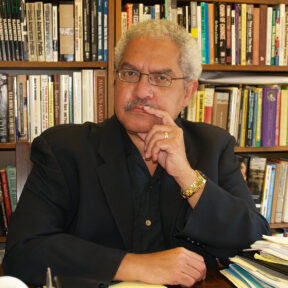
Manning Marable
: Photo from Wikipedia / Author of Photo: David ShankboneOverview
* Professor of History and Political Science, Columbia University
* Director of the Center for Contemporary Black History, Columbia University
* Director of the Institute for Research in African American Studies, Columbia University
* Marxist member of the Committees of Correspondence, a Communist Party faction
* Died in July 2011
Born in May 1950 in Dayton, Ohio, Manning Marable was a lifelong Marxist and a member of the Committees of Correspondence for Democracy and Socialism. He was also a member of the Working Families Party.
Marable earned an A.B. degree from Earlham College in 1971, an M.A. in American history from the University of Wisconsin-Madison in 1972, and a Ph.D. in American history from the University of Maryland in 1976. In 1980 he was hired as the senior research associate of Africana Studies at Cornell University. Two years later Marable became a professor of history and economics at Fisk University, where he also directed the Race Relations Institute. In 1983 he took a job as a professor of sociology at Colgate University, and four years later he moved to Ohio State University where he chaired the Black Studies Department. From 1989 to 1993, Marable taught ethnic studies at the University of Colorado at Boulder. In 1993 he became the founding director of the Institute for Research in African-American Studies at Columbia University, where he taught history and political science.
In the 1970s, Marable was active in the New American Movement. In 1982 he played a pivotal role in the formation of the Democratic Socialists of America (DSA). Marable served as vice chairman of that nascent group in 1983, when he was perhaps the most prominent black Marxist in the United States.
In the early 1980s, Marable was an Executive Committee member of the now-defunct Federation For Progress (FFP), a Marxist united front organization created by the highly militant Communist Workers Party (CWP). According to author/blogger Trevor Loudon, CWP not only “followed the policies of Mao Tse Tung, Joseph Stalin and … Pol Pot,” but also “originally gave some support to the Islamists of the Iranian Revolution.” Another notable FFP Committee member was Judy Chu, who later became a U.S. congresswoman.
Marable’s 1983 book How Capitalism Underdeveloped Black America conveyed the author’s deep sense of alienation from the United States. The book opened with an excerpt from Frederick Douglass’s bitter 1852 rejection of American Fourth of July celebrations, as though little, if anything, had changed in the U.S. since the era of slavery. By Marable’s reckoning, the capitalist system itself was racist and oppressive to its core. “America’s ‘democratic’ government and ‘free enterprise’ system are structured deliberately and specifically to maximize Black oppression,” he wrote. While acknowledging that Stalinism was imperfect, Marable nonetheless contended that the Soviet Union did a much better job of developing an equitable society than the United States, where “no real democracy has ever existed.” He held captalism responsible for black crime and the mass incarceration of African Americans, and, echoing Rev. Jeremiah Wright, firmly rejected “middle-classness.”
Marable’s book derided blacks who pursued careers in politics: “The instant that the Black politician accepts the legitimacy of the State, the rules of the game, his/her critical faculties are destroyed permanently, and all that follows are absurdities.” The author accepted political gradualism as a pragmatic means of eventually bringing down the American system: “The revolt for reforms within the capitalist state today transcends itself dialectically to become a revolution against the racist/capitalist system tomorrow.” “Progressives,”he added, “can gain positions within the state, especially at municipal and state levels, which can help fund and support grass roots interests and indirectly assist in the development of a socialist majority.
Marable was a featured speaker at the U.S. Peace Council‘s Tenth Anniversary National Conference in 1989, along with such notables as Leslie Cagan, John Conyers, Bernie Sanders, and Dessima Williams.
In 1990 Marable participated in a panel at the Socialist Scholars Conference in New York. Fellow panel members included Maulana Karenga, DSA member Paulette Pierce, and Paul Robeson, Jr.
In a 1993 brochure for the the Institute for Policy Studies‘ 30th anniversary celebration, Marable was listed as one of the “former Visiting Fellows and Visiting Scholars” in attendance.
In the fall of 1994, Marable was identified in a New Party (NP) publication as being one of 100+ activists “who are building the NP.” Other notable names on the list included John Cavanagh, Noam Chomsky, Barbara Ehrenreich, Randall Forsberg, Maude Hurd, Frances Fox Piven, Zach Polett (who later became a national political director for ACORN), Wade Rathke, Mark Ritchie, Joel Rogers, Gloria Steinem, Cornel West, Quentin Young, and Howard Zinn.
In late 1996 Marable led a delegation of fifteen prominent African Americans to Fidel Castro‘s Cuba, to engage in talks regarding the future of that nation and its relationship with Black America. When he later reflected on the trip, Marable wrote in the Chicago Defender (February 15, 1997) that “one of the highlights was having a lengthy conversations with Assata Shakur,” a convicted cop-killer and fugitive whom he described as “a prominent Black American activist … who had been unjustly imprisoned.” Adding that “today [Shakur] is a lecturer and teacher [who is] active in local affairs and remains an astute judge of society and politics,” Marable noted the positive things Shakur had said to him regarding life in Communist Cuba:
“Shakur emphasized that while Cuba has its problems, some of the Castro government’s strongest supporters are Afro-Cubans. This is because the actual conditions of daily life for Black people — incomes, educational opportunities, health care, etc. — have greatly improved.
“The old restrictions of racial segregation which had been imposed by the U.S. upon Cuban society have been dismantled for decades. The Castro government more recently has become supportive of Black cultural and religious groups such as Santeria, which draw their orientations from African spiritual traditions….
“The struggle to destroy racism still remains a central challenge in Cuba: but on balance, the Cubans are far more honest about their shortcomings, and have achieved greater racial equality for Blacks than we have in the U.S.
“
In 1997 Marable taught a workshop at that year’s Socialist Scholars Conference in New York City.
In 1998 Marable was among the 100+ African Americans who stepped forth as “Endorsers of the Call” for the formation of the Black Radical Congress (BRC) in 1998. Other endorsers of BRC included such luminaries as Amiri Baraka, Angela Davis, Lewis Gordon, Julianne Malveaux, Rosalyn Pelles, and Cornel West.
In October 1998, Marable was an endorser of a Brecht Forum presention in New York, to celebrate the 150th Anniversary of the Communist Manifesto.”
In 2000, Marable contributed $250 to Ralph Nader‘s presidential campaign.
In an April 2004 lecture entitled “Living Black History,” Marable denounced the “master narrative” of American history espoused by “white Americans,” which depicts the U.S. as a pluralistic society. According to Marable, America was “organized around structural racism” and “the ongoing racial stigmatization and systematic exploitation of a significant segment of the population.” The only possible solution, said Marable, was “the subversion of the master narrative itself, which must involve to a great extent the deconstruction of the legitimacy of white racial identity, and the uncovering and examination of massive crimes against humanity that have been routinely sanctioned and carried out by corporate and state power.”
That is the mission of Columbia’s Center for Contemporary Black History, which Marable established in 2002. The Center, according to the professor, seeks the “advancements of political projects that actively challenge structural racism and the consequences and effects of discrimination.” In 2003, working in concert with the NAACP and the Mississippi Legislative Black Caucus, the Center launched a project called “Freedom Summer 2004.” Its purpose was to mobilize 250 “college-aged” students in Mississippi to register new voters, and to repeal the “repressive voter laws” which allegedly had suppressed Democratic voter turnout in the past. Of specific concern were laws barring convicted felons from voting in general elections. In Professor Marable’s calculus, Freedom Summer 2004 was a vital front in the battle for “black liberation.”
Marable sounded similar themes in the pages of Souls, a quarterly interdisciplinary journal co-sponsored by his Institute for Research in African-American Studies. Serving as a platform for Marable’s political causes — reparations for American slavery being prime among them — the publication lists Amiri Baraka, Angela Davis, Ruby Dee, Michael Eric Dyson, Eric Foner, Priya Parmar, and Cornel West as some of its editorial advisory board members.
The other co-sponsor of Souls — Professor Marable’s Center for Contemporary Black History — is supported financially by George Soros’s Open Society Institute. At one time, the Center’s website featured a photograph of a clenched-fisted Huey Newton, who had posed for the picture during his incarceration for having killed a police officer.
Under Marable’s direction, the Center for Contemporary Black History has launched the Africana Criminal Justice Project (ACJP), whose mission, “distinguished by its forthright commitment to the pursuit of social justice,” is to radicalize Black Studies departments in universities across the country. As Marable put it, “To enrich the black intellectual tradition, we must push the boundaries of what has become ‘Black Studies’ well beyond Black Studies.” Toward this end, the ACJP promulgates a “black theory of justice,” maintaining that the U.S. criminal-justice system is irredeemably racist because American society is “defined by rigid racial hierarchies.” The “academic” sources for these conclusions are the works of “black scholars, artists, and public intellectuals,” including convicted cop-killer Mumia Abu-Jamal.
A revealing scholarly inquiry by the Center for Contemporary Black History is the “Malcolm X Project,” which proposes to “critically explore” the assassination of the Nation of Islam (NOI) leader, of whom Professor Marable was an outspoken devotee. In practice, the Project attempts to advance the conspiracy theory, to which Professor Marable long subscribed, that police and government officials colluded in Malcolm’s assassination. The theory was so extreme, however, that it was rejected even by Malcolm X’s film biographer, Spike Lee, as well as by reputable scholars in the field. Prior to Malcolm’s assassination, Louis Farrakhan had pronounced a death sentence upon him for betraying NOI, and two members of NOI were ultimately convicted of the crime.
But according to Professor Marable, the Project sought to answer the “lingering question of what those in law enforcement and government actually knew and did in this crime [the Malcolm X assassination],” and proposed a “reconstructed history” to “bridge the distance between the divided racial past and the present.” This alternate historical narrative, Marable explained, “could be incorporated into the curricula of public schools” and could function as “educational resources for a proposed memorial honoring Malcolm X” at Columbia University. “The goal,” he said, “is not just to educate and inform, but to transform the objective material and cultural conditions that perpetuate the status of marginalized groups,” and ultimately to “reconstruct America’s memory about itself.” The result, Marable hoped, would be the emergence of “new social movements” and “spontaneous insurrections.”
Professor Marable identified the white middle class as the chief source of the societal inequities that inflamed his radical passions. “Part of the historic difficulty in uprooting racial and gender inequality in the United States,” he wrote, “is that whites generally — and especially white middle and upper-class males — must be taught how the omnipresent structures of white privilege perpetuate inequality for millions of Americans.” The remedy lay in indoctrinating students “of privileged backgrounds” in “the meaning and reality of hunger and poverty,” so as to “create and nourish” in them “a commitment to a society committed to social justice … [to] foster impatience with all forms of human inequality … and [to] empower those without power.”
In 2007, Marable was elected chairman of the Movement for a Democratic Society.
In 2008 he signed a statement circulated by the Partisan Defense Committee calling for the release of convicted cop-killer Mumia Abu-Jamal. That same year, Marable supported Senator Barack Obama for U.S. President.
In addition to his academic duties, Marable served on the editorial board of the Black Commentator, alongside NAACP board chairman Julian Bond, Bennett College president Julianne Malveaux, and numerous others. Marable also sat on the advisory board of the National Jobs for All Coalition, and on the advisory board of the Left Forum. (To view a list of other noteworthy Left Forum board members, click here.)
A committed leftist, Marable held black conservatives in low regard. For instance, he once asserted that Supreme Court Justice Clarence Thomas had “ethnically … ceased to be an African American.”
In July 2010, Marable, who had been diagnosed with sarcoidosis, underwent a double lung transplant. On April 1, 2011, he died following a bout with pneumonia. At the time of his death, Marable had recently finished writing Malcolm X: A Life of Reinvention, which was scheduled for publication by Viking Press. Marable’s New York Times obituary stated:
Marable’s political philosophy was often described as transformationist, as opposed to integrationist or separatist. That is, he urged black Americans to transform existing social structures and bring about a more egalitarian society by making common cause with other minorities and change-minded groups like environmentalists. “By dismantling the narrow politics of racial identity and selective self-interest, by going beyond ‘black’ and ‘white,’ we may construct new values, new institutions and new visions of an America beyond traditional racial categories and racial oppression,” he wrote in … [1995].