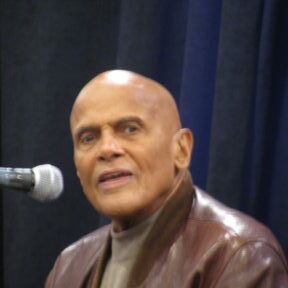
Harry Belafonte
: Photo from Wikimedia Commons / Author of Photo: SlowkingOverview
* Singer, actor, and political activist
* Aligned with the Communist Left
* Viewed America as an evil and profoundly racist nation
* Died in April 2023
Background
Harry Belafonte was born in Harlem, New York on March 1, 1927. From 1932 to 1940, he lived with his grandmother in her native country of Jamaica. Belafonte then returned to New York City, where he attended George Washington High School, and later served in the U.S. Navy during World War II. In the late 1940s, he took acting classes at the Dramatic Workshop of The New School in Manhattan. To pay for those classes, he found work as a local club singer.
Belafonte went on to become an immensely popular singer, activist, and actor. He popularized Jamaican mento folk music, which was marketed as Trinbagonian Calypso music in the 1950s. His breakthrough 1956 album Calypso was the first million-selling long-play album ever produced by a single artist.
Ally of Martin Luther King Jr.
Early in his career as an entertainer, Belafonte became a lifelong friend and ally of the Rev. Dr. Martin Luther King Jr. Indeed, he was a major fundraiser for Dr. King’s Southern Christian Leadership Conference; he took part in the famous 1963 March on Washington; and on multuple occasions he provided money to bail Dr. King and other civil rights activists out of jail.
According to The New York Times: “[Belafonte’s] spacious apartment on West End Avenue in Manhattan became Dr. King’s home away from home. And he quietly maintained an insurance policy on Dr. King’s life, with the King family as the beneficiary, and donated his own money to make sure that the family was taken care of after Dr. King was assassinated in 1968.”
Communist & Radical Ties
- Communist-Front Youth Groups: According to the historian Ron Radosh, “Belafonte’s public performances as a singer began when he appeared before communist-front youth groups on behalf of Henry Wallace and his 1948 presidential candidacy [under the auspices] of the communist-created and -dominated ‘Progressive Party,’” which opposed President Harry Truman’s tough stance against the Soviet Union.
- Paul Robeson: By the early 1950s, Belafonte had become a popular singer. His first widely released single, which went on to become the signature song of his live performances, was “Matilda,” recorded in April 1953. His breakthrough album, Calypso (1956), became the first LP in history to sell more than a million copies. But even as his entertainment career flourished, Belafonte pursued a radical political agenda, as evidenced by the fact that he looked to the anti-American communist Paul Robeson to be his “mentor.”
- Student Non-violent Coordinating Committee: In the late 1950s, Belafonte became a confidant of Martin Luther King Jr. and a stalwart in the civil-rights movement. In 1960, Belafonte was a founding member — along with such notables as Julian Bond, John Lewis, Bernice Johnson Reagon, David Forbes, James Lawson, Joyce Ladner, and Dick Gregory — of the Student Non-violent Coordinating Committee (SNCC). Among other things, Belafonte provided much of the seed money that helped establish the SNCC. In the 1960s, he performed benefit concerts on SNCC’s behalf. And in 1965 he arranged an expense-free trip to Guinea for SNCC chairman Stokely Carmichael and ten other members of the group. There, they took lessons in revolution from the country’s pro-communist president, Sekou Toure.
- Fidel Castro: By the 1980s Belafonte was making statements that revealed his affinity for Cuban dictator Fidel Castro, and his bitter skepticism about the Regan Administration’s endgame in the Cold War. “If you believe in freedom, if you believe in justice, if you believe in democracy,” Belafonte once said, “you have no choice but to support Fidel Castro!”
- Mengistu Haile Mariam: But Belafonte’s fondness for communists was not limited solely to Castro. For example, the late Leo Cherne, head of the International Rescue Committee, once wrote that Belafonte had “played a significant relief role in Ethiopia at a time [the 1980s] when [that country] was under the control of the left wing dictator Mengistu Haile Mariam, at the very time that the Castro military forces were playing an active support role.”
- Soviet Peace Movement: Also in the eighties, Belafonte praised Soviet “peace efforts” around the world. Speaking in October 1983 at a “World Peace Concert” run by East Germany’s official Communist youth organization, Belafonte gave his blessings to the Soviet-sponsored “peace” campaign pushing unilateral Western disarmament — at a time when the USSR was deploying SS-20 missiles in East Germany. Meanwhile, reported The New York Times, Belafonte “attacked the [1983] American invasion of Grenada and also criticized the scheduled NATO weapons deployment” of Pershing 2 missiles in West Germany, which were intended to offset the Soviet missile offensive.
- International Peace for Cuba Appeal: In 1994 Belafonte was an initiator of the International Peace for Cuba Appeal, an affiliate of the International Action Center. Other prominent initiators included Cuban Intelligence agent Philip Agee, professor Noam Chomsky, and Democratic congressmen John Conyers and Charles Rangel.
- Veterans of the Abraham Lincoln Brigade: In 1997 Belafonte was the featured speaker at the 60th Anniversary celebration of the “Veterans of the Abraham Lincoln Brigade,” an organization devoted to the preservation and dissemination of the history of the North American role in the Spanish Civil War (1936-1939) and its aftermath.
- Fidel Castro, Paul Robeson, & the Rosenbergs: In June 2000 Belafonte was a featured speaker at a rally in Fidel Castro’s Cuba, honoring the American Soviet spies Ethel and Julius Rosenberg. He lauded Cuba’s efforts to “kee[p] the principles the Rosenbergs fought and died for alive.” Tears, one observer reported, “streaked down” Belafonte’s face “as he recalled the pain and humiliation his friend [Paul] Robeson had been forced to endure” in 1950s America. This was just one of multiple trips that Belafonte made to Cuba.
- Karl Marx Theater: On December 3, 2002, Belafonte attended the inauguration of the 24th Festival of Latin American Cinema at the Karl Marx Theater in Havana, Cuba. While there, he posed for a photo with Colombian writer Gabriel Garcia Marquez.
- Center for Cuban Studies: In a March 2001 concert/fundraiser at New York’s Lincoln Center, Belafonte appeared on behalf of the Center for Cuban Studies, a pro-Castro U.S. organization dedicated to countering the effects of American policy toward Cuba.
- Father Michael Pfleger: In January 2003, Father Michael Pfleger, a liberation theologian and the pastor of Saint Sabina Catholic Church in Chicago, invited Belafonte to be a guest speaker at a Sunday Mass. During his talk there, Belafonte blamed the United States for the events of 9/11: “We [Americans] move about the world arrogantly, calling wars when we want, overthrowing governments when we want. There is a price to be paid for it — look at 9/11. [That] wasn’t just [Osama] bin Laden. Bin Laden didn’t come from the abstract. He came from somewhere, and if you look where … you’ll see America’s hand of villainy.” Because Belafonte has so frequently expressed such sentiments, the historian Ron Radosh has described him as “an unreconstructed Stalinist — a man who firmly, profoundly believes that America is evil.”
- Hugo Chavez: In January 2006, Belafonte — along with Danny Glover, Cornel West and others — had a friendly meeting with Venezuelan president Hugo Chavez, whom Belafonte described as a humane and capable leader who had “cut the ranks of his country’s unemployed in half.” “We’re here to tell you [that] not hundreds, not thousands, but millions of the American people … support your revolution,” Belafonte said to Chavez. Further, Belafonte referred to President Bush as “the greatest tyrant in the world, the greatest terrorist in the world” — for having launched the war in Iraq “without cause, and with treacherous intent.”
- Mumia Abu Jamal: In 2008 Belafonte signed a statement circulated by the Partisan Defense Committee calling for the release of the convicted cop-killer Mumia Abu-Jamal. The petition praised Mumia for being a “former Black Panther”; lamented that he had been “framed” as a murderer and sentenced to death by a racist U.S. justice system; and denounced capital punishment as “a legacy of chattel slavery and a barbaric outrage … [which] the lynch rope [had] made legal.”
- Fidel Castro: In a 2012 interview, Belafonte described Cuban dictator Fidel Castro’s violent and murderous ascension to power as “very heroic,” adding: “I thought he was a whiz. I saw in him a lot of heroics in the very beginning that was very, very attractive.”
- Miguel Díaz-Canel: In late September 2018, Belafonte was one of more than 30 celebrities whom actor Robert De Niro invited to attend a New York City gathering in honor of Cuban dictator Raúl Castro’s subordinate, Miguel Díaz-Canel, the Communist politician who would become Cuba’s next president in October 2019.
- Institute for Policy Studies: Belafonte has served as a board member of the Institute for Policy Studies.
- Rosenberg Fund for Children: Belafonte has served as an advisory board member of the Rosenberg Fund for Children.
Boycott of Apartheid South Africa
In the 1980s, Belafonte helped organize a cultural boycott of South Africa, as a protest against that nation’s apartheid system.
Raising Money to Fight Famine in Africa
Belafonte helped organize the July 1985 Live Aid concert and the star-studded 1985 recording “We Are the World,” both of which sought to raise money to fight famine in Africa.
UNICEF’s Goodwill Ambassador
In 1987, Belafonte replaced Danny Kaye as UNICEF’s good-will ambassador.
Contempt for Black Republicans
In October 2002 Belafonte stirred controversy when, during an interview on a San Diego radio station, he intimated that Secretary of State Colin Powell, by virtue of his service in the George W. Bush administration, was a traitor to African Americans. In that same interview, Belafonte elaborated: “There’s an old saying [that] in the days of slavery, there [were] those slaves who lived on the plantation, and there were those slaves who lived in the house. You got the privilege of living in the house if you served the master. Colin Powell was permitted to come into the house of the master … in the service of those who not only perpetuate the oppression, but sometimes design the way in which it is applied.”
Belafonte expressed similar sentiments regarding then-National Security Advisor Condoleezza Rice, whom he likened to a Jew “doing things that were anti-Semitic and against the best interests of her people.” Three years later, Belafonte revisited this theme of “race treason” by black Republicans when he said, “Hitler had a lot of Jews high up in the hierarchy of the Third Riech” — implying that such Jews were, at that time, the equivalent of conservative blacks in the post-2000 Bush Administration.
Denouncing America’s “Villainy”
Speaking at a 2004 Human Rights Award Ceremony in San Francisco, Belafonte reiterated that millions of people around the world were afflicted by disease and poverty as a direct result of “vast America’s villainy” and the U.S. “military industrial complex.”
Likening Blacks Who Supported President Bush, to Jews Who Had Aided Hitler
In an August 2005 interview with Cybercast News Service, Belafonte stated that “Hitler had a lot of Jews high up in the hierarchy of the Third Reich.” Belafonte then likened those Jews to African American “tyrants” who, in modern times, were working in the Bush Administration.
Portraying the U.S. & Republicans As Evil & Racist
In September 2005 Belafonte spoke at a town hall meeting of the Congressional Black Caucus‘s 35th Annual Legislative Conference. The event featured some of the leading figures of the Democratic Party and was nominally devoted to the subject of “eradicating poverty.” (A webcast of the meeting can be accessed here.) When he stepped to the podium, Belafonte: (a) impugned Republicans for “punishing” blacks for their resistance to segregation; (b) denounced the American criminal-justice system and its “prisons filled with victims of poverty”; (c) condemned U.S. foreign policy for having “made a wreck of this planet”; and (d) exhorted blacks to rise up and “let George Bush and the Christian Right know that their legs have just been amputated.”
Founder of Gathering For Justice
Also in 2005, Belafonte founded Gathering For Justice (GFJ), an organization focused on ending what Belafonte viewed as widespread racial discrimination in the American criminal-justice system.
Ties to George Soros
A key funder of GFJ has been George Soros‘ Open Society Foundations.
That was not Belafonte’s only tie to Soros. As Breitbart.com noted in January 2017:
“The Open Society also supported the New York production of a play starring Belafonte titled The Exonerated about wrongly convicted death row inmates. Soros’ foundation sponsored a series of ‘talk back’ conversions after the play ‘where justice advocates and death penalty experts from across the country [spoke] and field[ed] questions from the theater audience.’”
“Belafonte [also] serves on the board of the Advancement Project, which was one of four primary recipients of money from a group created in 2008 called the Election Administration Fund. The Fund reportedly raised between $5.1 million–$1 million from Soros’ Open Society Institute.
Condemning American Racism & Oppression
In a keynote address he delivered at Duke University on Martin Luther King Day 2006, Belafonte declared that America’s long history of oppression had begun centuries earlier, with the “Indian genocide.” Amplifying on this theme, he asserted that America’s foreign policy had always been “built on the demise of the poor.” And he lamented that the U.S. not only had the “largest prison population in the world,” but also that, as a result of a premeditated government policy, blacks were being incarcerated in grossly disproportionate numbers.
Likening America to Al Qaeda & the Nazis
Also in January 2006, Belafonte told The Raleigh News and Observer that the U.S. government was no more honorable than al Qaeda or the 9/11 hijackers: “When you have a president that has led us into a dishonorable war [in Iraq], who has killed tens of thousands, many of them our own sons and daughters, what is the difference between those who would fly airplanes into buildings killing 3,000 innocent Americans? What is the difference between that terror and other terrors?” In a subsequent CNN interview, Belafonte told newsman Wolf Blitzer: “Al Qaeda tortures. We torture. Al Qaeda’s killed innocent people. We kill innocent people.”
In January 2006 as well, Belafonte characterized the U.S. Department of Homeland Security (DHS) as the “new Gestapo.” When CNN’s Wolf Blitzer asked Belafonte to clarify whether he believed that what DHS “is doing to … some U.S. citizens suspected of terrorism is similar to what the Nazis did to the Jew[s], Belafonte replied: “Well, if you’re taking people out of a country and spiriting them someplace else, and they’re being tortured, and they’re being charged without – or not being charged, so they don’t know what it is they’ve done. It may not have been directly inside the Department of Homeland Security, but the pattern, the system, it’s what the system does. It’s what all these different divisions have begun to reveal in their collective.”
Featured Speaker at “One Nation Working Together” Rally
Belafonte was a featured speaker at an October 2, 2010 “March on Washington,” organized by One Nation Working Together. Other speakers included such luminaries as Deepak Bhargarva, Luis Gutierrez, Wade Henderson, Jesse Jackson, Ben Jealous, Van Jones, Al Sharpton, Richard Trumka, and Marian Wright Edelman.
Comparing Modern-Day America to the McCarthy Era
In a 2011 HBO documentary, Belafonte stated that he not only saw “great similarities” between the modern-day United States and “what went on in America” during the “crucifying days” of the [Joseph] McCarthy era, but that America was “headed to places that can go well beyond” what had occurred under McCarthy. “Today we have something that is most horrific written under the banner of ‘homeland security,’” said Belafonte. “The extremes of those laws allow any citizen to be whisked away without anyone’s knowledge, without charging the individual, and hiding them for an indefinite period of time…. That is the basis of a totalitarian state.”
Hatred for Black Republicans
In October 2011, Belafonte — emphasizing his view of America as a profoundly racist nation — condemned black Republicans “like Clarence Thomas, Herman Cain, and Condoleezza Rice” for “claim[ing] that black people are deluded when they talk about oppression,” and for “argu[ing] that people can magically ‘overcome’ their plight.”
Condemning Opponents of Barack Obama
In December 2012, Belafonte was a guest on Al Sharpton‘s MSNBC television program. During his appearance, Belafonte disparaged “this lingering infestation of really corrupt people who sit trying to dismantle the wishes of the people, the mandate that has been given to Barack Obama.” “And I don’t know what more they want,” Belafonte added. “The only thing left for Barack Obama to do is to work like a Third World dictator and put all these guys in jail [for] violating the American desire.”
Blaming Racism for White Opposition to Gun Control
During his acceptance speech for an honor he received at the NAACP Image Awards in February 2013, Belafonte spoke out on the subject of gun control. Asserting that the “group most devastated by America’s obsession with the gun is African Americans,” he suggested that white opposition to stricter gun-control measures was rooted in racism: “We [blacks] are the most unemployed, the most caught in the unjust systems of justice, and in the gun game, we are the most hunted. The river of blood that washes the streets of our nation flows mostly from the bodies of our black children. Yet, as the great debate emerges on the question of the gun, white America discusses the constitutional issue of ownership, while no one speaks of the consequences of our racial carnage.”
Belafonte Sues MLK’s Children
in 2013, Belafonte sued the three surviving children of the late Martin Luther King Jr., in a dispute over documents that Belafonte claimed were his property. The King children, meanwhile, maintained that the papers belonged to their father’s estate. The suit was eventually settled in 2014, with Belafonte retaining possession of the documents.
Comparing Conservative Philanthropists to Klansmen
Addressing the congregation in a November 2013 service at the First Corinthian Baptist Church in Harlem, New York, where he promoted the campaign of then-New York City mayoral candidate Bill de Blasio, Belafonte directly compared the conservative philanthropists Charles and David Koch to Klansmen:
“They make up the heart and the thinking in the minds of those who would belong to the Ku Klux Klan. They are white supremacists. They are men of evil. They have names. They are flooding our country with money. They’ve come into to New York City. They are beginning to buy their way in to city politics. They are pouring money into Presbyterian Hospital to take over the medical care system. The Koch brothers, that’s their name.”
Blaming the Tea Party for Fomenting “Racial Animus”
In 2013, Belafonte blamed the conservative Tea Party movement for the “racial animus” in the United States.
Supporting Hamas’s War Against Israel
In July 2014, when Israel was involved in a military operation designed to stop Hamas terrorists in Gaza from continuing to fire scores of potentially deadly rockets into the Jewish state each day, Belafonte lamented that Israel was killing many innocent Palestinian children and freedom fighters. By contrast, as historian Ron Radosh noted, “He said not one word about the rockets of Hamas crashing down on Israel, the desire of Hamas to destroy the Jewish state, and the failure of Hamas to accept the Egyptian proposal for a peace treaty, one that was accepted by Israel and the United States.”
Condemning the Alleged Mass Incarceration of Blacks
In September 2014, Belafonte was a guest speaker at “Growing Up Locked Down,” a three-day Juvenile Justice Conference presented at The New School in Manhattan by Justice League NYC. This event featured workshops and panels that addressed subjects ranging from the state of childhood incarceration to the media’s reportage on the issue. Another noteworthy speaker was Cornel West.
Supporting the Black Lives Matter Movement
In an October 2015 interview with Crosscut.com, Belafonte voiced his support for the Black Lives Matter (BLM) movement:
“What I’ve learned from the [BLM] activists and what is going on today is, those of us who have lived almost a century, have no right to cynicism. There is always something in motion, there is always people out there making a difference. One of the big problems with America and its smothering of radical thought and behavior, is people don’t know what’s going on. There is a lot of noise, but it doesn’t make the headlines of the New York Times or get on CNN with great regularity. For a long time I said, ‘What has happened to the young? What was all of that about, all my friends who were murdered: Bobby Kennedy, John F. Kennedy, Dr. King, etc, etc. etc.?’ Well, it sits there. It’s there. A lot of kids are studying it, learning it. … For me, I’m glad I’ve lived long enough to have it pushed right into my face. They’re saying, ‘We’re here, chief. We’re happening. We’re making noise.’”
Supporting Bernie Sanders
In February 2016, Belafonte endorsed the presidential campaign of Senator Bernie Sanders, an avowed socialist. That April, Belafonte appeared in a 30-second television advertisement produced by Spike Lee to promote Sanders’ bid for the White House. Speaking directly to the camera, Belafonte said: “People of color have a deeply vested interest in what Bernie Sanders brings to us in this election.”
As of June 2017, Belafonte was listed as a fellow with the newly launched Sanders Institute, a leftwing nonprofit educational organization designed to promote the agendas of Senator Bernie Sanders.
Accusing President Obama’s Detractors of Racism
In a February 2016 appearance on CNN’s Fareed Zakaria GPS, Belafonte asserted that the election of Barack Obama as America’s first black president had unleashed a great deal of racism that was embedded deeply in the nation’s population:
“I think if you look at the spectrum of race relations in this country, on a lot of fronts, there is a retrogression, there is a reversal. If you take a look at the way in which the right-wing movement in this country has gerrymandered voting districts, if you look at employment records, if you look at a lot of practices, black people are once again at the doorstep, the new wave of racist definitions and racist practices. […] I think a black man in the White House has awakened a lot of dichotomies here. I think, on the one hand, America took great pride in the fact that, to a world that saw us as a powerful force, but a very reactionary force, the election of Obama sent another signal. But it also awakened a right-wing energy in this country because nobody really expected that we would ever have elected a black man to be President. And when that reality was established, I think it shocked a lot of racist forces in this country. I think a lot of the hurdles, problems that Obama has faced is really very much based upon the fact that there is a force in this country that says no black man should ever be at the helm of this country.”
Hatred for Donald Trump
In early 2016, Belafonte joined such luminaries as Jane Fonda, Danny Glover, Lily Tomlin, and Rosie O’Donnell in signing onto an online petition using the Twitter hashtag #StopHateDumpTrump, designed to thwart the presidential campaign of Republican Donald Trump. The petition stated, “We have witnessed Trump inciting hatred against Muslims, immigrants, women, the disabled. We have seen him evidencing dangerous tendencies that threaten the bedrock of democracy: unleashing a lynch mob mentality against protesters, calling for the expulsion of Muslims from the country, bullying, and fear-mongering.”
On November 7, 2016 — the day before Election Day — The New York Times published a Belafonte opinion piece titled, “What Do We Have to Lose? Everything.” Some notable excerpts:
“If he wins this Tuesday, Donald J. Trump would be, at 70, the oldest president ever elected. But there is much about Mr. Trump that is always young, and not in a good way. There is something permanently feckless and immature in the man…. Mr. Trump … sees American greatness as some heavy, dead thing that we must reacquire. Like a bar of gold, perhaps, or a bank vault, or one of the lifeless, anonymous buildings he loves to put up. It is a simplistic notion, reducing all the complexity of the American experience to a vague greatness, and his prescription for the future is just as undefined, a promise that we will return to ‘winning’ without ever spelling out what we will win — save for the exclusion of ‘others,’ the reduction of women to sexual tally points, the re-closeting of so many of us.
“With his simple, mean, boy’s heart, Mr. Trump wants us to follow him blind into a restoration that is not possible and could not be endured if it were. Many of his followers acknowledge that (‘He may get us all killed’) but want to have someone in the White House who will really ‘blow things up.’
“What old men know is that things blown up — customs, folkways, social compacts, human bodies — cannot so easily be put right. What [the famous Harlem Renaissance poet] Langston Hughes so yearned for when he asked that America be America again was the realization of an age-old people’s struggle, not the vaporous fantasies of a petty tyrant. Mr. Trump asks us what we have to lose, and we must answer, only the dream, only everything.”
In January 2017, Belafonte and feminist icon Gloria Steinem served as honorary co-chairs of The Women’s March on Washington, a massive, anti-Donald Trump rally backed by a host of far-left organizations, including scores of groups financed by George Soros.
As Election Day 2020 approached, Belafonte published an opinion piece that said of Trump’s four years as president: “We have learned exactly how much we had to lose — a lesson that has been inflicted upon Black people again and again in our history — and we will not be bought off by the empty promises of the flimflam man.”
Death
Belafonte died of congestive heart failure at his home on the Upper West Side of Manhattan on April 25, 2023.
Belafonte’s Massive Wealth
At the time of his death, Belafonte’s net worth was approximately $30 million.