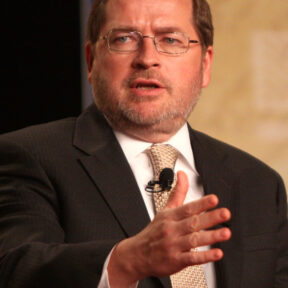
Grover Norquist
: Photo from Wikimedia Commons / Author of Photo: Gage SkidmoreOverview
* Longtime conservative activist
* Founder of Americans for Tax Reform
* Founder of the Islamic Free Market Institute
* Beginning in 1998, he established affiliations with radical Islamists and helped them gain access to President George W. Bush.
Born in October 1956, Grover Norquist was raised in Weston, Massachusetts. After earning a BA and an MBA from Harvard University, he served as executive director of the National Taxpayers Union and the College Republicans’ national organization. In the early 1980s, Norquist was in the forefront of conservative efforts to persuade the Reagan Administration to support the liberation struggles of anti-Communists in Central America, Africa, and Afghanistan. From 1983-84, he served as both an economist and chief speechwriter at the U.S. Chamber of Commerce. In 1985, at the request of President Reagan, Norquist founded the Washington, DC-based Americans for Tax Reform (ATR).
In 1993, Norquist launched his Wednesday Group Meeting series at ATR headquarters, initially to help fight President Bill Clinton‘s healthcare-reform proposal. Eventually blossoming into a significant institution in conservative politics, the Wednesday gatherings were attended by all manner of influential Washington conservatives, would-be politicians, think-tank denizens, journalists, and lobbyists. Norquist was also a campaign staffer on the 1988, 1992 and 1996 Republican Platform Committees. Working with eventual Speaker of the House Newt Gingrich, Norquist contributed to the Republicans’ celebrated 1994 Contract With America.
In 1998, Abdurahman Alamoudi, a self-described “supporter of Hamas and Hezbollah,” took an interest in Norquist, whom he knew to be one of the Republican Party’s most influential networkers. For years prior, Alamoudi had cultivated ties with the Democratic Party and had contributed significant amounts of money to its candidates. These donations had given Alamoudi access to the Clinton White House and enabled him and his associates to secure the right to select, train and certify Muslim chaplains for the U.S. military. Eager to retain this influential role even if the Democratic presidential candidate, Al Gore, were to lose the upcoming election, Alamoudi wrote two personal checks (a $10,000 loan and what appears to have been a $10,000 gift) that enabled Norquist to establish, and to become the founding chairman of, the Islamic Free Market Institute. Better known as the Islamic Institute, this entity’s stated purpose was to cultivate political support (for Republicans) from Muslim and Arab Americans who embraced conservative family values and free-market economics. In addition, Alamoudi in 2000 and 2001 made payments totaling $50,000 to Janus-Merritt Strategies, a lobbying firm with which Norquist was associated at the time.
Alamoudi’s longtime deputy, Khaled Saffuri, became the founding director of Norquist’s new Islamic Institute, whose associates would periodically make presentations at the Wednesday Group Meetings on such topics as: the plight of Palestinians under Israeli occupation; the allegedly misunderstood Islamist government of Sudan; the innocent nature of the process whereby Muslim chaplains were being selected for the U.S. armed forces; and the honored status of women in the Muslim world.
In 2000, as a result of Norquist’s influence, Khaled Saffuri was named the National Advisor on Arab and Muslim Affairs for the Bush presidential campaign. Holding out the promise of votes and donations in key battleground states with significant Muslim populations (espectially Michigan, Florida, and New Jersey), Norquist and Saffuri were able to persuade the Bush campaign’s chief strategist, Karl Rove, to entrust them with the task of identifying the groups and individuals upon whom Bush should rely to elicit such support. In the summer of 2000, moreover, Norquist persuaded Bush to sit down with leaders of the Muslim American Political Coordinating Committee, a confederation of community groups that included, among others, Alamoudi’s American Muslim Council, and the Council on American-Islamic Relations (CAIR).
Norquist was also a prime-mover behind efforts to abolish a section of the 1996 Anti-Terrorism and Effective Death Penalty Act that permitted authorities to use what critics called “secret evidence.” This was a rarely employed practice whereby prosecutors could withhold classified information from foreign suspects – provided that there was reason to believe that the disclosure of such information could compromise the sensitive intelligence “sources and methods” by which it had been obtained.
In his second presidential debate with Al Gore, candidate Bush formally pledged that, if elected, he would prohibit the use of secret evidence in terrorism cases. In recognition of the instrumental role Norquist had played in winning this pledge from Bush, Norquist was honored at a July 2001 event held by Sami Al-Arian’s National Coalition to Protect Political Freedom (NCPPF), where he (Norquist) received an award for being a “champion of the abolishment movement against secret evidence.”
An early 2001 White House memo, intended to coordinate Muslim and Arab-American public liaison events, showed that Norquist’s Islamic Institute played a vital role in establishing Islamist connections with the Bush administration. A leading Arab-American pollster, John Zogby, said that “absolutely, [Norquist is] central to the White House outreach.” Among the key players involved in Norquist’s outreach efforts were:
- CAIR executive director Nihad Awad, who was among those first introduced by Norquist and Saffuri to Bush during the presidential campaign, and whose access to the White House continued after 9/11;
- American Muslim Alliance founder/president Agha Saeed, who was invited to participate in the Bush campaign’s Muslim outreach meeting engineered by Norquist and Saffuri in 2000, and who was given post-9/11 access to the White House;
- Islamic Society of North America board president Muzammil Siddiqi, who met twice with President Bush in September 2001;
- Mahdi Bray, executive director of the Muslim American Society Freedom Foundation, political director of the Muslim Public Affairs Council, and founding board member of the NCPPF.
After 9/11, Norquist supported the NCPPF’s efforts to weaken and/or repeal the PATRIOT Act. He was the featured speaker at a November 2003 NCPPF event where he joined actor Alec Baldwin and People For the American Way president Ralph Neas in condemning the Act.
In 2007 Norquist, who had married a Palestinian Muslim in November 2004, promoted Suhail Khan‘s candidacy for election to the American Conservative Union‘s (ACU) board of directors. (Norquist was already an ACU board member.)
In 2009 Norquist tried to undermine Republican efforts aimed at preventing the Obama administration from trying 9/11 mastermind (and Guantanamo Bay detainee) Khalid Sheikh Mohammed in a U.S. civilian court, and from transferring other Guantanamo inmates to Thompson Prison in Illinois. According to Norquist, moving the suspected terrorists to the Illinois facility “makes good sense.” “The scaremongering about these issues should stop,” wrote Norquist, noting that there is “absolutely no reason to fear that prisoners will escape or be released into their communities.”
In 2010, Norquist emerged as an outspoken supporter of Faisal Abdul Rauf‘s effort to build a mosque near Ground Zero in Manhattan. According to Norquist, Republican opposition to the mosque was a politically counterproductive distraction away from key election issues.
At the 2011 CPAC conference, Norquist told the Soros-funded organization Think Progress that Islam “is completely consistent with the U.S. Constitution and a free and open society.”
In early November 2011, Hoover Institution fellow Paul Sperry described Norquist as someone who “dress[es] up [Muslim] Brotherhood agents who underwrite him as patriotic conservatives in order to give them political cover and gain the trust of the GOP establishment. Then with the backing of duped party leaders secured, he promotes these neo-Islamists to positions of power inside government.”
Norquist’s “latest project,” said Sperry, was Imad “David” Ramadan, a Lebanese immigrant who in 2011 was running for the Virginia state legislature with Norquist’s backing. A year earlier, Ramadan had signed an open letter — along with Norquist’s wife and Suhail Khan, to Republicans in support of the Ground Zero mosque. Notably, Ramadan had recently earned large amounts of money — much of which he used to fund his own campaign — from what he described as various “consulting” businesses based in the Middle East. He also had received political donations from many Muslim contributors, including $5,000 from the Virginia Muslim PAC, whose president, Mukit Hossain, was active with the Muslim American Society (a key node in the Muslim Brotherhood’s U.S. network) and was the head of FAITH, a Virginia-based charitable front for the Brotherhood. A few years earlier, FAITH had received a $150,000 donation from Brotherhood leader and SAAR Foundation president M. Yacub Mirza, whose home and offices had been raided by the FBI shortly after 9/11. Soon after FAITH had received the donation from Mirza (who had close ties to Abdurahman Alamoudi, Wachovia Bank closed FAITH’s accounts due to suspicious activity related to possible money-laundering.[
Another Muslim donor](http://frontpagemag.com/2011/11/08/how-the-muslim-brotherhood-penetrates-the-republican-party/?utm_source=FrontPage+Magazine&utm_medium=email&utm_campaign=29a1d42221-RSS_EMAIL_CAMPAIGN) to Ramadan’s 2011 campaign for state legislature was Norquist protege Ali Tulbah, who had replaced Suhail Khan at the White House when Khan landed a high-level spot at the Transportation Department. Tulbah’s father helped run a Brotherhood mosque in Houston.
Norquist has spoken out in favor of comprehensive immigration reform which would provide a path-to-citizenship for ilegal aliens residing in the United States. In October 2012, for example, he said:
“It’s the most important thing to focus on if you’re concerned about the future of the country both as an economic power and as a serious leader of the world, or simply as a successful society. It’s not only good policy to have more immigrants in the United States — dramatically more immigrants than we do today, to having a path forward for those people who are here. It’s not only a good idea, but it’s good politics.”
In addition to his work with ATR, ACU, and the Islamic Institute, Norquist serves on the boards of numerous organizations, including GOProud, the Hispanic Leadership Fund, the Indian-American Republican Caucus, the Nixon Center, and ParentalRights.org.