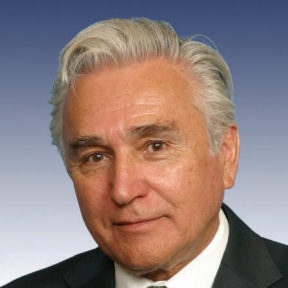
Maurice Hinchey
: Photo from Wikimedia Commons / Author of Photo: United States CongressOverview
* Former Democratic member of the Congressional Progressive Caucus
* Former member of the Out of Iraq Congressional Caucus
* Advocate of restoring the so-called “Fairness Doctrine” to radio broadcasting
* Died on November 22, 2017
Born on October 27, 1938 in New York City, Maurice Hinchey enlisted in the U.S. Navy at age 18 and completed his military service in 1959. He then spent two years working as a laborer in a cement factory before enrolling at the State University of New York at New Paltz, where he graduated in 1968 with a BS degree in political science and English. Two years later Hinchey earned an MA in English, also at New Paltz, and he subsequently found work as an analyst for the state education department.
In 1974 Hinchey, a Democrat, was elected to the New York State Assembly, where he went on to serve nine two-year terms. In 1992 he won a U.S. Congressional seat representing the 22nd District of New York. A member of the Congressional Progressive Caucus (CPC), he was re-elected every two years thereafter until he retired in 2013.
In August 1979 at Bryn Mawr College in Pennsylvania, Hinchey participated in a “Conference on Alternative State and Local Policies,” a project of the Institute for Policy Studies.
In October 1994, Hinchey and fellow CPC members Bernie Sanders, Nydia Velazquez and Major Owens introduced into Congress a “Jobs and Investment Bill” designed to appropriate $42 billion over several years for construction and infrastructure projects.
In 1995 Hinchey supported the “Living Wage, Jobs for All Act” introduced by Rep. Ron Dellums, a member of the Democratic Socialists of America (DSA). Other supporters of this legislation included John Conyers, Lane Evans, Bob Filner, Alcee Hastings, Jim McDermott, Cynthia McKinney, Eleanor Holmes Norton, Major Owens, Nancy Pelosi, Bernie Sanders, and Nydia Velazquez.
In 1997 Hinchey was one of 33 original co-sponsors of the Job Creation and Infrastructure Restoration Act which was introduced into Congress by California Rep. Matthew Martinez. This emergency federal jobs legislation, supported by the New York State Communist Party, was designed to create jobs at union wages in financially foundering cities by putting the unemployed to work on projects such as rebuilding schools, housing facilities, hospitals, libraries, public transportation, highways, and parks. Rep. Martinez had already introduced an earlier version of this bill in the previous Congress at the request of the Los Angeles Labor Coalition for Public Works Jobs, whose leaders were known supporters or members of the Communist Party USA.
In January 2003 Hinchey spent five days in Communist Cuba, for the purpose of “fact finding on the effects of the Cuban embargo.” The trip cost $1,832.78 and was paid for by the Christopher Reynolds Foundation. Later that year, Hinchey co-sponsored legislation to reduce or end the economic sanctions and travel restrictions which the U.S. government had imposed vis à vis Cuba.
In the immediate aftermath of the 2004 presidential election, Hinchey was one of 31 House members who maintained that the electoral votes from Ohio—a state that was won by Republican George W. Bush—were invalid due to “election irregularities” and thus should not be counted.
In 2005 Hinchey became a member of the Out of Iraq Congressional Caucus.
On December 22, 2009, Hinchey was one of 33 U.S. Representatives who signed a letter to Hillary Clinton, calling on the Secretary of State to pressure the Israeli government to end its ban on Palestinian student travel from Gaza to the West Bank. Three weeks later, Hinchey was one of 54 Members of Congress who signed a letter asking President Barack Obama to use diplomatic pressure to end Israel’s blockade of Gaza—a blockade which had been imposed in order to prevent the importation of weaponry from Iran and Syria.
Hinchey was one of Congress’s leading advocates of restoring the so-called “Fairness Doctrine” to radio broadcasting, a move that would stifle predominantly-conservative talk radio.
Among Hinchey’s leading campaign contributors over the years were the PACs, members, employees, and leaders of such unions and activist groups as the American Association for Justice (formerly known as the Association of Trial Lawyers of America), the AFSCME, the American Federation of Teachers, the Human Rights Campaign, the International Brotherhood of Teamsters, the League of Conservation Voters, the National Education Association, the Service Employees International Union, the Sierra Club, and the United Food & Commercial Workers International Union.
Hinchey’s political campaigns also received support and endorsements from the DSA, 21st Century Democrats, and J Street.
Over the course of his legislative career, Hinchey was guided by his belief that:
- all women should have an unrestricted right to abortion-on-demand at any stage of pregnancy – subsidized by taxpayers, in cases of economic hardship;
- public and private employers alike should be legally required to implement affirmative-action hiring and promotion policies that give preference to African Americans and women, as compensation for historical injustices;
- the Affordable Care Act (Obamacare) should serve a strategic stepping stone toward the eventual implementation of a single-payer healthcare system;
- the principle of church-state separation is inviolable and should preclude permitting prayer in the public schools, or the posting of the Ten Commandments in public places;
- voucher programs designed to enable low-income parents to send their children to private schools constitute bad policy because they rob the public schools of vital resources;
- the death penalty constitutes cruel and unusual punishment and should be abolished;
- more guns in the hands of private citizens inevitably result in higher levels of crime, thus the availability of firearms should be restricted by whatever means are effective;
- restrictions on immigration are basically racist because they tend to prevent Hispanics and other non-whites from entering the United States;
- social services should be available to all U.S. residents regardless of their immigration status;
- illegal aliens should be offered amnesty if they have been productive members of society; and
- an ever-increasing reliance on “green energy” sources such as wind and solar should be put in place, along with the phasing out of fossil fuels, the imposition of carbon taxes, and the raising of vehicle CAFE standards.
In January 2012, Hinchey held a news conference to announce his retirement from Congress.
For an overview of Hinchey’s voting record on numerous key issues during his congressional career, click here.
Hinchey died of dementia on November 22, 2017 in Saugerties, New York.
Further Reading: “Maurice Hinchey” (Votesmart.org); “Bill Would Restore Fairness Doctrine” (RCFP.org, 7-19-2005); Campaign Contributions to Rep. Maurice Hinchey (OpenSecrets.org); Maurice Hinchey’s Positions on Key Issues (OnTheIssues.org).