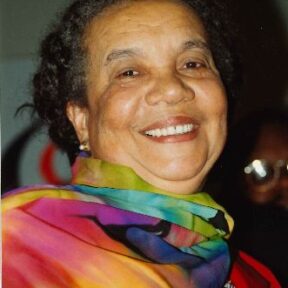
Marian Wright Edelman
Photo from Wikimedia Commons / Author of Photo: John Mathew Smith & www.celebrity-photos.com from Laurel Maryland, USAOverview
* Founded the Children’s Defense Fund (CDF) in 1973
* Claimed that President Clinton’s 1996 welfare-reform bill would plunge millions of black children into poverty
* Former trustee of Saul Alinsky’s Industrial Areas Foundation
* Resigned as President of CDF in 2020
Marian Wright Edelman was born on June 6, 1939, in Bennetsville, South Carolina. Her father, Arthur Jerome Wright, was a Baptist minister who died in 1953. Her mother, Maggie Leola Bowen Wright, was an activist for the rights of women and blacks.
After attending Spelman College for a relatively brief period, Edelman studied abroad on a Merrill scholarship and then eventually traveled to the Soviet Union on a Lisle fellowship. In 1959 she returned to the U.S., took an active role in the civil-rights movement, and graduated from Spelman in 1960. One professor who influenced Edelman significantly at Spelman was the Marxist historian Howard Zinn, who encouraged her to apply to law school. Edelman followed Zinn’s advice and was accepted to Yale Law School. “Howard Zinn, I swear, must have filled out my application,” Edelman later recalled with a laugh. “I didn’t know what law school was. But Lord, I got in and I hated every minute of it.”
On March 15, 1960, Edelman was arrested along with 77 other students during a sit-in at some segregated Atlanta restaurants that refused to serve blacks.
Edelman graduated from Yale Law School in 1963, becoming the first African-American woman ever admitted to the Mississippi bar. She then launched her post-academic career by working on a voter-registration project targeting Mississippi blacks, and later found employment with the Jackson, Mississippi office of the NAACP Legal Defense and Educational Fund, where she worked on civil-rights-movement matters and represented activists during the Mississippi Freedom Summer of 1964.[1] Edelman also helped establish the Head Start program for young children in 1965.[2]
When Marian married civil-rights attorney Peter Edelman in 1968, she expanded her name to Marian Wright Edelman.
Also in 1968, Edelman moved to Washington, D.C. to serve as counsel for the Poor People’s Campaign that Martin Luther King, Jr. had recently created. She also worked as an organizer for Dr. King’s Southern Christian Leadership Conference. Edelman subsequently founded a public-interest law firm called the Washington Research Project, and then spent two years as director of the Center for Law and Education at Harvard University.
From 1971-1977, Edelman was a member of the Yale University Corporation.
In 1972, Edelman, who served a stint on the Board of Trustees of the Industrial Areas Foundation, delivered a eulogy at the funeral of that organization’s founder, the famed Saul Alinsky. Edelman viewed Alinsky as a “brilliant” man who “was working for underdogs” and “trying to empower communities.”
In 1973, Edelman established the Children’s Defense Fund (CDF) as a vehicle with which to push for more generous social-welfare programs by emphasizing the need to help vulnerable children. “When you talked about poor people or black people you faced a shrinking audience,” Edelman later explained. “I got the idea that children might be a very effective way to broaden the base for change.” Noting the effectiveness of Edelman’s strategy, conservative author Jonah Goldberg has written: “The idea was as simple as it was brilliant: By making The Children the beneficiaries of welfare rather than the adults, the left could portray any attempt to curb the welfare state as ‘anti-child.’”
Hillary Rodham [Clinton] interned with the nascent CDF after graduating from law school in 1973, and Edelman became her trusted friend and mentor.
From 1976-87, Edelman chaired the Spelman College Board of Trustees.
Throughout her career, Edelman has called for increased federal spending on social welfare programs, coupled with cuts in military expenditures. In her 1987 book Families in Peril, she wrote: “We must curb the fanatical military weasel and keep it in balance with competing national needs.”
Lamenting that child poverty, teen pregnancy, academic failure, and criminal involvement afflict African-Americans at disproportionately high rates, Edelman, in her writings and speeches, rarely alludes to the fact that these problems are correlated much more highly with fatherlessness than with race. By Edelman’s calculus, they are largely the result of America’s intransigent racism. As she wrote in Families in Peril: “Children are poor because we have lost our moral bearings.”
A key barometer of those “moral bearings,” as Edelman defines them, is federal welfare spending. During the months prior to the August 1996 passage of the Personal Responsibility and Work Opportunity Reconciliation Act (PRWORA)—a measure designed to move large numbers of people off the welfare rolls and into jobs—Edelman warned that the bill, if enacted, would “codify a policy of national child abandonment” by “push[ing] millions of already poor children and families deeper into poverty.” On another occasion, she described the bill as “an outrage … that will hurt and impoverish millions of American children.” Edelman declared, further, that PRWORA represented the “biggest betrayal of children and the poor” that she had witnessed at any time “since the CDF began.” In an effort to spark public opposition to the bill, Edelman organized a June 1, 1996 “Stand for Children” March on Washington, which drew 300,000 people. Also in 1996, Edelman proposed, as an alternative to welfare reform, a government guarantee of full employment, socialized medicine, and federally funded babysitters: “Let’s guarantee a job. Let’s guarantee health care and children care [sic]. Let’s turn this welfare repeal into real welfare reform.”
When President Bill Clinton ultimately signed PRWORA into law, Edelman called it a “moment of shame.” To drive home the magnitude of her disappointment, Edelman said: “Never let us confuse what is legal with what is right. Everything Hitler did in Nazi Germany was legal, but it was not right.” But none of Edelman’s alarmist predictions about the consequences of welfare reform came to pass. For details of the legislation’s actual effects on the lives of the poor, click here.
In 2000, Edelman was a signatory to a letter titled “Appeal for Responsible Security” that appeared in the New York Times. The letter stated, “… we call upon the United States government to commit itself unequivocally to negotiate the worldwide reduction and elimination of nuclear weapons, in a series of well-defined stages accompanied by increasing verification and control.” Other signatories included Jimmy Carter, Martin Sheen, George Soros, John Sweeney, and Ted Turner.
A strong critic of what she considers America’s inherent and pervasive bigotry, Edelman blames white racism and white neglect for the decline of the nation’s inner-city schools during the decades that followed the Supreme Court’s 1954 Brown v. Board of Education ruling. “The strong black traditions of family and hunger for education,” she said in 2004, “have been undermined by white resistance to Brown, and [by] our nation’s choices not to invest adequately in quality public schools for all children.”
In June 2004 Edelman was a guest speaker at an International Socialist Organization event, along with such notables as Howard Zinn, Noam Chomsky, Daniel Ellsberg, Tom Hayden, and Alice Walker.
In an October 2004 press release, Edelman announced her plan to lead a major voter-mobilization drive during the run-up to the November presidential election, in hopes that she could persuade enough voters to support Democrat candidate John Kerry in his race against Republican incumbent George W. Bush. “Our nation’s moral compass needs resetting,” said Edelman. “If you believe it’s all right for our leaders to impose budget cuts on poor children in order to give massive tax breaks and subsidies to millionaires and powerful corporations, then stay home and don’t vote. There are some big weasels eating away at America’s Constitution and eating away at America’s professed values of freedom and justice. Unless we name them, challenge them, and pluck them out, they will destroy our nation’s soul and children’s future.”
In her 2005 book Social Injustice and Public Health, Edelman emphasized her desire to “address the root causes of social injustice,” which she identified as: “widening gaps between rich and poor, the unequal distribution of resources within our society, discrimination, and the disenfranchisement of individuals and groups from the political process.”
Speaking at a townhall meeting hosted by the Congressional Black Caucus Foundation in September 2007, Edelman stated that America’s political and financial priorities were harmful to children. “The only universal child policy America will guarantee all of our children is a jail or detention cell after they get into trouble,” she said. “We’re spending three times more per prisoner than per public school pupil in all of our states. That’s the dumbest set of investment priorities I can think of, and we’re standing for it.”
In December 2007, the Washington Examiner described Edelman as an avid admirer of the leftist education expert Jonathan Kozol, who, in the Examiner‘s words, “campaigns against charter schools, vouchers, testing, and any attempt to circumscribe the power of the teachers’ unions.”
In 2009, Edelman was listed as a Founding Sponsor of the leftwing magazine, The American Prospect.
On November 18, 2010, Edelman spoke before a hearing of the U.S. Senate’s Subcommittee on Children and Families. Her theme was that America, due to the heartless greed inherent in the capitalist economic system, was failing to invest enough money on helping nonwhite minority children overcome the handicaps associated with living in a systemically racist nation. She also suggested that increased spending on education in the present day would relieve society of the much greater burden of having to pay the costs associated with incarcerating uneducated prisoners later on. Some notable excerpts:
- “The greatest threat to America’s national security comes from no enemy without but from our failure to protect, invest in, and educate all of our children who make up all of our futures. Every 11 seconds of every school day a high school student drops out of school; every 32 seconds a baby is born into poverty; every 41 seconds a child is confirmed abused or neglected; every 42 seconds a baby is born without health insurance; every minute a baby is born to a teen mother; every minute a baby is born at low birthweight; every three hours a child or teen is killed by a firearm. A majority of children in all racial and income groups cannot read or do math at grade level in 4th, 8th or 12th grade and over 80 percent of Black and Hispanic children … are behind in these grade levels … We need to invest now in their health, early childhood development and education.”
- “God has blessed America with great material wealth but we have not shared it fairly with our children and our poor.”
- “Children are the poorest age group and the younger children are, the poorer they are. We rank highest among industrialized nations in relative child poverty and in the gap between rich and poor, and last in protecting children against gun violence.”
- “The gap between the rich and the poor is the highest ever recorded in America.”
- “In 2008, the highest-paid American CEO took home over $100 million, an amount equal to the salaries of 2,028 elementary school teachers, or 3,827 Head Start teachers, or 5,275 child care workers. The average CEO of a Fortune 500 company earned 319 times as much as the average worker.”
- “How morally obscene it is that a nation with a GDP exceeding $14 trillion cannot find the will, common sense and decency to provide a safety net to protect its more than 15 million poor children.”
- “This is a time when America can and must turn economic downturn into an opportunity to step forward to correct the gross imbalance of government subsidization of the wealthiest and most powerful among us and provide a safety net for all children from growing hunger, homelessness and stress…. Now is the time to correct the laissez-faire federal policies that enabled the few to run roughshod over the life savings of many hard working Americans and wreck the lives and dreams of millions of children.”
- “And now is the time to replace the costly, ineffective, unjust and abusive child and youth policies which favor punishment and incarceration and cost tens of billions of tax payer dollars, with more cost effective prevention and early intervention strategies … that put children on the path to healthy adulthood rather than into the adult criminal system.”
- “We are the world’s leading jailer and are criminalizing our poor and minority children at younger and younger ages – both shameful badges of misguided and negative leadership. A Cradle to Prison Pipeline® crisis, driven by poverty and racial disparities, is becoming the new American apartheid threatening to undermine the hard earned racial and social progress of the last half century…. There are more Black citizens under the purview of the corrections system today than there were Black people in slavery ten years before the Civil War.”
- “The federal government is spending $6.2 billion and states are spending $50 billion a year to incarcerate 2.4 million people. States are spending on average three times more per prisoner than per public school pupil…. Black children are 32 times more likely than White children to be incarcerated…. This unjustifiable profligate state youth prison spending of $210,000 per youth – the equivalent of four years at Harvard or Yale – is simply underwriting abusive prep schools for the adult criminal system.”
- “It is time to replace the costly, ineffective and destructive prison pipeline with a pipeline to college, career and productive work for all our young people.”
- “The selfish and reckless profiteering of Wall Street bankers who are still living high need to be adequately regulated – to prevent a repeat economic catastrophe…. If we could bail out bankers to steady the economy, we can bail out babies who without our help will see their hopes and dreams for a better life wiped out.”
In January 2013, Edelman participated in a demonstration where thousands of marchers rallied in Washington, D.C. to promote the passage of legislation for increased gun-control.
At a May 12, 2015 news conference held outside the U.S. Capitol, New York City Mayor Bill de Blasio publicly unveiled his “Progressive Agenda to Combat income Inequality” in America, a 13-point plan he had initially begun to craft during a closed-door meeting with a dozen fellow far-left leaders at his mayoral residence on April 2. Edelman was among those who had attended that meeting, along with such notables as Jonathan Soros (son of George Soros), Katrina vanden Heuvel, Van Jones, Sherrod Brown, Dannel Malloy, Joseph Stiglitz, Toni Morrison, and Raul Grijalva. Among the high-profile figures who attended and participated in the May 12 news conference were former Vermont Governor Howard Dean, Connecticut Rep. Rosa DeLauro, and black activist Al Sharpton.
Throughout the summer of 2020, Edelman participated in the Black Lives Matter protests that erupted following the infamous May 25 death of George Floyd. “I was out there every night,” she told The New York Times in September 2020. “It felt like the sit-in movement to me. It felt like everything I’ve been living all my life. You see yourself again at 17, 18 and 19. Young people were finding their voice and I could relate in a deep way.”
On September 2, 2020, Edelman retired from her post as CDF President and stepped into the new role of President Emerita in the Office of the Founder. She was replaced as CDF President by Rev. Starsky Wilson, an activist who had gained a high profile in the protests that followed the fatal police shooting of Michael Brown in Ferguson, Missouri in 2014.
Over the years, Edelman has served as a board member of the Robin Hood Foundation and the Association to Benefit Children; a member of the Council on Foreign Relations, the American Philosophical Society, the American Academy of Arts and Sciences, and the Institute of Medicine of the National Academy of Sciences; and a founding sponsor of The American Prospect. She has received more than 100 honorary degrees, along with a host of awards including the Albert Schweitzer Humanitarian Prize (1988), the Heinz Award in the Human Condition (1996, administered by the Heinz Family Foundation), the MacArthur Foundation Prize Fellowship (1990), the Presidential Medal of Freedom (2000), and the Robert F. Kennedy Lifetime Achievement Award (2000).
Edelman has authored nine books:
- Families in Peril: An Agenda for Social Change
- The Measure of Our Success: A Letter to My Children and Yours
- Guide My Feet: Meditations and Prayers on Loving and Working for Children
- Stand for Children
- Lanterns: A Memoir of Mentors
- Hold My Hand: Prayers for Building a Movement to Leave No Child Behind
- I’m Your Child, God: Prayers for Our Children
- I Can Make a Difference: A Treasury to Inspire Our Children
- The Sea Is So Wide and My Boat Is So Small: Charting a Course for the Next Generation
Further Reading: “Marian Wright Edelman” (ChildrensDefense.org, Britannica.com, South Carolina Encyclopedia); “Biography of Marian Wright Edelman” (Thoughtco.com).
Footnotes:
- Gates Jr., Henry Louis; Brooks, Evelyn (2004). African American Lives. Oxford University Press. p. 265.
- Zigler, Edward; Styfco, Sally J. (2010). The Hidden History of Head Start. Oxford University Press. p. 65.