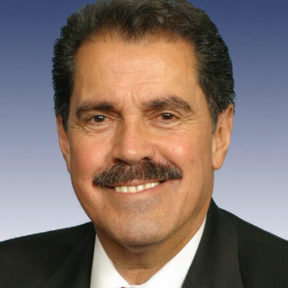
Jose Serrano
: Photo from Wikimedia Commons / Author of Photo: U.S. CongressOverview
* U.S. Congressman representing New York
* Member of the Congressional Progressive Caucus
* Favors comprehensive immigration reform that provides a path-to-citizenship for illegal aliens
* Admires Fidel Castro
* Praised President Clinton’s clemency offer to FALN Puerto Rican terrorists
Born in Mayagüez, Puerto Rico on October 24, 1943, Jose Serrano was raised in the South Bronx, New York. He attended Lehman College before joining the Army Medical Corps, where he served for three years during the Vietnam War. After leaving the Army in 1966, Serrano became active in Democratic Party politics in the Bronx. He worked for the New York City Board of Education for five years, and in 1974 he was elected to the New York State Assembly. In 1985 he ran unsuccessfully for the office of Bronx Borough President, but retained his assembly seat.
In January 1990, scandal-plagued Democrat Robert Garcia resigned from his post as the representative for a New York City congressional district centered on the mostly-Hispanic South Bronx. With vocal support from key Democratic leaders — including Jesse Jackson, New York Mayor David Dinkins, and Bronx Borough President Fernando Ferrer — Serrano won Garcia’s vacated seat in a special March 1990 election and has held it ever since. A number of his political campaigns have been supported by the Democratic Socialists of America.
Describing his own political ideology as “to the left of the left,” Serrano is a member of the Congressional Progressive Caucus, the Congressional Hispanic Caucus, and the Congressional Urban Caucus. In 2005 he also demonstrated his opposition to the Iraq War by joining the Out of Iraq Congressional Caucus.
Serrano has established a reputation as one of Congress’s most ardent advocates of comprehensive immigration reform that would provide a path-to-citizenship for millions of illegal aliens. In so doing, he has depicted Republicans and conservatives who oppose such a measure as racists and xenophobes who are unwilling to accept brown-skinned newcomers from Central America to the United States. In the June 11, 1994 edition of the Communist Party USA‘s People’s Weekly World, for instance, Serrano published an article titled “Immigrant Bashing — A Dirty Political Sport.” In 2007 he was a vocal supporter of then-New York Governor Eliot Spitzer’s plan to permit illegal aliens to acquire driver’s licenses; the congressman blamed the measure’s ultimate defeat on “the hate in this country toward immigrants right now.”
In 1997 Serrano was one of 33 original co-sponsors of the Job Creation and Infrastructure Restoration Act, which was introduced into Congress by California Rep. Matthew Martinez. Supported by the New York State Communist Party, this legislation was designed to create jobs at union wages in financially foundering cities by putting the unemployed to work on infrastructure projects. Rep. Martinez had already introduced an earlier version of this bill in the previous Congress at the request of the Los Angeles Labor Coalition for Public Works Jobs, whose leaders were known supporters or members of the Communist Party USA.
In the late 1990s, Serrano — along with Representatives Nydia Velazquez and Luis Gutierrez — led the lobbying effort aimed at persuading President Bill Clinton to offer clemency to 16 incarcerated members of the FALN, a Marxist-Leninist terror group that had been active in the U.S. from the mid-1970s through the early 1980s, and whose overriding mission was to secure Puerto Rico’s political independence from the United States. Depicting the inmates in question as “political prisoners,” Serrano — along with such notables as Velazquez, Gutierrez, Jesse Jackson, Coretta Scott King, Rigoberta Menchu, and Desmond Tutu — actively supported the the Pro-Human Rights Committee of Puerto Rico’s campaign calling for the prisoners’ release.
A longtime advocate of normalized American diplomatic relations with Havana, Serrano in 2003 sent one of his staffers to Cuba “to examine U.S. policy toward Cuba, the impact of the American trade embargo, and the economy of Cuba.” The cost of the trip was covered by a grant from the Center for Democracy in the Americas, which has close ties to the Institute for Policy Studies.
When Cuban dictator Fidel Castro announced in 2008 that he was ceding his governmental power to his brother Raul, Serrano praised “this important figure” for “def[ying] the attempts of his critics to paint him simply as a power-hungry authoritarian”; for proving that he “sees clearly the long-term interests of the Cuban people and recognizes that they are best served by a carefully planned transition”; and for “ensuring that the changes he brought about will live on and grow.” “I would like to congratulate both Fidel Castro and the Cuban people for this smooth transition of power,” the congressman expanded. “… It proves that there is a broad base of support for the Cuban system on the island. It also proves that despite constant criticisms, Castro’s revolution was not merely a series of military events in Cuba in the late 1950s and early 1960s, but instead a process that continues to evolve in Cuba today.” Portraying Castro as “a great leader for his people,” the congressman denounced America’s “backward and counterproductive policy of blockading and isolating the Cuban people.”
Serrano has long called for increasing U.S. federal aid to his native Puerto Rico, which he describes as an American “colony.” He has repeatedly proposed legislation that would allow for a referendum by which Puerto Rico could declare either its independence from the U.S., or its wish to become America’s 51st state.
In 2005 Serrano brokered a deal in which the state-run oil company of Hugo Chavez‘s Venezuela agreed to provide, through its U.S. subsidiary Citgo, some eight million gallons of home heating oil at a discounted rate to low-income residents of the Bronx. When Chavez died in March 2013, Serrano eulogized him as a man who “understood the needs of the poor”; “was committed to empowering the powerless”; “used his unique talents and gifts to try to lift up the people and the communities that reflected his impoverished roots”; “believed that the government of the country should be used to empower the masses, not the few”; “understood democracy and basic human desires for a dignified life”; and sought to ensure “a better life for the poor and downtrodden.”
On September 17, 2009, Serrano was one of only 75 House Members (all Democrats) who voted against a proposal to defund the notoriously corrupt community organization ACORN.
In 2015, Serrano was a signatory to New York City Mayor Bill de Blasio‘s “Progressive Agenda to Combat Income Inequality.”
In May 2015, Serrano was one of Sixteen Democratic members of the U.S. House of Representatives who signed a letter calling on President Obama to withdraw U.S. sanctions on seven Venezuelan government officials.
In December 2015, Serrano was a co-sponsor to House Resolution 569, titled “Condemning Violence, Bigotry, and Hateful Rhetoric Towards Muslims in the United States.” As KeyWiki.org reports: “The legislation [was] based on unsourced claims that there is a ‘rise of hateful and anti-Muslim speech, violence, and cultural ignorance,’ and a ‘disproportionate targeting’ of ‘Muslim women who wear hijabs, headscarves, or other religious articles of clothing … because of their religious clothing, articles, or observances.’”
In 2019, Serrano co-sponsored Rep. Pramila Jayapal‘s Medicare For All Act of 2019. He also endorsed Rep. Alexandria Ocasio-Cortez‘s HR 109, and environmental and economic bill known as the Green New Deal.
For an overview of Serrano’s voting record on a variety of key issues, click here.
For additional information on Jose Serrano, click here.