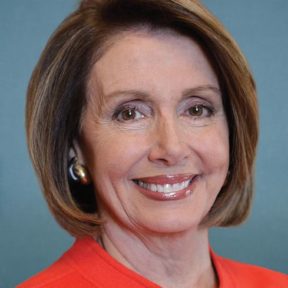
: Photo from Wikimedia Commons / Author of Photo: United States Government
Overview
* Member of the U.S. House of Representatives, from California’s 8th Congressional District
* One of the wealthiest members of Congress
* A key figure in the passage of Obamacare in 2010
* Former (and Current) Speaker of the House of Representatives
Nancy Pelosi was born on March 26, 1940 in Baltimore, Maryland, the youngest of six children. Her father, Thomas D’Alesandro Jr., served as a Democratic U.S. congressman representing Maryland’s Third District from 1939-47, and as the mayor of Baltimore from 1947-59.
On May 2, 1948, Thomas D’Alesandro Jr. spoke at the dedication of a monument to honor Confederate generals Robert E. Lee and Thomas “Stonewall” Jackson. Among his remarks were the following: “Today, with our nation beset by subversive groups and propaganda which seeks to destroy our national unity, we can look for inspiration to the lives of Lee and Jackson to remind us to be resolute and determined in preserving our sacred institutions. We must remain steadfast in our determination to preserve freedom, not only for ourselves, but for the other liberty-loving nations who are striving to preserve their national unity as free nations. In these days of uncertainty and turmoil, Americans must emulate Jackson’s example and stand like a stone wall against aggression in any form that would seek to destroy the liberty of the world.”
The D’Alesandro family home was a highly politicized place when Nancy was a child, constantly replete with mounds of brochures, placards and bumper stickers bearing political messages. “Our whole lives were politics,” the congresswoman Pelosi said in an interview many years later. “If you entered the house, it was always campaign time, and if you went into the living room, it was always constituent time.”[1]
Political Beginnings
Nancy Pelosi graduated with a BA from Trinity College in 1962 and then interned for Democratic U.S. Senator Daniel Brewster of Maryland before moving, with her husband (Peter Pelosi), to San Francisco in 1969. From 1977-81, Mrs. Pelosi served as the Democratic Party chairwoman for Northern California. From 1981-83, she was state chair of the California Democratic Party. And in 1985 she made an unsuccessful bid to become chair of the Democratic National Committee.[2]
During the late 1970s and early ’80s, Pelosi befriended Phillip Burton, the powerful Democratic congressman who since 1964 had represented California’s Eighth District, which included most of San Francisco. When Burton died in 1983, his wife, Sala, succeeded him in office. Three years later she was diagnosed with cancer and chose Pelosi to be her successor within the party, thereby assuring Pelosi the backing of the Burtons’ political allies. Mrs. Burton died on February 1, 1987, just a month after she had begun her second full term in office. In a special election to determine who would fill Burton’s now-empty House seat, Pelosi narrowly defeated San Francisco supervisor Harry Britt and took office on June 2, 1987. She has held that seat ever since.
During her 1987 congressional race, Pelosi described herself as a “rabid, foaming-at-the-mouth person in the Democratic Party.” “I’m a hardened Democrat and have never voted for a Republican in my life,” she added.[3] In some of her campaign literature, Pelosi derided the sitting U.S. President, Ronald Reagan, as a man who “has no compassion” and “has no vision.” “For the past two decades,” she boasted, “I have battled Ronald Reagan whenever he has attempted to disenfranchise people, jeopardize our environment or risk our future…. Now as a candidate for Congress, I want to bring my longtime battle with Ronald Reagan to the floor of the House of Representatives.”[4]
Opposing the First Gulf War
During the 1990 run-up to the first Gulf War, Pelosi staunchly opposed U.S. military action against Iraq and accused President George H. W. Bush of “illegally” carrying out an “ill-conceived policy of violence.”[5] During a speech she delivered from the House floor, Pelosi explained that her opposition to military intervention was also based, in part, on environmental considerations. “The war cloud that would result from exploding oil fields and large-scale bombing of Kuwait, Iraq, Saudi Arabia, and other countries in the Middle East would doom the environment for many years to come,” she said.[6]
Ties to the Democratic Socialists of America
On November 11 1995, Pelosi and fellow Democratic Congressman Ron Dellums were the keynote speakers at a public hearing on jobs and economic insecurity in San Francisco. The event was co-sponsored by the San Francisco Democratic Socialists of America (DSA) and the Full Employment Coalition.
In the 1996 Congressional elections, the DSA’s Political Action Committee endorsed Pelosi’s candidacy. “I pride myself in being called a liberal,” Pelosi said that year. “… I don’t consider myself a moderate.”[7]
Opposing Welfare Reform
That same year, Pelosi strongly opposed the Personal Responsibility and Work Opportunity Reconciliation Act of 1996—the famously successful welfare-reform legislation which was a cornerstone of the Republican Party’s 1994 “Contract With America.”[8]
Co-Sponsoring a Jobs Bill Favored by Communist Party Members
In 1997 Pelosi co-sponsored Congressman Matthew Martinez’s Job Creation and Infrastructure Restoration Act, which proposed to use $250 billion in federal funds for the establishment of union-wage jobs rebuilding infrastructure (e.g., schools, hospitals, libraries, public transportation, highways, and parks). Martinez had previously introduced this bill in 1995 at the the request of the Los Angeles Labor Coalition for Public Works Jobs, whose leaders were all supporters or members of the Communist Party USA.
Ties to the National Council of La Raza
Pelosi has long had a close relationship with the National Council of La Raza (NCLR). In 1998 the organization honored her with its Congressional Award, in recognition of her work on behalf of the Latino community. NCLR president Raul Yzaguirre praised Pelosi for “her outstanding record on human and civil rights.”
Pelosi & Iraq, 1998-2002
On December 16, 1998, Pelosi articulated her personal belief that Iraqi dictator “Saddam Hussein has been engaged in the development of weapons of mass destruction technology which is a threat to countries in the region and he has made a mockery of the weapons inspection process.” In October 2002, however, she voted against authorizing President George W. Bush to invade Iraq.
Public Praise for Hardline Communists
In 2001, on the hundredth anniversary of the birth of the late Harry Bridges (1901-90)—a former leader of the International Longshoremen’s and Warehousemen’s Union who was later (in 1992) exposed as having been a longtime member of the Communist Party USA‘s Central Committee—Pelosi honored Bridges as a man who was “beloved by the workers of this Nation, and recognized as one of the most important labor leaders in the world.” Bridges’ International Longshoremen’s and Warehousemen’s Union, Pelosi added, was “the most progressive union of the time.” As scholar Joshua Muavichik explains, Bridges had been directly approved for his Central Committee post by the Kremlin: “This means, plain and simple, that he had devoted his life to the service of the Soviet Union and its ruler, Joseph Stalin, one of the three greatest mass murderers of all time.” Pelosi’s praise of Bridges, Muravchik adds, does not mean that Pelosi was ever a Communist, but it did illustrate “Pelosi’s wretched record in judging who are history’s good guys and who are its bad.”
In 2001 as well, Pelosi also praised another prominent Bay Area socialist, Vivian Hallinan—whose husband, Vincent Hallinan, had co-founded the National Lawyers Guild‘s San Francisco chapter and had run for U.S. president in 1952 on the Progressive Party (which was a Communist Party front) ticket—as “a role model for many of us” and a “pioneer” in “a wide range of progressive causes.” In Pelosi’s view, “Vivian was devoted intellectually and passionately to many causes, well before they became popularly embraced.” Accuracy In Media’s Cliff Kincaid notes that “these causes included support for communists in Central America during the 1980s, when Soviet- and Cuban-backed forces were subverting Central America through violence and terrorism and fighting for control of the region.” Indeed, Pelosi’s tribute specifically lauded Mrs. Hallinan for having: (a) “opposed U.S. policy in Central America” under President Reagan; (b) “befriended Daniel Ortega, Nicaragua’s [Communist] Sandinista leader”; and (c) met with Cuban dictator Fidel Castro. The Hallinan family, it should be noted, was at one time under scrutiny by the California Senate Fact-finding Subcommittee on Un-American Activities for its efforts in promoting pro-Soviet propaganda.
Minority Whip, Democratic House Leader
In 2001 Pelosi became House Minority Whip. The following year, she was named Democratic Leader of the House of Representatives, thereby becoming the first woman in American history to lead a major party in the U.S. Congress.
The Iraq War & Pelosi’s Campaign to Smear President George W. Bush
In late 2002, when President George W. Bush asked Congress to authorize the use of force to drive Saddam Hussein from power, a Democratic majority in the Senate supported his request. When American forces entered Iraq on March 19, 2003, a large majority of the Democratic leadership, including the former president, his secretaries of state and defense, and his entire national security team, supported the invasion. When the Iraqi regime was overthrown three weeks later, the Democratic leadership joined in the celebration, although some dissenters, such as Nancy Pelosi, were already complaining that it cost too much.
But by mid-2003, Pelosi and many other leading Democrats were contending that the war was “unnecessary” because Iraq posed “no threat.” They maintained that because the war in Iraq was a war of “choice,” it was therefore immoral. Above all, they claimed that the president had manipulated intelligence about Iraqi weapons of mass destruction, and thus the premise of the war. But copies of the National Intelligence Estimate on which the president’s decision was based were provided to every Democratic senator who voted for or against it. The findings were confirmed by government intelligence agencies around the world, including those of France, Britain, Russia, and Jordan. In other words, President Bush could not have manipulated the intelligence on which the vote was based and the war was actually authorized.
Throughout the early 2000s, Pelosi’s deep contempt for President Bush steadily intensified. For example, in a May 2004 interview with the San Francisco Chronicle concerning Bush and the Iraq War, she said:
“Not to get personal about it, but the president’s capacity to lead has never been there. In order to lead you have to have judgment. In order to have judgment you have to have knowledge and experience. He has none. Bush is an incompetent leader. In fact, he’s not a leader. He’s a person who has no judgment, no experience, and no knowledge on the subjects that he has to decide upon…. They [the Bush Administration] are so pathetic; they are so in denial about their own ineffectiveness…. George Bush is in over his head…. It’s hopeless for George Bush. He has made it hopeless. In the private sector he would have been long gone…. He simply doesn’t have the capacity to lead us to a resolution in Iraq. We need a new commander in chief.”[9]
After Bush’s reelection in November 2004, Pelosi consulted with Silicon Valley marketing mavens on how the Democrats might go about popularizing their brand with the voting public. The advisors recommended that Pelosi and her fellow Democrats in the House and Senate boil down their many ideas to a handful of simple principles and priorities. This resulted in the formulation of the Democrats’ so-called “Partnership for America’s Future,” which consisted of six major priorities. These were: “Real Security: at Home and Overseas”; “Prosperity: Better American Jobs, and Better Pay”; “Opportunity: College Access for All”; “Energy Independence”; “Affordable Health Care”; and “Honest Leadership and Open Government.”[10]
Pelosi’s advisors lauded these six ideas but warned the congresswoman that if she were to publicly unveil them at that time, they would fail to have the desired effect. “He is the President of the United States, you’re the minority,” the advisors explained. “You have so little power. You can’t compete unless you take him down a few pegs first. That’s the way it’s done in the private sector.” Thus the first two orders of business would be for the Democrats to: (a) conduct a ruthless smear campaign designed to erode President Bush’s popularity as much as possible, and (b) clearly differentiate their own agendas from those of Bush. Then—and only then—would they roll out their campaign platform, which would be called “New Direction—Six for ’06.”[11]
Pelosi put this strategy into effect in early 2005, when President Bush announced that he was in favor of allowing taxpayers the option of investing a portion of their Social Security funds in non-governmental vehicles if they wished. Pelosi and Senate minority leader Harry Reid immediately tried to foment panic among senior citizens, charging that Bush was intent on “privatizing Social Security” and bankrupting seniors through high-risk private investments.[12]
Another key element of the Democrat smear campaign against Bush was the charge—made relentlessly—that the president had led the U.S. into a disastrously ill-conceived war which he was wholly unqualified to prosecute. In January 2004, Pelosi said: “The president led us into the Iraq war on the basis of unproven assertions without evidence; he embraced a radical doctrine of pre-emptive war unprecedented in our history; and he failed to build a true international coalition.” In June 2005 Pelosi referred to the Iraq War as a “grotesque mistake.”
Yet another focal point of the Democrats’ smear-Bush initiative was their excoriation of the president’s allegedly ineffective—and even racially insensitive—response to Hurricane Katrina, which ravaged the Gulf Coast on August 29, 2005.[13]
Undergirding Democratic criticisms regarding each of these issues was the constant refrain—led by Pelosi—that Bush and the Republicans had created a “culture of corruption, cronyism, and incompetence.”[14] Steadily and inexorably, as author Rochelle Schweizer writes in her 2010 book She’s the Boss: The Disturbing Truth About Nancy Pelosi, “Pelosi’s strategy of demonize-and-destroy [moved] the needle of public opinion in the Democrats’ favor.”[15] By the summer of 2006, with the midterm elections just around the corner, Bush’s approval rating was a meager 38%.[16]
Pelosi and her advisors calculated that the Republican Party was were vulnerable, and that the time was now right to announce their “New Direction—Six for ’06” platform.[17] Continuing, meanwhile, to cast the war in Iraq as a sinister plot of the Bush administration, they claimed that it was a distraction from what would have been a legitimate war with the Islamic terrorists who had attacked America. “The issue is the war they [the Bush administration] got us into,” Pelosi told60 Minutes in October 2006, just before she became Speaker of the House. “If the president wants to say the war in Iraq is part of the war on terror, he’s not right.” The dialog continued as follows:
60 Minutes: Do you not think that the war in Iraq now, today, is the war on terror?
Pelosi: No. The war on terror is the war in Afghanistan.
60 Minutes: But you don’t think that the terrorists have moved into Iraq now?
Pelosi: They have. The jihadists in Iraq. But that doesn’t mean we stay there. They’ll stay there as long as we’re there.
60 Minutes: You mean if we leave Iraq, the terrorists will leave?
Pelosi: Yes.
The Democrats’ relentless assault the Bush White House paid big dividends for them when they took control of the House of Representatives in the midterm elections of November 2006. And Pelosi was elected Speaker of the House, a post she held until 2010, when Democrats lost their majority in Congress.
Claiming That Terrorists Would Leave Iraq if the U.S. Military Would Withdraw
In a 60 Minutes interview in late 2006, Pelosi suggested that the major reason why so many terrorists were in Iraq, was because of the American military presence there. “The jihadists [are] in Iraq,” she said. “But that doesn’t mean we [the U.S. military should] stay there. They’ll stay there as long as we’re there.”
Pelosi on Global Warming
After becoming Speaker of the House, Pelosi grew increasingly outspoken on the issue of global warming, a purportedly ominous phenomenon which she attributed to the carbon emissions associated with human industrial activity. Among other things, she predicted that global warming would eventually cause political volatility across the planet as refugees fleeing the effects of climate change moved from nation to nation.[18]
Pelosi wholly discounts the ideas of those who disagree with her regarding either the reality or the genesis of global warming. Indeed, her position on the matter is as non-negotiable as religious dogma. In April 2007, for instance, Pelosi proclaimed that her environmental policies were consistent with the Old Testament scripture: “To minister to the needs of God’s creation is an act of worship. To ignore those needs is to dishonor the God who made us.” “We must move quickly,” she added, “to honor God’s creation by reducing greenhouse gas pollution in the United States and around the world.” The method by which such an effect could best be achieved, in Pelosi’s estimation, was government intervention via extensive regulations and massive taxes on polluters.[19]
In the summer of 2008, Pelosi again gave voice to her impatience with anyone whose view on global warming differed from her own. When Republicans fought to lift the moratorium on offshore oil and gas exploration, the congresswoman declared: “I’m trying to save the planet; I’m trying to save the planet. I will not have this debate trivialized by [the Republicans’] excuse for their failed policy.”[20]
Notably, Rochelle Schweizer points out that “Pelosi’s drive to hammer Big Oil has a flip side” rooted in her own quest for personal profit. Writes Schweizer: “[Pelosi] has invested in green companies such as Clean Energy Fuels Corporation [owned by oilman T. Boone Pickens], purchasing shares valued at $50,000 to $100,000 in an auction when Pickens publicly launched Clean Energy, in May 2007. In short, the Speaker stands to profit personally from the anti-oil, pro-green energy policies she has pushed as House Speaker.”[21]
Opposing the Military Troop Surge of 2007 in Iraq
In January 2007, Pelosi strongly opposed President Bush’s decision to deploy an additional 21,500 troops in a military “surge” designed to turn the tide of the Iraq War—which had devolved into a bloody quagmire—back in America’s favor. Along with Senate Majority Leader Harry Reid, the House Speaker condemned the plan: “Adding more combat troops will only endanger more Americans and stretch our military to the breaking point for no strategic gain.” Instead, Pelosi called for “the phased redeployment of our forces in the next four to six months.”
In February 2008 Pelosi declared the surge a “failure” that had “not produced the desired effect.” But in fact, the surge proved to be a monumentally important strategy that finally enabled the U.S. to emerge victorious in the war. Prior to the surge, it had not been uncommon for 3,000 or more Iraqi civilians and security-force members to die at the hands of terrorist violence during any given month. By May 2008, the monthly mortality figure stood at 19, and it then fluctuated between 7 and 25 deaths per month over the ensuing 14 months.
Pelosi Appoints a Senior Policy Analyst of George Soros
Misrepresenting Official U.S. & Israeli Policy During an Unauthorized Trip to Syria
In April 2007 Pelosi traveled to Damascus to discuss foreign-policy issues with Syrian President Bashar Assad. She made this trip against the wishes of President Bush, who said that it sent “mixed messages” and undermined U.S. policy vis à vis what he called “a state sponsor of terror.” Pelosi’s purpose for making the trip was to pressure the Bush administration to open up a direct dialogue with the Syrian government. After her meeting with Assad, the congresswoman told reporters: “We came in friendship, hope, and determined that the road to Damascus is a road to peace.”
Former State Department official Robert F. Turner saw Pelosi’s Damascus trip as a felonious violation of the Logan Act of 1798, which calls for a prison sentence of up to three years for any American who, “without authority of the United States,” tries to influence a foreign government’s behavior as regards any “disputes or controversies with the United States.”
After her trip to Syria, Pelosi also told reporters: “[Our] meeting with the president [Assad] enabled us to communicate a message from [Israeli] Prime Minister Olmert that Israel was ready to engage in peace talks as well.” But in fact, Olmert had conveyed no such sentiment. Israel’s position remained what it always had been: its participation in peace talks with Syria was contingent upon the latter ending its support for terrorism.
Speaking to the Youth Arm of the Center for American Progress
In July 2008 Pelosi characterized President Bush as “a total failure” who had lost “all credibility with the American people on the war, on the economy, on energy, [and any other issue].”
Abortion & Pelosi’s Catholic Faith
In 2008, Pelosi sparked controversy by asserting that “doctors of the [Catholic] Church” were in disagreement over when exactly human life begins, and stating that abortion “continues to be an issue of controversy” in the Church. In response to Pelosi’s utterly unfounded claims, a number of U.S. bishops publicly scolded the congresswoman and pointed out that the Catholic Church’s opposition to abortion dated back to the first century.[22]
Pelosi has repeatedly cited the doctrine of free will as a justification for choosing abortion. On January 13, 2010, San Francisco Archbishop George Niederauer stated outright that Pelosi’s claim was “entirely incompatible with Catholic teaching.”[23]
At a June 2013 press conference, a Weekly Standard reporter asked Pelosi to clarify her position on abortion in the wake of the recent trial of Kermit Gosnell, an abortionist who was convicted of killing a number of newborn babies after they had survived attempted abortions. “What is the moral difference between what Dr. Gosnell did to a baby born alive at 23 weeks and aborting her moments before birth?” the reporter asked. Pelosi dismissed the question and equated Gosnell’s actions with pro-life activists’ condemnation of abortion. “What was done in Philadelphia was reprehensible and everybody condemned it,” she said. “For them to decide to disrespect a judgment a woman makes about her reproductive health is reprehensible. Next question.” When pressed for an answer, Pelosi said: “As a practicing and respectful Catholic, this is sacred ground to me when we talk about this. I don’t think it should have anything to do with politics. And that’s where you’re taking it and I’m not going there.”
In response to Pelosi’s comments, Father Frank Pavone, the national director of the pro-life group Priests for Life, wrote Pelosi an open letter saying:
“Public servants are supposed to be able to tell the difference between serving the public and killing the public. Apparently, you can’t. Otherwise, you would have been able to explain the difference between a legal medical procedure that kills a baby inside the womb and an act of murder…. Abortion is not sacred ground; it is sacrilegious ground. To imagine God giving the slightest approval to an act that dismembers a child he created is offensive to both faith and reason. And to say that a question about the difference between a legal medical procedure and murder should not ‘have anything to do with politics’ reveals a profound failure to understand your own political responsibilities, which start with the duty to secure the God-given right to life of every citizen. Whatever Catholic faith you claim to respect and practice, it is not the faith that the Catholic Church teaches. And I speak for countless Catholics when I say that it’s time for you to stop speaking as if it were.”
Pelosi’s Profligate Spending of Taxpayer Dollars
In April 2009, Citizens Against Government Waste (CAGW), a non-partisan government watchdog group, named Pelosi and Senate Majority Leader Harry Reid as its 2008 “Porkers of the Year” because of their consistent record of fiscal irresponsibility.
In her 2010 book She’s the Boss: The Disturbing Truth About Nancy Pelosi, author Rochelle Schweizer writes:
“In 2009, Pelosi dropped $30,610 of taxpayer money on food and beverage, $2,740 on bottled water and, between June and October alone, $2,993 on flowers. She also spent $5,000 on flowers as House minority leader in 2006. Granted, these expenses, though excessive, involve legitimate factors like schmoozing dignitaries and officials, as Pelosi’s congressional offices are apt to remind critics. But what about a $10,000 contract she paid to have former Clinton White House speechwriter Heather Hurlburt write the speech she would deliver before the Israeli Knesset? Or the 51 workers on her payroll during the third quarter of 2006, compared with the 35 people [whom previous House Speaker Dennis] Hastert employed?”[24]
In December 2009 Pelosi led at least 20 members of Congress (and many of their spouses and children) on an all-expenses-paid trip to attend a global-warming summit in Copenhagen, Denmark. The delegation was so large, that three military jets were required to transport its members. A number of senators and staffers also made the trip, courtesy of taxpayer dollars, via commercial airliners, and many of them stayed at 5-star hotels in Copenhagen. Although Pelosi was personally responsible for deciding who went the summit, she subsequently refused to answer any reporters’ questions regarding the cost of the trip.
According to documents obtained under the Freedom of Information Act, during 2008-09 Pelosi incurred expenses of some $2.1 million for her use of Air Force jets for travel—including $101,429 for in-flight expenses such as food and alcohol. She regularly used Air Force aircraft to travel back-and-forth between Washington and her home district, at an average cost of $28,210.51 per flight. And, of 103 Pelosi-led congressional delegations during the two-year period, 31 trips included members of her family.
Pelosi’s Lies About Waterboarding
Following the end of the Bush administration, Pelosi repeatedly characterized waterboarding—an enhanced-interrogation technique which the CIA had used on a handful of high-value terrorist suspects during the Bush years—as a form of torture that was wholly incompatible with American values and unacceptable under any circumstances. Moreover, she called for punitive action against those in the Bush administration who had deemed waterboarding appropriate. In response to suggestions that Pelosi herself may actually have been aware of waterboarding’s use for several years, the congresswoman told reporters on April 23, 2009: “We were not—I repeat—were not told that waterboarding or any of these other enhanced interrogation methods were used. What they did tell us is that they had some … Office of [Legal] Counsel opinions, that they could be used, but not that they would.”[25]
Then, in May 2009 it was learned that as early as September 2002, the CIA had actually briefed Pelosi herself about its use of waterboarding in certain circumstances, and that the congresswoman had never subsequently raised any objection. Pelosi responded to these reports by accusing the CIA of “misleading the Congress of the United States.” “They mislead us all the time,” she said.
Then it was learned that in February 2003—six months after Pelosi’s September 2002 briefing—one of Pelosi’s top aides, Michael Sheehy: (a) had attended a CIA briefing in which the actual mechanics of waterboarding were described in detail, and in which it was revealed that waterboarding had been used on al Qaeda operational planner Abu Zubaydah; and (b) had told Pelosi what had been discussed in the briefing. Pelosi finally acknowledged the veracity of Sheehy’s claims in a tense press conference on May 14, 2009.[26]
By Any Means Necessary, & Disregarding the Constitution
Pelosi has long depicted her political opponents as heartless monsters and/or uninformed fools. Recall, for instance, how she trivialized the views of Republicans who disagreed with her regarding global warming (see above).[27] The congresswoman treats her opponents on the issue of healthcare with the same dismissive contempt. “Listen, I go on the floor of the House every day and deal with people who don’t want to give health care to poor little children in America,” she once said during the effort to pass Obamacare into law. “We’re trying to get a job done.”[28]
Because she holds her adversaries in such low regard, Pelosi is quite comfortable with the process of trying to force legislation through the political pipeline. “Nancy really doesn’t care about Republicans, because she doesn’t believe the whole bi-partisan thing exists,” says one of Pelosi’s close associates. “Her attitude is, ‘God bless their souls, but these people … just don’t agree with us.’”[29] This attitude was clearly on display in January 2010, when Pelosi and Senator Harry Reid were leading the rancorous process by which Democrats were seeking to pass healthcare reform. At that time, Pelosi articulated her determination to enact the new legislation: “You go through the gate. If the gate’s closed, you go over the fence. If the fence is too high, we’ll pole-vault in. If that doesn’t work, we’ll parachute in. But we’re going to get health care reform passed for the American people.”
In October 2009, a CNS News reporter asked Pelosi, “Madam Speaker, where specifically does the Constitution grant Congress the authority to enact an individual health insurance mandate?” Unable to answer the question, Pelosi simply dismissed it and said: “Are you serious? Are you serious?” When the reporter replied that he was in fact serious, Pelosi shook her head and proceeded to take a question from another reporter. Pelosi’s press spokesman, Nadeam Elshami, later told CNS News: “You can put this on the record. That is not a serious question. That is not a serious question.”
Likening Obamacare’s Opponents to Nazis & Murderers
In the summer of 2009, a San Francisco Chronicle reporter asked Pelosi whether she believed that there was “legitimate grass-roots opposition” to the Democrats’ healthcare plan. Characterizing that opposition as something contrived by wealthy Republican elites rather than ordinary Americans, Pelosi replied, “I think they are Astroturf”—a term connoting her adversaries’ alleged lack of authenticity. She then likened conservatives who had been heckling pro-Obamacare Democrats at town hall meetings, to Nazis: “They’re carrying swastikas and symbols like that to a town meeting on healthcare.”
On another occasion (in September 2009), Pelosi compared vocal opponents of Obamacare to people who had committed violence in the congresswoman’s hometown many years earlier. In an emotional news conference, with her voice breaking, Pelosi said: “I have some concerns about some of the language being used, because I saw this myself in the late ’70s in San Francisco; this kind of rhetoric was very frightening, and it created a climate where violence took place.”[30] She was referring to the 1978 killings of Harvey Milk (the first openly gay member of the city’s board of supervisors) and progressive mayor George Moscone.
Claiming That Obamacare Could Be Funded by Taxing the “Wealthy”
One of the ways in which Pelosi tried to advance the Democrat healthcare-reform bill was by claiming that much of it could be paid for by raising taxes on the wealthy. As Rochelle Schweizer notes:
“How [Pelosi] developed the income surcharge reveals how passing her agenda expeditiously was more important than any numbers related to the solvency of the plan. Initially the new taxes would strike adjusted gross incomes of $280,000 for individuals and $350,000 or more for families. Pelosi said, ‘I’d like it to go higher than it is.’ She wanted to raise the thresholds to $500,000 for individuals and $1 million for families so she could call it a ‘millionaire’s tax.’ Pelosi explained, ‘When someone hears, two, they think, Oh, I could be there, because they don’t know the $280,000 is for one person. It sounds like you’re in the neighborhood. So I just want to remove all doubt. You hear $500,000 a year, you think, My God, that’s not me.’”[31]
Breaking the Democrat Pledge to Have Healthcare Reform Negotiations Open to Public View
In January 2010, Pelosi did everything in her power to help President Obama violate the pledge he had made during the 2008 campaign, when he had told voters that “we’ll have [health-care reform] negotiations televised on C-SPAN, so the people can see who is making arguments on behalf of their constituents and who is making arguments on behalf of the drug companies or the insurance companies.” In early January 2010, Pelosi announced that the House and Senate would devise the final healthcare bill “behind closed doors, according to an agreement by top Democrats.”[32]
Procedural Gimmicks
In March 2010, Pelosi stated that she wished to avoid a House vote on healthcare reform because the legislation would surely be defeated in that chamber. “Nobody wants to vote for the Senate bill,” she said. Thus she supported the so-called “Slaughter solution.” Under this plan, the House would vote on a procedural motion—that is, the “rule” that is supposed to govern debate on a matter going before the House. In this case, a “self-executing rule” would be used that would “deem” the Senate version of Obamacare to have been passed. Thus lawmakers would be able to vote to approve the Senate version of the healthcare legislation—complete with unpopular add-ons such as Senator Ben Nelson’s “Cornhusker Kickback” and Senator Mary Landrieu’s “Louisiana Purchase”—and then be able to tell their constituents that technically all they had done was approve a procedural motion.
“We Have to Pass the Bill So That You Can Find out What Is in It”
Also in March 2010, Pelosi told the National Association of Counties’ annual legislative conference: “You’ve heard about the controversies, the process about the bill … but I don’t know if you’ve heard that it is legislation for the future—not just about health care for America, but about a healthier America. But we have to pass the bill so that you can find out what is in it—away from the fog of the controversy.”
An “Entrepreneurial” Bill to Help Americans Escape “Job-Lock”
In a March 2010 interview with MSNBC’s Rachel Maddow, Pelosi explained how Obamacare would liberate many Americans to pursue their dreams: “Think of an economy where people could be an artist or a photographer, a writer without worrying about keeping their day job in order to have health insurance. Or that people could start a business and be entrepreneurial and take risks, but not be job-locked because a child has a child has asthma or diabetes or someone in the family is bipolar. You name it, any condition is job-locking.”
Pelosi would subsequently revisit this theme numerous times:
In May 2010 she said that Obamacare was “an entrepreneurial bill, a bill that says to someone, if you want to be creative and be a musician or whatever, you can leave your work, focus on your talent, your skill, your passion, your aspirations because you will have health care.”
In February 2014 the Congressional Budget Office (CBO) released a report indicating that Obamacare would result in a net loss of some 2.3 million jobs nationwide within seven years. The report said that because Obamacare gives substantial subsidies to people below certain income thresholds—subsidies that are funded by all the people above those thresholds—many Americans would choose to work less, or to not work at all, in order to limit their incomes and thus continue to have their healthcare subsidized. Pelosi depicted the CBO report as something positive, telling reporters: “What we see is that [thanks to Obamacare] people are leaving their jobs because they are no longer job-locked. They are following their aspirations to be a writer; to be self-employed; to start a business. This is the entrepreneurial piece. So it’s not going to cost jobs. It’s going to shift how people make a living and reach their aspirations…. [T]his was one of the goals. To give people life, a healthy life, liberty to pursue their happiness. And that liberty is to not be job-locked, but to follow their passion.”
In a February 5, 2014 news release, Pelosi again emphasized: “Yesterday, the CBO projected that by 2021 the Affordable Care Act will enable more than 2 million workers to escape ‘job-lock’—the situation where workers remain tied to employers for access to health insurance benefits.”
A Stepping Stone to “Single-Payer,” Government-Run Healthcare
Addressing a group of bloggers in March 2010, Pelosi made reference to the fact that the Obamacare bill she was seeking to pass was merely the first phase of a larger effort to bring about ever-greater government control over the American medical system: “My biggest fight has been between those who wanted to do something incremental and those who wanted to do something comprehensive. We won that fight, and once we kick through this door, there’ll be more legislation to follow.” Shedding further light on what such additional legislation might entail, Pelosi said: “I have supported—when I say support, [I mean] signs in the street, advocacy in legislatures—I have supported single payer [i.e., a healthcare system run entirely by the federal government] for longer than many of you have been—since you’ve been born, than you’ve lived on the face of the earth. So I think, I have always thought, that was the way to go.”
Pelosi revisited the theme of a single-payer healthcare system in October 2016 when, in response to a reporter who asked whether she was concerned about the high cost of Obamacare premiums, which were unaffordable for many middle-class people who did not qualify for government subsidies, she said: “I wanted single-payer. I mean, I wanted a—I’d love a single-payer, but we’re not—I wanted a public option, which would address that. But we’ve never done anything, whether it was Social Security, Medicare and the rest where we haven’t said how does this— let’s see how it works, and let’s improve it. But no, I wouldn’t worry about that.”
In June 2014—in the midst of a sudden, massive influx across America’s southern border by more than 50,000 unaccompanied, illegal-immigrant minors hailing from Central America—Pelosi visited a holding place (for the border-crossers) in southern Texas and then made the following remarks:
“What we just saw was so stunning. If you believe as we do that every child, every person, has a spark of divinity in them and is therefore worthy of respect, what we saw in those rooms was [a] dazzling, sparkling array of God’s children, worthy of respect. So we have to use … the crisis … as an opportunity to show who we are as Americans, that we do respect people for their divinity and worth….”
Rejecting the Notion of a U.S-Mexico Border
Suggesting that America and Mexico were not entities entirely distinct from one another, Pelosi also said: “This is a community with a border going through it.” Moreover, she indicated that she wanted to become personally involved with caring for the children: “I’m a mother of five. I have nine grandchildren. I wish that I could take all those children home with me.”
Using Religion to Justify Open Borders
In a July 2014 appearance on MSNBC’s Morning Joe program, Pelosi again addressed the issue of the young people who were illegally crossing the border into the U.S.: “I reference the Conference of Bishops’ statement in which they say baby Jesus was a refugee from violence. Let us not turn away these children and send them back into a burning building. That’s the bishops, so we have to do this in a way that honors our values but also protects our border and does so in a way that the American people understand more clearly.”
Opposing Republican Legislation to End DACA
During a House debate on August 2, 2014, Republican lawmakers moved to pass a border-security bill as well as legislation designed to end President Obama’s Deferred Action for Childhood Arrivals (DACA) program, which permitted hundreds of thousands of illegal immigrants under age 30—and who first came to the U.S. as minors—to remain in America without fear of being deported. Pelosi reacted angrily to a floor speech from Rep. Tom Marino (R-Pennsylvania). “You know something that I find quite interesting about the other side?” Marino said. “Under the leadership of the former Speaker [Pelosi], and under the leadership of their former leader [Rep. Steny Hoyer (D-Maryland)]—when in 2009 and 2010, they had the House, the Senate and the White House, and they knew this problem existed. They didn’t have the strength to go after it back then. But now are trying to make a political issue out of it now.” Soon after Marino made those remarks, Pelosi stood up and shouted at him off-microphone, wagging her finger at him and calling him an “insignificant person.” Afterward, Marino said: “If she considers another elected member of Congress insignificant, I can only imagine what she thinks of the millions of hard working Americans who send us to Washington with the simple expectation that we work to secure our borders.”
Disparaging “Five White Guys” in Congress Seeking to Pass Immigration Laws
At a January 2018 news conference, Pelosi complained that immigration negotiations in Congress were being led by “five white guys” — a reference to Senate Majority Whip John Cornyn (R-Texas), Senate Minority Whip Dick Durbin (D-Ill.), House Majority Leader Kevin McCarthy (R-Calif.), House Minority Whip Steny Hoyer (D-Maryland), and White House Chief of Staff John Kelly. “The five white guys I call them, you know,” said Pelosi. “Are they going to open a hamburger stand next or what?” (The latter quip was a reference to the hamburger chain Five Guys.)
Pelosi Calls Unemployment Insurance an Economic “Stimulus”
In July 2010, Pelosi stated that unemployment insurance “is one of the biggest stimuluses to our economy.” “Economists will tell you,” she continued, “this money is spent quickly. It injects demand into the economy and is job-creating. It creates jobs faster than almost any other initiative you can name, because again, it is money that is needed for families to survive, and it is spent. So it has a double benefit. It helps those who’ve lost their jobs, but it also is a job creator.” Pelosi would reiterate these themes in December 2011.
Supporting the “Ground Zero Mosque”
In August 2010, Pelosi spoke out in favor of Faisal Abdul Rauf‘s Cordoba Initiative, a proposal to build a 13-story, $100 million Islamic Center just 600 feet from Ground Zero in lower Manhattan. Criticizing opponents of the project, the congresswoman said: “There is no question that there is a concerted effort to make this a political issue by some. And I join those who have called for looking into how is this opposition to the mosque being funded [and] ginned up.”
Supporting Big Government & Wealth Redistribution
In an October 2010 speech to the United Steelworkers union, Pelosi gave voice to her unwavering belief in big government and wealth redistribution: “We’re talking about addressing the disparity in our country of income, where the wealthy people continue to get wealthier and some other people are falling out of the middle class when we want to bring many more people into the middle class, But that disparity is not just about wages alone. That disparity is about ownership and equity. Its all about fairness in our country.”
Hypocrisy Regarding the Killing of Osama Bin Laden
On May 3, 2011, after it was announced that U.S. Navy SEALs had located and killed al Qaeda leader Osama bin Laden, Pelosi said the following: “The death of Osama bin Laden marks the most significant development in our fight against al-Qaeda…. I salute President Obama, his national security team, Director Panetta, our men and women in the intelligence community and military, and other nations who supported this effort for their leadership in achieving this major accomplishment…. [T]he death of Osama bin Laden is historic….”
Those remarks, however, were a stark contrast to what Pelosi had said on September 7, 2006, when she derided President George W. Bush for allegedly having become distracted from the goal of finding bin Laden: “[E]ven if [Osama bin Laden] is caught tomorrow, it is five years too late. He has done more damage the longer he has been out there. But, in fact, the damage that he has done, is done. And even to capture him now I don’t think makes us any safer.”
Supporting Occupy Wall Street
In October 2011, Pelosi expressed support for the anti-capitalist Occupy Wall Street movement which was spreading to numerous cities across the United States. Said Pelosi: “God bless them for their spontaneity. It’s independent … it’s young, it’s spontaneous, and it’s focused. And it’s going to be effective…. The message of the protesters is a message for the establishment everyplace. No longer will the recklessness of some on Wall Street cause massive joblessness on Main Street.”
In January 2013, Pelosi appointed Nadeam Elshami, her longtime communications director, to be her chief of staff. Elshami had formerly worked for Senator Dick Durbin (D-IL) and Representative Jan Schakowsky (D-IL). Elshami’s Egyptian mother, Zainab Elberry, is a Tennessee-based Muslim activist who lobbied for construction of a mega-mosque in Murfreesboro, Tennessee; supported the ouster of Egypt’s pro-America president, Hosni Mubarak; and helped organize the radical Islamic Center of Nashville.
Pelosi on Immigration:
Using Religion to Justify Open Borders
At the Catholic Community Conference on Capitol Hill on May 6, 2010, Pelosi said that she had told Catholic cardinals, archbishops, and bishops to speak about the importance of comprehensive “immigration reform” from their pulpits, and to tell their parishioners that such reform would serve as “a manifestation of our living the gospels.” At the same event, Pelosi suggested that her religious beliefs regularly influenced her public-policy decisions on a wide range of issues, including immigration: “My favorite word is the Word, is the Word…. And … we have to give voice to what that means in terms of public policy that would be in keeping with the values of the Word.”
Condemning the Deportation of Illegals, & Making It More Difficult to Deport Them
In 2013, Pelosi was one of 28 California congressional representatives (all Democrats) who supported the Trust Act, state legislation designed to make it more difficult to deport immigrants residing in the U.S. illegally. The 28 Democrats sent a letter to Governor Jerry Brown urging him to sign the bill if it reached his desk.
In a December 2013 interview with Telemundo regarding immigration law, Pelosi said: “Our view of the law is that … if somebody is here without sufficient documentation, that is not reason for deportation. If somebody has broken the law, committed a felony or something, that’s a different story.” Pelosi’s position was contrary to federal law, which holds that those who are in the U.S. without authorization—either because they illegally crossed the border or they overstayed their visas—are deportable. Drew Hammill, Mrs. Pelosi’s spokesman, called the Speaker’s comments “a restatement of her long-held belief that being an undocumented immigrant is not a basis for deportation.” Hammill also asserted that Pelosi wished to pass a new law legalizing illegal immigrants in order to put to rest all controversy about the matter. Pelosi added: “I think that there is discretion in the law as to the implementation, enforcement of the legislation that is calling for these deportations.”
In an April 2014 interview with Politico, Pelosi likened the deportation of foreigners living illegally in the United States to the forced internment of some 110,000 ethnic-Japanese Americans during World War II. Said Pelosi:
“I’ll be very honest with you: Looking at the numbers at some point, in terms of how people are treated and deported and families separated and the rest, this has a scent of Japanese internment. It’s really a black mark…. I believe that if [immigration] status is the violation, then that should not be even in the scheme of things as to whether somebody would be deported or else you would be deporting 11 million people, which doesn’t make any sense.”
Pelosi on Government Spending & Taxes
In a February 10, 2013 television interview, Pelosi said it would be wrong for the federal government to cut any funding for such items as education, science, and food safety. She claimed that America’s budget deficit “isn’t so much a spending problem as it is a priorities [problem]”—i.e., the items on which tax dollars are spent. In the same interview, she said it was “almost a false argument to say we have a spending problem.” Rather, she explained, there was “a government deficit problem”—the implication being that additional tax revenues were needed. The following day, White House spokesman Jay Carney was asked whether President Obama agreed with Pelosi’s assertion. Carney replied, “Of course, the president believes that we have a spending problem,” adding that the problem was “specifically driven” by health care spending.
In March 2013, Pelosi categorized tax breaks for businesses as forms of “spending” that needed to be cut:
“Tax cuts are spending. Our whole budget is what, $3.5 trillion? So, when we talk about reducing spending, we certainly must, and we certainly have–$1.6 trillion in the previous Congress, $1.2 of it in the Budget Control Act. But spending is subsidies for big oil, subsidies to send jobs overseas, breaks to send jobs overseas, breaks for corporate jets. They are called tax expenditures. Spending money on tax breaks. And that’s the spending that we must curtail as well.”
In a September 22, 2013 interview with CNN, Pelosi stated that Republican-led efforts to rein in government spending were pointless because there was nothing left to cut in the $3.8 trillion federal budget. “The cupboard is bare,” she said. “There’s no more cuts to make. It’s really important that people understand that. We cannot have cuts just for the sake of cuts.”
Lying About Obamacare
At a June 6, 2013 press conference, Pelosi responded to news reports that, contrary to earlier claims by Barack Obama and Pelosi herself, Obamacare would cause health insurance premiums to rise dramatically for many people purchasing their own insurance in the individual market: “I don’t remember saying that everybody in the country would have a lower premium.” But in fact, during a July 1, 2012 appearance on Meet The Press, Pelosi had stated that because of Obamacare “everybody will have lower rates, better quality care and better access.”
In November 2013—amid immense public outrage over the fact that Obamacare regulations were, contrary to the repeated assurances of President Obama and the Democrats, forcing insurers to cancel the existing healthcare plans of millions of Americans—Pelosi was asked whether she owed an apology to the formerly insured who had been misled. She replied, “Did I ever tell my constituents that if they liked their plan they could keep it? I would have if I’d ever met anybody who liked his or her plan. But that was not my experience.”
Advocating a U.S. Military Attack on Syria
On September 3, 2013, Pelosi explained to reporters why a U.S. military attack on Syria, where more than 100,000 people had already been killed during a 30-month civil war that continued to rage, was now justified by the fact that the Syrian regime had apparently used chemical weapons to kill some 1,400 people (including perhaps 400 children) on August 21. Said the congresswoman:
“My five-year-old grandson, as I was leaving San Francisco yesterday, he said to me, Mimi, my name, Mimi: War with Syria. Are you yes war with Syria, [or] no war with Syria. Now he’s five years old. And war, he’s saying war. I mean, we’re not talking about war; we’re talking about an action. Yes war with Syria, no with war in Syria? I said, ‘Well, what do you think?’ He said, ‘I think no war.’ I said, ‘Well, I generally agree with that, but you know, they have killed hundreds of children, they’ve killed hundreds of children.’ And he said, five years old, ‘Were these children in the United States?’ And I said, ‘No, but they’re children wherever they are.’
“So I don’t know what news he’s listening to or—but even a five year old child has to—you know, with the wisdom of our interest, how does it affect our interest. Well, it affects our interests because, again, it was outside of the circle of civilized behavior. It was, humanity drew a line decades ago that I think if we ignore, we do so to the peril of many other people who could suffer.”
Pelosi on Health Insurance Coverage for Abortifacients
In July 2014, Pelosi reacted angrily to the Supreme Court’s Hobby Lobby decision, which upheld the religious rights of companies not to offer health-insurance coverage for certain forms of birth control (i.e., “emergency contraception” that some people consider to be abortifacients). “That court decision was a frightening one,” said Pelosi, “that five men should get down to specifics of whether a woman should use a diaphragm and [whether] she should pay for it herself, or her boss. It’s not her boss’ business. The business is whatever his business is, but it’s not what contraception she uses.”
Fox News coomentator Megyn Kelly subsequently offered her legal analysis of Pelosi’s attempt to “stoke resentment,” noting that in 1973 Roe v. Wade was decided by a majority of men: “Does Ms. Pelosi think those justices were ill-equipped to fairly decide that case? Or is it only when a judge disagrees with Ms. Pelosi that his gender is an issue. If Speaker John Boehner made a similar comment about the female Supreme Court justices, Nancy Pelosi would be crying sexism—and that’s what she is guilty of here.” Calling Pelosi’s claim a “gross misrepresentation,” Kelly added: “News flash: all birth control that was legal before this decision remains legal today. The high court simply found that a religious freedom law which was co-sponsored by none other than—wait for it—Nancy Pelosi, sometimes protects corporations from being forced to violate their religious beliefs.”
Pelosi on the Arab-Israeli Conflict
In late July 2014, while the Israeli Defense Forces were engaged in a significant military operation designed to stop the terror group Hamas’s relentless firing of potentially deadly rockets from Gaza into Israel, Pelosi was interviewed by CNN’s Candy Crowley. In the course of the interview, Pelosi said that the U.S. must look to Qatar, a staunch ally and funder of Hamas, for advice in bringing the Palestinian-Israeli conflict to a peaceful end. Said the congresswoman: “[T]his has to be something where we try to have the two-state solution, that we have to support… [Palestinian Authority chairman Mahmoud] Abbas and his role as a leader there. We have to support Iron Dome to protect the Israelis from the missiles. We have to support the Palestinians and what they need. And we have to confer with the Qataris, who have told me over and over again that Hamas is a humanitarian organization, maybe they could use their influence to—” At that point, Crowley interrupted Pelosi to ask: “The U.S. thinks they’re a terrorist organization though, correct? Do you?” Pelosi responded affirmatively: “Mmm hmm.”
Opposing the Use of American Troops to Fight ISIS Terrorists
On September 17, 2014—after the barbaric terrorist group ISIS (Islamic State in Iraq and Syria) had overwhelmed the Iraqi military and taken control of vast swaths of that country’s territory—Pelosi said that a return of U.S. ground troops to Iraq would only exacerbate the violence. “I don’t think the American people are up for it,” she explained. “I don’t know that it would even achieve success to send troops in. But whatever it is, I’m against [troops on the ground].”
When a reporter subsequently asked what she would do if President Obama suddenly decided that a troop deployment was absolutely necessary, Pelosi replied: “Well what would be the purpose? What is the purpose? Our purpose is not to engage in civil war in Syria and our purpose is not to continue the war in Iraq—our purpose is to stop ISIS from its brutality.” She then paraphrased a quote from the late political theorist Hannah Arendt to make her point: “People think that one more act of violence is going to stop violence, but instead it’s like a flywheel that just keeps producing more violence…. The worse it gets there, the less reason I think we should send in troops. Just an endless flywheel.”
Pelosi Lies About Obamacare Architect Jonathan Gruber
In early November 2014, MIT professor Jonathan Gruber — who, by his own account, had “helped write the federal [Obmacare] bill” and “was a paid consultant to the Obama administration to help develop the technical details as well” — became a source of great controversy when video clips of some of his past speeches on Obamacare came to public attention. Most notably, Gruber boasted that he and the Democrats had knowingly and repeatedly lied about key aspects of the legislation so as to deceive American voters, whom the professor characterized as “too stupid” to realize what was happening.
At a November 14, 2014 press conference, Pelosi tried to downplay Gruber’s devastating comments by first saying that they “were a year old, and he has backtracked from most of them.” Shortly thereafter she added: “I don’t know who he [Gruber] is. He didn’t help write our [Obamacare] bill. So, with all due respect to your [the reporter’s] question, you have a person who wasn’t writing our bill, commenting on what was going on when we were writing the bill, who has withdrawn some of the statements that he made. So let’s put him aside.”
But soon after Pelosi issued this statement, the Washington Post reported that in November and December of 2009, Pelosi’s own office had cited Gruber’s analysis of the legislation as an authoritative source substantiating Democrat claims that the bill would lower health insurance premiums for millions of people. In fact, Pelosi herself (in 2009) personallycited Gruber as an authority: “We’re not finished getting all of our reports back from CBO, but we’ll have a side-by-side to compare. But our bill brings down rates. I don’t know if you have seen Jonathan Gruber of MIT’s analysis of what the comparison is to the status quo, versus what will happen in our bill for those who seek insurance within the exchange. And our bill takes down those costs, even from now, and much less preventing the upward spiral.”
When Pelosi’s obvious familiarity with Gruber was reported in the media in November 2014, the congresswoman’s office told the Washington Post that she had simply “meant that she didn’t know Gruber personally.” As Pelosi spokesman Drew Hammill put it, the minority leader “said she doesn’t ‘know who he is,’ not that she’s ‘never heard of him.’”
Supporting the Iran Nuclear Deal
On July 14, 2015, the Obama-Biden administration — along with the leaders of Britain, France, Russia, China, and Germany — together finalized a nuclear agreement with Iran. Its official name was the Joint Comprehensive Plan of Action (JCPOA). The key elements of the deal were the following:
Iran was permitted to keep and operate more than 5,000 nuclear centrifuges, machines necessary for enriching uranium to the degree necessary for the production of nuclear weapons.
Iran received $150 billion in revenue from sanctions relief, even though Obama-Biden acknowledged that Iran would likely use some portion of that money to fund its military and terrorist activies.
Iran was prohibited from purchasing weapons from other countries for five years, and from buying missile technology for eight years. But there were two enormously significant exceptions: Russia and China could continue to make weapons deals with Iran.
Iran was given the discretion to block international inspectors from its military installations.
Only inspectors from countries that had diplomatic relations with Iran would be given access to Iranian nuclear sites. Thus, there would be no American inspectors.
Sanctions were lifted on critical parts of Iran’s military, including a previously existing travel ban against Qasem Suleimani, leader of the terrorist Quds force of the Islamic Revolutionary Guard Corps.
Iran would not be required to renounce terrorism against the United States, as the Obama-Biden administration deemed such an expectation “unrealistic.”
Iran would not be required to affirm its “clear and unambiguous … recognition of Israel’s right to exist” — a requirement that Prime Minister Benjamin Netanyahu had pleaded for.
Whatever restrictions were placed on Iran’s nuclear program, would expire — due to so-called “sunset clauses” — at various times over the ensuing 5 to 11 years.
Pelosi called the deal “a diplomaticmasterpiece.” Similarly, the 2016 Democratic Party Platform stated: “We support the nuclear agreement with Iran because, as it is vigorously enforced and implemented, it verifiably cuts off all of Iran’s pathways to a bomb without resorting to war.”
By contrast, Israeli Prime Minister Benjamin Netanyahu described the deal as a “bad mistake of historic proportions” that would enable Iran to “continue to pursue its aggression and terror in the region” and “receive a sure path to nuclear weapons.” And Hoover Institution Fellow Thomas Sowell wrote: “Clearing the way for Iran to get nuclear bombs may — probably will — be the most catastrophic decision in human history. And it can certainly change human history, irrevocably, for the worse.”
Pelosi Runs Up Massive Taxpayer-Funded Expenses for Her Overseas Travel
From July 30 to August 6, 2015, Pelosi led a thirteen-person group — consisting of nine Members of Congress plus four of their family members, one of whom was Pelosi’s husband Paul — on a trip to Italy and Ukraine. Their flights were made aboard U.S. Air Force jets and cost American taxpayers $184,587.81. During the trip, the delegation dined at highly expensive restaurants such as the James Beard American Restaurant in Milan, where a single five-course meal could cost up to $190. In January 2016, the political watchdog group Judicial Watch wrote in a statement: “Beginning in 2009, after the media failed to follow up on concerns raised about Nancy Pelosi’s use of luxury Air Force jets to travel between her congressional district and DC, Judicial Watch’s Freedom of Information act requests exposed her abuse of this travel perk. Judicial Watch uncovered the fact that Pelosi’s military travel cost the United States Air Force $2,100,744.59 over one two-year period — $101,429.14 of which was for in-flight expenses, including food and alcohol.”
Pelosi Condemns Republicans, Based on Fake Twitter Posts
In February 2017, Pelosi reacted gleefully to news reports indicating that President Donald Trump’s national security adviser, General Michael Flynn, was resigning amid allegations that two months earlier — during the period between the 2016 presidential election and the January 2017 presidential inauguration — he had engaged in a phone conversation with the Russian ambassador to the United States, Sergey Kislyak, wherein the two may have discussed the possibility of the incoming Trump administration lifting sanctions against Moscow. Then, on February 14, 2017, a pair of fake tweets — falsely purporting to have been written by Flynn — appeared on Twitter, saying: “While I accept full responsibility for my actions, I feel it is unfair that I have been made the sole scapegoat for what happened. But if a scapegoat is what’s needed for this administration to continue to take this great nation forward, I am proud to do my duty.” That same day, Pelosi appeared at a press conference and said the following:
“I didn’t know, until I heard from our colleague [Rep. Elijah Cummings] that the tweet of General Flynn was ‘scapegoat..’ Scapegoat. Do you know what a scapegoat is? That means that, in a community where people want to absolve themselves of guilt, they get a goat and they heap all of the ills onto the goat, and then they run the goat out of town. So the inference to be drawn from his statement is that other people have blame that should be shared in all of this. The good news is that General Flynn is gone, because he was totally inappropriate, wrong for the job. But the questions that arise are even bigger. I have a tweet I’m going to make, I’m telling my staff right now. It’s not ‘scapegoat.’ It’s ‘stonewall.’ And that’s exactly what the Republicans in Congress are doing…. We want to know, by what authority did General Flynn have these conversations [with Kislyak], and who did he report to after that?…”
When an aide finally whispered to Pelosi that the Flynn tweets were fake, she appeared to be stunned. “What do you mean it’s fake?” she asked.
Pelosi Supports Sanctuary Cities
Hundreds of Democrat-run cities across the United States have implemented “sanctuary” policies to protect illegal aliens from law-enforcement authorities. These policies require city employees to refrain from notifying the federal government that these illegals are living in their communities. During a CNN town hall in January 2017, Pelosi argued that sanctuary city policies make Americans “safer.” “In our sanctuary cities,” she said, “our people are not disobeying the law. These are law-abiding citizens, it enables them to be there without being reported to ICE in case of another crime that they might bear witness to.”
Pelosi Depicts President Trump’s Immigration Proposal As Racist
In January 2018, Pelosi derided President Donald Trump’s proposal for dealing with the people who came under the purview of former President Obama’s Deferred Action for Childhood Arrivals (DACA) program, an executive action by which Obama had given many DREAM Act-eligible individuals temporary legal status, work permits, access to certain publicly funded social services, and protection from deportation. Trump’s proposal was to grant amnesty to approximately 1.8 million illegal immigrants; permit them to become citizens within 10-12 years; create a $25 billion fund for the construction of a border wall; put an end to chain migration (only the parents and minor children of those amnestied would be allowed to stay in the U.S.); permit the 4 million people who were already on the chain migration list to enter the country over the course of the ensuing 20 years; and end the so-called “visa diversity lottery.”
In response to Trump’s proposal, Pelosi wrote in a statement: “The administration’s anti-immigrant framework is an act of staggering cowardice which attempts to hold the DREAMers hostage to a hateful anti-immigrant scheme. The 50 percent cut to legal immigration in the framework and the recent announcements to end Temporary Protected Status for Central Americans and Haitians are both part of the same cruel agenda. They are part of the Trump administration’s unmistakable campaign to make America white again.”
Speaking to the United States Conference of Mayors, Pelosi said: “[T]hat [Trump’s] plan is a campaign to make America white again. It’s a plan that says over 50% of the current legal immigration will be cut back, that many people will be sent out of the country. If you read through it, you’re thinking, do they not understand that immigration has been the constant reinvigoration of America?” Also in her remarks, Pelosi thanked many of the mayors for their “courage” in overseeing sanctuary cities, jurisdictions that do not cooperate with federal authorities in the enforcement of immigration law. “People don’t understand—the one problem I think the current occupant of the White House—they don’t understand that sanctuary cities is [sic] what helps law enforcement,” Pelosi said. “It helps public safety. If only they just understood how somebody could come forward if they know they’re protected to help public safety, but they don’t really want to know because that doesn’t serve their purpose.”
Pelosi Says That Americans Who “Do Not Share Our View” May Suffer “Collateral Damage”
In an October 2018 interview regarding climate change and its connection to job creation with economist and New York Times columnist Paul Krugman, Pelosi said: “We owe the American people to be there for them, for their financial security, respecting the dignity and worth of every person in our country, and if there is some collateral damage for some others who do not share our view, well, so be it, but it shouldn’t be our original purpose.”
Pelosi Thanks Al Sharpton for “Saving America”
Speaking at the National Action Network Legislative & Policy Conference on November 14, 2018, Pelosi praised Al Sharpton for his efforts in helping the Democrats generate the voter turnout that enabled them to regain control of the House of Representatives in the previous week’s midterm elections. Said Pelosi: “Thank you for helping take back America. People all over the place are calling me, writing, in airports, here and there, saying, ‘Thank you for saving America.’ I give those thanks to you. Thank you for saving America. Reverend Sharpton, thank you for saving America.”
Pelosi Introduces a Bill to Restore Voting Rights to Felons, Mandate Automatic Voter Registration, & More
In February 2018, Pelosi and House Democrats — most notably John Lewis — unveiled the “For The People Act,” a bill designed to immediately restore voting rights to all convicted felons in the U.S. who have completed their prison sentences. The bill also called for the mandatory, automatic registration of voters nationwide. Moreover, it included a provision that would require sitting presidents and vice presidents, in addition to presidential and vice presidential candidates, to publicly release ten years of their personal tax returns.
Pelosi Falsely Accuses President Trump of Characterizing Immigrants As “Animals”
A major New York Times piece titled “Donald Trump’s Racism: The Definitive List” notes that “during a White House meeting in 2018, [Trump] referred to some undocumented immigrants as ‘animals.’” To buttress that claim, the article’s co-authors provide a link to a May 16, 2018 New York Timesstory that begins as follows: “President Trump lashed out at undocumented immigrants during a White House meeting on Wednesday, warning … that dangerous people were clamoring to breach the country’s borders and branding such people ‘animals.’” Similarly, a May 17, 2018 story on the National Public Radio website ran the headline: “During Roundtable, Trump Calls Some Unauthorized Immigrants ‘Animals.’” And an article in USA Today started with these words: “President Trump used extraordinarily harsh rhetoric to renew his call for stronger immigration laws …, calling undocumented immigrants ‘animals’ …”
Leading Democrats, too, complained vocally about Trump having equated immigrants with “animals.” Pelosi, for her part, said solemnly that Trump’s comments made her wonder whether or not the president believes “we are all God’s children.” “When the president of the United States says about undocumented immigrants, ‘these aren’t people, these are animals,’ you have to wonder,” added Pelosi, “does he not believe in the spark of divinity, the dignity and worth of every person?”
Contrary to Pelosi’s implication, however, the president’s reference to “animals” was actually made in direct response to Fresno County Sheriff Margaret Mims’ complaint that immigration-law restrictions were preventing her from informing federal authorities that certain deportable, illegal-alien members of the brutally violent and murderous MS-13 gang were being housed, at that very moment, in a Fresno prison. “There could be an MS-13 member I know about — if they don’t reach a certain threshold, I cannot tell ICE [Immigration & Customs Enforcement] about it,” said an exasperated Mims.
It was in response to that statement, that Trump made his famous “animals” remark. Clearly, Trump was not referring to “undocumented” or “unauthorized” immigrants generally, but to MS-13 members specifically. And in light of the fact that MS-13 has long been notorious for its involvement in robbery, extortion, kidnapping, drug trafficking, human trafficking, torture, and cold-blooded murder — and that its official motto is “Kill, Rape, Control” — it is clear that Trump’s assessment of the gang’s members was in fact quite accurate. It is equally clear that Pelosi’s depiction of his comments was a malicious lie.
Pelosi Advocates “Uprisings All over the Country” to Protest Trump’s Immigration Policies
In June 2018, Pelosi said the following about the American public’s reaction to President Trump’s immigration policies: “I just don’t even know why there aren’t more — why there aren’t uprisings all over the country, and maybe there will be.”
Open to Supporting Reparations for Slavery
In 2019, Pelosi called for “an open mind and full participation of the public in [the] discussion” on reparations for slavery.
Advising Illegal Aliens on How to Evade Immigration Authorities
In July 2019, Pelosi offered advice to illegal aliens seeking to avoid arrest and deportation by Immigration and Customs Enforcement (ICE) officers. Reading from prepared remarks at her weekly press conference, she said: “An ICE deportation warrant is not the same as a search warrant. If that is the only document ICE brings to a home raid, agents do not have the legal right to enter a home. If ICE agents don’t have a warrant signed by a judge, a person may refuse to open the door and let them in.” She also said she planned to urge religious leaders to speak out against the planned raids.
Pelosi’s Role in the Impeachment of President Trump in January 2020
To understand the impeachment of President Trump that occurred in January 2020, we must first understand what happened six years earlier. In February 2014, Joe Biden’s second son, Hunter Biden, was discharged from the Navy Reserve after testing positive for cocaine use. Two months later, in April 2014 — a mere three weeks after Joe Biden had visited Ukraine to urge its government to increase its natural gas production — Hunter Biden was appointed to the board of Burisma Holdings, a large Ukrainian natural gas company. The position paid him as much as $83,000 per month, even though he had no expertise in either Ukrainian matters or natural gas. Also in April 2014, British officials who were investigating allegations of Burisma’s involvement in money laundering, froze a number of London bank accounts containing $23 million that belonged to Burisma owner Mykola Zlochevksy.
From 2014 onward, Joe Biden consistently claimed that he knew nothing about his son’s arrangement with Burisma, and that he had never once spoken with Hunter about the latter’s overseas dealings. But this claim would be proven false in October 2020, when the New York Post published a bombshell report indicating that, according to an email retrieved from a computer hard drive, Hunter Biden had introduced his father to Vadym Pozharskyi, an executive at Ukraine’s Burisma energy company, in April 2015.
In March 2016 — while Ukraine’s Prosecutor General, Viktor Shokin, was actively investigating Burisma’s alleged corruption — Vice President Biden threatened to withhold $1 billion in U.S. loan guarantees to the Ukrainian government unless Ukraine agreed to fire Shokin immediately. Because the revocation of American aid would have been devastating to Ukraine, President Petro Poroshenko caved to Biden’s threat and fired Shokin on March 29. At the time of Shokin’s termination, he and other Ukrainian prosecutors were in the midst of preparing a request to interview Hunter Biden about his activities and the funds he was receiving from Ukraine.
In a sworn affidavit prepared for a European court, Shokin later testified that he had been told that the reason for his firing was that Joe Biden was troubled by the Burisma investigation. “The truth,” said Shokin, “is that I was forced out because I was leading a wide-ranging corruption probe into Burisma Holdings, a natural gas firm active in Ukraine and Joe Biden’s son, Hunter Biden, was a member of the Board of Directors. On several occasions President Poroshenko asked me to have a look at the case against Burisma and consider the possibility of winding down the investigative actions in respect of this company but I refused to close this investigation.”
And here is how Joe Biden himself — in a January 2018 speech at the Council on Foreign Relations — boastfully recollected his own role in getting Shokin fired:
“I was supposed to announce that there was another billion-dollar loan guarantee. I had gotten a commitment from [Ukrainian President] Poroshenko and from [Prime Minister] Yatsenyuk that they would take action against the state prosecutor [Shokin]. And they didn’t. So they said they had — they were walking out to a press conference. I said, nah, I’m not going to — or, we’re not going to give you the billion dollars. They said, ‘you have no authority. You’re not the president. The president [Obama] said’ — I said, ‘call him’ [Obama]. I said, ‘I’m telling you, you’re not getting the billion dollars.’ I said, ‘You’re not getting the billion. I’m going to be leaving here in,’ I think it was about six hours. I looked at them and said: ‘I’m leaving in six hours. If the prosecutor is not fired, you’re not getting the money.’ Well, son of a bitch. He got fired. And they put in place someone who was solid at the time.”
Nineteen months later, on August 12, 2019, an unidentified “whistleblower” from the intelligence community filed a complaint in which he expressed his own “urgent concern” regarding a July 25, 2019 conversation between President Trump and the new Ukrainian President, Volodymyr Zelenskyy. Most notably, said the informant, Trump had asked Zelenskyy to look into why Ukrainian Prosecutor General Viktor Shokin had been fired in 2016.
As The Federalist noted: “The formal complaint from an anti-Trump ‘whistleblower’ alleging various crimes by President Donald Trump is riddled with third-hand gossip and outright falsehoods…. The document itself is riddled not with evidence directly viewed by the complainant, but repeated references to what anonymous officials allegedly told the complainant.”
Under traditional whistleblower rules — which required whistleblowers to provide direct, first-hand knowledge of alleged wrongdoings — this “whistleblower” would not have been able to file his complaint. But sometime between May 2018 and August 2019, the intelligence community had quietly eliminated that rule. Now, whistleblower complaints could be filed even by individuals who had only “heard about [wrongdoing] from others.”
When Democrats erupted with outrage and vowed to use Trump’s July 25 conversation with Zelenskyy as a reason to initiate a “formal impeachment inquiry” against the president, Trump declassified and made public a transcript of the conversation, as it had been transcribed by note-takers in the White House Situation Room. Below are the most noteworthy remarks made by both Trump and Zelenskyy in the course of their dialog:
TRUMP: “I will say that we [the U.S.] do a lot for Ukraine. We spend a lot of effort and a lot of time. Much more than the European countries are doing and they should be helping you more than they are. Germany does almost nothing for you. All they do is talk and I think it’s something that you should really ask them about. When I was speaking to Angela Merkel she talks Ukraine, but she doesn’t do anything. A lot of the European countries are the same way so I think it’s something you want to look at but the United States has been very very good to Ukraine. I wouldn’t say that it’s reciprocal necessarily, because things are happening that are not good but the United States has been very very good to Ukraine.”
TRUMP: “I would like you to do us a favor, though, because our country has been through a lot and Ukraine knows a lot about it. I would like you to find out what happened with this whole situation with Ukraine, they say Crowdstrike [a California-based cybersecurity technology company that helped investigate the Democratic National Committee cyber attacks and connected those attacks to Russian intelligence services] … I guess you have one of your wealthy people… The server, they say Ukraine has it. There are a lot of things that went on, the whole situation. I think you’re surrounding yourself with some of the same people. I would like to have the Attorney General call you or your people and I would like you to get to the bottom of it. As you saw yesterday, that whole nonsense ended with a very poor performance by a man named Robert Mueller, an incompetent performance, but they say a lot of it started with Ukraine. Whatever you can do, it’s very important that you do it if that’s possible.”
ZELENSKYY: “Yes, it is very important for me and everything that you just mentioned earlier…. I guarantee as the President of Ukraine that all the investigations will be done openly and candidly.. That I can assure you.”
TRUMP: Good, because I heard you had a prosecutor [Shokin] who was very good and he was shut down and that’s really unfair. A lot of people are talking about that, the way they shut your very good prosecutor down and you had some very bad people involved. [Trump attorney Rudolph] Giuliani is a highly respected man. He was the mayor of New York City, a great mayor, and I would like him to call you. I will ask him to call you along with the Attorney General. Rudy very much knows what’s happening and he is a very capable guy. If you could speak to him that would be great. The former ambassador from the United States, the woman, was bad news and the people she was dealing with in the Ukraine were bad news so I just want to let you know that. The other thing, There’s a lot of talk about Biden’s son, that Biden stopped the prosecution and a lot of people want to find out about that so whatever you can do with the Attorney General would be great. Biden went around bragging that he stopped the prosecution so if you can look into it… It sounds horrible to me.”
ZELENSKYY: “I wanted to tell you about the prosecutor. First of all, I understand and I’m knowledgeable about the situation. Since we have won the absolute majority in our Parliament, the next prosecutor general will be 100% my person, my candidate, who will be approved, by the parliament and will start as a new prosecutor in September. He or she will look into the situation, specifically to the company that you mentioned in this issue….”
TRUMP: “I will have Mr. Giuliani give you a call and I am also going to have Attorney General Barr call and we will get to the bottom of it. I’m sure you will figure it out. I heard the prosecutor was treated very badly and he was a very fair prosecutor, so good luck with everything.”
Based on the allegations made by the “whistleblower,” House Speaker Pelosi launched an impeachment inquiry against President Trump on September 24, 2019, claiming that Trump had abused the power of the presidency.
A key matter around which the impeachment effort centered, was the fact that the Trump administration had temporarily delayed the distribution of $391 million in congressionally approved military aid to Ukraine. It was a 55-day delay, from July 18 to September 11, 2019. Trump’s accusers claimed that the delay was due to the president’s effort to pressure Ukraine into investigating Burisma and the Bidens, before the money would be released to Ukraine — i.e., a quid pro quo arrangement.
But in a private deposition before the House Intelligence, Foreign Affairs, and Oversight Committees on October 17, 2019, Gordon Sondland, the U.S. ambassador to the European Union, testified that he had told Bill Taylor, the U.S. Charge d’affaires for Ukraine, that President Trump had sought “nothing” from Ukraine, and that there had been “no quid pro quo” during the president’s July 25 telephone call with Ukrainian President Volodymyr Zelenskyy.
In a closed-door hearing before the House Intelligence Committee in October 2019, Mark Sandy, an official at the White House Office of Management and Budget (OMB), testified that the OMB had been instructed to withhold aid to Ukraine because President Trump was concerned “about other countries not contributing more to Ukraine.”
In closed-door testimony in early November 2019, Under Secretary of State for Political Affairs David Hale testified that the U.S. had held up aid to Lebanon at roughly the same time, and in the same manner, as it had delayed aid to Ukraine. “Contrary to Democrats’ claims that the administration singled out Ukraine for the president’s own personal and political reasons,” said Breitbart.com, “Hale seemed to suggest that Trump’s actions were part of a ‘long overdue’ policy of paying closer attention to where foreign aid was going and how it was being spent. Hale, like many other witnesses, also testified that there had been no link between aid to Ukraine and the investigations that Trump had requested.”
Hale also testified that he had “no knowledge” of any use of aid as leverage by which to pressure Ukraine to conduct investigations into the Bidens and Burisma, and that Secretary of State Mike Pompeo had never discussed any such a strategy with him. Moreover, Hale testified that the transcript of the president’s July 25 phone call with Ukrainian President Zelensky seemed “perfectly normal.”
Moreover, Ukrainian President Volodymyr Zelensky adamantly denied that there had been any quid pro quo:
At a September 25, 2019 press conference in New York, Zelensky was asked: “Have you felt any pressure from President Trump to investigate Joe Biden and Hunter Biden?” Zelensky replied: “I’m sorry, but I don’t want to be involved to democratic, open elections — elections of USA. No, you heard that we [Trump and I] had, I think, good phone call. It was normal. We spoke about many things. And I — so I think, and you read it, that nobody pushed — pushed me.”
And in a December 2, 2019 interview with reporters from Time magazine and three of Europe’s leading publications, Zalensky was asked: “When did you first sense that there was a connection between Trump’s decision to block military aid to Ukraine this summer and the two investigations that Trump and his allies were asking for? Can you clarify this issue of the quid pro quo?” Zelensky replied: “Look, I never talked to the President from the position of a quid pro quo.”
In a closed-door hearing on October 15, 2019, testimony was given by George Kent, who had served as Deputy Chief of Mission in Kyiv (2015 -18) and as Deputy Assistant Secretary of State for European and Eurasian Affairs (September 4, 2018 to present). Kent testified that when Hunter Biden had joined the board of Burisma, he (Kent) had worried that Biden’s position with the gas company would complicate U.S. diplomats’ efforts to help Ukrainian officials understand the importance of avoiding conflicts of interest and the appearance of impropriety: “I raised my concerns that I had heard that Hunter Biden was on the board of a company owned by somebody that the U.S. Government had spent money trying to get tens of millions of dollars back [from], and that could create the perception of a conflict of interest. The message that I recall hearing back was that the vice president’s son Beau was dying of cancer, and that there was no further bandwidth [to] deal with family-related issues at that time… That was the end of that conversation.”
In short, Mr. Kent affirmed that President Trump’s desire to uncover possible corruption by the Biden family was entirely reasonable and justified.
Nevertheless, on December 5, 2019, Pelosi announced the filing of articles of impeachment against President Trump. She began by characterizing Trump as a man who sought, like the British king from whom America had declared independence 243 years earlier, to rule as an omnipotent monarch, as “a king-president corrupted by foreign influence.”
Pelosi also claimed that Trump had stated that Article II of the Constitution “says I can do whatever I want.” But that was a blatant lie by Pelosi. Trump had never said any such thing. Pelosi cherry-picked words that the president had said in a completely different and very narrow context, and she used them to support her claim that the president saw himself as being above the law. The Trump comment about Article II was taken from a June 2019 interview with George Stephanopoulos on ABC, where the president said:
“Look, Article II, I would be allowed to fire [special counsel] Robert Mueller. Assuming I did all of the things, I said I want to fire him. Number one, I didn’t. He wasn’t fired. Number one, very importantly, but more importantly, Article II allows me to do whatever I want. Article II would allow me to fire him. I wasn’t going to fire him. You know why — because I watched Richard Nixon firing everybody, and that didn’t work out too well.”
Trump was saying, very specifically and correctly, that the authority given to him by Article II allowed him to fire special counsel Robert Mueller if he chose to do so, though ultimately he never did. The president most certainly did not claim that Article II placed him above the law, or above the separation of powers in the Constitution. Pelosi’s allegation was a willful, premeditated, malicious lie.
At a press conference in the Capitol Building on December 10, 2019, House Democrats unveiled their articles of impeachment against President Trump, accusing him of abusing the power of his office and obstructing Congress’s attempts to investigate him.
In November 2019, Victor Davis Hanson explained why the impeachment charges were illegitimate to their core:
“Asking a corrupt foreign head of state to look into past corruption is pro forma. That Joe Biden is now a candidate for president and Trump’s potential rival does not ensure him exemption from his possible wrongdoing in the past as vice president when his son used the Biden name for lucrative advantage in leveraging Ukrainian money for assumed preferential Obama-administration treatment.”
“Even if there were ever a quid, there is no quo: Unlike the case of the Obama administration, the Trump administration didsupply arms to Ukraine, and the Ukrainians apparently did not reinvestigate the Bidens. As a matter of general policy, Trump has been far harder on Russia and far more concretely supportive of Ukraine than was the Obama administration. That stubborn fact is ipso facto evidence that if there was any quid pro quo, it was more likely a matter of Biden rather than Trump pressuring the Ukrainians, given the actual quite different results: Again, the Trump administration armed the Ukrainians; Obama and his administration did not.”
After approximately eight hours of debate on December 18, 2019, the Democrat-controlled House of Representatives approved the two articles of impeachment against President Trump. The final votes on the two articles were largely along party lines.
Under the U.S. Constitution, a two-thirds majority of the Senate is required to convict the president and remove him from office. On February 5, 2020, the Senate acquitted Trump on both counts. The votes, sharply divided along party lines, were 52–48 to acquit on the first count, and 53–47 to acquit on the second count. Republican Mitt Romney became the first senator in U.S. history to vote to convict an impeached president from his own party, voting “guilty” on the first count.
Criticizing President Trump for Ordering the Killing of Iranian General Qasem Soleimani
Pelosi condemned President Trump’s January 2020 decision to order the drone strike that killed Qasem Soleimani, the notorious general who: (a) headed Iran’s Islamic Revolutionary Guard Corps, (b) had long been considered a terrorist by American officials, (c) headed Iranian-affiliated terrorist operations that trained Iran proxies who were responsible for more than 600 American deaths, and (d) was believed to be in the process of preparing additional attacks on U.S. diplomats in the Middle East. The strike that killed Soleimani near Baghdad International Airport followed an incident where Iranian-backed militias had attacked the U.S. Embassy in Baghdad, breaching its walls, setting fires, and damaging property before Trump sent American military personnel to the scene to drive away the attackers. Criticizing President Trump’s decision to order Soleimani’s assassination, Pelosi said in a statement:
“American leaders’ highest priority is to protect American lives and interests. But we cannot put the lives of American service members, diplomats, and others further at risk by engaging in provocative and disproportionate actions. Tonight’s airstrike risks provoking further dangerous escalation of violence. America—and the world—cannot afford to have tensions escalate to the point of no return. The administration has conducted tonight’s strikes in Iraq targeting high-level Iranian military officials and killing Iranian Quds Force Commander Qasem Soleimani without an Authorization for Use of Military Force (AUMF) against Iran. Further, this action was taken without the consultation of the Congress.”
Pelosi’s Lies About President Trump’s Handling of the Coronavirus Pandemic
According to the official Democratic Party Platform of 2020: “President Trump’s abject failure to respond forcefully and capably to the COVID-19 pandemic — his failure to lead — makes him responsible for the deaths of tens of thousands of Americans.” “If the president had done his job … from the beginning,” said presidential candidate Joe Biden, “all the people would still be alive.” In the 2020 vice presidential debate, Kamala Harris characterized Trump’s response to coronavirus as “the greatest failure of any presidential administration in the history of our country.” But in fact, President Trump’s response to the coronavirus pandemic bore no resemblance to the Democrats’ characterizations. Consider the following facts:
As early as September of 2019, Chinese medical authorities first noticed a new, unfamiliar type of coronavirus in a number of patients in the city of Wuhan. But those authorities kept this discovery a secret for more than three months, during which time they continued to discover new cases of the virus on a regular basis. A University of Southampton study estimates that the number of coronavirus cases worldwide could have been reduced by 95%, had China taken steps to contain the virus, and to alert the rest of the world about it, just three weeks sooner.
On January 21, 2020, the U.S. confirmed its first known case of coronavirus in a young man who had recently traveled to Wuhan.
Eight days later, President Trump created a White House Coronavirus Task Force to coordinate the federal government’s response to the virus outbreak and to keep the American people as informed about it as possible.
At that time, congressional Democrats were giving no attention whatsoever to the coronavirus threat. They had not held even a single hearing — for even a single moment — about the matter. Instead, they had spent the preceding four months entirely obsessed with one agenda item: impeaching President Trump and trying to remove him from office. The Senate impeachment trial, which had commenced on January 21, was still in high gear. Coronavirus was, quite literally, the last thing on any of their minds.
On January 31, President Trump formally declared coronavirus to be a public health emergency and became the first national leader in the world to implement a ban on travel from China to the United States. There had not yet been a single known American death from the virus.
National Institute of Allergy and Infectious Diseases Director Dr. Anthony Fauci, a lead member of the Coronavirus Task Force, later noted that “the very timely decision on the part of the president to shut off travel from China” had “absolutely” gone “a long way” toward limiting the number of coronavirus infections in the U.S. “We did it early,” said Fauci, adding: “When the infection burden shifted from China to Europe, we did the same thing. We shut off travel from Europe, which again was another safeguard to prevent influx from without, in.” Moreover, Fauci stated that the Trump administration’s “coordinated response” to the crisis had been “impressive.” “I can’t imagine that, under any circumstances, anybody could be doing more,” said the doctor. Fauci also made it clear, in March 2020, that Trump “has never overruled me” vis-à-vis following the science, rather than political concerns, in combating the virus.
But on February 1 — the day after Trump’s announcement of the China travel ban — Joe Biden depicted the president as an anti-Asian racist: “This is no time for Donald Trump’s record of hysteria and xenophobia — hysterical xenophobia — and fearmongering,” he said.
In subsequent weeks, President Trump announced further travel restrictions on certain global hot spots where coronavirus was becoming increasingly widespread — namely Iran (February 26), South Korea (February 29), and eventually, all of Europe (March 11 & 14).
On February 24, Pelosi visited San Francisco’s crowded Chinatown area and encouraged people to come and patronize its various shops and vendors. “[W]hat we’re trying to do here today,” said Pelosi, “is to say everything is fine here. Come because precautions have been taken. The city is on top of the situation…. [W]e think it’s very safe to be in Chinatown and hope that others will come. It’s lovely here. The food is delicious, the shops are prospering, the parade was great. Walking tours continue. Please come and visit and enjoy Chinatown.” Within a few weeks, Pelosi would falsely claim that President Trump — and not she — had failed to take the deadliness of the virus seriously enough.
Pelosi Stuffs Coronavirus Rescue Bill with Pork Designed to Promote Vast Leftwing Agenda
On March 23, 2020, House Speaker Pelosi presented a 1,120-page coronavirus rescue bill which included a massive wish list of Democrat agenda items. Among these items were the following, as documented and highlighted by Breitbart.com, the Daily Wire, and TheBlaze.com:
1) Increased fuel emission standards for airlines receiving funds and carbon offsets:
“Not later than 90 days after the enactment of this Act, the Administrator of the Federal Aviation Administration shall require each air carrier receiving assistance under section 101, to fully offset the annual carbon emissions of such air carriers for domestic flights beginning in 2025.”
“The Administrator of the Federal Aviation Administration shall require each air carrier receiving assistance under section 101 to: (A) make and achieve a binding commitment to reduce the greenhouse gas emissions attributable to the domestic flights of such air carrier in every calendar year, beginning with 2021, on a path consistent with a 25 percent reduction in the aviation sector’s emissions from 2005 levels by 2035, and a 50 percent reduction in the sector’s emissions from 2005 levels by 2050, applying the standards, recommended practices, and guidance agreed to by the United States pursuant to the European Union Emissions Trading Scheme Prohibition Act of 2011.”
2) Payment for up to $10,000 in student loans:“Not later than 270 days after the last day of the COVID–19 emergency period, the Secretaries concerned shall jointly carry out a program under which a qualified borrower, with respect to the covered loans and private education of loans of such qualified borrower, shall receive in accordance with paragraph (3) an amount equal to the lesser of the following: (A) The total amount of each covered loan and each private education loan of the borrower; or (B) $10,000.”
3) Same-day voter registration, early voting, voting by mail, ballot harvesting, absentee balloting:Democrats claimed that the coronavirus crisis should force the government to make it easier for people to vote in multiple ways, other than in-person or on election day:
Same-Day Registration & Early Voting: “Each State shall permit any eligible individual on the day of a Federal election and on any day when voting, including early voting, is permitted for a Federal election: (A) to register to vote in such election at the polling place using a form that meets the requirements under section 9(b) of the National Voter Registration Act of 1993 (or, if the individual is already registered to vote, to revise any of the individual’s voter registration information); and (B) to cast a vote in such election.”
Online Voter Registration: “Requiring Availability of Internet for Voter Registration.”
Ballot Harvesting: “The State— (A) shall permit a voter to designate any person to return a voted and sealed absentee ballot to the post office, a ballot drop-off location, tribally designated building, or election office so long as the person designated to return the ballot does not receive any form of compensation based on the number of ballots that the person has returned and no individual, group, or organization provides compensation on this basis; and (B) may not put any limit on how many voted and sealed absentee ballots any designated person can return to the post office, a ballot drop off location, tribally designated building, or election office.”
Automatic Mailing of Absentee Ballots to All Voters: “If the area in which an election is held is in an area in which an emergency or disaster … is declared during the period …”
4) Preserving collective bargaining powers for unions: Several provisions in the bill were centered around labor protections, collective bargaining, and organizing, as well as overturning President Trump’s executive orders viv-a-vis federal employee unions. (For example, if a medium-sized business — 500 to 10,000 employees — were to take a Treasury loan, they would not be permitted to oppose any union organizing effort.)
5) The expansion of wind and solar tax credits: Democrats tried to include the expansion of wind and solar tax credits in the bill.
6) Requirements for federal and corporate gender and racial diversity data: The bill demanded that corporate beneficiaries of federal financial assistance be required to report racial and gender data regarding salaries, number of employees, supplier diversity, and the composition of corporate boards. It also required federal agencies to use businesses and financial institutions owned by nonwhite minorities or women.
7) Post Office bailout:“For payment to the ‘Postal Service Fund,’ for revenue forgone due to the coronavirus pandemic, $20,000,000,000, to remain available until September 30, 2022.”
8) Automatic extension of nonimmigrant visas:“Notwithstanding any other provision of law, with respect to any alien whose nonimmigrant status, status under section 244 of the Immigration and Nationality Act (8 U.S.C. 1254a), or employment authorization has expired within the 30 days preceding the date of the enactment of this act, or will expire not later than one year after such date, the Secretary of Homeland Security shall automatically extend such status or work authorization for the same time period as the alien’s prior status or work authorization.”
9) Restricting colleges from providing information about citizenship status: “On the official 2020 decennial census of population form may be provided to the Bureau of the Census pursuant to this section. No institution of higher education may provide any information to the Bureau on the immigration or citizenship status of any individual.”
10) A $15-per-hour minimum wage at companies that receive federal assistance
11) Permanent paid leave at companies that receive federal assistance
12) Allocating money to certain universities and museums, the JFK Performing Arts Center, the IRS, the National Oceanic and Atmospheric Administration, and migration and refugee assistance
Pelosi & the Black Lives Matter/Antifa Protests & Riots
Countless thousands of Black Lives Matter (BLM) and Antifa rioters spent the spring, summer, and fall of 2020 tearing apart scores of American cities and burning large swaths of those cities to the ground, purportedly in response to the May 25 death in Minneapolis of a black man named George Floyd following his physical altercation with a white police officer.
On June 25, Pelosi spoke on the Floor of the House of Representatives in support of H.R. 7120, the George Floyd Justice in Policing Act. Among Pelosi’s remarks were the following:
“[E]xactly one month ago, George Floyd spoke his final words, ‘I can’t breathe,’ and changed the course of history in our nation…. Since that horrific day in Minneapolis, Americans from every walk of life and corner of the country have been marching, protesting and demanding that this moment of national agony become a moment of national action. Today, by passing the … George Floyd Justice in Policing Act, the House is honoring his life and the lives of all killed by police brutality…. [This legislation] will fundamentally transform the culture of policing to address systemic racism, curb police brutality and save lives, as it puts an end to shielding police from accountability…. This legislation contains bold, unprecedented reforms, including banning chokeholds…. Stopping no-knock warrants on drug offenses,… ending the court-created qualified immunity doctrine that is a barrier to holding police officers accountable for wrongful conduct.”
Downplaying the Significance of Radicals Who Destroy Statues & Monuments
When Black Lives Matter and Antifa protesters were tearing down and defacing numerous statues and monuments across the United States during the summer of 2020, Pelosi downplayed the significance of those actions. When asked about a 14-foot-tall marble statue of Christopher Columbus that a mob of Baltimore protesters pulled down and dumped into the Inner Harbor on the Fourth of July, Pelosi said matter-of-factly on July 9: “People will do what they do.” “It would have been a good idea,” she added, “from a safety standpoint,” for city officials themselves to pre-emptively take down the statue in order to respect the wishes of the community: “It could just be a community view. If the community doesn’t want the statue, the statue shouldn’t be there.” Tripling down on her indifference to the statue demolitions, Pelosi also said: “I don’t care much about statues.”
“We Can Impeach [Trump] Every Day of the Week for Anything He Does”
A mere 12 days after President Trump took office, Democratic congressman Joaquin Castro (Texas) became the first of many Democrats to publicly call for his impeachment — specifically, in anticipation of the possibility that the president might disobey a court ruling that had placed a “hold” on his executive order banning travel to the U.S. from several nations that were hotbeds of Islamic terrorism. Trump did in fact abide by those court orders — and by all others after them — but the Democrats were relentless in finding new, additional reasons to impeach. By the end of 2019, elected Democrats had proposed more than 100 such reasons, as documented by Grabien.com. Pelosi, for her part, declared in September 2020: “We can impeach him every day of the week for anything he does.”
Pelosi & Democrats Draft “Gender-Neutral” Rules Package for the House of Representatives
In early January 2021, Pelosi and fellow Democratic Rep. James McGovern — in an effort to “honor all gender identities” — introduced a resolution that would require Members of Congress, in any legislation or other written text, to reference a father, mother, son, daughter, brother, sister, husband, wife, or in-law as “parent, child, sibling, spouse, or parent-in-law.” The stated purpose of this resolution was to change “pronouns and familial relationships in the House rules to be gender-neutral [and to] remov[e] references to gender, as appropriate, to ensure we are inclusive of all Members, Delegates, Resident Commissioners and their families – including those who are nonbinary.” Pelosi stated that the proposed changes “will make the House more accountable, transparent and effective in our work to meet the needs of the American people.” The House approved the rule change — as part of a package of “sweeping” rule changes — on January 4, 2021. The vote was 217-206, strictly along party lines.
Pelosi Eliminates the “Motion to Recommit,” Thereby Stripping Republicans of Power
Pelosi’s package of January 4, 2021 rule changes also included — at the demand of the Congressional Progressive Caucus — the elimination of the “motion to recommit,” a legislative tool that had existed since the very first Congress, and that for nearly 90 years had allowed the minority party to offer the last amendment to legislation. This provision historically had enabled the minority party to draw attention to, and start a debate on, controversial matters. But as the Wall Street Journal explained on January 5, 2021: “[T]he new rules strip the minority of the ability to use the motions to amend bills. Republicans will only be able to offer motions that send a bill back to committee. This spares swing-district Democrats from difficult votes and [in light of the Democrats’ razor-thin majority in the House] reduces Mrs. Pelosi’s chance of defeat on the floor.”
Pelosi Leads the Push to Pass the “For The People Act of 2021,” a Bill Designed to Destroy Election Integrity
On January 4, 2021, Speaker Pelosi, House Administration Chair Zoe Lofgren, and Democracy Reform Task Force Chair John Sarbanes together re-introduced H.R. 1, The For the People Act of 2021, and then issued the following statement:
“Our democracy is in a state of deep disrepair. During the 2020 election, Americans had to overcome rampant voter suppression, gerrymandering and a torrent of special interest dark money just to exercise their right to vote. Across the country, people of all political persuasions – including Democrats, Independents and Republicans – are profoundly frustrated with the chaos, corruption and inaction that plague much of our politics.
“That’s why House Democrats are doubling down on our longstanding commitment to advance transformational anti-corruption and clean election reforms by again passing H.R. 1, the For the People Act.
“H.R. 1 will protect the right to vote, ensure the integrity of our elections, hold elected officials accountable and end the era of big, dark, special-interest money in our politics.
“Our historic reform effort will clean up decades of dysfunction in Washington, return power to the people and build a more just, equitable and prosperous country for all Americans.”
The Heritage Foundation, in an overview that can be found here, laid bare the provisions and agendas of the For The People Act, which would encourage and facilitate massive amounts of fraud and chaos in political elections.
On March 3, 2021, the House of Representatives voted 220-210 along party lines to pass the bill. Every Republican opposed the bill, and only one Democrat, Bennie Thompson, opposed it.
Pelosi Seeks to Impeach President Trump a Second Time
On January 10, 2021, Pelosi announced that the House of Representatives would move to impeach President Trump a second time, in response to a January 6 incident where several hundred people claiming to be his supporters had temporarily occupied the Capitol building in Washington to protest what they viewed as an illegitimate presidential election outcome. She claimed that Trump had incited an “insurrection.” “In protecting our Constitution and our Democracy, we will act with urgency, because this President represents an imminent threat to both,” Pelosi wrote in a letter to her Democrat colleagues in the House. She further stated that Trump represented an “ongoing assault on our democracy” that required immediate action.
On January 11, Republican Rep. Alex Mooney (West Virginia) on January 11 blocked Democrats from introducing a resolution via unanimous consent to ask Vice President Mike Pence to invoke the 25th Amendment to remove President Trump from office. Mooney said that Pelosi “should not attempt to adopt a resolution of this magnitude without any debate on the floor of the U.S. House of Representatives,” explaining that “it is wrong to have sent members of Congress home and then try to adopt without any debate a precedent-setting resolution that could imperil our Republic. The U.S. House must never adopt a resolution that demands the removal of a duly elected president, without any hearings, debate or recorded votes.”
After the resolution was blocked, Pelosi stated: “The House Republicans rejected this legislation to protect America, enabling the President’s unhinged, unstable and deranged acts of sedition to continue. Their complicity endangers America, erodes our Democracy, and it must end. The House will next take up the Raskin legislation in regular order to call upon the Vice President to activate the 25th Amendment to remove the President. We are further calling on the Vice President to respond within 24 hours after passage.”
On January 13, 2021, the House of Representatives voted to impeach Trump by a vote of 232 to 197, with 10 Republicans supporting the measure.
After the Senate acquitted Trump on February 13, 2021, an angry Pelosi said: “[W]hat we saw today was a cowardly group of Republicans who apparently have no options because they were afraid to defend their job – respect the institution in which they serve.” When asked about the possibility of censuring Trump, Pelosi stated that such a punishment would be wholly inadequate. “Oh, these cowardly senators who couldn’t face up to what the president did and what was at stake for our country are now going to have a chance to give a little slap on the wrist,” she said. “We censure people for using stationary for the wrong purpose. We don’t censure people for inciting insurrections.”
Pelosi Calls for Crew-Manned Machine Guns to Be Deployed In D.C.
In a January 19, 2021 interview with Fox News, Acting DHS Deputy Secretary Ken Cuccinelli stated that in order to help prevent future unrest by Trump supporters in the District of Columbia, Pelosi had requested the deployment, to D.C., of more National Guard troops and of “crew-manned machine guns.” This was a sharp contrast to the position the congresswoman had taken in 2020 when President Trump sought to use the military to deal with the violence of the nationwide Black Lives Matter protests. “Violence has no place and violence must be addressed,” Pelosi had told National Public Radio’s All Things Considered in June 2020. “But there is no reason for the U.S. military to be called out for this.”
Pelosi Tells Reporter Regarding Question About the Upcoming Impeachment Trial: “Your Question Is a Waste of Time”
When a reporter on February 4, 2021 asked Pelosi to comment on Republican Senator Lindsey Graham’s threat to ask FBI agents to provide details of how the January 6 events at the Capitol had been planned in advance, rather than “incited” by President Trump during his speech on January 6, Pelosi abruptly dismissed the question with a single sentence: “Your question is a waste of time.” She then proceeded to call on another reporter.
Pelosi Enacts Metal-Detector Requirement in Congress, Then Violates It Almost Immediately
In a party-line vote on February 2, 2021, Pelosi and her fellow House Democrats pushed through a measure requiring all Representatives to pass through metal detectors that Capitol Hill police had installed outside the House chamber in the aftermath of the infamous January 6, 2021 incident where several hundred Trump supporters had temporarily occupied the Capitol building to protest what they viewed as a stolen presidential election. Violators of Pelosi’s new rule would be hit with a $5,000 fine for their first offense, followed by a $10,000 fine for each additional violation. “It is tragic that this step is necessary, but the chamber of the People’s House must and will be safe,” Pelosi said in a statement. “It is beyond comprehension why any member would refuse to adhere to these simple, commonsense steps to keep this body safe,” she added.
Several Republican lawmakers, including Reps. Lauren Boebert and Louie Gohmert, flatly refused to abide by the rule, which they viewed as entirely unnecessary. This prompted Pelosi to add an extra penalty for noncompliance. Gohmert, for his part, was fined $5,000 on February 5 for bypassing the metal detectors when he returned to the House floor after having left to use a restroom. Fellow Republican Andrew Clyde was likewise fined $5,000 on February 3.
But on February 4, Pelosi herself went to the House floor by way of an entrance known as the Speaker’s lobby, which had no metal detector and was supposed to be off-limits for all people except those with physical disabilities.
Noting Pelosi’s hypocrisy, GOP legislators demanded that she pay the penalty required by her own rule. As Republican Congressman Dan Crenshaw said: “Now is this a smart rule? No. Is this a rule that makes sense? No, of course not. But that’s not the point, the point is they’re her rules. She’s literally confiscated property in the form of money, which we think is unconstitutional, but in any case they’re doing it. She won’t abide by the rules herself, so we’re going to make a huge push for her to actually have to pay that fine.”
In a March 18, 2021 speech on the House floor, Pelosi, who was working to pass a massive amnesty bill through Congress, said that the beneficiaries of former President Obama’s Deferred Action for Childhood Arrivals (DACA) program — which permitted hundreds of thousands of illegal immigrants to remain in America without fear of being deported — “are true and legitimate heirs … of our founders.” The new amnesty legislation, Pelosi asserted, “is protecting ‘dreamers,’ and TPS [Temporary Protected Status] and DED [Deferred Enforced Departure] recipients, [and] honors the truth that immigrants are the constant reinvigoration of our country. When they come here with their hopes and dreams and aspirations, these parents bringing their children, their hopes and dreams and aspirations for a better future for their children, that courage, that determination, those aspirations, are American traits, and they all make America more American, with all of that. Indeed they are true and legitimate heirs, these dreamers are, of our founders. E Pluribus Unum, from many one, we talk about that all the time.” “Again, dreamers, TPS, DED recipients are American in every way,” Pelosi added.
Praising George Floyd for His “Sacrifice”
At an April 20, 2021 press conference held shortly after the announcement that former police officer Derek Chauvin had been found guilty of murdering George Floyd in Minneapolis 11 months earlier, Pelosi looked toward the sky and said: “Thank you, George Floyd, for sacrificing your life for justice. For being there to call out to your mom — how heartbreaking was that — call out for your mom, ‘I can’t breathe.’ But because of you, and because of thousands, millions of people around the world who came out for justice, your name will always be synonymous with justice.”
Pelosi Praises House Vote to Transform D.C. into a State
On April 22, 2021, the Democrat-controlled House of Representatives voted in favor of HR 51, to transform Washington, D.C. into a state, on a pure party-line vote of 216-208. Prior to the vote, Pelosi argued in favor of the bill because, by her telling, D.C. residents were being “denied their right to fully participate in their democracy.” Moreover, she noted that D.C. “pays more federal taxes per capita than any other state. Its budget is larger than 12 states. Its population is larger than two states…. Its people have been fighting for voting rights for 220 years, with a full 86 percent recently voting for statehood.” Pelosi also lauded Del. Eleanor Holmes Norton for her “leadership in bringing this historic legislation to the floor.”
Archbishop Tells Pelosi: Devout Catholics Do Not Support Abortion
On July 22, 2021, an Francisco Archbishop Salvatore Cordileone replied to Pelosi’s claim that she is a devout Catholic who supports abortion. Pelosi had said: “As a devout Catholic and mother of five in six years, I feel that God blessed my husband and me with our beautiful family [of] five children in six years, almost to the day. But it’s not up to me to dictate that that’s what other people should do. And it’s an issue of fairness and justice for poor women in our country.” Cordileone responded with the following remarks:
“Let me repeat: no one can claim to be a devout Catholic and condone the killing of innocent human life, let alone have the government pay for it. The right to life is a fundamental—the most fundamental—human right, and Catholics do not oppose fundamental human rights,” San Francisco Archbishop Salvatore Cordileone said in a statement.
“To use the smokescreen of abortion as an issue of health and fairness to poor women is the epitome of hypocrisy: what about the health of the baby being killed? What about giving poor women real choice, so they are supported in choosing life? This would give them fairness and equality to women of means, who can afford to bring a child into the world.”
“It is people of faith who run pro-life crisis pregnancy clinics; they are the only ones who provide poor women life-giving alternatives to having their babies killed in their wombs. I cannot be prouder of my fellow Catholics who are so prominent in providing this vital service. To them I say: you are the ones worthy to call yourselves ‘devout Catholics!’”
Pelosi Violates Her Own Mask Mandate Soon After She Announced It
On July 28, 2021, Pelosi — citing concern about the possible spread of coronavirus — ordered U.S. Capitol Police (USCP) to arrest visitors and staff — regardless of their vaccination status — who refused to wear a mask on the House side of the Capitol complex. She also instructed the police not to arrest members of Congress for that same infraction, but warned that violators would be subjected to fines starting at $500 and increasing incrementally to as much as $2,500. That same day, Republican Representatives Thomas Massie, Brian Mast, and Marjorie Taylor Greene filed a lawsuit against Pelosi vis-a-vis the mask order.
Pelosi then proceeded to violate her own mask mandate at least 5 times in the next 2 days, as reported by Breitbart.com:
“On the first day of the new mask mandate,… Pelosi … was in the House chamber, speaking at the speaker’s podium without a mask, and wiping her nose with a what looked like a Kleenex while also touching the area around her, as she [was] giving orders for others to wear the mask.
“Pelosi, on July 29, just a day after she imposed the mask mandate and the same day the U.S. Capitol Police were told to arrest mask defiers, was seen during a Select Committee on Economic Disparity and Fairness in Growth hearing, again maskless. The mask she had was around her neck, and she was coughing.
“Pelosi, on July 30,… was seen during a press conference, not wearing a mask, talking to others, touching the podium and her nose, while everyone after the speaker is following the directions she imposed. She introduced House Majority Leader Steny Hoyer (D-MD) and stepped to the side during the conference, still with no mask on.
“On the same day, just hours apart, she was caught removing her mask to take a picture with Rep. Jake Ellzey (R-TX) and his family members after his swearing-in. Ellzey won a special election earlier in the week to represent Texas’s Sixth Congressional District.
“Additionally, later on in the same day, Pelosi was seen in another video published by the Republican National Committee’s (RNC) War Room and was the only one not wearing a mask while inside the Capitol.”
Pelosi Touts the “Transformative Nature” of Massive Spending Bill
On October 12, 2021, Pelosi spoke about the fact that some Democrats wished to lower the cost of their party’s ten-year, $3.5 trillion “Build Back Better” spending bill. She indicated that the legislation’s price tag would be negotiated down, most likely by reducing the number of years it would cover. “We ha[ve] some important decisions to make in the next few days so that we can proceed,” said Pelosi. “I’m very disappointed that we’re not going with the original $3.5 trillion, which was very transformative, but in whatever we do, we’ll make decisions that will continue to be transformative about women in the workplace.” Any changes, Pelosi elaborated, “only would be [made] in such a way that does not undermine the transformative nature of it.”
Pelosi Pushes Electric Vehicle Subsidies As Her Husband’s Tesla Stock Soars in Value
On October 28, 2021, The Washington Free Beaconreported:
“House Speaker Nancy Pelosi’s husband hit pay dirt on Monday [October 25] as Tesla’s valuation rose to $1 trillion. The news comes as Pelosi spearheads legislation that doles out tens of billions of dollars in subsidies to the electric vehicle industry, including Tesla, with provisions to build charging stations for cars and incentivize electric car purchases through tax credits.
“The financial dealings of Pelosi’s husband, Paul, came under scrutiny earlier this year when he purchased as much as $1 million of Tesla call options, one of the largest transactions of Tesla shares disclosed by a member of Congress. At the time, Republicans charged that the House speaker was cashing in on her power.
“Members of Congress and their spouses are legally allowed to buy and sell stock, as long as it is not based on insider information. … Pelosi is spearheading negotiations with the White House as Democrats look to pass Joe Biden’s Build Back Better plan and a reconciliation bill that includes the electric car incentives. Tesla, a pioneer in the electric car industry, is poised to see a significant boost from the legislation, according to industry watchers.
“Democrats are proposing nearly $120 billion to fund various clean energy projects, and another $34.5 billion dedicated to zero-emission vehicles. The reconciliation bill also proposes $42 billion in tax credits for purchases of electric vehicles, which Democrats hope will incentivize new car buyers to purchase electric vehicles instead of gas-powered cars. The bill offers up to $12,500 in credits for each car. It also calls for tens of billions of dollars in spending to build charging stations for electric cars across the country.”
Allegation That Pelosi Has Been Hiding Her Own Role in the Capitol Security Breakdown on January 6, 2021
On January 4, 2022, Breitbart.com reported: “House Speaker Nancy Pelosi is concealing information about her culpability in the security breakdown during the Jan. 6 [2021] riot [at the U.S. Capitol], according to Republican lawmakers who have been pursuing those documents since immediately after the attack on the U.S. Capitol. Rep. Rodney Davis of Illinois said Mrs. Pelosi is stonewalling. He is the top Republican on the House Administration Committee, which oversees the management of the Capitol complex.” Wrote Davis in a January 4, 2022 statement to The Washington Times: “The Sergeant at Arms, at the direction of the speaker has refused to provide us their communications surrounding Jan. 6. I believe those records will show there was a lot of communications and coordination between the speaker’s office and law enforcement officials leading up to and on Jan. 6.”
The previous day, on January 3, 2022, Davis had written a letter to Pelosi that reiterated House Republicans’ demand for the release of documents and communications involving the decision not to deploy any National Guard troops in preparation for the mass demonstrations that were anticipated for January 6, 2021. Said Davis in his letter: “In the immediate aftermath of January 6th, Republicans began an examination of the Capitol’s security vulnerabilities. On Jan. 13, 2021, as the ranking Republican member of the House Administration Committee, I sent letters to the Acting House Sergeant-at-Arms, the House Chief Administrative Officer and the Acting Chief of the U.S. Capitol Police (USCP) asking them to preserve all records relating to January 6th. Although the USCP immediately complied with my request to preserve and produce relevant documents, the House Sergeant-at-Arms and Chief Administrative Officer — the two House officers who report directly to you — responded jointly that they were ‘unable to comply with the request at this time.’ Now, nearly a year after this request, the House Sergeant-at-Arms and Chief Administrative Officer have yet to comply with my request.”
In a February 1, 2021 reply to Davis’ letter, the Capitol’s chief administrative officer and sergeant-at-arms had denied Davis’ request to turn over documents.
Then, on February 15, 2021, the top Republicans on several House committees had sent Pelosi a letter asking that she turn over her communications with law enforcement related to the January 6 security plans for the Capitol.
In January 2022, Rep. Jim Jordan of Ohio, the leading Republican on the House Judiciary Committee, reported that there had been conflicting accounts about the security preparations that were made in the days leading up to January 6, 2021. Said Jordan in a Fox News interview: “You have conflicting testimony from that time period. The Capitol Hill police have said that they asked for the National Guard to be present on Jan. 6. The sergeant-at-arms has said, ‘No, you didn’t.’ So one guy says we asked for it; the other guy says we didn’t. The guy who says we didn’t ask for it reports directly to the speaker and won’t turn over the documents. The guy who said we did ask for the National Guard, they’ve given us the information.”
Also in January 2022, the Republicans from the Judiciary, Oversight and Reform, and intelligence committees wrote in a letter to Pelosi: “It has been widely reported and confirmed by multiple sources that when [U.S. Capitol Police] Chief [Steven] Sund requested the National Guard be activated ahead of the January 6th Joint Session of Congress, the response from the [sergeant-at-arms], acting on your behalf, was that the ‘optics’ of having the National Guard on-site were not good and the intelligence didn’t support the move.”
Pelosi’s Son Is Linked to at Least 5 Business Entities under Investigation for Fraud
On January 14, 2022, the Daily Mail reported that Pelosi’s only son, 52-year-old Paul Pelosi Jr., had been hired by at least five business entities that were under investigation by both federal and state authorities for alleged fraud. Below are some key, extended excerpts from the article:
Nancy Pelosi’s son was involved in five companies probed by federal agencies – but has never been charged himself, a DailyMail.com investigation reveals. A shocking paper trail shows Paul Pelosi Jr.’s connections to a host of fraudsters, rule-breakers and convicted criminals. […] While Paul Pelosi Jr.’s mother once pledged to lead “the most honest, most open, most ethical Congress in history,” her son has a staggering wake of criminal colleagues, fraudulent companies and federal investigations.
Pelosi Jr.’s links to alleged lawbreakers include:
The 52-year-old joined the board of a biofuel company after it defrauded investors according to an SEC ruling, and whose CEO was convicted after bribing Georgia officials
Pelosi Jr. was president of an environmental investment firm that turned out to be a front for two convicted fraudsters
He joined a lithium mining company and received millions of shares, allegedly issued as part of a massive $164 million fraud
He was vice president of a company previously embroiled in an investigation of scam calls that targeted senior citizens
He has close business ties with a man accused by the Department of Justice of running a fake UN charity that stole investors’ money
A medical company Pelosi Jr. worked for tested drugs on people without FDA authorization, according to an FDA investigation
Pelosi Jr. has never been accused or charged with crimes relating to these cases.
Cold Call Scammers
Though frugal, Pelosi Jr. certainly wasn’t strapped for cash in February 2007, he had just landed a $180,000 job as Senior Vice President at data company InfoUSA, despite already holding a full-time position as a home loan officer at Countrywide Home Loans in San Mateo and having no experience in database marketing. The company [InfoUSA] was run by major Democrat donor Vinod Gupta, who had been embroiled in a criminal investigation by the Iowa Attorney General’s Office since 2004.
Investigators claimed that between 2001 and 2004 InfoUSA knowingly sold millions of consumers’ data to fraudsters who used the information to scam the elderly, stripping some of their life savings. According to a 2007 New York Times report on the investigation, InfoUSA sold a list of 500,000 gamblers over age 55 called “Oldies but Goodies,” which described its members as “gullible.” InfoUSA also sold lists of people with cancer or Alzheimer’s called “Suffering Seniors,” the Times reported. The data company denied their lists had such titles. Iowa investigators found emails showing InfoUSA staff knew the firms they were selling to were being investigated for fraudulently targeting old people, but continued to sell the data regardless, the state’s AG said. Gupta and InfoUSA cooperated with the Iowa investigation into the scammers and were not charged. The investigation was closed before Pelosi Jr. joined the company. […]
Some believed Gupta appointed Pelosi Jr. to curry favor with his powerful mother, though Pelosi Jr. denied it at the time. “I don’t think that’s really what happens,” he told news site NewsMax in 2007. “I don’t see it that way, but I could see why you’d ask the question… I guess you always wonder why somebody hires you, right?”
A Front Company for Criminals
In 2009, Pelosi Jr. was recruited to be president of an environmental investment company called Natural Blue Resources. According to charges filed in 2014, Pelosi Jr. was recruited to create the firm along with former New Mexico governor and attorney general Toney Anaya. The firm was ostensibly formed to find and use new underground aquifers in New Mexico.
But a Securities and Exchange Commission (SEC) investigation found that the company was in fact “secretly controlled” by two convicted criminals, who used Pelosi Jr. and others as a front to let them “personally profit from the company without disclosing their past brushes with the law to investors.”
According to charges filed in 2014, Pelosi Jr. was recruited to create the firm along with former New Mexico governor and attorney general Toney Anaya by the two “consultants,” James Cohen and Joseph Corazzi. Cohen had previously been jailed for financial fraud, and Corazzi had been charged with breaking federal securities laws and was permanently barred from acting as an officer of a public company.
Though Anaya was charged, Pelosi Jr. was not. Pelosi Jr. served as president and board member of Natural Blue from its public stock exchange listing in August 2009 for five months, and served on the board of another company run by Cohen’s wife.
When approached by DailyMail.com, the SEC declined to comment on Pelosi Jr.’s involvement in the case. However, the SEC wrote in its conclusion to the case that Pelosi Jr. did not play a ‘meaningful role’ in one of the key transactions for the Natural Blue scheme, he “strenuously object[ed]” to proposed fundraising contracts, was ousted from the board by the accused fraudsters, and ultimately appeared as a witness for the prosecution.
Fraud and Bribery in Atlanta
In October 2013 Pelosi Jr. landed a job as Vice President of biofuel company FOGFuels, according to a corporate press release. If he had googled his new business partner, Pelosi Jr. would have known he was wading into murky territory. Just one month earlier the SEC announced that it had filed charges against the company and its founder, Paul Marshall. The federal complaint said Marshall stole $3 million from mostly elderly investors in FOGFuels and another of his companies “to pay for a variety of Marshall’s personal expenses, including luxury vacations, child support and alimony payments, and private school tuition and camps for his children.” At the same time, an Atlanta, Georgia official was found guilty of helping arrange city contracts for Marshall’s wireless internet company in exchange for bribes. Marshall had previously agreed to cooperate with prosecutors in his $3 million fraud case, and was not charged in the bribery case.
FOGFuels, of which Pelosi Jr. was Vice President at the time, also won an Atlanta City Council resolution to turn waste restaurant grease into biofuel. A councilman was subject to an ethics complaint over the vote, but the contract was never taken up, and neither Pelosi Jr. nor the company itself were charged in the FBI bribery probe.
FOGFuels was dissolved at the end of 2015. In 2018, Marshall was sentenced to six years in federal prison for defrauding investors, after cooperating with the FBI on the bribery case. He was released in 2020.
In 2014 Pelosi Jr. moved on to two new roles. The first was as Independent Director of Los Angeles-based drug company Targeted Medical Pharma, which, a year after Pelosi Jr. left the firm, was accused by the Food and Drug Administration (FDA) of testing drugs on people without authorization.
Pelosi Jr. quit the company seven months after joining according to SEC filings, and left the FOGFuels position off his LinkedIn resume completely.
After receiving a warning letter, the company told the FDA it “complied with all the applicable FDA regulations’, and had not broken any rules because it was not marketing its product, Theramine, as a drug in the US but rather as a “medical food.”
Targeted Medical Pharma told DailyMail.com the investigation was “a clerical issue on behalf of the FDA.” The FDA did not take any further action against the company.
A “Fake” United Nations Charity
Pelosi Jr. did decide to include a new full-time role on his LinkedIn resume in October 2014 as “Business Development Executive” of the Corporate Governance Initiative (CGI) — though he has since removed it. SEC filings say CGI is “a non-profit group” focused on “transparency, capitalism and building sustainable organization[s]’ and that Pelosi was promoted to Executive Director of the organization in December 2015.
Ironically, it was through this ethics-focused job that he developed close ties with an alleged scammer accused by the DoJ of running a fake charity. In November 2019, prosecutors accused New York-based executive Asa Saint Clair of running a cryptocurrency scam through his charity, the World Sports Alliance, which they described as a “sham affiliate of the United Nations.” “Saint Clair allegedly defrauded investors in IGObit, a digital currency he claimed WSA [World Sports Alliance] was developing, but which turned out to be the fraudulent bait with which to lure victim investors,” the DoJ said.
Prosecutors say the alleged fraudster recruited investors between 2017 and September 2019 by claiming their money would help developing countries around the world – but instead used the cash “to pay his personal expenses, including dinners at Manhattan restaurants, airline tickets, and online shopping.” Saint Clair, who was reportedly arrested in California trying to get on a plane to Madagascar by way of Paris, has been charged with wire fraud and faces up to 20 years in prison if convicted. He is pleading not guilty. His case is due to be heard in March.
Pelosi Jr. endorsed the allegedly fraudulent digital currency on its website in January 2018, saying: “IGOBit is the absolute best offering I have ever seen.”
Press releases show Pelosi Jr.’s organization, CGI, had close ties with Saint Clair and his alleged scam charity. A December 2016 CGI press release proclaimed that Saint Clair had ‘officially endorsed’ the organization, announcing he will be working closely with them and pouring praise on Pelosi Jr.
Saint Clair described Pelosi Jr. as “a longtime associate, both business and personal” in the press release, and the House Speaker’s son is quoted as saying “I agree whole heartedly with Mr. St. Clair,” and “I am honored Mr. St. Clair has followed the same path I’ve taken.”
Another CGI press release from March 2017 proclaimed WSA’s “support [for] Paul Pelosi Jr. and the CGI in its quest for proper corporate and social governance.”
Pelosi Jr has not been charged or named in any public court documents in Saint Clair’s case.
A $164 Million Fraudulent Shares Scheme
Oroplata Resources, a lithium mining company, announced Pelosi Jr. had joined the firm as a Senior Advisor in July 2016. One month earlier, Oroplata’s company leadership was accused of “breaching its fiduciary responsibility” and “fraudulently” issuing $26 million of shares without the approval of the board of directors, according to a 2018 Nevada civil lawsuit. The lawsuit, which was brought by Oroplata against its old management, claimed that the former Chairman, President and CEO awarded 16 million shares worth $26 million “to themselves and close ally recipients” without board approval, a move the lawsuit described as “fraudulent.” The company has since changed its name to American Battery Metals Corporation. A source close to the company told DailyMail.com that Pelosi Jr. received 2.8 million of the allegedly fraudulent shares in July 2016. The source said Pelosi Jr. bought the shares for $2,800, when their market value was between $4,228,000 and $5,152,000.
According to Boston federal prosecutors, the alleged fraudulent share scheme was one of a collection of stock scams all coordinated by a Swiss financier, now convicted for the $164 million securities fraud. Prosecutors claimed the financier replicated the alleged fraudulent activity in Oroplata in many other companies as part of a ‘massive global securities fraud scheme that netted proceeds of approximately $164 million.’
In January 2020 the man at the center of the huge ‘pump-and-dump’ scheme, Swiss asset management firm owner Roger Knox, 49, pled guilty to securities fraud. Documents from the federal case say Oroplata was one of several companies ensnared in the scheme. Knox now faces a sentence of up to 20 years in prison, three years of supervised release and a fine of $5 million.
Pelosi Jr. was not named in the criminal case or the Nevada civil case brought by Oroplata. Pelosi Jr. declined to comment when contacted by DailyMail.com.
Pelosi Is Outraged by Leaked Supreme Court Decision to Overturn Roe v. Wade
On May 2, 2022, Politicoreported that an unidentified individual had leaked an initial draft majority opinion, written by Supreme Court Justice Samuel Alito, in which the Court had decided to strike down the 1973 Roe v. Wade decision. “No draft decision in the modern history of the court has been disclosed publicly while a case was still pending,” said Politico. Whereas Roe had guaranteed federal constitutional protections for abortion rights, the new ruling would return responsibility for those rights to each individual state. “Roe was egregiously wrong from the start,” Alito wrote in his opinion, adding: “We hold that Roe and Casey [a 1992 decision that largely reaffirmed the rights set forth in Roe] must be overruled. It is time to heed the Constitution and return the issue of abortion to the people’s elected representatives.” In response to the Court’s decision, an outraged Pelosi joined with Senate Majority Leader Charles Schumer in issuing the following statement:
“If the report [in the leak] is accurate, the Supreme Court is poised to inflict the greatest restriction of rights in the past fifty years – not just on women but on all Americans.
“The Republican-appointed Justices’ reported votes to overturn Roe v. Wade would go down as an abomination, one of the worst and most damaging decisions in modern history.
“Several of these conservative Justices, who are in no way accountable to the American people, have lied to the U.S. Senate, ripped up the Constitution and defiled both precedent and the Supreme Court’s reputation – all at the expense of tens of millions of women who could soon be stripped of their bodily autonomy and the constitutional rights they’ve relied on for half a century.
“The party of Lincoln and Eisenhower has now completely devolved into the party of Trump. Every Republican Senator who supported Senator McConnell and voted for Trump Justices pretending that this day would never come will now have to explain themselves to the American people.”
Pelosi Condones Pressure to Force the Justices to Change Their Votes on Overturning Roe v. Wade
During a May 6, 2022 appearance on MSNBC’s Deadline, Pelosi emphasized the fact that the leaked Court decision was not final, and that therefore the Justices might still be vulnerable to external pressures aimed at persuading them to change their votes. Said the senator:
“We have to have clarity in what this draft decision means so that the final decision doesn’t go that far. The chief justice has said this is authentic, but it is not final. I don’t want to use the word authentic. It’s real but not final. Again, Lincoln said public sentiment is everything, and with it, you can accomplish almost anything, and without it, nothing. Women just have to weigh in. I don’t think there’s a good outcome here, but I think there’s a better outcome than what we have seen in the first draft, which is radical. It dispenses with precedent even though some of these candidates [Justices], when they were candidates for confirmation, said they support it as what you’ve seen over and over and they support the precedent and what it means, especially the precedent that has repeatedly been reinforced.
“We’re talking about your life, the life of women in our country, and how we have again, a calibration of all of this in Roe v. Wade and how we must have it be enshrined as the law of the land. They will make charges about it, and we have to stay very clear and very focused about what it is and what it means in people’s lives. This is a severe danger to women. It is a severe danger to the Constitution of the United States. It’s a severe danger to other rights of privacy that are in the Constitution, but again, it’s the here and now. The here and now and the focus that we must have.”
Pelosi Favors Ending Senate Filibuster Rule & Passing Legislation to Permanently Enshrine Roe v. Wade
During a May 8, 2022 appearance on CBS’s Face the Nation, Pelosi called for the end of the Senate filibuster rule, so that Democrats might be able to pass legislation permanently enshrining Roe v. Wade with a mere 51 votes in the Senate. She also stated that that Supreme Court’s leaked draft opinion “slapped women in the face” and signaled the possible loss of additional rights, like the right to “marriage equality” and “contraception”:
“I do think that it puts an urgency on what’s happening in the election. Two more — one or two more senators could sweep back the filibuster rule for this purpose,[33] and then women would have a right to choose. This is about something so serious and so personal and so disrespectful of women. Here we are on Mother’s Day, a week where the court has slapped women in the face in terms of disrespect for their judgments about the size and timing of their families. So, the fact is, let’s keep our eye on the ball. The ball is in the court of those justices. One of them at least said over and over again that precedent had been established again and again on Roe v. Wade and that — so this decision is about being anti-precedent and anti-privacy and has serious ramifications as we go- as we go down this path and has to be softened. And I don’t think there’s a good outcome, but there’s a better outcome as far as this is concerned. Let’s just be prayerful about this. This is — this is about respect for privacy. What’s next? What’s next? Marriage equality? What’s next, contraception?”
Archbishop Bars Pelosi from Receiving Communion
On May 20, 2022, Francisco Archbishop Salvatore Cordileone declared that Pelosi, because of her uncompromising pro-abortion stance, would no longer be permitted to receive the sacrament of Communion in the Catholic Church, whose Catechism opposes abortion. Cordileone wrote in a public post that his “many requests” to speak with Pelosi since she had publicly vowed on May 9th to keepRoe v. Wade intact, had not been accepted. The archbishop referred to the Catholic Church’s Cannon 915, which says: “Those who have been excommunicated or interdicted after the imposition or declaration of the penalty and others obstinately persevering in manifest grave sin are not to be admitted to holy communion.”
“As you have not publically repudiated your position on abortion, and continue to refer to your Catholic faith in justifying your position and to receive Holy Communion, that time has now come,” Cordileone wrote. “Therefore, in light of my responsibility as the Archbishop of San Francisco to be ‘concerned for all the Christian faithful entrusted to [my] care … by means of this communication I am hereby notifying you that you are not to present yourself for Holy Communion and, should you do so, you are not to be admitted to Holy Communion, until such time as you publically repudiate your advocacy for the legitimacy of abortion and confess and receive absolution of this grave sin in the sacrament of Penance.”
The archbishop reiterated his position in a follow-up tweet: “After numerous attempts to speak with Speaker Pelosi to help her understand the grave evil she is perpetrating, the scandal she is causing, an the danger to her own soul she is risking, I have determined that she is not to be admitted to Holy Communion.”
Pelosi’s Reaction to the Archbishop’s Remarks
In response to Archbishop Cordileone’s remarks about Pelosi and abortion, Pelosi said on MSNBC: “What’s so sad about it … and what is important for women to know, and families to know, that this is not just about terminating a pregnancy. These same people are against contraception, family planning, in vitro fertilization. It’s a blanket thing. And they use abortion as the front man for it, while they try to undo so much.” “Our archbishop has been vehemently against LGBTQ rights, too,” the congresswoman added. “… So this decision taking us to privacy and precedent is very dangerous in the lives of so many of the American people and … not consistent with the Gospel of Matthew.” She described the Gospel of Matthew as “sort of the agenda of the Church that is rejected by many who side with them on terminating a pregnancy.”
Pelosi also said: “I come from a largely pro-life Italian American Catholic family, so I respect people’s views about that, but I don’t respect us foisting it onto others.”
Pelosi’s Husband Is Arrested for DUI
Late on the night of May 28, 2022, Nancy Pelosi’s husband, Peter Pelosi, was involved in a traffic collision and was arrested and charged with driving under the influence in Napa Valley, California. “Pelosi was attempting to cross SR-29,” reported CNN, “when his 2021 Porsche was hit by a 2014 Jeep traveling northbound on the road, according to a collision report from the California Highway Patrol, which doesn’t identify either driver as being at fault in the crash. Troopers were called to the scene just before 10:30 p.m., the report said. There were no injuries reported in the crash and the Jeep’s driver was not arrested, the report said.”
On June 23, 2022, the Napa County District Attorney’s Office announced that it had filed misdemeanor drunken driving charges against Mr. Pelosi. The chareges were: driving under the influence of alcohol causing injury, and driving with a .08% blood alcohol level or higher and causing injury. Mr. Pelosi’s blood alcohol level was .082.
In late August 2022, Mr. Pelosi pleaded guilty to a DUI charge stemming from his car accident three months earlier. As a penalty, he was sentenced to three years’ probation and five days of jail time. Mr. Pelosi would not, however, be required to spend any additional time behind bars, as he was given credit for two days he had already served in jail at the time of his arrest, plus good-conduct credit for two of the other days on his sentence, plus one day during which he would be required to serve eight hours in the court’s work program. Moreover, Mr. Pelosi’s probation terms also mandated that he complete a three-month drinking-and-driving course, have his vehicle equipped with an ignition interlock device for one year, and pay a $150 fine.
Pelosi Calls Herself “Very Catholic” & Refuses to Condemn Violent Attacks Against Churches & Pro-Life Groups
During a June 16, 2022 press conference, Pelosi was asked about the spate of violent attacks against churches and pro-life organizations which had occurred during the weeks since the leaked Supreme Court decision striking down Roe v. Wade. Asked one reporter: “Madam Speaker, actually, as far as the abortion case is concerned, there has been a number of attacks on churches, on crisis pregnancy centers. Republicans are going after Democrats for not saying anything, and they’re saying that your rhetoric is contributing to these attacks on these crisis pregnancy centers.” In the course of her response, Pelosi said that “this talk of politicizing all of this, I think, is something uniquely American and not right.” Claiming also that the “very Catholic countries” of Ireland, Italy, and Mexico had each passed laws expanding abortion rights in recent times, the congresswoman added: “I’m a very Catholic person, and I believe in every woman’s right to make her own decisions.”
Pelosi’s Husband Buys Millions of Dollars Worth of Computer Chip Stocks Shortly Before Senate Vote on Massive Chip Subsidy
On February 4, 2022, the House of Representatives: (a) passed a bill to provide tax credits as well as $52 billion in domestic subsidies for the semiconductor industry and computer chip companies, including Nvidia, one of the world’s largest semiconductor corporations; and (b) demanded that the Senate vote to finalize those credits and subsidie. On June 17, 2022 — with the Senate vote slated to take place that same month (though it was eventually delayed until July) — Pelosi’s husband, Paul, purchased 20,000 shares of Nvidia stock (worth approximately $5 million).
In mid-July, Craig Holman, a government affairs lobbyist for the left-wing think tank Public Citizen, said of Mr. Pelosi’s transaction: “It certainly raises the specter that Paul Pelosi could have access to some insider legislative information. This is the reason why there is a stock trading app that exclusively monitors Paul’s trading activity and then its followers do likewise.”
In a similar vein, Richard Fischer, who chaired the Federal Reserve of Dallas between 2005 and 2015, said on CNBC: “Clearly people have taken advantage of inside information forever. I’m sorry to see that Paul Pelosi and Nancy Pelosi and others appear to have taken advantage of inside information. Something needs to be done.”
On August 24, 2022, President Joe Biden announced that his Department of Education would be forgiving up to $20,000 in student loans for anyone who had qualified for Pell Grants, and up to $10,000 for all other student-loan borrowers whose annual earning were less than $125,000. When Pelosi was asked on August 23 about reports that the President’s announcement was forthcoming, she welcomed the news, saying: “Well, we’re excited about the president, because we didn’t know what — what authority the president had to do this. And now clearly, it seems he has the authority to do this: $10,000 for those … making under $125,000 a year.”
But just 13 months earlier, at a July 28, 2021 press conference, Pelosi had said that Biden lacked the executive authority to “forgive” student-loan debt: “People think that the President of the United States has the power for debt forgiveness. He does not. He can postpone. He can delay. But he does not have that power. That has to be an act of Congress.” “The President can’t do it,” she added at the press conference. “So that’s not even a discussion. Not everybody realizes that. But the President can only postpone, delay, but not forgive.” Pelosi also speculated that voters would likely reject a student-loan “forgiveness” initiative because it did not seem to be “fair.” She mentioned a scenario where “your child just decided they want to – at this time, not want to go to college, but you’re paying taxes to forgive somebody else’s obligations.” (In 2021 as well, the Department of Education argued in a memo that the executive branch “does not have the statutory authority to cancel, compromise, discharge, or forgive, on a blanket or mass basis, principal balances of student loans, and/or to materially modify the repayment amounts or terms thereof.”)
Video of Pelosi Saying on January 6, 2021, That She Would Like to Physically “Punch … Out” President Trump & Go to Jail As a Consequence
On October 13, 2022, CNN’s Anderson Cooper 360aired never-before-seen video footage that had been filmed by Nancy Pelosi’s daughter Alexandra during the breach of the U.S. Capitol on January 6, 2021. in that footage, the House Speaker stated that if President Trump were to come to the Capitol that day, she would physically assault him and would be glad to serve time in jail as a consequence. (During his speech earlier that day at the Ellipse, Trump had told a large crowd of his supporters: “And after this, we’re going walk down, and I’ll be there with you. We’re going walk down to the Capitol.”) A staff member told Pelosi, “The Secret Service said they have dissuaded him from coming to Capitol Hill. They told him they don’t have the resources to protect him here. So at the moment, he is not coming, but that could change.” An enraged Pelosi responded: “I hope he comes. I want to punch him out…. I’ve been waiting for this, for trespassing on the Capitol grounds. I want to punch him out, and I’m going to go to jail, and I’m going to be happy.” Pelosi also stated: “Tell him [Trump] if he comes here, we’re going to the White House.”
Asserting That Trump Has a Right “to Prove Innocence” at His Trial
On March 30, 2023, Pelosi — commenting on New York City D.A. Alvin Bragg‘s decision to indict former President Donald Trump – wrote in a tweet: “The Grand Jury has acted upon the facts and the law. No one is above the law, and everyone has the right to a trial to prove innocence. Hopefully, the former President will peacefully respect the system, which grants him that right.”
After Pelosi issued her statement, Fox News reported: “Many have been quick to zero in on Pelosi’s claim that Trump has the right to a trial ‘to prove innocence.’ According to uscourts.gov, a cardinal principal of the justice system in the United States is that any person accused of a crime is presumed innocent until proven guilty beyond a reasonable doubt in a court of law. The presumption of innocence until proven guilty means the burden of proof is always on the government to satisfy that the defendant is guilty of the crime with which they are charged beyond a reasonable doubt.”
Former Capitol Police Chief Blames Pelosi for Security Failures of January 6, 2021
On September 19, 2023, Kerry Pickett reported the following in The Washington Times:
Rep. Nancy Pelosi was among the key players whom former U.S. Capitol Police Chief Steven A. Sund said was responsible for the breakdown in security that led to the riot at the Capitol on Jan. 6, 2021. Mr. Sund testified before the House Administration Oversight subcommittee Tuesday [September 19, 2023] and told lawmakers that at the time of the attack, he learned that then-Speaker Pelosi never wanted the National Guard deployed.
According to Mr. Sund, on Jan. 3, 2021, he talked to House Sergeant at Arms Paul Irving and Senate Sergeant at Arms Michael Stenger about calling in the National Guard. He was told by Mr. Stenger that he should ask Maj. Gen. William Walker, who was the commander of the D.C. National Guard, how quickly his troops could deploy to the Capitol Complex if necessary.
Mr. Sund said at the hearing that four months after the riot, Mr. Stenger told him Mrs. Pelosi, California Democrat, did not want the guard on Capitol grounds that day. “I said, ‘Mr. Stenger, you came up with that response fairly quickly for me to call Gen. Walker.’ And he told me Paul Irving had called him ahead of time and said, ‘Sund came here asking for the National Guard. We’ve got to come up with another plan. Pelosi will never go for it.’ I was floored by him saying that.”
According to Mr. Sund, on the day when a pro-Trump mob stormed the Capitol and disrupted Congress’ certification of President Biden’s win, he contacted Mr. Irving at 12:58 p.m. and requested they call in the National Guard. “He was fully aware of just how bad it was outside …. and I did not get the approval,” he said. He said Mr. Irving said he would “run it up the chain” to get approval. Final approval, which Mr. Sund interpreted as getting from Mrs. Pelosi, was not received for another 71 minutes, he said.
Mr. Sund resigned on Jan. 16, 2021, after Mrs. Pelosi called for him to step down from his post and blamed him for not securing the Capitol.
He maintains that he called the National Guard six times for three days before the attack, but they didn’t deploy.
Response to Deadly Hamas Attack Against Israel
At daybreak on October 7, 2023 — which was the major Jewish holiday of Simchat Torah — the Islamic terror group Hamas carried out a massive, multi-front, surprise attack against Israel, firing thousands of rockets from Gaza into the Jewish state, while dozens of Hamas fighters infiltrated the Israeli border in a number of locations by air, land and sea. The attack had been planned in conjunction with officers from Iran’s Islamic Revolutionary Guard Corps, along with agents of three other Iran-sponsored terrorist groups. “In an assault of startling breadth,” reported CBS News, “Hamas gunmen rolled into as many as 22 locations outside the Gaza Strip, including towns and other communities as far as 15 miles from the Gaza border. In some places they gunned down civilians and soldiers as Israel’s military scrambled to muster a response.” By October 8, at least 600 Israelis had been killed and 1,800 wounded, making it the bloodiest day Jews had experienced since the Holocaust. Moreover, Hamas took more than 240 Israelis hostage, including dozens who were American citizens, and moved them to the Gaza Strip. The terrorists also paraded Israelis’ mutilated bodies in Gaza, to cheering crowds of Palestinians. By October 19, the official casualty toll in Israel had reached more than 1,400 dead (including at least 32 Americans) and 4,500 injured. (On October 27, 2023, the Israeli Defense Forces launched an invasion of the Gaza Strip with the stated aim of destroying Hamas and its leadership once and for all.)
After an early-April 2024 Israeli air strike that inadvertently killed 7 aid workers serving the World Central Kitchen (WCK) — a not-for-profit, non-governmental organization that provides food relief for people in need around the world — Pelosi issued a statement that said: “The killing of seven World Central Kitchen workers delivering deeply needed food aid in Gaza is an outrage. Our prayers are with these heroes and their families during this sad time — as well as with the innocent civilians killed and families suffering in Gaza…. The government of Israel must allow the flow of life-saving aid to innocent families in Gaza and ensure safe passage for those delivering the aid. Hunger cannot be a weapon of war. We must share our food and our humanity.”
On April 5, 2024, Pelosi signed on to a letter addressed to President Biden and Secretary of State Antony Blinken, in which congressional Democrats called for the Biden administration — as a gesture of protest vis-a-vis the recent WCK deaths — stop transferring weapons of war to Israel. The letter said, in part:
“We write to express our shared concern and outrage regarding the recent Israeli airstrike which killed seven World Central Kitchen aid workers, including an American citizen. In light of this incident, we strongly urge you to reconsider your recent decision to authorize the transfer of a new arms package to Israel, and to withhold this and any future offensive arms transfers until a full investigation into the airstrike is completed. If this strike is found to have violated U.S. or international law, we urge you to continue withholding these transfers until those responsible are held accountable. We also urge you to withhold these transfers if Israel fails to sufficiently mitigate harm to innocent civilians in Gaza, including aid workers, and if it fails to facilitate – or arbitrarily denies or restricts – the transport and delivery of humanitarian aid into Gaza.
“It is estimated that over 32,000 people have been killed in Gaza since the start of this war, nearly half of whom are children. The most recent report from the Integrated Food Security Phase Classification initiative (IPC) indicates that 1.1 million people in Gaza are experiencing catastrophic food insecurity and widespread famine is imminent and expected to occur anytime between now and the next month if there is not an immediate cessation of hostilities.
“While we appreciate your administration’s recent efforts to increase the delivery of desperately needed humanitarian aid to Gaza, these efforts will not be sufficient to meet the extraordinary need on the ground. The Israeli government’s restrictions on the flow of aid into Gaza, coupled with the death and grave harm that aid workers have faced during this war, are compounding this hunger crisis. Recent reports indicate that hundreds of aid trucks sit idle outside the Rafah border crossing due to Israel’s restrictions. And now over 200 aid workers have been killed since the start of the war. These attacks and deaths are having a chilling effect with the World Central Kitchen and other humanitarian groups now suspending their operations in Gaza. …
“Prime Minister Netanyahu has stated that this was a ‘tragic case of our forces unintentionally hitting innocent people.’ If this is true, it is a shockingly unacceptable mistake. We strongly urge your administration to conduct a thorough investigation into this airstrike to determine how the aid convoy could have been mistakenly targeted despite coordinating their movements with the Israeli military and traveling in clearly marked vehicles.
“Given the horrifying facts on the ground, we are also greatly concerned by your recent decision to authorize an arms transfer to Israel, which reportedly includes 1,800 MK-84 2,000-pound bombs, 500 MK-82 500-pound bombs, and 25 F-35A fighter jets. The MK-84 2000-pound bombs have been linked to multiple mass casualty events in Gaza and are capable of killing or wounding people more than 1,000 feet away. We are also concerned by recent reports that the administration is considering authorizing another $18 billion arms transfer to include dozens of F-15 aircraft.
“In light of the recent strike against aid workers and the ever-worsening humanitarian crisis, we believe it is unjustifiable to approve these weapons transfers. We again strongly urge you to withhold any offensive weapons transfers until the investigation into the airstrike is concluded and, if it is found this strike violated U.S. or international law, those responsible are held accountable. And we again urge you to ensure that any future military assistance to Israel, including already authorized transfers, is subject to conditions to ensure it is used in compliance with U.S. and international law.”
Speaking to RTÉ’s Six One News during a visit to Ireland on April 22, 2024, Pelosi said that while “[w]e recognize Israel’s right to protect itself, [w]e reject the policy and practice of [Israeli Prime Minister Benjamin] Netanyahu — terrible. What could be worse than what he has done in response?” “I don’t know whether he’s afraid of peace, incapable of peace, or just doesn’t want peace, but he has been an obstacle to the two-state solution,” the congresswoman added. Moreover, Pelosi asserted that Netanyahu “should resign” because “he’s ultimately responsible.”
In that same interview, Pelosi said that Israel’s military response to the October 7th atrocities had become grossly disproportionate and unjustified. One exchange between Pelosi and the interviewer went as follows:
PELOSI: “The overwhelming — we don’t know how many people have died. We have the Hamas report, let’s — let’s accept that. It’s tens of thousands. Ten would be too many, but tens of thousands —”
INTERVIEWER: “35,000 seems to be the number [claimed by Hamas] at the moment.”
PELOSI: “I know, that’s what it said. And let’s — let’s accept that. It’s too many, whatever it is.”
Video Emerges of Pelosi Privately Saying “I Take Responsibility” for the January 6, 2021 Riot at U.S. Capitol
On June 10, 2024, the House Administration Subcommittee on Oversight publicly released a video clip showing then-House Speaker Pelosi riding in an SUV and speaking via telephone to her chief of staff, Terri McCullough, during the infamous Capitol riot of January 6, 2021 and acknowledging her own culpability for the chaos that was unfolding that day. The video was obtained from HBO and had been filmed by Rep. Pelosi’s daughter Alexandra during the course of producing a documentary on the congresswoman.
Conceding that the lack of preparedness for crowd control in Washington on January 6 was her fault, Pelosi, as heard in the video, asked McCullough incredulously: “Why weren’t the National Guard there to begin with?” “They clearly didn’t know,” she added, “and I take responsibility for not having them just prepare for more.” (Notably, then-President Donald Trump had tried to arrange for 10,000 National Guard troops to reinforce Capitol Police in D.C., but Pentagon leadership resisted the idea.)
According to former Capitol Police Chief Steven Sund, who resigned on January 7, 2021, Pelosi’s deputies had rejected requests for preemptive deployment of National Guard troops six times prior to the day of the riot — chiefly because the speaker’s staff felt that the presence of such troops in D.C. would constitute bad “optics,” particularly in light of the many Democrat denunciations of troop deployments that had been put into effect during the violent, riot-filled summer of 2020.
The Federalist reported on June 11, 2024: “Sund also said he desperately pleaded for policymakers to deploy the National Guard as the demonstrations escalated beyond his team’s control. According to Sund, the House sergeant at arms took 71 minutes to approve the dispatching of additional National Guard troops while the Capitol was attacked.”
Pelosi’s Husband Sells 2,000 Shares of Visa Stock, Just Before DOJ Sues Visa
On July 1, 2024, Nancy Pelosi’s husband, Paul, sold 2,000 shares of Visa stock worth between $500,000 and $1 million. Just a few weeks later, on September 24, the Department of Justice filed a lawsuit against Visa, claiming that the company was illegally monopolizing the debit card market. Reported the New York Post: “At the time Paul sold the Visa stock, there was no public indication that the antitrust lawsuit against the company was imminent. Shares of Visa closed down 5.5% the day the lawsuit was announced.”
The PELOSI Act: Targeting Financial Corruption by Members of Congress
On May 8, 2025, Republican Senator Josh Hawley spoke about a piece of legislation he had reintroduced in April, titled the “Preventing Elected Leaders from Owning Securities and Investments” (PELOSI) Act, which called for barring House and Senate elected officials and their family members from trading or holding stocks. Hawley noted that the bill’s namesake, Nancy Pelosi, had made “hundreds of millions” of dollars during her years in Congress — despite having been paid a salary that never exceeded $223,500. “You don’t do it legally,” Hawley said of Pelosi’s acquisition of such immense wealth. “And here’s the thing, Nancy Pelosi and her husband last year, in 2024, beat every hedge fund in the nation, practically. So, either Nancy Pelosi is a mathematical and financial analyst genius… or maybe, maybe the information that she’s privy to turns out to be pretty darn valuable. And everybody knows it’s the second thing. It’s just outrageous.”
Hawley said that for Pelosi to have earned such a massive sum of money without illegally exploiting insider information, she would have to be “a total financial genius, the likes of which comes along once every I don’t know, 1,000 years.”
“Members of Congress are paid a salary,” said Hawley. “That’s fine, obviously, but we’re not talking about that. We’re talking about millions and millions and millions of tens of millions of dollars – hundreds of millions, in the Pelosi case that they’ve made while she has been in office.” Members of Congress “leveraging the office” to enrich themselves is “the farthest thing from what the Founders intended,” Hawley continued. “And really it’s a disaster for our system if it’s allowed to continue without any kind of check.” “If you’re a member of Congress,” he added, “you shouldn’t be up here day trading. You should be focused on your job.”
Depicting Trump as “a Vile Creature” & “The Worst Thing on the Face of the Earth”
In a November 2025 interview with host Elex Michaelson on CNN’s The Story Is with Elex Michaelson, Pelosi spoke about President Trump in dehumanizing terms: “He’s just a vile creature. The worst thing on the face of the Earth.” Michaelson responded by asking, “You think he’s the worst thing on the face of the earth?” Pelosi replied, “I do, yeah. I do. Because he’s the President of the United States, and he does not honor the Constitution of the United States. In fact, he’s turned the Supreme Court into a rogue court, he’s abolished the House of Representatives, he’s chilled the press – he’s chilled the press. He’s scared people who are in our country legally, by making them – smashing into their cars and the rest…”
SOURCES CITED IN THE FOOTNOTES BELOW
Acronym “DAIS”: Do As I Say, Not As I Do, by Peter Schweizer (New York: Doubleday, 2005)
Acronym “STB”: She’s The Boss: The Disturbing Truth About Nancy Pelosi, by Rochelle Schweizer (2010, Kindle Edition)
Footnotes:
STB: Loc. 663-69
DAIS: p. 137
STB: Loc. 985-87
STB: Loc. 1400-04
STB: Loc. 1816-19
STB: Loc. 1820-23
STB: Loc. 1691-92
DAIS: p. 138
STB: Loc. 3747-60
STB: Loc. 2061-71; 2096-2100
STB: Loc. 2061-71
STB: Loc. 2071-74
STB: Loc. 2083-84
STB: Loc. 2081-82
STB: Loc. 2077-78
STB: Loc. 2094
STB: Loc. 2096-2100
STB: Loc. 2697-2701
STB: Loc. 2706-11
STB: Loc. 2815-18
STB: Loc. 2812-15
STB: Loc. 3392-95
STB: Loc. 3410-14
STB: Loc. 3045-49
STB: Loc. 3668-72
STB: Loc. 3668-79
STB: Loc. 2815-18
STB: Loc. 150-51
STB: Loc. 2025-28
STB: Loc. 3844-49
STB: Loc. 2475-81
STB: Loc. 2551-56
This was a reference to Joe Manchin and Kyrsten Sinema, the only two Senate Democrats who had taken a stand against their party’s repeated calls to eliminate the Senate filibuster rule.