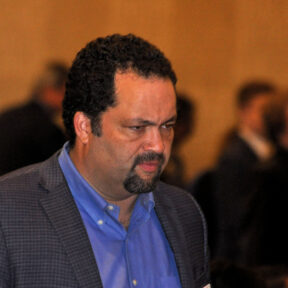
Ben Jealous
Overview
* Executive Director of the Sierra Club
* Former President/CEO of the NAACP
* Views America as a nation infested with white racism
* Likens voter ID requirements to Jim Crow laws and poll taxes
* Portrayed the Tea Party movement as a white-supremacist phenomenon
* Former head of Amnesty International’s U.S. Domestic Human Rights Program
* Former President of the Rosenberg Foundation
* Former President of People For the American Way
* Supported the Occupy Wall Street movement
Background
Benjamin (Ben) Todd Jealous was born to a mixed-race couple on January 18, 1973 in Pacific Grove, California. His mother was an African-American psychotherapist, and his father was a white education administrator. Both parents had participated in Baltimore’s desegregation movement during the 1960s. When Ben Jealous was 13, he attended the birthday party of the son of Ford Foundation president McGeorge Bundy, former National Security Adviser to Presidents John Kennedy and Lyndon Johnson.
While attending York School—a private Episcopal high school in Monterey, California—Jealous became a community organizer who not only helped the NAACP register new voters, but also organized a youth voter-registration drive supporting the 1988 presidential candidacy of Jesse Jackson. During his high-school years as well, Jealous spent a semester in Washington, D.C., working as a page for Leon Panetta and as an intern for Sam Farr, two Congressional Democrats from California.
Activist at Columbia University
When Jealous began attending Columbia University in 1991, he continued his community organizing work for the NAACP Legal Defense Fund, where he focused heavily on the issue of healthcare access in Harlem. As president of Columbia’s Black Student Organization, Jealous led a series of campus protests:
- One rally, for instance, called for the preservation of Columbia scholarships earmarked specifically for nonwhite students.
- On another occasion, in December 1992, Jealous and a group of fellow demonstrators climbed through a window of Columbia’s Low Memorial Hall in order to disrupt a Board of Trustees meeting. Specifically, the protesters were trying to prevent Columbia, which had recently purchased the Audubon Ballroom where Malcolm X was assassinated in 1965, from proceeding with its plan to raze that structure and replace it with a biomedical-research complex. Columbia suspended Jealous for one semester as punishment for his role in that protest, but two years would pass before he actually returned to the university.
Organizer with the AFL-CIO
Following his suspension from Columbia, Jealous moved to Mississippi to take a student-organizing position with the AFL-CIO.
Reporter & Editor
Jealous then joined the African-American newspaper, The Jackson Advocate, initially as a graphic designer and later as an investigative reporter and managing editor.
Completing His Higher Education
Jealous returned to Columbia in the mid-1990s to complete his undergraduate degree in political science. Then, as a Rhodes Scholar at Oxford University, he earned a master’s degree in Comparative Social Research in 1999.
National Newspaper Publishers Association
From 1999-2002, Jealous served as executive director of the National Newspaper Publishers Association, the largest consortium of black community newspapers in the United States.
Amnesty International & the Fight Against Capital Punishment & Racial Profiling
In 2002 Jealous was hired to head Amnesty International’s U.S. Domestic Human Rights Program, where he focused chiefly on efforts to outlaw the death penalty for minors and to ban all forms of racial profiling. In 2004, Jealous and Amnesty International researcher Niaz Kasravi co-authored a 50-page report titled “Threat and Humiliation: Racial Profiling, Domestic Security, and Human Rights in the United States,” which received enormous media attention upon its publication. Arguing that racial profiling affected “a staggering number of people in the United States,” the authors called on the federal government to pass sweeping reforms.
The Rosenberg Foundation
Jealous left Amnesty International in 2005 to become president of the Rosenberg Foundation, a California-based grantmaking organization.
NAACP President
In September 2008, Jealous was elected president of the NAACP.
Accusing the Justice System of Racism
In June 2009, Jealous authored a piece for CNN.com in which he lamented the U.S. criminal-justice system’s disproportionate impact on black males, and how that phenomenon was likely to affect his three-year-old daughter’s future dating prospects. “I do want her to have a choice of African-American men,” said Jealous. “The disproportionate number of black men swept into the prison system threatens that hope.”
Lamenting America’s Racism
At the NAACP’s 100th anniversary celebration in July 2009, Jealous lamented that despite “having a black family in the White House” – i.e., President Barack Obama and First Lady Michelle Obama – “there’s a lot more work that needs to be done” vis-à-vis the cultivation of racial justice in the United Staes.
Accusing the Tea Party Movement of Racism
At the NAACP’s annual convention in 2010, Jealous characterized the conservative Tea Party movement as a white supremacist phenomenon: “Here comes the genetic descendent of the White Citizens Council, burst from its coffin, carrying signs and slogans like ‘Lynch Barack Hussein Obama.’” In the media firestorm that ensued, Jealous declared, inaccurately: “For more than a year we’ve watched as Tea Party members have called congressmen the N-word, have called congressmen the F-word. We see them carry racist signs and whenever it happens, the membership tries to shirk responsibility.”
Supporting the Occupy Wall Street Movement
In 2011, Jealous and the NAACP issued a formal statement in support of the Occupy Wall Street (OWS) movement.
Likening the Shared Oppressions of Blacks & LGBT People
In January 2012, Jealous spoke at the 24th annual National Lesbian and Gay Task Force convention in Baltimore, where the theme was “Creating Change.” He used his speech to link the struggles of African Americans to those of LGBT people in the United States. He also commended the “transgendered spirit” of his adopted brother Jason. And he warned that “historically, voter suppression always increases after there has been an expansion of the voting population – after the XIII, XIV and XV amendments, after the passage of the Voting Rights Act, and now after the election of an African American president.”
Likening Voter ID Laws to Jim Crow & Poll Taxes
That same year, Jealous claimed that a series of Voter ID statutes that recently had been passed in several states were, like the Jim Crow laws and poll taxes of an earlier era, manifestations of a “rising tide of voting suppression” that sought “to encode discrimination into law.” He warned that America was again facing “Selma and Montgomery times”; that “our democracy is literally under attack from within”; and that nothing less than “the battle to preserve democracy itself” was at stake.
In March of 2012, Jealous and the NAACP went so far as to take their arguments against Voter ID laws to the United Nations Human Rights Council. “In the past twelve months,” Jealous lamented around that time, “more U.S. states have passed more laws pushing more U.S. citizens out of the ballot box than in any year in the past century.”
At a Netroots Nation panel on “voting rights” in June 2013, Jealous offered this argument against photo voter ID requirements: “As many people know, I have an adopted brother who’s transgender and he typically doesn’t dress the way he does when he hangs out in the Tenderloin [a well-known LGBT community in San Francisco] when he goes to a government office. And so if you show his ID, you know, and he would hold it up to his face, it looks like two different people.”
Resigning as NAACP President
Jealous resigned as NAACP president at the end of 2013. The following year, he became a senior partner at Kapor Capital, an Oakland-based firm that aims to “leverage information technology” for progressive “social impact” on behalf of “underrepresented communities.” He also joined the Center for American Progress as a senior fellow.
Demanding “Criminal-Justice Reform”
In July 2015, Jealous condemned “the problem of mass incarceration” of African Americans as an egregious “moral failing” of a criminal-justice system replete with “racial disparities.” “A black man in America today is three times more likely to be incarcerated than a black man in South Africa at the height of apartheid, and a white man is three-fourths as likely,” he stated. To address this matter, Jealous called for sweeping “criminal-justice reform” that would: send drug addicts “to rehab instead of to prison”; help “offenders who go into prison illiterate leave prison knowing how to read”; ensure that “the Department of Corrections actually helps correct the paths of our neighbors who have lost their way”; and “approach the most crime-ridden neighborhoods with humanity and understanding.”
Endorsing Bernie Sanders for President in 2016
During the Democratic presidential primaries in February 2016, Jealous endorsed socialist Bernie Sanders for U.S. President. “Bernie Sanders has been a principled, courageous, insistent fighter against the evils that Dr. King referred to as the giant triplets of racism, militarism and greed,” he said. Almost immediately thereafter, Jealous became part of Sanders’ inner circle, participating in strategy meetings and introducing the candidate nearly everywhere he went.
Board Member of “Our Revolution”
In 2017, Jealous became a board member of the newly formed Our Revolution, an organization run by former campaign workers and supporters of Bernie Sanders’ failed presidential bid of 2016.
Supporting the “We Rise” Tour of Van Jones
In August 2017, Jealous spoke at the “We Rise” tour organized by the self-identified revolutionary communist Van Jones, which brought numerous artists, athletes, thought leaders, and local leaders to cities across the United States in an effort to promote “social change” in the “neighborhoods hardest hit, economically.”
Failed Run for Governor of Maryland
Jealous ran for governor of Maryland in 2018, but lost the election by a wide margin to the incumbent governor, Republican Larry Hogan. Jealous ran on a staunch progressive platform that included support for: a $15-per-hour minimum wage, the legalization of marijuana, the banning of capital punishment, the enactment of Medicare-for-all, and free college tuition for in-state resident students. During the course of his campaign, Jealous repeatedly attempted to tie Gov. Hogan — a frequent Trump critic — to the Trump administration. “Since President Trump has come into office,” said Jealous, “[Hogan] has repeatedly bowed and submitted to the will of the most extreme members of the Trump administration, from president Trump himself to [Education] Secretary [Betsy] DeVos, to EPA chief [Scott] Pruitt to Attorney General Jefferson Beauregard Sessions.” Jealous’ campaign received the backing of such notables as Barack Obama, Joe Biden, Elizabeth Warren, Bernie Sanders, Kirsten Gillibrand, Kamala Harris, Cory Booker, 350.org, the SEIU, the Justice Democrats, the Communications Workers of America, the Maryland Working Families Party, and the Sunrise Movement.
President of People For the American Way
In June 2020, Jealous became the president of People For the American Way (PFAW) and the People For the American Way Foundation. “I am thrilled to be joining PFAW at this critical moment, when the people of our nation urgently need change,” he said. “We are facing critical elections this fall. The [COVID-19] pandemic has highlighted the necessity of finishing the work of MLK, [PFAW co-founder] Barbara Jordan, and FDR. And the rising generation in America has made clear that we must finally and fully reform the relationship between police and our communities.”
Supporting Sanders for President in 2020, Portraying Trump as “Evil”
In the early stages of the Democratic presidential primaries, Jealous favored Bernie Sanders in the race for the party’s nomination. But after Sanders was eventually defeated by Joe Biden, Jealous, citing Biden’s professed commitment to combating systemic racism in the U.S., enthusiastically threw his support behind the former vice president. After the Democratic National Convention in which Biden had linked Trump and Republicans to neo-Nazis and other hate groups, Jealous stated: “The theme of this convention was really one of unity. This is a time when we have to come together to defeat a president [Trump] who is the most evil, the most corrupt that any of us have seen.”
Celebrating Biden’s Presidential Victory
After the 2020 election in which Joe Biden was elected president, a celebratory Jealous wrote on November 25, 2020:
“Thanksgiving and nationalism can be mixed in unhealthy ways. Yet this year, I feel a special patriotic gratitude to live in a country where we are free to choose our leaders.
“And I’m proud that Black people showed once again that we can shape our future by pushing back against the corruption and unprincipled power plays and institutionalized racism that are used to try to keep us from participating fully in our democracy.
“I am grateful for the multi-racial, multigenerational social justice movement that has been brought into being to challenge unjust policing. I’m grateful for all the young people who made their first run for public office. And I am especially grateful for leaders and organizers who use their God-given talents and their hard-won skills and experience to organize, motivate and mobilize our people — leaders like Stacey Abrams and so many others who worked to bring change to their cities and states and our country.
“Of course, there’s more to do. We have important U.S. Senate [runoff] elections coming up in Georgia [where Democrats Jon Ossoff and Raphael Warnock would face Republicans David Perdue and Kelly Loeffler, respectively]. And next year, we’ll make many demands on local, state and national officials to address the issues that affect our lives and our future.
“For now, let us be grateful for new hope and new direction in our nation, and for everyone who has given of themselves to help our neighbors and strengthen our communities.”
Supporting the “For the People Act”
In 2021, Jealous was a vocal supporter of H.R. 1, the 791-page “For the People Act.” If signed into law, this legislation would, as the Heritage Foundation explained:
- “seize the authority of states to regulate voter registration and the voting process by forcing states to implement early voting, automatic voter registration, same-day registration, online voter registration, and no-fault absentee balloting.”
- “make it easier to commit fraud and promote chaos at the polls through same-day registration.”
- implement “15 days of mandated early voting,” so that “voters who vote early don’t have the same information as those who vote on Election Day [will miss] late-breaking developments that could affect their choices.”
- “degrade the accuracy of registration lists by requiring states to automatically register all individuals (as opposed to ‘citizens’) from state and federal databases.”
- “constitute a recipe for massive voter registration fraud by hackers and cyber criminals through online voter registration that is not tied to an existing state record, such as a driver’s license.”
- “require states to count ballots cast by voters outside of their assigned precincts, overriding the precinct system used by almost all states that allows election officials to monitor votes, staff polling places, provide enough ballots, and prevent election fraud.”
- “mandate no-fault absentee ballots, which are the tool of choice for vote thieves.”
- “ban witness signature or notarization requirements for absentee ballots”
- “require states to allow vote trafficking (vote harvesting) so that any third parties—including campaign staffers and political consultants—can pick up and deliver absentee ballots.”
- “prevent election officials from checking the eligibility and qualifications of voters and removing ineligible voters.”
- “ban state voter ID laws by forcing states to allow individuals to vote without an ID [by] merely signing a statement in which they claim they are who they say they are.”
Director of the Sierra Club
In November 2022, Jealous, who had already served on the boards of multiple environmentalist organizations, was named executive director of the Sierra Club. He officially took office in early 2023.
In March 2023, Jealous explained how the environmental concerns of the Sierra Club overlapped with social problems like racism and poverty: “The maintenance of mass poverty creates the political context in which the destruction of the environment and wild places is relegated permanently to second position. In other words, if there’s a social injustice that’s destroying the planet, it’s poverty. Racism helps maintain it.”
Major Policy Positions
As matters of principle, Jealous believes that:
- all women should have an unrestricted right to abortion-on-demand at any stage of pregnancy – subsidized by taxpayers, in cases of economic hardship;
- public and private employers alike should be legally required to implement affirmative-action hiring and promotion policies that give preference to African Americans and women, as compensation for historical injustices;
- the Affordable Care Act (Obamacare) is an excellent statute that can serve as a strategic stepping stone toward the eventual implementation of a government-run, single-payer healthcare system;
- voucher programs designed to enable low-income parents to send their children to private schools rather than to failing public schools, constitute bad policy because they rob the public schools of vital resources;
- the discretion of judges and juries should not be diminished by formulaic sentencing policies like “Three Strikes” laws;
- the death penalty should be abolished as “cruel and unusual punishment”;
- more guns in the hands of private citizens inevitably result in higher levels of crime, thus the availability of firearms should be restricted by whatever means are effective;
- restrictions on immigration are basically racist because they tend to prevent Hispanics and other non-whites from entering the United States;
- social services should be available to all U.S. residents regardless of their immigration status;
- illegal aliens should be offered amnesty if they have been productive members of society;
- America’s defense spending should be reduced dramatically;
- voter ID laws make it unnecessarily difficult for many people to vote in political elections;
- an ever-increasing reliance on “green energy” sources such as wind and solar should be put in place, along with the phasing out of fossil fuels, the imposition of carbon taxes, and the raising of vehicle CAFE standards;
- the War on Drugs has failed and should be ended, a move that would undoubtedly cause organized crime and drug-related crime to decrease.