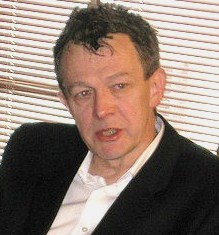
Joel Rogers
: Photo from Wikimedia Commons / Author of Photo: aflcio / Bernard PollackOverview
* Founder of the New Party, COWS, the Apollo Alliance, Green For All, Emerald Cities
* Original mastermind of “the green economy”
A professor of law, political science, and sociology at the University of Wisconsin-Madison, Joel Rogers is an influential figure in progressive politics. He is the author of several books, works as a contributing editor for Boston Review and The Nation, and has founded some of the most powerful leftist organizations and coalitions in the United States. Newsweek named Rogers one of the 100 Americans most likely to shape U.S. politics and culture in the 21st century, and Glenn Beck has called him “the man behind [Barack] Obama.” Van Jones, the revolutionary communist who served briefly as President Obama’s “green jobs czar,” has praised Rogers’ “extraordinary set of achievements,” asserting that Rogers has given “three great gifts” to the progressive movement:
- “an economic model,” which is “now reflected in the [Obama] White House”;
- a “new politics,” based upon the “New Party” and its successor, the “Working Families Party,” that “brings together labor, civil rights, and feminists […] which is the basic framework for what just took over the White House [when Obama was elected]”; and
- “a new energy paradigm” as outlined by the Apollo Alliance, an organization Rogers helped create.
Rogers earned a B.A. from Yale College in 1972, a J.D. from Yale Law School in 1976, an M.A. from Princeton University in 1978, and a Ph.D. from Princeton in 1984.
In 1992 Rogers founded the tax-exempt Center on Wisconsin Strategy (COWS), based at the University of Wisconsin-Madison. COWS describes itself as “a national policy center and field laboratory for high-road economic development — a competitive market economy of shared prosperity, environmental sustainability, and capable democratic government.”
That same year, Rogers co-founded the New Party, a socialist coalition that endorsed and helped elect left-wing political candidates; one of its most noteworthy members in the mid-1990s was Barack Obama.
In the fall of 1994, Rogers was listed in a New Party publication that named more than 100 activists “who are building the NP.” Other notable names among the list of 100+ were: John Cavanagh, Noam Chomsky, Barbara Ehrenreich, Randall Forsberg, Maude Hurd, Manning Marable, Frances Fox Piven, Zach Polett, Wade Rathke, Mark Ritchie, Gloria Steinem, Cornel West, Quentin Young, and Howard Zinn.
During the early years of the New Party, Rogers fought to institute, in the state of Minnesota, the practice of electoral fusion — where two or more political parties can support the same political candidate and thereby pool the votes for all the parties involved; this practice enables smaller parties to influence the agendas of big-party candidates. When the U.S. Supreme Court ruled against electoral fusion in 1997, the New Party shut down its operation. It was reincarnated in 1998, however, by Rogers’ partner, Daniel Cantor, as the Working Families Party, which became a powerful front group for ACORN.
As the ’90s progressed, Rogers remained intent upon building a progressive alliance to redress the supposed failure of liberalism in America. “All around us is the wreckage of unrestrained capitalism—falling living standards, families strained to breaking point, rising inequality,” he lamented in 1994. For Rogers, liberals were ill-equipped to save the U.S. from economic decline and stagnation, since they “lack […] confidence in ordinary people” and, therefore, cannot build “organized popular support.” Progressives, by contrast, “actually believe in democracy” and can “do the heavy lifting against entrenched and resourceful corporate actors,” said Rogers.
In 1995 Rogers won a MacArthur Foundation Fellowship, nicknamed the “Genius Award.” Meanwhile, his COWS group continued to flourish, receiving the funding of the Alfred P. Sloan Foundation, the Annie E. Casey Foundation, the Carnegie Corporation of New York, the Carolyn Foundation, the Ford Foundation, the Garfield Foundation, the Joyce Foundation, Living Cities, the Nathan Cummings Foundation, George Soros’ Open Society Institute, the Rockefeller Foundation, the Surdna Foundation, the Wallace Global Fund, and the Wisconsin Department of Workforce Development.
In early 1995, Rogers published an essay in The New Left Review – a periodical whose content is largely Marxist/socialist – suggesting that the New Party represented an important new voice in American politics. Moreover, he derided liberals for their failure to gain “social control of the economy” or to put “serious constraints on capital.” With euphemism and convoluted language, Rogers carefully avoided making an open call for socialism. Rather, he advocated “economic democracy,” whose “biggest … barrier,” he lamented, was “capitalism” — an “undemocratic” system featuring “private ownership of the means of production.” Rogers pushed for “reforms” that would “facilitate greater popular control of capital itself, which would permit experimentation with different forms of ownership and production….” Toward this end, he proposed a new “bill of rights” consisting of a de facto guaranteed minimum income, wage controls, and “employment redistribution” – i.e., guaranteed full employment, which could be achieved by a mandated shortening of the work-week.[
In a 1996 speech](http://www.youtube.com/watch?v=BAxYvYfx2rE) at Columbia University, Rogers said that “profit-seeking business” was characterized by “swaggering ruthlessness,” immense “greed,” and “a blank indifference to all that is good and human.” He described capitalism as “monstrous.” He accused “the right in the early 1970s” of having commissioned intellectuals to “produce just tons of junk … books and case studies and made-up studies and empirical studies and fake studies.” Then he declared, “We [progressives] should do the same.” Moreover, he proposed that the U.S. should “double the minimum wage within three years.” He said that every child in America “should be fed, clothed, housed, decently fed, and insured, and eventually they’ll grow up and then vote for national health insurance.” And he made reference to Christian fundamentalists as “ungodly.”
In 1997 Rogers was a guest speaker at the Socialist Scholars Conference in New York City.
On September 20, 2001, Rogers spoke at a New York City gathering to honor the work of Richard Cloward (co-creator of the Cloward-Piven Strategy), who had died a month earlier. Other speakers included such notables as Barbara Ehrenreich, June Jordan, Gus Newport, Frances Fox Piven, Miles Rappaport, Tim Sampson, Cornel West, and Howard Zinn.
Also in 2001, Rogers co-founded EARN, a self-described “poverty group” whose board of directors includes executives from AJW Inc., Citibank, Covington & Burling LLP, Goldman Sachs, Sotheby’s International Realty, and Wells Fargo. In addition, he became an advisor to the Campaign for America’s Future (CAF). Soon after 9/11, Rogers’ COWS partnered with CAF’s sister organization, the Institute for America’s Future, and with the Tides Center, to create the Apollo Alliance (AA), where Rogers served as the nascent group’s first chairman. At the AA, Rogers was able to lay out a strategy for green economics, which, as longtime AA board member Van Jones claimed, became the immediate model for the Obama administration’s environmental policy.
In addition to AA, Rogers’ COWS also developed a host of other progressive projects, most notably the Emerald Cities Collaborative, a major player in the push for Cap-and-Trade legislation, and Green For All (with Van Jones as founder).
In the August/September 2004 issue of The Nation, Rogers lamented that “the dismantling of the New Deal welfare state, twentieth-century American liberalism’s greatest domestic achievement” had already taken place, with the Bush Administration representing the culmination of America’s “devolution” and posing “the greatest internal threat to our democracy in our history.” Progressives, Rogers argued, needed a new strategy to wrest power away from conservatives:
“[I]n no state are there functional majorities of self-consciously progressive elected officials, working together off a visible, coherent program of progressive economic, social and political reform, linked systematically to outside progressive forces. That is what the right is building on its side, and what we need to build on ours.”
Rogers calls for progressives to place their own candidates inside government, candidates who will “systematically” follow the agendas of “outside progressive forces” to engineer radical change in America. Such change, Rogers hopes, will cause the U.S. not only to become more judicious in its use of military force overseas, but also to begin to make amends for its “four hundred years’ racism.”
Along with his other duties and affiliations, Rogers is a Senior Fellow at the Brookings Institution.