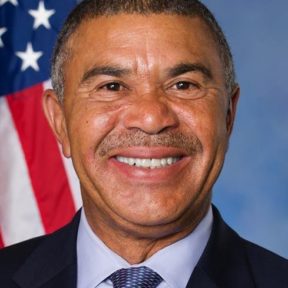
William Lacy Clay Jr.
Overview
* Democratic Member of Congress from 2001-2021
* Member of the Congressional Progressive Caucus and the Congressional Black Caucus
* Lost the Democratic primary to Black Lives Matter activist Cori Bush in August 2020
William Lacy Clay Jr. was born in St. Louis, Missouri in July 1956 and grew up in Silver Spring, Maryland. His father is the veteran politician Bill Clay (born 1931), who served as Missouri’s First-District congressman from 1969-2001.
While working as a staffer in the House of Representatives, William Lacy Clay Jr. attended night classes and earned a bachelor’s degree in political science from the University of Maryland in 1983. That same year he returned to St. Louis, where Democratic bosses backed his successful run for a suddenly vacant seat in the state legislature. Seven years later Clay was elected to the Missouri state senate, and he served there from 1991-2000.
In 2000, Clay’s father retired from the House of Representatives and left his political machine and most of his contributors – including more than 30 influential union locals – to his son. As a result, William Lacy Clay captured 61 percent of the vote in a six-candidate Democratic primary, then won the general election for the First-District seat in November. One of his campaign advisers was the unionist and Communist Party USA affiliate Lew Moye.
In the House of Representatives, Clay became a member of both the Congressional Black Caucus (CBC) and the Congressional Progressive Caucus (CPC).
In his numerous political campaigns from 2000 onward, Clay continued to receive strong financial support from the members and political action committees of large and powerful labor unions like AFSCME, the National Education Association, the American Federation of Teachers, the AFL-CIO, the Teamsters, and the Service Employees International Union.
In April 2005, Clay supported a 19-day sit-in by the Washington University (St. Louis) Student Worker Alliance, which demanded that the school’s contract employees (who earned $7.50 per hour) be paid a living wage. The effort ultimately proved to be successful when campus officials agreed to commit at least $1 million over the ensuing two years toward higher salaries and better benefits for the workers.
Later in 2005, Clay became a member of the Out of Iraq Congressional Caucus.
Clay was one of 27 Members of Congress to co-sponsor H. Res. 333, which Rep. Dennis Kucinich introduced on April 24, 2007. This bill set forth articles of impeachment against Vice President Dick Cheney, for having “purposely manipulated the intelligence process” to “deceive” U.S. citizens and Congress alike “about a threat of Iraqi weapons of mass destruction, and about an alleged relationship between Iraq and al Qaeda, to justify the use of the U.S. Armed Forces against Iraq in a manner damaging to U.S. national security interests.”
In early 2007, Clay made headlines when he strongly objected to an attempt by U.S. Representative Steve Cohen of Tennessee, a Caucasian Democrat who represented a majority-black district in Memphis, to become the first white member of the Congressional Black Caucus (CBC). “He’s white and the Caucus is black,” Clay told reporters. “It’s time to move on. We [the CBC] have racial policies to pursue and we are pursuing them, as Mr. Cohen has learned. It’s an unwritten rule. It’s understood. It’s clear.” In reply to Cohen’s subsequent complaint about having been denied admittance to the CBC, Clay issued this official statement:
“Quite simply, Rep. Cohen will have to accept what the rest of the country will have to accept — there has been an unofficial Congressional White Caucus for over 200 years, and now it’s our turn to say who can join ‘the club.’ He does not, and cannot, meet the membership criteria, unless he can change his skin color. Primarily, we are concerned with the needs and concerns of the black population, and we will not allow white America to infringe on those objectives.”
Throughout his career in Congress, Clay’s voting record was consistently 85 to 100 percent on the left side of legislation, according to Americans for Democratic Action.
Click here for an overview of his votes on numerous key bills.
In 2014, Clay and his fellow CBC members reacted with outrage to two separate white-police-vs.-black-suspect altercations that resulted in the deaths of the blacks involved, and became the focal points of a massive, nationwide protest movement alleging that white officers were routinely targeting African Americans with unjustified use of force. The deceased were a 43-year-old New Yorker named Eric Garner and 18-year-old Michael Brown of Ferguson, Missouri. “These tragedies have illuminated, with the harsh light of truth, the deep divisions and very real disparities that we have yet to overcome as a nation,” said Clay.
When the Daily Caller in February 2018 contacted Clay and a number of his fellow Congressional Black Caucus members to ask if they would be willing to publicly denounce the notorious Nation of Islam leader Louis Farrakhan because of his racist and anti-Semitic rhetoric, Clay was one of 20 who declined not only to denounce him, but also to issue any comment at all regarding his infamous anti-Semitic, anti-white rhetoric.
In early January 2019, Clay announced that he would join several dozen fellow Democratic congressmen in boycotting president-elect Donald Trump’s inauguration. The lawmaker said that he would be “back home in St. Louis speaking to school kids” instead.
In August 2020, Clay, who was seeking re-election to an eleventh term in the House of Representatives, lost the Democratic primary to Black Lives Matter activist Cori Bush.
Further Reading: “William Lacy Clay Jr.” (Votesmart.org, Keywiki.org); “Victory for Wash U Students in Living Wage” (People’s World, 4-29-2005); “Black Caucus: Whites Not Allowed” (Politico, 1-22-2007); “Racism of the Congressional Black Caucus” (World Net Daily, 1-26-2009); “Clay Salutes 2016 Congressional Art Competition Winners” (press release, 5-6-2016); “DC Law Enforcement Demand Removal of Capitol Painting Depicting Cops As Racist Pigs” (Daily Caller, 12-30-2016); “Rep. Hunter Removes Painting Depicting Cops As Pigs from Capitol Wall” (Daily Caller, 1-6-2017); “Clay Won’t Attend Trump Inaugural” (St. Louis Post-Dispatch, 1-13-2017).