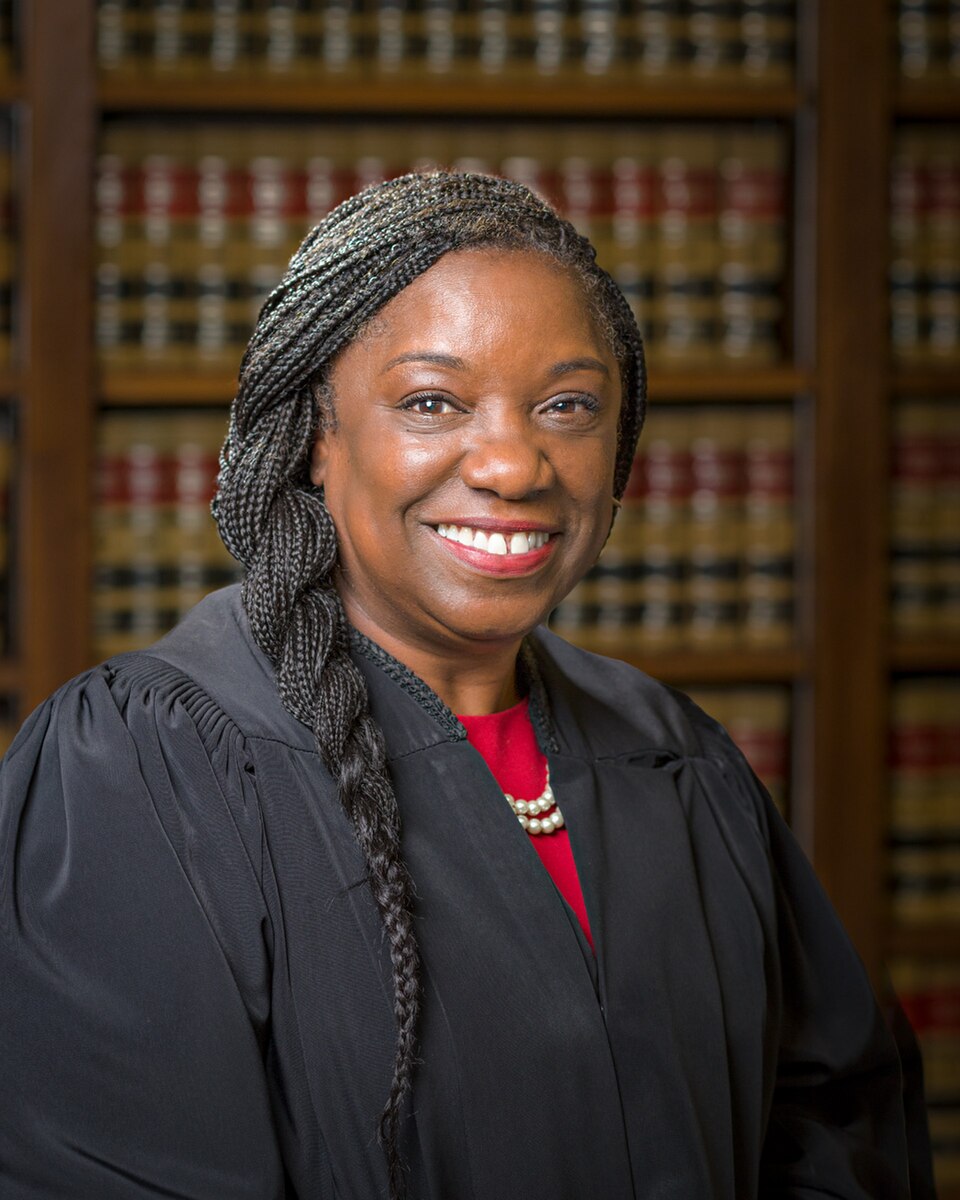
Trina Thompson
Copyright Information: Photo from Wikimedia Commons / Author of Photo: United States District Court for the Northern District of California / Source of Photo: https://www.cand.uscourts.gov/judges/trina-l-thompson-tlt/Overview
Overview[1]
Trina Lynn Thompson was born on June 3, 1961, in Oakland, California. She earned a BA degree in Legal Studies from UC Berkeley in 1983, and a JD from the UC Berkeley School of Law in 1986.
After completing her legal studies, Thompson:
- served as an assistant public defender in the Alameda County Public Defender’s Office from 1987-1991
- was a criminal defense attorney at her own Oakland-based law firm from 1991-2000
- was a juvenile court commissioner in Alameda County Superior Court from 2000-2002
- served as a state court judge in the Alameda County Superior Court from 2002-2022
On November 3, 2021, President Joe Biden nominated Thompson for a judgeship with the United States District Court for the Northern District of California. The U.S. Senate confirmed her for that post on May 18, 2022, by a vote of 51-44. (Senate Democrats supported her 46-0, Republicans opposed her 44-3, and Independents supported her 2-0.)
In addition to the activities and positions cited above, Thompson also:
- was appointed by President Barack Obama to serve on the Coordinating Council on Juvenile Justice and Delinquency Prevention, under the direct supervision of U.S. Attorney General Eric Holder
- was a lecturer in UC Berkeley’s Ethnic Studies and Legal Studies Departments from 2014-2021
- was a faculty member for the “Continuing the Dialogue” series at the California-based Center for Judicial Education and Research
- has been an adjunct professor at the UC Berkeley School of Law since 2018
- served a stint as Vice President of the Association of African American California Judicial Officers, where she is a life member
- is also a life member of the California Association of Black Lawyers and the Charles Houston Bar Association
Racial Obsessions
At San Francisco State University’s Constitution Day Conference in 2018, Thompson delivered a presentation titled “White Supremacy in Constitutional Law,” which included an analysis of what Thompson and her colleagues described as “the most astonishingly racist Supreme Court rulings in American history” – one of them being the 2018 decision in Trump v. Hawaii.
At the UC Berkeley American Cultures Center in 2020, Thompson participated in a panel titled “Race, Racism, and Racialization in History: An Ethnic Studies Perspective,” where she opined that “Ethnic Studies should be part of the curriculum beginning at elementary school.”
Leftwing Perspectives
Following is a list of written questions that various Republican senators asked Thompson during the Senate confirmation process for her 2022 nomination to the U.S. District Court for the Northern District of California. Many of her answers were evasive and noncommittal:
Question: Is climate change real?
Response: As a judicial nominee, it would not be appropriate for me to comment on a policy question or issue that could come before me. Specifically, I would not want to create an impression that I had taken a side regarding a political or social issue or that I have prejudged the facts regarding an issue that could come before me.
Question: Is when a human life begins a scientific question?
Response: … Understanding that the question of when human life begins is a matter of passionate legal, religious, scientific, moral and philosophical debate, it would not be appropriate for me to respond to this question….
Question: Can someone change his or her biological sex?
Response: Questions regarding gender identity are matters of current political, legal, and societal debate. As a sitting judge and a judicial nominee, I do not wish to prejudge any issue that might come before me….
Question: Do you believe that we should defund or decrease funding for police departments and law enforcement, including the law enforcement entities responsible for protecting the federal courthouses in Portland from violent rioters? Please explain.
Response: As a sitting judge, it is improper for me to weigh in on policy matters, such as how a federal legislature, state legislature or local municipality should allocate their funding….
Question: Do you believe that local governments should reallocate funds away from police departments to other support services? Please explain.
Response: As a sitting judge, it is improper for me to weigh in on policy matters, such as how a mayor or local municipality should allocate their funding. This is a question for policymakers to consider….
Question: Does a law restrict abortion access if it requires doctors to provide medical care to children born alive following failed abortions?
Response: As a sitting judge and a judicial nominee, it is not appropriate for me to opine on the outcome of a hypothetical issue….
Question: Is the criminal justice system systemically racist?
Response: I am aware that there is an ongoing debate about whether aspects of certain criminal justice systems lead to disparate racial outcomes. The United States Sentencing Commission concluded “that the crack/powder sentencing differential ‘fosters disrespect for and lack of confidence in the criminal justice system’ because of a ‘widely-held perception’ that it ‘promotes unwarranted disparity based on race.’”
Question: Is it appropriate to consider skin color or sex when making a political appointment? Is it constitutional?
Response: I have not handled any cases involving this issue. If this issue was presented in a case before me, I would faithfully and impartially apply Supreme Court and Ninth Circuit precedent to the facts of the case.
Question: Is it your belief that everyone harbors implicit bias? Do you harbor implicit bias? Against what groups do you have a bias?
Response: … My understanding is that implicit bias refers to the idea, supported by social science research, that all people have unconscious biases. Unconscious bias refers to attitudes and stereotypes that affect decision-making without an individual’s awareness or intentional control. We all have unconscious bias that may affect our judgment and decision-making processes but with the motivation to change one can begin to reduce unconscious bias. Cultural responsiveness is the ability to learn from and relate respectfully with people of one’s own culture as well as those from other cultures.
Question: Do you believe America is a systemically racist country?
Response: The question whether there are systemic issues in our county, including racism, is an important question for policy makers to consider.
Question: Do you think constitutional law in the United States favors one race over another?
Response: The law has evolved since Dred Scott, Plessy v. Ferguson and Pace v. Alabama. In any case presenting questions of racial bias, racial disparities, and/or racial discrimination, I would hear from the parties, research the relevant law, make factual findings as appropriate, and apply the law to the facts consistent with binding Supreme Court and Ninth Circuit precedent.
Question: Would you describe yourself as an originalist?
Response: … I do not apply labels to myself. If confirmed as a United States District Judge, I will interpret the Constitution as directed by Supreme Court and Ninth Circuit precedent.
Question: Would you describe yourself as a textualist?
Response: I don’t apply labels to myself. If confirmed as a federal district court judge, I will apply Supreme Court and Ninth Circuit precedent when determining the meaning of any legal text.
Banning “Medical Misinformation” Regarding COVID Vaccines
In August 2023, then-Democrat presidential primary candidate Robert F. Kennedy Jr. — who at that time was Joe Biden’s closest competitor for the party’s nomination — sued Google and its subsidiary YouTube after they removed videos of several speeches and interviews wherein Kennedy had made claims that they classified as examples of “medical misinformation” about the COVID-19 pandemic and the vaccines that had been developed to combat it. For example, a YouTube spokesperson noted that one video of Kennedy being interviewed by popular podcast host Jordan Peterson had been struck from the platform because of YouTube’s prohibition against the posting of “content that alleges that vaccines cause chronic side effects, outside of rare side effects that are recognized by health authorities.” Kennedy’s lawsuit, which sought the issuance of a temporary restraining order (TRO) that would force YouTube to restore such censored videos, was founded on the premises that:
- (a) Google and YouTube should be considered “state actors” because their policy vis-a-vis “medical misinformation” relied on guidance from government-related sources like the World Health Organization, the largest intergovernmental health entity on Earth; and
- (b) State actors are required by law to honor First Amendment protections against the suppression of free speech.
Kennedy’s lawsuit was filed in the Northern District of California, where it was assigned to Judge Thompson. Ruling that Google and YouTube were private entities rather than state actors — and thus were not bound by the First Amendment — Thompson rejected Kennedy’s request for a TRO. “The Court finds that the First Amendment claim is unlikely to succeed on the merits because Google and YouTube are not state actors,” the judge explained, adding that: “There is no evidence before the Court that any … identified government officials … demanded that Google adopt a COVID-19 medical misinformation or vaccine misinformation policy. Moreover, there is no evidence before the Court that government officials communicated with Google regarding Kennedy at all.”
Thompson further stated that:
- “Plaintiff [Kennedy] was not, and will not, be irreparably harmed if a temporary restraining order is not issued because he does not demonstrate urgency or that he will not be able to share his videos through other sites and methods.”
- “The coronavirus still poses a health risk to certain individuals, and it would not serve the public interest to let medical misinformation proliferate on YouTube.”
Barring the Revocation of Migrants’ TPS Status
In 1990, Congress established “Temporary Protected Status” (TPS) as a designation to shield certain migrants who were in the United States without legal status from being deported to their home countries if such relocations were likely to place them in danger.[2] According to U.S. Citizenship & Immigration Services (USCIS):
“The Secretary of Homeland Security may designate a foreign country for TPS due to conditions in the country that temporarily prevent the country’s nationals from returning safely, or in certain circumstances, where the country is unable to handle the return of its nationals adequately…. The Secretary may designate a country for TPS due to the following temporary conditions in the country: ongoing armed conflict (such as civil war); an environmental disaster (such as earthquake or hurricane), or an epidemic; other extraordinary and temporary conditions.
“During a designated period, individuals who are TPS beneficiaries or who are found preliminarily eligible for TPS upon initial review of their cases … are not removable from the United States; can obtain an employment authorization document (EAD); may be granted travel authorization…. TPS is a temporary benefit that does not lead to lawful permanent resident status or give any other immigration status.”
Hondurans and Nicaraguans had been given TPS status in January 1999 as a federal response to the crisis conditions brought about by Hurricane Mitch, a catastrophic tropical cyclone which killed almost 7,300 people in those two countries in late 1998. Nepal joined the TPS program in June 2015 after a powerful 7.8 magnitude earthquake struck scarcely 50 miles from the country’s densely populated capital of Kathmandu. As of early 2025, some 60,000 people from the three countries — 51,000 Hondurans, 7,200 Nepalis, and 2,900 Nicaraguans — were still living in the United States under the protection of TPS; many of them had been in America for decades.
Then, in early June 2025, the Trump administration – noting that modern-day conditions in the three aforementioned nations were no longer so dire as to warrant TPS designation — announced that such protections would be terminated by August 5 for people from Nepal, and by September 8 for people from Honduras and Nicaragua.
In response to Trump’s announcement, the National TPS Alliance — an activist group advocating on behalf of TPS beneficiaries across the United States — sued the federal government on July 8, arguing not only that the TPS terminations violated the Administrative Procedure Act, but also that they were motivated by racial animus against non-European and non-white people.
The case went to Judge Thompson, who on July 31 ordered that the planned elimination of TPS for migrants from Nepal, Honduras and Nicaragua be delayed until at least November 18, at which time Thompson would hold a scheduled hearing to examine the merits of each side’s case. Wrote Thompson in her order: “The freedom to live fearlessly, the opportunity of liberty and the American Dream. That is all plaintiffs seek. Instead, they are told to atone for their race, leave because of their names and purify their blood. The Court disagrees.”
Lamenting the hardships that the migrants would supposedly face if they were forced to return to their home countries, Thompson, in her order of July 31, went so far as to liken the termination of TPS to the horrors of the trans-Atlantic slave trade, writing:
“During oral argument, Plaintiffs argued that granting unfettered discretion over TPS terminations would allow the President to give or take TPS away from some country whenever he feels like it or for the purpose of trade negotiations. The Court recognizes that the United States has a long history of transporting individuals against their will, to places unfamiliar to them, and for the purposes of trade. For example, the United States was an active participant in the transatlantic slave trade which uprooted individuals in Africa and brought them to this continent. The emancipation of slaves saw the same pattern, but in reverse. America has seen this pattern before. Many freed slaves were sent to countries to which they had no connection whatsoever. These efforts made ‘free blacks fearful of a mass deportation across the Atlantic Ocean reminiscent of the Middle Passage.’”
Thompson further stated that Department of Homeland Security Secretary Kristi Noem harbored “animus against immigrants and the TPS program.” The judge accused Noem of “stereotyping the TPS program and immigrants as invaders that are criminal,” and of making public statements that “perpetuate the discriminatory belief that certain immigrant populations will replace the white population.”
White House deputy chief of staff Stephen Miller denounced Thompson’s ruling as a manifestation of “judicial tyranny,” while Turning Point USA founder Charlie Kirk called it “completely lawless.” ”The legal rationale here is ‘I think Trump is a racist’ therefore to hell with the law,” Kirk added in a social media post. “Black robe tyranny is a scourge on this land. Such egregious rulings by bad judges MUST start to come with consequences, or it won’t stop.”
On August 20, 2025, a three-judge panel of the U.S. Court of Appeals for the Ninth Circuit unanimously approved the Trump administration’s request for a stay of Thompson’s July 31 order, pending appeal — thereby allowing the administration to continue with its dismantling of the TPS program for people from Nepal, Honduras and Nicaragua.
Footnotes:
- https://ballotpedia.org/Trina_Thompson
https://bidenwhitehouse.archives.gov/briefing-room/statements-releases/2021/11/03/president-biden-names-ninth-round-of-judicial-nominees/
https://www.law.berkeley.edu/wp-content/uploads/2023/04/Thompson-Narrative-Bio-2022.pdf - As of mid-2025, people from South Sudan, Ethiopia, Cameroon, Afghanistan, Nepal, Myanmar, Syria, Haiti, Venezuela, Nicaragua, and Honduras were in the United States under the protection of TPS status.