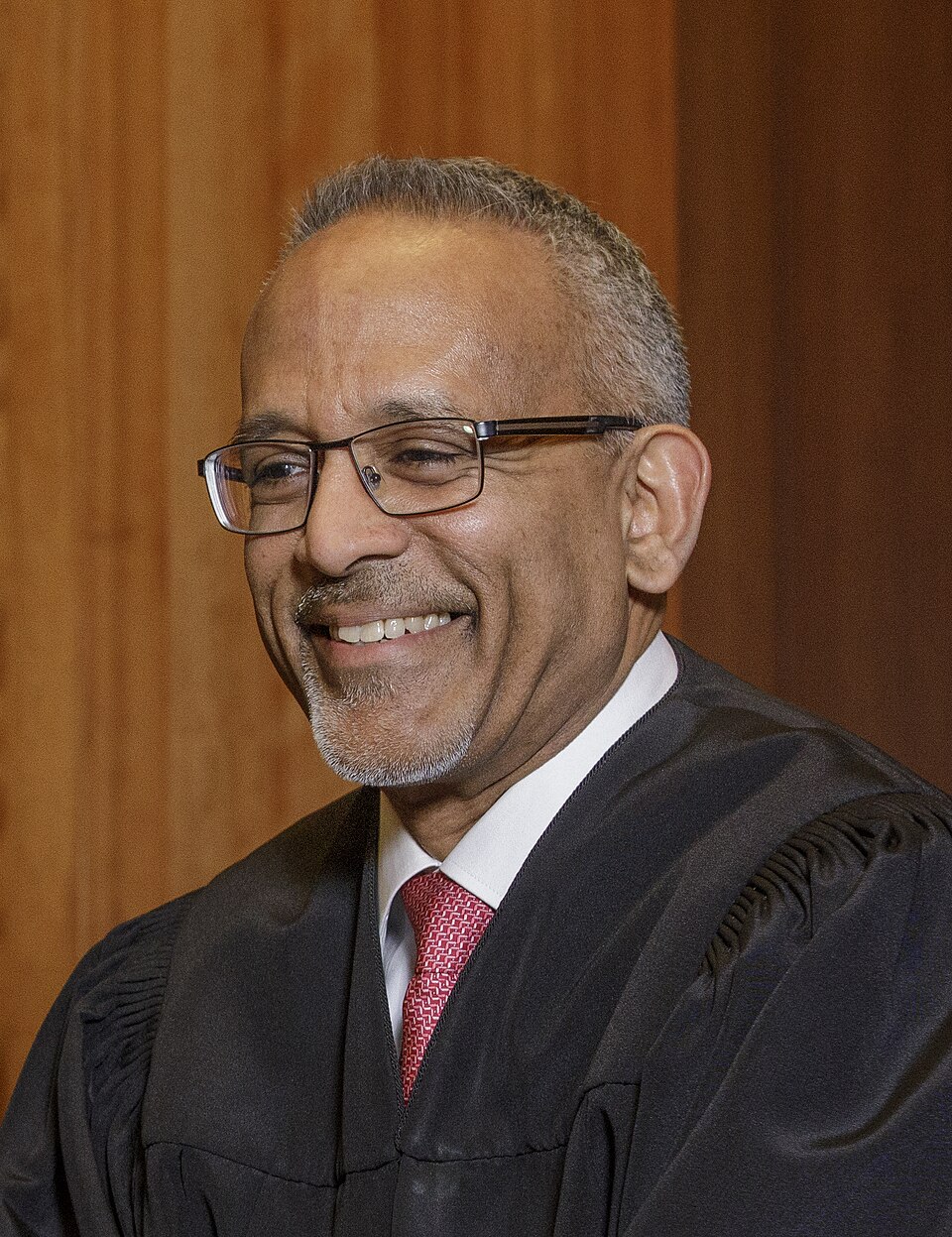
Mustafa Kasubhai
Copyright Information: Photo from Wikimedia Commons / Author of Photo: Wikilawcontributor / Source of Photo: Own work / January 29, 2021, 09:52:21Overview
Overview[1]
Mustafa Taher Kasubhai was born in the Los Angeles suburb of Reseda, California in 1970. His parents were of Indian heritage and immigrated to the United States from Mumbai in the 1960s.
After earning a B.A. degree in business administration from UC Berkeley in 1992, Kasubhai took a job as an outdoor school instructor for elementary school students in Connecticut. There, he met his future wife, Kristin, who was also employed as a teacher in that program.
Kasubhai subsequently earned a J.D. from the University of Oregon School of Law in 1996. He then joined Rasmussen, Tyler & Mundorff — a plaintiff-side law firm in Oregon — where in 1997-1998 he handled cases involving personal injury, civil rights, employment, workers’ compensation, and family law matters. After that, he spent five years dealing with these same types of cases as the head of his own private legal practice based in the city of Eugene.
In 2003, Oregon’s then-Governor, Democrat Ted Kulongoski, appointed Kasubhai to a full-time position with the Oregon Workers’ Compensation Board.
In 2007 Kulongoski appointed Kasubhai as a judge with the Lane County Circuit Court, where he would go on to serve for the next 11 years.
In 2018, Kasubhai became a Magistrate Judge with the U.S. District Court for the District of Oregon, making him the nation’s first Muslim American federal judge.
On September 18, 2023, President Joe Biden nominated Kasubhai to serve as a U.S. judge with the U.S. District Court for the District of Oregon, where he would replace Judge Ann Aiken as she moved to senior status (semi-retirement with a lighter caseload). The Senate eventually confirmed Kasubhai on November 19, 2024, by a vote of 51 to 44.[2]
Over the course of his professional career, Kasubhai has been an active member of the Oregon Asian Pacific American Bar Association (OAPABA).
Kasubhai’s Leftwing Political Orientation
Kasubhai proudly and openly embraces leftwing views regarding issues like diversity, discrimination, racial preferences, the tenets of transgender dogma, and what he sees as the pervasiveness of American bigotry and intolerance. In a March 2019 profile of Kasubhai, the Multnoma County (Oregon) Bar Association stated: “Judge Kasubhai hopes that he can play a small role in furthering diversity in Oregon. He recognizes exclusion and discrimination exist on many axes and that people holding positions of power have the opportunity to exclude or to make room at the table.”
Kasubhai has made many public-speaking and panel-discussion appearances at events where his political and ideological views were strongly promoted. Some examples:
- February 17, 2021: Panelist at an Oregon Women Lawyers virtual discussion of “Unconscious Bias in the Courts”
- October 13, 2022: Speaker at a Lane County Bar Association event, where he discussed the “Use of Pronouns and Honorifics in Court and Legal Practice”
- October 18, 2022: Panelist at Annual Oregon Judicial Conference discussion about “Gender Identity and Access to the Courts”
- November 12, 2022: Panelist at a National Association of Muslim Lawyers Annual Conference virtual discussion about “Muslims in the Judiciary: Challenges and Perspectives”
- April 8, 2023: Opening Speaker at the Oregon Muslim Bar Association’s 2nd Annual Ramadan Iftar
- May 19, 2023: Speaker at an Oregon State Bar-sponsored training session on “Pronouns and Gender Inclusivity”
Kasubhai made a particularly notable appearance in Eugene on November 18, 2022, where he met with members of the University of Oregon Law School’s Muslim Students Association (MSA), speaking to them about externships, clerkships, and other matters of concern to aspiring attorneys. The MSA connection is highly significant because of the parent organization’s radical Islamist ties. Indeed, the national MSA was the first Muslim Brotherhood affiliate to gain a foothold in the United States in the 1960s, and has long been a key lobbying organization for the fundamentalist Wahhabi sect of Islam.
When it came time for the U.S. Senate to decide whether or not to confirm Kasubhai’s nomination for a judgeship on the U.S. District Court for the District of Oregon in 2024, Republicans viewed him as a radical. Senator Ted Cruz of Texas, for instance, described him as being “far out of the mainstream.” Senator Mitch McConnell opined similarly: “Judge Kasubhai’s record and judicial philosophy put him well outside the mainstream.”
Kasubhai has made a small handful of modest donations to political candidates over the years, all to Democrat recipients.
Diversity Activism
In 2019, Kasubhai became a member of the Committee on Bias in the Justice System in Oregon (formerly known as the Ad Hoc Committee on Unconscious Bias in the Justice System in Oregon). In 2020 he joined the Oregon Mediator Diversity Project, a program designed to help nonwhite lawyers start and build mediation practices; in 2023 he became secretary of the Project’s board of directors.
Praising Ibram X. Kendi
In notes that he prepared for a 2019 speech that he would be delivering to the University of Oregon Law School’s incoming class, then-magistrate judge Kasubhai enthusiastically endorsed Kendi’s belief that “[It] is not enough to be not a racist. Rather you must be anti-racist, anti-sexist, anti-homophobic.” In the same speech notes, Kasubhai wrote that he would “like to push some of lbram’s ideas a bit further.” When he was asked during his Senate confirmation process in 2024 whether he considered himself “to be anti-racist,” Kasubhai replied in writing: “The term ‘anti-racist’ means something different to different people. As I understand that term,… I refer to someone who is stating their position about equity and diversity in a positive framing. To me the term means someone who is in support of equity and treating people equally. My understanding of the term does not include fighting discrimination with discrimination. I am absolutely opposed to such an idea or practice.”
In a 2020 publication discussing the Oregon Women Lawyers Society’s “Mediation Diversification Project, Kasubhai referred to Kendi as “an amazing historian and author.”
During his Senate confirmation process in 2024, Kasubhai was asked in writing: “Kendi is famous for authoring the following statement: ‘The only remedy to racist discrimination is antiracist discrimination. The only remedy to past discrimination is present discrimination. The only remedy to present discrimination is future discrimination.’ Do you agree with this statement?” He replied: “No, I do not agree with those statements. I learned of these statements for the first time at the Committee hearing. My understanding of diversity and equity does not include fighting discrimination with discrimination…. I am generally familiar with Mr. Kendi’s work as he has written a number of New York Times Bestsellers. However, I have not read every book he has written, nor am I aware of every idea he has expressed.”
Viewing America as a Racist, Sexist, Homophobic, Islamophobic Nation
In notes that he prepared for a February 7, 2020 speech titled Reflections on Equity and Privilege, Kasubhai wrote: “I am disappointed about the way in which the Founding Fathers of this country perpetuated inequity.”
In those same preparatory notes, Kasubhai wrote: “The identity of Muslims also need to be normalized in a country that is so deeply Islamophobic.”
In notes that he prepared for a May 17, 2023 speech addressing the question “Does Race Matter?” Kasubhai wrote: “Does race matter? Hell yes. You know that T-shirt at the Saturday markets, the one that says something like, ‘Love sees no color,’ and it has all the colors of the rainbow all over it, and it’s like a tie dye shirt? Well, the first time I saw it, I said, ‘Ah, how sweet.’ Then I got angry. If love doesn’t see color, then I don’t have allies.”
In a 2021 interview with the Oregon State Bar Bulletin, Kasubhai spoke extensively about how he viewed himself and fellow nonwhites as victims of racism and “Islamophobia.” Some notable excerpts:
- “It is isolating to be a Muslim American lawyer or judge in Oregon, and to be clear, there is prejudice and discrimination.”
- “In 1993, I was the only South Asian or Muslim American in my law school class. There were only a handful of students of color. I know that several white classmates considered many of us to be affirmative action beneficiaries. The sentiment was conveyed pejoratively, and it was stigmatizing.”
- “The most demoralizing experience for me came when it was time for bar preparation. The OSB’s [Oregon State Bar’s] diversity representative had often met with the students of color at the University of Oregon School of Law and made available some financial support for the non-traditional students of color. But when I asked about applying for some assistance, she told me I would not get any because I didn’t qualify as an eligible person of color. I was shell-shocked. My experience as a Muslim American of South Asian descent is often filled with this kind of divergent experience. To some, I’m too alien if not also dangerous. To others, I’m not enough of a person of color.”
- “I won’t enumerate the countless macro and micro aggressions I’ve experienced…. I know I’m certainly not the only one who experiences these kinds of aggressions.,,, [F]or most of my adult life — including in law school, private practice and as a judge — I have had a recurrent experience whenever a tragic act of terrorist violence occurs anywhere in the world. While mourning the senseless loss of life in the 1995 Oklahoma bombing that killed hundreds of people, for example, I concurrently felt the dread of not knowing whether the perpetrator might be a brown person with an Arab name. Because when that happens, as it did on 9/11, I brace for the backlash of hate crimes directed at anyone who might look like a Muslim, including family members, friends and me.”
- “More specifically to the point of racism in our legal profession (and in Oregon), it quickly became apparent to me that we must meet the challenge of becoming comfortable with being uncomfortable about talking about race. Oregon is predominantly a white state because of past practices and official policies that excluded Black, Indigenous and other people of color. That fact leaves very little opportunity for white Oregonians to confront their own racism face to face with people of color in real time.”
- “The truth is, white privilege in Oregon insulates so many in our state from ever having to deal with the issue [of racism]. Some lawyers and judges have told me over the years that they just don’t see racism in Oregon, and when examples and experiences are shared, they still won’t believe it. This kind of denial makes real conversations nearly impossible and allows racism to go unchecked.”
- “I’ll share one regularly occurring experience of mine that embodies a kind of pernicious racism that feeds off this denial. As a lawyer and judge, I have experienced many times that when I speak passionately about something — either one-on-one or in groups — the reaction among some people is a kind of shutting down and defensiveness that seems out of proportion to the subject matter…. I’ve come to realize that my audience sees an angry brown man when I speak expressively. I’ve been forced to be acutely aware how the stereotype of the Middle Eastern terrorist is a trope that informs how people interpret my presence in their lives…. It is no secret to me that this pernicious stereotype has been used by others to foreclose significant professional opportunities as well. This is a form of Islamophobia.”
- “[B]oth our profession and specifically the courts need to acknowledge the significant impact of unconscious bias in litigation and our decision-making. Jury instructions admonish jurors from employing bias in their deliberations; these instructions have generally referred to explicit biases. But there is a large body of research on the existence and impact of unconscious bias relating to race, sex, gender and gender identity, sexual orientation, ability, socio-economic status and body type that drive decisions. This research should be applied to educating jurors, attorneys and judges on the effects of unconscious bias in decision-making. If we describe and validate the phenomenon of unconscious bias, then we can then bring this bias to the surface of our awareness…. The next step is to help lawyers and judges learn how to be comfortable with the uncomfortable task of talking about this kind of bias with jurors in voir dire. Unconscious bias work in the courtroom will also help our profession improve equity, diversity and inclusion in our ranks.”
Setting Aside “Conventional Ideas of Proof”
In the same 2021 interview with the Oregon State Bar Bulletin, Kasubhai was asked how he would reply to people who might ask him to prove that the racism which he claimed to have experienced was not merely a manifestation of his own misinterpretations. He answered:
“We have to set aside conventional ideas of proof when we are dealing with the personal and interpersonal work of equity, diversity and inclusion. As a judge, I can appreciate the challenge of employing a different mode for understanding truth than that which most lawyers are accustomed to in our work. But I’d ask anyone whose first response is to doubt that racism is real to consider that disbelief comes from a place of privilege and the luxury of not having to chronically suffer the diminishment of one’s identity. I’d ask that person to acknowledge the vulnerability of anyone willing to share a discriminating experience, and then accept the disclosure as true. I would also ask that person (myself included) to do so anytime someone describes an aggression because of race, gender, LGBTQIA+ identity or ability. Once we can accept someone else’s experience as valid, then we can have an uncomfortable and hopefully productive conversation that might start breaking down barriers. Then, and only then, can we include more voices that are not our own in our profession.”
Thoughts on “Privilege,” Capitalism, & Property
Regarding the mindset of “privilege” and greed that purportedly underpin free-market capitalism, Kasubhai issued the following remarks during a February 7, 2020 speech titled Reflections on Equity and Privilege:
- “First, the world is wide enough for all of us. Privilege derives its power from the belief in scarcity. Scarcity of money, natural resources, food, and power itself. The desire to control it all drives privilege. I want to suggest to you that equity, the ideal of equity rejects this model of scarcity.”
- “White male straight people allow privilege to remain in place.”
- “Privilege is incredibly similar to narcissistic personality disorder.”
In an article he wrote as a law student in the early to mid-1990s — titled “Centralized Property Theory” — Kasubhai said: “Property is not simply a relationship between an owner and an object of ownership. Property is primarily a complex relationship between people, and secondarily regards the objects people exploit. Historically three paradigms have dominated European notions of property. Locke appealed to the notion that labor points to who has the right to exploit property. Bentham relied on utility to dictate who has rights based on how the property is exploited. And Marx was plainly disgusted with the alienation that property imposed and its establishment of an us-and-them and haves-and-have-nots. Each theory alone denies important components of human experience. Among them are the ability to work the need for personal privacy and boundaries, and uniquely diverse desires which spin us all in differing life directions. However, the process towards integrating all three may provide a framework for relationships that enhances each unique self. The aspiration towards intimate knowing the intimate knowing of oneself and others, is a creative struggle towards redefining property.”
Embracing Radical Gender Ideology
When Kasubhai was a magistrate judge from 2018-2024, he injected pronoun requirements into his case management orders and into the “Courtroom Rules” that he identified on the webpage of his Oregon District Court, which read:
“Pronoun Usage: The parties and counsel are encouraged to advise the Court of their pronouns and honorifics (such as Mx., Ms., or Mr.). People appearing before this Court may provide their pronouns and honorifics in writing or orally when appearing for conferences, hearings, or trials. Attorneys are encouraged to identify their pronouns and honorifics in their signature lines when submitting documents for filing. Parties and counsel are instructed to address each other in all written documents and court proceedings by those previously identified pronouns and honorifics.”
Then-magistrate judge Kasubhai expanded on that theme in “Pronouns and the Courts,” a tip sheet he drew up for his own courtroom, which read as follows:
1. Introducing yourself in a meeting: My name is Judge _____ and my pronouns are ______.
2. Rule 16 Conferences and Oral Argument: “Thank you for being available to discuss [subject matter] today. I’d like counsel to please introduce yourselves including giving me your full name and your honorific, such as Ms. Mx. or Mr. so I can address you respectfully throughout our meeting today.”
3. Criminal Docket: Before calling the first case, give the general instruction, “I’d like counsel to introduce themselves giving me your full name and your honorific, such as Ms., Mx., or Mr., and if your client will be making an appearance, I ask you to please introduce them to the Court by giving me their full name and their honorific, such as Ms., Mx., or Mr.”
4. Trial: When walking attorneys through trial protocols, advise attorneys to “please be sure to introduce clients and witnesses with their honorifics so that I can be sure to address them respectfully throughout the trial.”
5. Jury Selection: “Good morning, members of the public. My name is Judge ________ and my pronouns are ______. I’d like each of you to introduce yourselves by giving me your full name. Please be sure to give me your honorific, such as Ms., Mx., or Mr., so that I can respectfully address you throughout our time together.”
Moreover, Kasubhai identified his own pronouns along with his name in the full listing of judges on the Oregon District Court website.
In “Pronouns and Privilege,” a 2021 essay published by the Oregon Women Lawyers Society, Kasubhai wrote:
“Until 18 months ago, I failed to more clearly see or hear the value, the weight, and the power of pronouns. I give credit to the many trailblazers—those faculty at the UO [University of School of Law; the diversity, equity, and inclusion staff at the Oregon State Bar; and all the newer lawyers who provided their pronouns in their email signature lines. They realized something I had clearly missed. It is grammatically clear that conventional singular pronouns used to describe people are intrinsically gendered. The use of these gendered pronouns every day and all of the time required me to assume someone’s gender and also exclude people who identify as non-binary….
“Now, if you receive an email from me, in the automated signature line and next to the District of Oregon seal you will find my pronouns (he/him) by my name. Once I started using my pronouns in my signature line, my courtroom deputy and law clerks began including their pronouns in their email signature lines, without any direction from me….
“The last formal procedure I have adopted is to include my pronouns in my signature line on all my written opinions, unpublished and published. Assuming the practice reflects an authentic commitment to equity and inclusion, imagine how powerful a statement it could be when Ninth Circuit Court judges do this. And dare I dare to imagine when U.S. Supreme Court justices include their pronouns?
“Over the last year I’ve had many uncertain experiences with pronouns. Admittedly my footing has not always been steady as I’ve tried to navigate this landscape. So why do this work? As a judge in our federal courts I have a responsibility to find ways to ensure access to our courts. When people are not seen or heard, they have no real access to the courts. When people feel unsafe coming into the courts because of their gender identity, there is no real access. When we deny someone their identity, we have the power to erase them. That is horrifying. But when we can acknowledge gender, a name, and identity, we exercise the power to honor a person’s dignity. When we do this we say, ‘I see you, I hear you.’ That is how we can break the silences between us.”
Quoting Catharine MacKinnon’s Assertions about Heterosexual Relations
One of Kasubhai’s early writings was a 1996 article titled “Destabilizing Power in Rape: Why Consent Theory in Rape Law Is Turned on Its Head.” In that piece, he approvingly discussed the radical professor Catharine MacKinnon’s theory that, as the judge paraphrased, “sexuality itself is a power web in which heterosexual relations per se are infused with violence and control.” He also quoted MacKinnon’s assertion that: “Sexuality is the social process that creates, organizes, expresses, and directs desire…. It is taken for a natural essence.., but is actually created by the social relations, the hierarchical relations, in question. This process creates the social beings we know as women and men, as their relations create society.”
Ruling That Eugene’s Citywide Curfew during the 2020 Riots Was Unjustified
On May 24, 2023, then-Magistrate Judge Kasubhai issued a noteworthy ruling in the case of Boudjerada v. City of Eugene, which centered around three particular plaintiffs who had been arrested three years earlier — on May 31, 2020 — for violating a city-wide curfew that political leaders in Eugene enacted because of the violent protests that were rocking the city in the wake of George Floyd’s recent death. Alleging that their First, Fourth, and Fourteenth Amendment rights had been violated, the plaintiffs filed a civil rights lawsuit asking Kasubhai, who had been assigned to preside over the case, to resolve two issues: “(1) whether the City-Wide Curfew was unconstitutional under the First Amendment; and (2) whether Plaintiffs’ arresting officers lacked probable cause to arrest them.” Ultimately, Kasubhai ruled that the curfew would have been justified if it had been confined to the downtown area where previous violent disruptions had occurred, but that the citywide restriction went too far and “could have criminalized people’s behavior of just trying to get home.” Some notable extracts from the judge’s decision:
- “The Court finds that the City-Wide Curfew was a constitutionally impermissible time, place, and manner restriction on protestors’ First Amendment rights.”
- “The Court finds that the City-Wide Curfew was not narrowly tailored to serve the City’s stated purpose. In particular, the City (1) improperly relied on past acts of violence as a justification to restrict future speech, and (2) failed to tailor a restriction that targeted and eliminated no more speech than was necessary to protect against its concerns.”
- “Based on the record before the Court, there are no facts that would support a concern that the small group or groups of protestors posed a threat to the entire geographic area of the city. The City-Wide Curfew was not narrowly tailored to the City’s interest in preventing violence and protecting public safety.”
Kasubhai also criticized the fact that the city-wide curfew had eliminated certain avenues by which the protesters could have made their feelings heard in a public setting and at a time of their choosing:
- “Defendants cite no authority from which this Court could find that a complete ban on demonstrations in all public forums for any period of time can be said to leave open ample alternative channels of communication, much less a seven-hour curfew that applies to an entire city.”
- “A timebased restriction … must leave open alternative means during the hours of that restriction…. [B]ecause many people work during daytime hours, nighttime hours are the only times available for protest. The Court is also mindful that, in the context of protests that are a reaction to a recent event, there is an immediacy that distinguishes this from other cases in which the time of protest matters less…. Here, the killings of George Floyd and Breonna Taylor were fresh in people’s minds, and protestors in Eugene had an interest in conveying their message of outrage concurrent in time with protests occurring across the country. As Plaintiffs rightly point out, ‘it was critical to the nationwide character of their message for the residents of Eugene to express their outrage without having to leave the city…. Delaying speech when citizens have an immediate need to protest fails to leave open ample alternatives for that expression.”
Blocking Trump’s Effort to Verify Citizenship for Voter Registration
In March 2025, President Trump issued an Executive Order calling for significant changes to election rules in numerous states and declaring that the federal government — in an effort to ensure “free, fair, and honest elections unmarred by fraud, errors, or suspicion” — would thenceforth “assist States in determining” whether the people listed on their respective voter rolls “are eligible to register and vote.” Toward that end, the Trump administration decreed that the Election Assistance Commission would “require, in its national mail voter registration form,” that all aspiring registrants provide “documentary proof of United States citizenship.” To ensure compliance, “the Department of Homeland Security, in coordination with the DOGE Administrator, shall review each State’s publicly available voter registration list and available records concerning voter list maintenance activities as required by 52 U.S.C. 20507, alongside Federal immigration databases and State records.”
According to the Eugene-Springfield publication Lookout: “First in July and then in August, the federal Department of Justice submitted letters seeking voter-roll data to include personally identifiable information about all [Oregon] voters, including address information, date of birth, and driver’s license number or the last four digits of the registered voter’s Social Security number.” But Oregon Secretary of State Tobias Read refused to hand over the data, saying that not only would such a course of action violate people’s privacy rights, but also that the federal government had no authority to demand the information it was seeking. In response to Read’s obstinacy, the Trump administration’s Department of Justice (DOJ) sued him and the State of Oregon on September 16, 2025, alleging that by their uncooperativeness they were violating the National Voter Registration Act, the Help America Vote Act, and Title III of the Civil Rights Act of 1960. Judge Kasubhai was assigned to preside over this case.
In January 2026, Kasubhai issued what he described as a tentative, though likely final, decision dismissing the DOJ’s September lawsuit. “There is a distinct interest the states have in maintaining privacy,” said the judge, “that must be struck with the government’s ability to maintain compliance” with federal law. Noting that elections in the U.S. historically have been administered separately by each individual state rather than collectively by the federal government, Kasubhai emphasized that “the decentralization is not a glitch, but an absolutely necessary feature.” And “this court won’t disturb that balance, not through this decision today,” he added. Subtly deprecating the fact that the Trump administration was pushing for ID-related reforms that, if enacted, would inevitably cause voter rolls to shrink, Kasubhai said: “I can appreciate that the context in which the Civil Rights Act was promulgated was because of the historical exclusion of people on the basis of race from voting. And so I think exclusion was the primary consideration, not over-inclusion.” Moreover, he told the administration that he was “very cautious and doubtful that what you’re asking for, which is an unredacted list [of voters’ names and data points], is actually going to give you the information that you need to establish a violation” of voting-related laws. A reasonable compromise, he suggested, might be for Oregon officials to provide the federal government with redacted copies of their voter registration lists.
Footnotes:
- https://web.archive.org/web/20231004225424/https://www.judiciary.senate.gov/imo/media/doc/kasubhai_sjq2.pdf
https://vettingroom.org/2023/10/23/mustafa-kasubhai/
https://web.archive.org/web/20190226170826/http://oapaba.org/oregon-federal-district-court-appoints-first-muslim-american-to-be-a-federal-judge/
https://ballotpedia.org/Mustafa_Kasubhai
https://assets.mbabar.org/MLs/2019/Mar2019-ML-Final_web.pdf
https://afj.org/nominee/judge-mustafa-kasubhai/ - Senate Democrats supported Kasubhai’s confirmation by a margin of 47-0. Independents supported him 4-0. And Republicans opposed him 0-44.