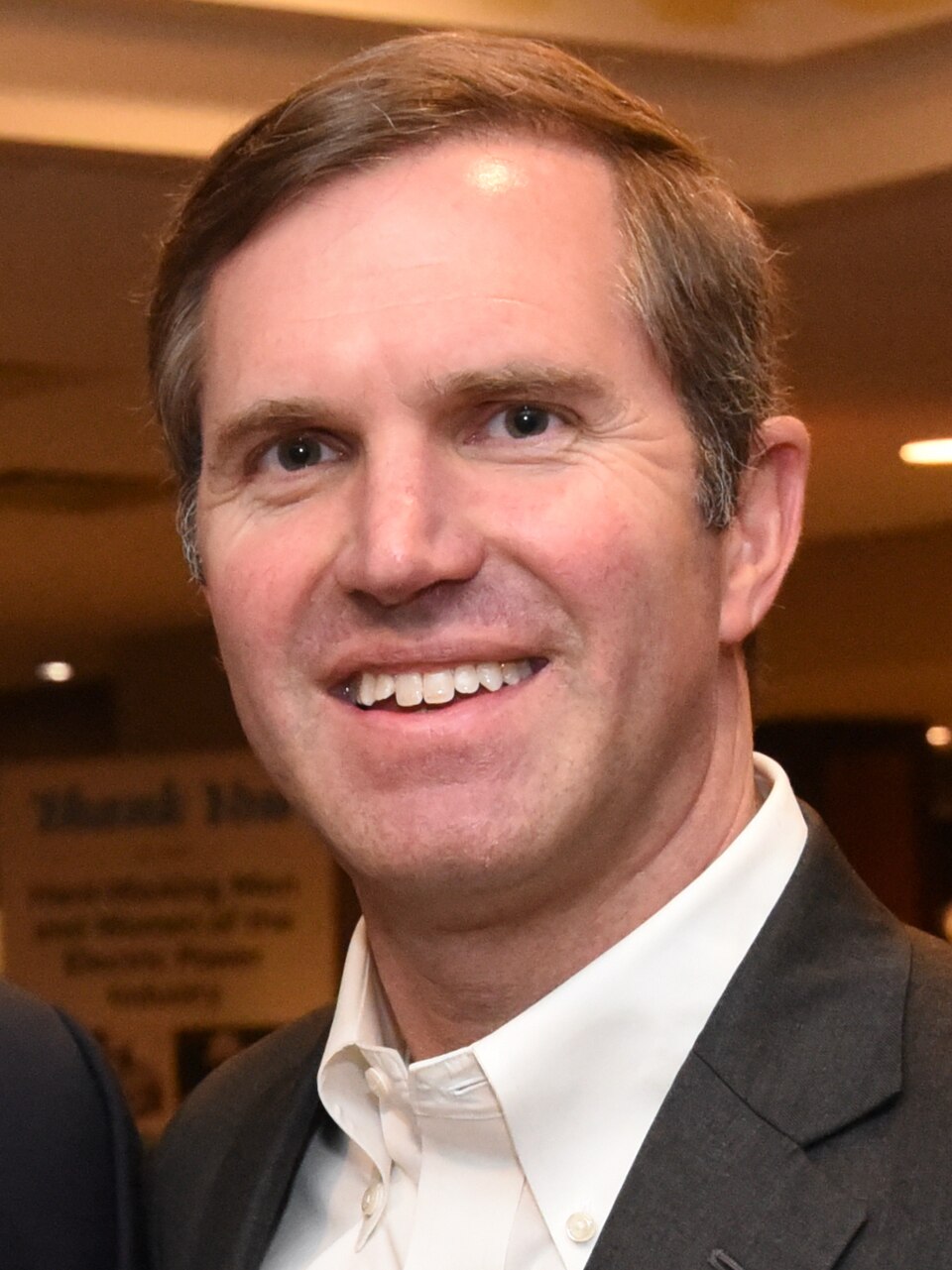
Andy Beshear
Copyright Information: Photo from Wikimedia Commons / Author of Photo: Maryland GovPics / Source of Photo: IAFF Conference (March 4, 2024)Overview
Overview
Andrew “Andy” Graham Beshear was born in Louisville, Kentucky, on November 29, 1977. His father, Steve Beshear, was active in Kentucky politics for many years, serving the state as: a member of its House of Representatives from 1974-1980; Attorney General from 1980-1983; Lieutenant Governor from 1983-1987; and Governor from 2007-2015.
In 2000, Andy Beshear obtained a B.A. degree in political science and anthropology from Vanderbilt University. Three years later, he earned a Juris Doctor at the University of Virginia School of Law. After completing his legal studies, he took a job with the Kentucky law firm of Stites & Harbison, where his father was already established as a partner.
In 2015, Andy Beshear — a Democrat like his father — was elected as Kentucky’s Attorney General.
In 2019 he was elected Governor of Kentucky, narrowly defeating Republican incumbent Matt Bevin by a margin of 49.2% to 48.8%. Beshear then won re-election in 2023, outpacing yet another Republican opponent — former Kentucky Attorney General Daniel Cameron — by a margin of 52.53% to 47.46%.
Beshear was elected Chair of the Democratic Governors Association in early December 2024, and began his term in that post a year later.
Viewing America As a Racist, Sexist Land of Injustice
Beshear views the United States as a nation thoroughly infused with racism, sexism, homophobia, and all manner of inequity. In his role as Governor, in April 2022 he vetoed Kentucky’s Senate Bill 1, which sought, in part, to prohibit teachers from using their classrooms to promote the notion that America has been irremediably racist to its core since its founding. One notable excerpt from the text of the bill that Beshear vetoed:
“A public school or public charter school shall provide instruction and instructional materials that are … consistent with … [t]he understanding that the institution of slavery and post-Civil War laws enforcing racial segregation and discrimination were contrary to the
fundamental American promise of life, liberty, and the pursuit of happiness, as expressed in the Declaration of Independence, but that defining racial disparities solely on the legacy of this institution is destructive to the unification of our nation.”
Beshear likewise contends that America’s criminal-justice system is structurally racist:
- He is passionately committed to the goal of decreasing the size of Kentucky’s prison population, whose makeup is disproportionately black. Toward that end, in January 2020 the governor stated that “criminal justice reform” that “addresses the racial bias and racism in our justice system” was “the right thing to do.” “We have one of the highest incarceration rates in the country and in the world,” he said as well. “Our people aren’t more violent. We don’t have more criminals. We just put more people in our prisons and jails.”
- He was troubled by the September 2020 grand jury decision not to indict the three police officers who had fatally shot a 26-year-old black woman named Breonna Taylor while executing a “no-knock” search warrant at her Louisville apartment six months earlier. “I will never feel the weight of 400 years of slavery, segregation and Jim Crow,” the governor stated, “but I can listen, I can try to hear, and I can be clear: Systematic racism exists in this world, in this country and in our commonwealth. It impacts everything from wealth, earnings, education, even how long we live on this earth.”
- Accepting the premise that both “three-strike laws” and cash bail disproportionately impact “people of color,” Governor Beshear in 2024 vetoed House Bill 5 — the “Safer Kentucky Act” — which, among other things: (a) mandated life-in-prison-without-parole for individuals convicted of three or more violent felonies; and (b) limited the extent to which charitable organizations could help low-income criminal defendants pay their bail.
- Troubled by the fact that blacks in America are arrested for cannabis-related crimes at much higher rates than whites, Beshear believes that “no one who is caught simply possessing marijuana should ever go to jail or should ever go to prison.” In December 2020, he exhorted Kentucky lawmakers to legalize medical cannabis. In November 2022, he signed an Executive Order toward that same end. And on March 31, 2023, he signed Senate Bill 47, legislation that officially legalized the possession and use of medical cannabis in Kentucky. Even the possession of “serious drugs,” Beshear contends, “should end in treatment, not in jail.”
Beshear further views the political disenfranchisement of convicted felons — who are disproportionately black — as evidence that racism pervades America’s justice system. In one of his first acts as Governor, he signed a December 2019 Executive Order that restored voting rights to more than 180,000 Kentuckians who had lost those rights as a legally mandated condition of felony convictions; no other Governor in U.S. history has ever re-enfranchised that many criminals.
In an effort to garner public support for his position on the restoration of felons’ voting rights, Beshear emphasizes that only people convicted of nonviolent offenses are eligible to benefit from the policy. But the Governor’s assurances deceptively obscure the fact that between 94 and 97 percent of all successfully prosecuted criminal cases nationwide end in plea bargains instead of going to trial. Thus, Beshear’s reference to “nonviolent” felony convictions is very misleading; prosecutors commonly allow defendants charged with violent crimes to plead guilty to lesser, nonviolent offenses – convictions that fail to reflect the actual violent nature of the incidents in question. Nevertheless, Beshear has been relentless in striving to bring felons back to the voting booth. “It’s time to pass a constitutional amendment that automatically restores voting rights to non-violent offenders that complete their sentence,” he said in January 2020.
Governor Beshear’s view of America as a country whose moral standing is compromised by its historical transgressions against nonwhites has likewise been reflected in his decision to repeatedly issue annual proclamations recognizing “Indigenous Peoples’ Day” on the second Monday of October — traditionally known as Columbus Day. On October 13, 2025, for instance, he declared that: (a) “Kentucky has been home to Native American people for more than twelve thousand years, and (b) “many historic tribes, including Chickasaw, Shawnee and Cherokee, called Kentucky home before forced removal.”
COVID Restrictions
In April 2020, Beshear directed Kentucky state troopers to record the license-plate numbers on the vehicles of churchgoers while they were attending Easter Sunday services in violation of the state’s COVID-19 stay-at-home order. These plate numbers, the governor explained, would be used for contact tracing in the event that anyone attending the services were to become infected with the coronavirus.
Asserting also that racial inequities in America’s health care system were responsible for the fact that blacks had higher rates of COVID infections than their white counterparts, Beshear in June 2020 promised to provide free health care to all black Kentucky residents who needed it.
In August 2020, Beshear signed an Executive Order authorizing the release of inmates from Kentucky’s prisons and jails in an effort to curb crowding and thereby slow down the spread of the coronavirus. The Kentucky Department of Information and Technology Services later found that of the 1,704 inmates who were released as a result of the order, more than 48 percent went on to commit at least one crime within a year, and approximately one-third of those crimes were felonies. “You do the math, that’s hundreds, nearly a thousand new crimes,” Republican Rep. Jason Nemes said. “It’s new families that are victims that didn’t have to be.” But Beshear defended his decision on the inmate releases, saying: “When COVID hit and we saw how it moved through prison, we made what I believe was reasonable decisions.”
Diversity, Equity, & Inclusion
In light of his belief that America is a structurally racist nation, Beshear is a committed supporter of the principles of “Diversity, Equity, and Inclusion” (DEI), which the Heritage Foundation defines as follows:
“DEI policies are often overtly racist and sexist in that they mandate that government or firms establish quotas or otherwise discriminate based on sex, skin color, ethnicity, or sexual orientation rather than making determinations based on individual achievement, talent, experience, or competence. DEI defines diversity entirely in terms of these immutable characteristics and assigns them to a hierarchy of privilege and deprivation, oppressor and oppressed. … Morally, DEI represents a marked step backwards. It is rejection of the principle that people should be judged on the content of their character and their individual achievement rather than their sex, race, national origin, ethnicity, or sexual orientation. It judges people as members of a racial or sexual group rather than as individuals. It is a rejection of the principle of equal protection under the law…. It is a rejection of the principle that all are created equal. Discrimination or quotas on the basis of race, ethnicity, or sex should be a relic of the past—and most Americans agree.”
In March 2025, Governor Beshear vetoed the state legislature’s recently passed House Bill 4, which aimed to prevent Kentucky’s public colleges from spending money on DEI programs that were “designed or implemented to promote or provide preferential treatment or benefits to individuals on the basis of religion, sex, color, or national origin.” “We’ve worked hard to make our commonwealth a welcoming place,” the governor said in a social media post regarding his veto. “House Bill 4 takes us away from that. We should be embracing diversity, not banning it.” “This bill isn’t about love,” Beshear said before signing his veto message. “House Bill 4 is about hate, so I’m gonna try a little act of love myself, and I’m gonna veto it right now.”
False Christian Piety
During a February 2026 television appearance on The View, Beshear presented himself as a devout Christian, saying: “Most of the decisions I make are based on that Golden Rule that says we love our neighbor as ourself, and that parable of the Good Samaritan that says everyone is our neighbor.” His utterance on that occasion perfectly exemplified the overtly Christian conservative Standing For Freedom Center’s (SFFC’s) observation that Beshear “has built his [political] career on appealing to Christian-sounding platitudes while championing abortion, gender-transition procedures for minors, open borders, and other staples of leftist ideology.” Let us examine these SFFC claims:
Abortion
In May 2019, then-gubernatorial candidate Beshear said: “I’m pro-choice and I support Roe v. Wade. I have consistently taken action to stand up to the legislature and [then-Governor] Matt Bevin when they have pushed to undermine women’s reproductive freedom. I think the parameters set forth in Roe v. Wade have the balance about right and I would not support changes to them. As Governor I would move to codify Roe v. Wade into state law if the Supreme Court overturned the decision.”
As the COVID-19 pandemic shifted into high gear In April 2020, the Kentucky legislature passed a bill known as the Born-Alive Infant Protection Act, which required doctors statewide to provide – on pain of felony charges for noncompliance — lifesaving care to any infant who somehow managed to survive an attempted abortion. Beshear vetoed the bill.
“Gender-Affirming Care” & “Conversion Therapy”
During his aforementioned February 2026 television appearance on The View, Beshear defended his 2023 decision to veto legislation that called for a ban on so-called “gender-affirming care” – a reference to measures like (a) the administration of puberty blockers and sex-change drugs, and (b) radical surgeries that amount, in essence, to mutilation of the very same body that an authentic Christian would be expected to cherish as a gift from God. The legislation the Governor cited was Kentucky’s Senate Bill 150, which sought to prohibit: (a) medical professionals from administering “gender-affirming care” to minors, and (b) the inclusion of human sexuality education in elementary-school curricula without the consent of parents.
In a synopsis of Senate Bill 150’s most significant elements, Votesmart.org reported that the bill:
- “requires public schools to notify parents regarding health services and mental health services related to human sexuality, contraception, or family planning available at the student’s school and request that parents give consent or decline any of those services …“
- “disallow[s] the Kentucky Board of Education from making policies regarding keeping records confidential from parents …”
- “requires the school district to respect the rights of parents “regarding preferred pronouns that do not conform to a student’s biological sex, or the usage of a student’s preferred pronouns by a school district“
- “prohibits students from receiving any instruction that has the goal or purpose of students learning about gender identity or sexual orientation“
- “requires [that] public schools offering curricula and materials on sexuality and human development must inform parents 2 weeks in advance“
Viewing the foregoing objectives as ill-conceived, Beshear once described Senate Bill 150 as “the nastiest piece of anti-LGBTQ+ legislation that this state [Kentucky] had ever seen.”
In February 2020, Beshear spoke at a gay-rights rally at the site of Kentucky’s Capitol, where, according to US News & World Report, he “endorsed legislation to ban conversion therapy” — a form of professional intervention that attempts to change an individual’s sexual orientation from gay to straight, or a person’s “gender identity” from “transgender” to “cisgender.” His effort to prohibit the practice of conversion therapy constituted an assault on the Free Speech protections of the U.S. Constitution’s First Amendment because the only acceptable options for counselors were to: (a) entirely avoid having open, consensual conversations with clients who sincerely wished to purge intrusive and tormenting thoughts from their minds, and (b) steer their clients toward “gender-affirming” measures like social transition, sex-change drugs, and radical surgeries.
Beshear was still crusading against conversion therapy in September 2024, when he signed an Executive Order that placed a blanket ban on such interventions for minors. “My faith teaches me that all children are children of God,” he said during the signing ceremony at the Kentucky Capitol. “And where practices are endangering and even harming those children, we must act. The practice of so-called ‘conversion therapy’ hurts our children.”
Rejecting The One Big Beautiful Bill Act’s Border Policy
In July 2025, Beshear strongly opposed the so-called “One Big Beautiful Bill Act” (OBBBA), which was passed by congressional Republicans and then signed into law by President Trump on July 4, 2025. A 2025 Heritage Foundation report stated that the bill, in its effort to address issues related to border protection and immigration policy:
- substantially boosts funding to secure the border to build 701 miles of primary wall, 900 miles of river barriers, 629 miles of secondary barriers, 141 miles of vehicle and pedestrian barriers, as well as hire 3,000 new Border Patrol agents
- provid[es] funding to hire 10,000 new Immigration and Customs Enforcement (ICE) agents and fund at least 100,000 detention beds
- reduces frivolous asylum applications by creating application fees for aliens
- discourages illegal immigration and unauthorized employment by establishing a remittance tax
Beshear characterized the OBBBA as a “devastating” bill that was “the single worst piece of legislation I’ve seen in my lifetime.”
Beshear Rejects the Rest of The One Big Beautiful Bill Act
The aforementioned 2025 Heritage Foundation report enumerated additional key provisions of the OBBBA as follows:
- prevents a $4 trillion tax hike that would have severely crushed almost all individuals and families
- saves Americans an average of $2,314 per year in federal income taxes between 2026 and 2034
- simplifies taxes for Americans by preserving and increasing the standard deduction
- helps families by raising the child tax credit to $2,200 from $2,000
- ensures no tax on tips and overtime
- helps seniors by creating a new deduction of $6,000 per eligible senior
- encourages businesses to invest in their companies by permanently extending the 100% expensing provision for equipment and machinery
- rewards companies that manufacture in America by enabling businesses to instantly write off the expenses of constructing and investing in new factories, refineries, and agricultural buildings
- modernizes our military and strengthens the armed forces with over $150 billion in targeted investments, prioritizing warship procurement and expanding shipbuilding capacity
- expands American defense manufacturing and production capacity, and reduces reliance on foreign supply chains
- defunds big abortion providers like Planned Parenthood of Medicaid funding for one year
- promotes upward mobility for Americans by requiring able-bodied adults ages 18-59 to work, train, or volunteer to maintain [SNAP or Medicaid] benefits
- prevents fraud by tightening [Medicaid] eligibility requirements and removing at least 1.4 million illegal immigrants from the rolls
- reduces inflation by cutting Green New Deal giveaways from Biden’s Inflation Reduction Act that cost taxpayers billions
- lowers electric costs and improves energy reliability by halting federal support for unproven, uneconomical renewable energy technologies
- reduces dependence on China by eliminating the Electric Vehicle Tax Credit and other tax credits President Trump refers to as the “Green New Scam”
Notwithstanding all of the foregoing facts, Beshear in July 2025 characterized the OBBBA as a “devastating” bill that was “the single worst piece of legislation I’ve seen in my lifetime”
Economic Policy
Beshear opposes Kentucky’s “right-to-work” law, which was enacted in January 2017 and allows employees in any given workplace to choose whether or not they wish to join a labor union and/or pay union-related dues. “[A]ll right-to-work does is pay our working families less,” Beshear said in 2017. While running for governor in 2019, he said: “The first thing we’re going to do is support a bill that repeals right-to-work, and I’m going to fight like heck to get it passed.”
Education
Beshear opposes the proliferation of charter schools, which are publicly funded institutions that operate independently of the traditional public school system. As their name suggests, each of these schools is administered under a “charter,” which in essence is a contract between the school and an authorizing body (like a state or local government) that sets broad-based rules and student-performance standards. The contract not only defines the school’s mission and objectives, but also provides an operational definition of how its success will be measured. Failure to meet the standards of success as the contract defines it, can result in the closure of the school.
Like regular public schools, charter schools are tuition-free for the children who attend, but the schools are not bound to abide by all the same rules and regulations as traditional public schools. As U.S. News & World Report explains: “[I]ndividual charter schools can tailor their curriculum, academic focus, staffing ratios, discipline policies and other matters that, for other public schools, are decided at the school district or state board level. In exchange for that flexibility, charter schools are supposed to be accountable to parents and the state or local governments that authorize them.” In recent years, the demand for charter schools has grown dramatically – particularly in American cities where the public school systems are little more than assembly lines for the mass production of poorly behaved, maladjusted illiterates and innumerates. As the National Alliance for Public Charter Schools reported in October 2024:
- “Charter school enrollment has steadily increased by nearly 400,000 students over the past five years, while district public schools have lost about 1.75 million students.”
- “Charter schools have seen significant gains in Black and Hispanic student enrollment, with Hispanic enrollment growing 18 times faster than in district schools.”
Similarly, a 2021 report by The Heritage Foundation states: “More than 7,500 charter schools and campuses meet families’ needs every day, providing a safe and effective education. And they do so for a fraction of what is spent per pupil at traditional public schools. ‘Our analysis shows that student cohorts in the charter sector made greater gains from 2005 to 2017 than did cohorts in the district sector,’ Harvard’s Paul E. Peterson and M. Danish Shakeel wrote at Education Next, adding: ‘The difference in the trends in the two sectors amounts to nearly an additional half-year’s worth of learning. The biggest gains are for African Americans and for students of low socioeconomic status attending charter schools.’”
But Beshear remains unpersuaded, arguing that “charter schools overall are unconstitutional under the way our constitution writes about a system of public schools and what’s required,” because “schools run by corporations are not public schools.” He also sees charter schools as entities that siphon vital resources away from public schools, saying: “You can’t starve public schools of the dollars that they need and then tell them they’re not doing a good enough job and then give their dollars to corporations. Charter schools are not the right path.”
Consistent with that attitude, Beshear in April 2022 vetoed Kentucky’s House Bill 9, which called for the establishment of public tax credits for charter schools across the state.
Beshear also opposes other types of school-choice programs – e.g., magnet schools, private school vouchers, and education savings accounts (ESAs). In January 2025, for instance, he said: “Let’s stop the voucher nonsense…. Instead, let’s do the hard work to strengthen and improve our public schools.” Beshear likewise opposed the Kentucky state legislature’s proposed Amendment 2 in 2024, which sought “to give parents choices in educational opportunities for their children” by providing “financial support for the education costs of students in kindergarten through 12th grade who are outside the system of common (public) schools.” Calling the amendment a “money grab” that would mean “less money in public schools,” the governor said in 2024: “Public dollars should only go to public schools, period. I’m against this constitutional amendment. And if they pass it, I will work every day to defeat it at the ballot box in November.”
Israel
At daybreak on October 7, 2023, the Gaza-based Islamic terror group Hamas carried out a massive, multi-front, surprise attack against Israel, firing thousands of rockets into the Jewish state while dozens of Hamas fighters simultaneously infiltrated the Israeli border by air, land and sea. The attack had been planned in conjunction with officers from Iran’s Islamic Revolutionary Guard Corps (IRGC), along with agents of three other Iran-sponsored terrorist organizations. Shortly after the barbaric Hamas attacks — whose official casualty toll in Israel reached more than 1,200 dead and 4,500 injured — Israeli Prime Minister Benjamin Netanyahu declared that his nation was officially “at war” with the aggressors. The Israel Defense Forces launched a massive, devastating invasion of the Gaza Strip with the stated aim of destroying Hamas and its leadership once and for all.
While affirming in a March 2026 interview that Israel “has the right to exist as a democratic [and] Jewish country,” Beshear charged that both “Netanyahu and President Trump … could have lessened the suffering [after October 7, 2023] in Gaza” and “in this war with Iran” – a reference to America’s March 2026 military assault on the Islamic Republic of Iran. “That’s a different thing. I believe the United States needs a strong Israel, but not one with decisions being made in the way that Netanyahu is making them.”
Beshear similarly stated in that same interview: “I understand that Israel was hit with a terrorist attack [on October 7, 2023] the likes of which it had never seen, and [that] it has been through a lot, and that it deserves the right to defend itself and to eradicate that terrorist organization. I believe that it [Israel’s retaliation] could have been done without a lot of the suffering [in Gaza], but I put a lot of that blame also on Donald Trump. If he’d said, ‘we are coming in and we are bringing food and aid [to the Gazan people], and you [Israel] are going to make sure that we’re safe, it would’ve happened.”
Medicaid Work Requirements
In 2019, Beshear rescinded a Republican-passed waiver that required able-bodied adults receiving Medicaid benefits to perform 20 hours of work or community service each week in order to qualify for continued aid. “Health care is a basic human right and every Kentucky family deserves to see a doctor and receive treatment when they are sick,” the Governor said. “I will not allow burdensome roadblocks and unnecessary red tape to stand in the way of the health and well-being of Kentuckians. If we are going to move forward as a Commonwealth, and build a bigger and brighter future for all our families, we must first ensure they have access to health care.”
In 2025, Governor Beshear vetoed House Bill 695, legislation from the General Assembly that sought to reinstate work requirements for able-bodied adults on Medicaid. Such preconditions, he said, would “put up barriers to, and delay health care for, Kentuckians.”
Pay Equity for Women
In May 2019, Beshear said: “It’s wrong and absurd that women in Kentucky make significantly less than men for doing the same job. As the father of both a son and a daughter, this is personal for me. Kentuckians should not be paid different amounts just because of their sex. This is common sense, and as governor I’ll work to eliminate this pay gap.”
Beshear revisited this theme in January 2020, when he stated that “good jobs must pay a woman the same as they would a man,” adding: “It’s time equal work results in equal pay.”
But Beshear’s professed concern that female workers were not being paid equitably as compared to their male counterparts was rooted entirely in falsehoods. Consider some pertinent facts:
- Far more often than men, women tend to seek employment in fields that are non-technical or which involve the social—as opposed to the physical—sciences. Moreover, they seek employment in fields that: offer a high level of physical safety; involve work that is performed indoors as opposed to outdoors (where bad weather can make working conditions poor); feature a pleasant and socially dynamic working environment; are characterized by lower levels of emotional turbulence; offer desirable shifts or flexible working hours; and require fewer working hours per week or fewer working days per year. As well, women tend to gravitate toward fields that do not require long commutes; men on average commute 36% farther to get to work, a fact that translates into about $1,500 in extra annual pay. Similarly, women are more inclined to pursue jobs that do not require geographic relocation—the result being that females make up only 18% of all workers who are transferred abroad by their employers.
- Such advantages come at a cost; they make certain fields more attractive and thus expand the pool of applicants to a point that, in some cases, exceeds the demand for services. This, in turn, exerts a downward pressure on salaries. Yet this tradeoff is quite acceptable to many working women: Only 29% of women, versus 76% of men, report that their primary motivation for working is to “build wealth.” Research has shown repeatedly that women are more likely to pursue jobs that they perceive to be socially useful, while men, for various reasons, tend to give greater emphasis to money.
- An even more significant contributor to the “gender pay gap” is that women tend to compile fewer years of uninterrupted service in their jobs than men. Indeed, women are far more likely to leave the workforce for extended periods in order to attend to family-related matters such as raising children. This is simply a life choice to forego some degree of financial reward in exchange for the emotional reward of being an at-home parent, whether full-time or part-time. During the course of their overall work lives, men accumulate an extra 5 to 9 years on the job as compared to their female counterparts, and each of those additional years translates to approximately 3 or 4 percent more in annual pay.
When all of the above variables are factored into the equation, the “gender pay gap” disappears entirely. That is, when men and women work at jobs where their titles, their responsibilities, their qualifications, and their levels of experience are equivalent, they are paid exactly the same. And by no means is this a new phenomenon. Even in the 1950s, the pay gap between men and never-married women — i.e., those women who were unlikely to have temporarily left the work force in order to raise children — was less than 2%. Never-married white women actually earned 6% more than never-married white men.
Voter ID
During a February 2026 appearance on CNN News Central, Beshear was asked by co-host Boris Sanchez: “When it comes to voter ID measures in your home state — you have spoken out against them — polling shows that it is a popular proposal, even among members of your [Democrat] party.” The Governor replied: “Well, I think that voting rules should be reasonable. They should be reasonable because people shouldn’t have to go through a ton of different steps just to exercise their most fundamental right. We shouldn’t be putting new policies or new requirements on the American people if most, if not virtually all of the American people don’t already have the types of documents or IDs that would otherwise satisfy it. We’ve got to make sure that while we want to make sure our voting system is safe and that there is not fraud, that we are not putting different policies in place that would push people away from the ballot box.”
Possible Presidential Run
In July 2025, CNN host Dana Bash asked Beshear if he might consider seeking the Democratic Party’s nomination for U.S. President in 2028. In the course of his response, Beshear said: “If you’d asked me this question a couple of years ago, I would have said no. My family’s been through a lot, but I do not want to leave a broken country to my kids or anyone else’s. So, what I think is most important for 2028 is a candidate that can heal this country, that can bring people back together. So, when I sit down, I’m going to think about whether I’m that candidate or whether someone else is that candidate.”