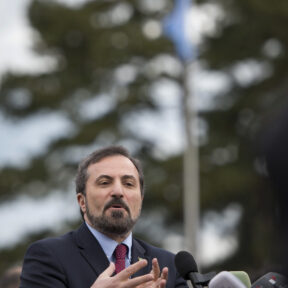
Louay Safi
: Photo from Creative Commons / Author of Photo: UN GenevaOverview
* Former official with the International Institute of Islamic Thought, the Association of Muslim Social Scientists, the Center for the Study of Islam and Democracy, and the Islamic Society of North America
* Supported former Palestinian Islamic Jihad leader Sami Al-Arian
* Was a trainer at Fort Hood (Texas) in November 2009, when U.S. Army Major Nidal Hasan killed 13 Americans in a jihadist shooting spree
* Spoke out in defense of Siraj Wahhaj, an un-indicted co-conspirator in the 1993 bombing of the World Trade Center
* Serves as a fellow at the Prince Alwaleed bin Talal Center for Muslim-Christian Understanding
Louay M. Safi was born in 1956 in Damascus, Syria. He immigrated to the United States in the early 1980s and went on to earn a B.S. degree in civil engineering, and an M.A. and Ph.D. in political science—all at Wayne State University in Detroit. Safi subsequently worked as a political science instructor at Wayne State from 1988-92, an associate professor at the International Islamic University of Malaysia from 1994-99, and a visiting professor at George Washington University in 2001-02. Safi also served as executive director (1995-97) and director of research (1999-2003) at the International Institute of Islamic Thought (IIIT); editor of the Journal of Islamic Social Sciences (1999-2003); president of the Association of Muslim Social Scientists (1999-2003); and board member of the Center for the Study of Islam and Democracy (1999-2007).
Beginning in the mid-1990s, Safi, who had ties to the terrorism-financing Safa Group, came under the scrutiny of U.S. government investigators. He was caught, on a 1995 FBI wiretap of Palestinian Islamic Jihad leader Sami Al-Arian, voicing concern that Al-Arian might be negatively impacted by President Bill Clinton‘s recently-issued executive order prohibiting financial transactions with terrorist organizations. In 2002, federal agents raided Safi’s IIIT offices as part of a widespread government probe into the SAAR Network, a Saudi-funded, Muslim Brotherhood-dominated financial empire that bankrolled a host of Islamic terror activities. Shortly after the government raids, Safi publicly complained that “those who have been targeted are very moderate voices.” Moreover, he wrote a number of editorials asserting that the “extreme right” was waging “a campaign against Islam”—a phrase that Philip Zelikow, director of the 9/11 Commission, characterized as part and parcel of “the jihadi narrative.”In his 2003 book, Peace and the Limits of War, Safi explained that Islamic jihad, or “the war against the apostates,” seeks “not to force [non-believers] to accept Islam, but to enforce the Islamic law and maintain order.” “It is up to the Muslim leadership,” he added, “to assess the situation and weigh the circumstances as well as the capacity of the Muslim community before deciding the appropriate type of jihad.” In some instances, said Safi, such leaders might determine that jihad waged “through persuasion or peaceful resistance” represents “the best and most effective method to achieve just peace.”
In 2005 Safi was identified as “un-indicted co-conspirator Number 4” in the terrorism trial of Sami Al-Arian. That same year, Safi condemned “the double-standard approach adopted by many Western governments and institutions toward Muslims.” Public outrage “should not be reserved [solely] for atrocities committed by the terrorists against Western civilians,” he said, “but must also address Muslim pain and suffering visited on them by the action of Western democracies.” Such “legitimate grievances,” he added, constituted “the roots of anger and frustration that breed militancy and give rise to terrorism.” In particular, Safi exhorted American leaders not to ignore “the Israeli, the Indian, or the Thai aggression against Muslim populations that live under their control.”
In a December 2005 article titled “Will the Extreme Right Succeed? Turning the War on Terror into a War on Islam,” Safi impugned critics of Islam for “reading Islamic texts out of context” and giving what he claimed was the false impression that Muslim terrorists drew inspiration for their violent activities from the Koran.
From 2004-08, Safi served as executive director of the Islamic Society of North America‘s (ISNA) Leadership Development Center (LDC). In 2009, he was the LDC’s communications and leadership development director. In both of those roles, Safi was tasked with teaching the tenets and customs of Islam to American troops who were deploying to Iraq and Afghanistan. He was one of just seven lecturers in the U.S. Army’s Islamic education program, and one of only two endorsing agents for the Pentagon’s Muslim military-chaplain program. He taught, among other things, that the use of a “preemptive strike” against Islam’s enemies is sometimes justified when waging jihad.
Safi’s relationship with the Pentagon came under scrutiny in November 2009, when U.S. Army Major Nidal Hasan, putting the “preemptive strike” doctrine into action, killed 13 Americans and wounded 31 others in a shooting spree at Fort Hood (Texas). At the time of Hasan’s attack, Safi was teaching a course entitled “Theology of Islam” at Fort Hood, and was a trainer on Islam for soldiers at Fort Bliss (located in Texas and New Mexico). Following the massacre, Safi and a group of U.S. Muslim Brotherhood leaders held a press conference to announce the formation of a “Fort Hood Family Fund” under the auspices of ISNA. In December 2009, Safi presented a check (on ISNA’s behalf) to the families of the victims, and he continued to instruct Fort Hood soldiers about Islam. Reflecting upon Hasan’s murderous actions, Safi explained that “the extremist ideology responsible for violent outbursts is often rooted in the systematic demonization of marginalized groups.”
By February 2010, Safi had been suspended from working on U.S. military bases, pending a criminal inquiry. He kept a relatively low profile until August 2011, when he resurfaced as political-office director of the newly formed Syrian National Council (SNC), an organization thoroughly dominated by the Syrian Muslim Brotherhood, historically one of the world’s most violent Brotherhood offshoots.
In October 2009, Safi spoke out in defense of Siraj Wahhaj, a pro-Sharia, Brooklyn-based Imam who was an un-indicted co-conspirator in the 1993 bombing of the World Trade Center. Said Safi:
“He’s a very popular motivational speaker. The sad thing is that the public is only allowed to see him through the veil of an unindicted co-conspirator. He has been charged in the press…. Remember, he is a motivational speaker. If you take statements by anyone, from the president to congressmen to anyone else, you can take one sentence out of context…. He’s done a lot of good work in his community, clearing the area of drug addicts and trying to foster a great sense of community. He’s done a lot of good work in the New York area.”
In addition to his role with SNC, Safi today serves as a fellow at the Georgetown University-based Prince Alwaleed bin Talal Center for Muslim-Christian Understanding; an associate professor at Indiana University/Purdue University; and a non-resident fellow with the Institute for Social Policy and Understanding. He speaks frequently on such issues as human rights, the Middle East, and Islamic-Western relations, and has published eleven books.
For additional information on Louay Safi, click here.