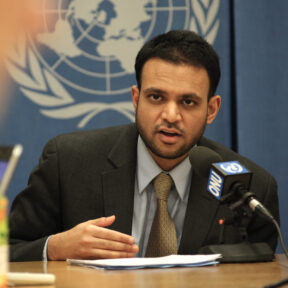
Rashad Hussain
: Photo from Wikimedia Commons / Author of Photo: U.S. Department of State, US Mission to the UN Geneva, photographer not specifiedOverview
* Was named deputy associate counsel to President Barack Obama in 2009
* Was appointed (by Obama) as a special envoy to the Organization of the Islamic Conference in 2010
* Was appointed director of the Center for Strategic Counterterrorism Communications in 2015
The son of Indian-born U.S. citizens, Rashad Hussain was born in Wyoming in 1978 and was raised in Plano, Texas. He holds a bachelor’s degree in philosophy and political science from the University of North Carolina at Chapel Hill, a master’s degree in Arabic & Islamic studies from Harvard University, and a J.D. from Yale Law School. In the summer of 2000, he served as an intern in the office of Democratic congressman Richard Gephardt.
In October 2000, Hussain spoke at a conference sponsored by the Association of Muslim Social Scientists and Georgetown University’s Prince Alwaleed Center for Muslim-Christian Understanding. Titled “Islam, Pluralism, and Demoracy,” this gathering featured appearances by numerous leaders of the global Muslim Brotherhood, including such notables as Louay Safi, Jamal Barzinji, Hisham Al-Talib, and AbdulHamid AbuSulayman.
In June 2002, Hussain participated in a Congressional Staffers panel at the American Muslim Council’s (AMC) 11th annual convention. At that time, AMC was headed by the Muslim Brotherhood leader Abdurahman Alamoudi, who would later be convicted and incarcerated on terrorism charges.
In 2003 Hussain was a recipient of the Paul & Daisy Soros Fellowship for New Americans, which was founded by, and named after, George Soros‘s older brother and sister-in-law.
After completing law school, Hussain worked as a legislative assistant for the House Judiciary Committee, then as a trial attorney at the Justice Department, and afterward as a law clerk to Judge Damon Keith on the U.S. Court of Appeals for the Sixth Circuit in Detroit, Michigan.
In 2004 Hussain wrote a major article in the Yale Law Journal stating that it was “difficult to assess” whether the U.S. government’s post-9/11 counterterrorism initiatives “encroach upon” Americans’ civil liberties, and “whether such initiatives enhance or undermine security.”
While attending Yale Law School, Hussain was a member of the organizing committee for an April 2004 conference held by Critical Islamic Reflections, a student group sponsored by the International Institute of Islamic Thought and the American Learning Institute for Muslims (ALIM). Among ALIM’s instructors were such prominent Muslim Brotherhood figures as Tariq Ramadan, Jamal Badawi, and Taha Al-Alwani.
In September 2004, while still a Yale law student, Hussain took part in a session at the annual conference of the Muslim Students Association of the U.S. and Canada. Appearing alongside the daughter of Palestinian Islamic Jihad leader Sami Al-Arian, Hussain characterized Al-Arian’s recent prosecution on terrorism charges as “politically motivated persecution” that was calculated “to squash dissent.”
In August 2008, Hussain published a paper (for the Brookings Institution) titled “Reformulating the Battle of ideas: Understanding the Role of Islam in Counterterrorism Policy.” A number of the paper’s recommendations were consistent with the agendas and worldviews of the U.S. Muslim Brotherhood. For example:
- “Policymakers should reject the use of language that provides a religious legitimization of terrorism such as ‘Islamic terrorism’ and ‘Islamic extremist.’ They should replace such terminology with more specific and descriptive terms such as ‘Al-Qaeda terrorism.’”
- “The United States should welcome and encourage the further development of mainstream Muslim organizations and moderate institutions.” (Specifically, Hussain’s paper references the work of the Fiqh Council of North America, which is tied to the U.S. Muslim Brotherhood.)
- “The primary cause of broad-based anger and anti-Americanism is not a clash of civilizations but the perceived effect of U.S. foreign policy in the Muslim world.”
In January 2009, Hussain — recruited by Cassandra Butts, advisor to (and former Harvard Law School classmate of) President Barack Obama — was named deputy associate counsel to the President. In that position, Hussain focused on issues involving national security, new media, and outreach to the Muslim community. As Obama prepared for his June 2009 trip to Cairo, Hussain helped Ben Rhodes, the President’s principal foreign-policy speechwriter, draft the address that Obama would deliver at Cairo’s Al-Azhar University. According to Hussain, his own input was geared toward emphasizing the contributions that Muslims have made to American society, and clarifying the context behind some passages in the Koran.
Thirteen months later, Hussain, reflecting on Obama’s Cairo address, characterized the speech as “[a framework] that recognizes that we cannot engage one-fourth of the world’s population [i.e., Muslims] based on the beliefs [i.e., jihadism] of just a fringe few and that our engagement can’t be limited to an issue like violent extremism [i.e., terrorism], but that it must be much broader than that.”
In May 2009, Hussain spoke at a Leadership Summit of the Council for Advancement of Muslim Professionals (CAMP). Among the event’s sponsoring organizations were Islamic Relief, Amana Mutual Funds, the Muslim Public Affairs Council, the Council on American-Islamic Relations, and the Institute for Social Policy and Understanding; all of these have ties to the Muslim Brotherhood.
On February 13, 2010, President Obama appointed Hussain as a special envoy to the Organization of the Islamic Conference, a 57-country coalition that seeks to outlaw any and all criticism of Islamic people, practices, legal codes, and governments — depicting such criticism as “Islamophobia.”
In August 2010, Hussain took part in an interfaith “bridge-building” trip organized by the Muslim Brotherhood-affiliated Suhail Khan. Steven Emerson of the Investigative Project on Terrorism pointed out that “two of the Islamic leaders attending the trip … had made anti-Semitic, radical Islamic statements or [had] justified terrorist attacks” on previous occasions.
In February 2015, President Obama appointed Hussain to take over (in April) as director of the Center for Strategic Counterterrorism Communications, an office within the U.S. Department of State.
It should be noted that, notwithstanding his ties to the Muslim Brotherhood and its allies, Hussain endorses the use of the term “Hamas terrorists.” Further, he urges Muslim leaders to spread the message that genuine Islam forbids acts of terrorism and extremism. While aiming to “discredi[t] the terrorist ideology,” however, Hussain cautions against efforts to tie that objective to the imposition of democracy on Islamic nations; such efforts, says Hussain, could be perceived by Muslims as manifestations of an imperialistic mindset. Thus he proposes that the U.S. build a Muslim coalition “not limited to those who advocate Western-style democracy, and avoid creating a dichotomy between freedom and Islamic society.”