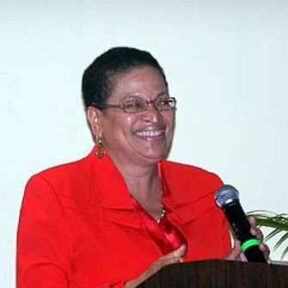
Julianne Malveaux
: Photo from Wikimedia Commons / Author of Photo: DivainredOverview
* President of Bennett College
* Economist and commentator who focuses heavily on race and gender
* Claims that the poor in Cuba are “much better off” because of Fidel Castro’s communist revolution
* Publicly expressed her hope that conservative Supreme Court Justice Clarence Thomas would “die early”
Background & Overview
Julianne Malveaux was born on September 22, 1953 in San Francisco, California. She entered college without having first finished high school, received her undergraduate and master’s degrees in economics from Boston University (in 1974 and 1975, respectively), and earned a Ph.D. in that same field from MIT in 1977. During the eighties and early nineties, Malveaux taught classes in economics, public policy, and African-American Studies at San Francisco University and UC Berkeley. At other times during her academic career, she has been a visiting faculty member at the New School for Social Research, the College of Notre Dame (San Mateo, California), Michigan State University, and Howard University. In 2014, she was a special guest lecturer at Meharry Medical College, (Nashville, Tennessee), and in 2017 she delivered a three-part lecture as part of a W.E.B. Dubois lecture series at Harvard University’s Hutchins Center for African and African American Research.
Best known for her work as a television commentator, Malveaux has been a frequent guest expert on such programs as ABC‘s Politically Incorrect, PBS‘s To the Contrary and Lehrer News Hour, and news programs on a various cable TV networks like CNN, BET, the Fox News Channel, TV One, C-SPAN, MSNBC, and CNBC.
Malveaux also has a background in radio. She hosted her own nationally broadcast daily show on Pacifica Radio from 1995-1996, and later hosted a weekly program – titled Julianne Malveaux’s Capitol Report – on station WLIB in New York. In addition, she has hosted talk radio programs in Washington, San Francisco, and New York.
As a writer and syndicated columnist, Malveaux’s work has appeared frequently in such publications as USA Today, Black Issues in Higher Education, Ms. magazine, Essence magazine, and The Progressive, the Los Angeles Times, the Charlotte Observer, the New Orleans Tribune, the Detroit Free Press, the San Francisco Examiner, and the San Francisco Sun Reporter.
Malveaux has long sat on the Economic Policy Institute‘s board of directors, along with — at various times — such luminaries as Keith Ellison, Mary Kay Henry, Thomas Perez, Randi Weingarten, Leo Gerard, Bob King, Robert Reich, and Richard Trumka.[1] She also has served on the boards of the National Committee for Responsive Philanthropy, Women Building for the Future, and the Recreation Wish List Committee of Washington, D.C. And she has sat on the editorial board of Black Commentator, along with notables like Julian Bond and Manning Marable.
Socialist Scholars Conference
In April 1992, Malveaux was a guest speaker at the Socialist Scholars Conference in New York City.
Wishing for the Death of Clarence Thomas
On the November 4, 1994 edition of PBS’s To the Contrary, Malveaux voiced her deep contempt for conservative Supreme Court Justice Clarence Thomas by wishing for his death: “The man is on the Court. You know, I hope his wife feeds him lots of eggs and butter and he dies early like many black men do, of heart disease. Well, that’s how I feel. He is an absolutely reprehensible person.”
Last Word Productions
In 1995 Malveaux founded the multimedia company Last Word Productions (LWP) as a vehicle for the production of her speeches, books and other writings, consulting activities, radio and television programs, and business-development efforts. She served as LWP’s president and CEO until 2007.
From May 2012 to January 2014, Malveaux served as a “Thought Leader” at Last Word Productions, the multimedia company she had founded in 1995.
Malveaux’s Views on Louis Farrakhan
In an October 8, 1995 column for The Washington Post, Malveaux offered a mixed assessment of Nation of Islam leader Louis Farrakhan: “[W]hile I reject white Americans’ use of Louis Farrakhan as a litmus test of acceptable black opinion, I also reject the notion that I have to embrace Farrakhan just because white America looks askance at him. Farrakhan and the Nation of Islam offer an array of positives and negatives to black America. On the plus side, there is his focus on economic development and discipline. On the minus side, there is the antisemitic rhetoric and the traditionalism in gender relations.”
In May 2005, Malveaux attended an event where Farrakhan announced his plan to lead a civil-rights march in Washington, D.C. in October.
When the Daily Caller in February 2018 contacted a number of Congressional Black Caucus members to ask if they would be willing to publicly denounce Louis Farrakhan because of his long history of racist and anti-Semitic rhetoric, at least 20 of those CBC members declined to criticize him in any way whatsoever. Malveaux likewise refused to brand Farrakhan as a racist or anti-Semite. In March 2018, the Nation of Islam’s official newspaper, The Final Call, quoted Malveaux as saying: “We have tens of thousands if not millions of people, Black people, in these United States who are members of the Nation of Islam. They are productive people in our community, who many of us interact with, work with, on a daily basis. They are not racist people. They are not anti-Semitic. They are Black people. So, until these Jewish people who are running around asking Black people to buck dance, until they ask white people to buck dance, I ain’t having it! I’m just not having it!”
In a November 29, 2018 op-ed in the Birmingham Times, Malveaux wrote the following in defense of Farrakhan: “White people’s hatred for Minister Farrakhan is irrational and, might I say, racist. He is the only person, the only human being that Congress has censured. No David Duke, no Charlottesville murderers, none of the hatemongers that have caused the racist tension in our nation. Just Minister Farrakhan. But then our society is consistent with its double standards and its demands that black people bend over backward to prove that we, too, sing America.”
Black Radical Congress
In March 1998 Malveaux was listed among the “Endorsers of the Call” to establish a Black Radical Congress (BRC), which urges rebellion against American “racism,” “sexism,” “homophobia,” “class antagonisms,” and “social injustice.” Other endorsers of BRC included such luminaries as Amiri Baraka, Angela Davis, Lewis Gordon, Manning Marable, Rosalyn Pelles, and Cornel West.
Malveaux’s Views on Fidel Castro
In an August 2006 National Public Radio segment, Malveaux characterized Cuban President Fidel Castro‘s regime as a “mixed bag” that, along with “oppression,” had brought “a total redistribution and transformation” economically, leaving many poor people “much better off.”
President of Bennett College, a Historically Black Institution
In March 2007 Malveaux became the fifteenth president of Bennett College, one of America’s oldest historically black colleges for women.
In her welcome message to students in 2009-10, Malveaux called Bennett College “a place where sisters [black women] are educated, celebrated, and developed into global citizens and twenty-first century contributors.”
Praise from Cornel West
Sometime before 2006, the Marxist academic Cornel West described Malveaux as “the most iconoclastic public intellectual in the country.”
Detecting Racism in Many Places
“Not only is the pace of social change exceedingly slow,” Malveaux complained in 2007, “but the backlash in terms of the new racism, sexism, and classism are incredibly frustrating.”
One “bone-chilling” manifestation of American racism, she said in 2010, was the fact that after Barack Obama was elected president and vacated his Senate seat in 2009, the Senate, which had no remaining black members, became “segregated legislative bod[y]” in the “so-called post-racial 21st century.”
In 2010 Malveaux characterized the Tea Party protesters — conservatives who demonstrated against runaway government spending and the healthcare reform bill which had pushed America closer toward government-run healthcare — as people who suffered from the “disease” and “pre-existing condition” of “racism.” Emphasizing that white racism was ubiquitous in the United States, Malveaux, on another occasion said: “There’s no great, white bigot; there’s just about 200 million little white bigots out there.”
In a July 8, 2010 column, Malveaux lamented that Kendrick Meek, a black Democrat, was having difficulty obtaining his party’s nomination for a U.S. Senate seat in Florida. “If Meek can’t pull this one off,” wrote Malveaux, “the United States Senate will become, again, a segregated body.” She also described the existing composition of the Senate as “lily-white” and “all-white.” But in fact, the Senate at that time included one Hispanic (Robert Menendez), two Asians (Daniel Inouye and Daniel Akaka), and one black (Roland Burris, who had succeeded Barack Obama when the latter was elected President).
Supporting the Marxist Cop-Killer, Mumia Abu-Jamal
In 2008 Malveaux signed a statement circulated by the Partisan Defense Committee calling for the release of convicted cop-killer Mumia Abu-Jamal, praising Mumia for being a “former Black Panther,” lamenting that he had been “framed” as a murderer and sentenced to death by a racist U.S. justice system, and denouncing capital punishment as “a legacy of chattel slavery and a barbaric outrage … the lynch rope made legal.” To view a list of other prominent signatories, click here.
“Black Agenda” Panel
On March 20, 2010 at Chicago State University, Tavis Smiley organized and moderated a panel of prominent African-Americans to discuss the need to promote a “black agenda” in the United States. Malveaux was one member of this panel along with advertising pioneer Tom Burrell, professors Michael Eric Dyson and Cornel West, Nation of Islam leader Louis Farrakhan, and the Rev. Jesse Jackson.
Portraying Democrats As the Party That Cares about the Poor & Downtrodden
Malveaux frequently writes about issues of unemployment and poverty, arguing that the key to reducing both is the election of Democratic politicians. In a syndicated column from 2010, for instance, she wrote that Democratic victories in the upcoming midterm elections would be crucial to the well-being of those “who need an opportunity to engage in our economy.”
High Praise for Maxine Waters
In September 2010, Malveaux identified Congresswoman Maxine Waters as “one of my sheroes, a sister I love, admire and emulate. Specifically, Malveaux described Waters as “a relentless advocate for the least and the left out,” “a loyal champion of Rev. Jesse Jackson‘s presidential campaign[s]” in the 1980s, and “a whirlwind force for social and economic justice in California.”
Resigning As President of Bennett College
On May 6, 2012, Malveaux resigned from her post as president of Bennett College.
Founder of “Economic Education”
In March 2014, Malveaux founded Economic Education, a 501(c)(3) nonprofit organization that, by Malveaux’s telling, “designs and delivers curriculum and training that ranges from personal finance to economic trends.” She has served as president of this organization ever since.
Supporter of Reparations for Slavery
On June 19, 2019, Malveaux testified as a witness at a House Judiciary Subcommittee on the Constitution, Civil Rights, and Civil Liberties hearing on H.R. 40, a bill calling for the formation of a “Commission to Study and Develop Reparation Proposals for African-Americans.” In the course of her testimony, she said:
- “When people talk about ‘we’ve already paid reparations,’ I’ve heard people talk about the fact that white people died in the Civil War fighting on the side of the North. Well, the North was also a beneficiary of enslavement, quite frankly. So, no, reparations have not been paid and the fact is, again, some folks may want checks, but what we’re really talking about is closing that wealth gap and making people whole.”
- ““I don’t like to think that white people are evil. I think that white people are ignorant. I think that white people do not know what the history is and I commend you all to look at the history and the work you’ve done in the past and then challenge you to do the right thing.”
- “People want to talk ugly about Democrats [and their historical ties to slavery]; people change their ideologies. So the Democrats were the devil once upon a time. There were these groups called the Red Shirts, which were the Klan, they were Democrats. However, the Republicans took that over, they became the devil.”
Smearing President Trump As an “Orange Orangutan”
In a July 13, 2019 appearance on Joy Reid‘s MSNBC program, Malveaux exhorted her fellow Democrats to remain focused on the overriding objective of removing President Donald Trump, whom she characterized as “the organge orangutan,” from office: “At the end of the day, the goal has to be to get rid of the orange orangutan.”
Malveaux and Israel
In a column published by the Richmond Free Press on May 2021, Malveaux wrote, “Israel has a lock on U.S. foreign policy, and too many Jewish people say that criticism of Israel makes you anti-Semitic.”
Footnotes:
- Among EPI’s more prominent former board members were Andrew Stern and Raul Yzaguirre.