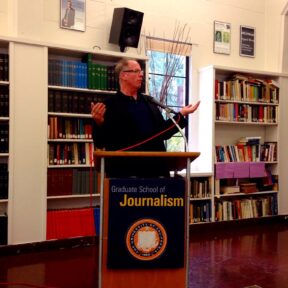
Robert McChesney
: Photo from Creative Commons / Author of Photo: Steve RhodesOverview
* Professor at University of Illinois Urbana-Champaign
* Founder of the “media reform” organization Free Press
* Former co-editor of the Marxist journal Monthly Review and a current director of the tax-exempt Monthly Review Foundation
* Board member of the Institute for Public Accuracy
Born on December 22, 1952 in Cleveland, Ohio, Robert McChesney graduated with a B.A. in economics and history from Evergreen State College in 1977. During his college years, he became a friend and lifelong collaborator of John Bellamy Foster.
From 1977-79, McChesney worked as Seattle circulation coordinator for the socialist weekly In These Times and as editor of 30 Day Notice, the bi-monthly newsletter of the Seattle Tenants Union. In 1979 he became a sports stringer for United Press International. He was also the publisher and president of the short-lived counter-cultural newspaper The Seattle Sun, and of the music and pop culture magazine The Rocket (which he founded).
In 1986 McChesney earned a master’s degree in communications from the University of Washington, and three years later he completed a Ph.D. there. From 1988-98 he taught journalism and mass communication at the University of Wisconsin-Madison, where he became friends with local radical journalist John Nichols, now Washington correspondent for The Nation magazine. McChesney and Nichols went on to co-author several books about the American media.
In 1999 McChesney was hired as research associate professor at the Institute of Communications Research (in the University of Illinois’ Graduate School of Library and Information Science). He was also appointed as senior research scientist at that school’s National Center for Supercomputer Applications. In 2000 he was promoted to the position of research professor.
McChesney participated in a panel on culture and contemporary capitalism at the eighteenth annual Socialist Scholars Conference in 2000. The following year, he became co-editor (with John Bellamy Foster) of the socialist periodical Monthly Review. McChesney ceased to be an editor in 2004, but he continued to write for the publication and to serve as a director of its tax-exempt Monthly Review Foundation, which operates both the journal and its book-publishing arm, Monthly Review Press.
In 2001 Adbusters magazine—whose founder, Kalle Lasn, would play a key role in the launch of the Occupy Wall Street movement in 2011—named McChesney as one of its “Nine Pioneers of Mental Environmentalism.”
In 2002 McChesney and Josh Silver) co-founded the “media reform” organization Free Press and the Free Press Action Fund. Both men continue to serve on the Free Press board of directors.
Since 2002 McChesney has hosted his own Sunday radio show, Media Matters, on WILL radio, the Urbana, Illinois affiliate of National Public Radio.
Viewing the American media largely as a collection of shills for conservatism, McChesney has long sought to “reform” the media by purging it of capitalism and private ownership—i.e., transforming it into a “post-corporate,” government-controlled industry. In a November 2000 Monthly Review article titled “Journalism, Democracy, and Class Struggle,” he wrote: “Our job is to make media reform part of our broader struggle for democracy, social justice, and, dare we say it, socialism. It is impossible to conceive of a better world with a media system that remains under the thumb of Wall Street and Madison Avenue, under the thumb of the owning class.” Adam Therier of the blog TechLiberation interprets McChesney’s statement this way: “To cast things in neo-Marxist terms that they [McChesney and his allies] could appreciate, they want to take control of the information means of production.” In a 2010 interview with journalist John Fund, McChesney candidly acknowledged that he was a socialist and said he was “hesitant to say I’m not a Marxist.”
In 2007 McChesney, citing Venezuelan president Hugo Chavez as the exemplar of “free press” champions, maintained that “aggressive unqualified political dissent is alive and well in the Venezuelan mainstream media, in a manner few other democratic nations have ever known, including our own.” Further, he lauded Chavez as an immensely popular ruler who “has won landslide victories that would be the envy of almost any elected leader in the world.”
In 2009 McChesney said that “any serious effort to reform the media system would have to necessarily be part of a revolutionary program to overthrow the capitalist system itself … to remove brick by brick the capitalist system itself, rebuilding the entire society on socialist principles.” Deriding advertising as “the voice of capital,” he wrote: “We need to do whatever we can to limit capitalist propaganda, regulate it, minimize it, and perhaps even eliminate it.”
“Only government can implement policies and subsidies to provide an institutional framework for quality journalism,” McChesney and John Nichols wrote in March 2009. Asserting that “the media system produces vastly less of quality than it would if corporate and commercial pressures were lessened,” McChesney emphasized that his “radical” goal of developing a “post-corporate” media under “public control” was a matter of considerable “urgency.”
Proclaiming that “the ultimate goal is to get rid of the media capitalists,” McChesney in 2009 told the website SocialistProject that “unless you make significant changes in the media, it will be vastly more difficult to have a revolution.” This was “one of the core issues,” he explained, “that any successful Left project needs to integrate into its strategic program.” A campaign “to democratize the media system so that people without property can play a much larger role in the media and in political life,” McChesney added, would likely result in “a marked shift to the political Left.”
The way to achieve meaningful media reform, said McChesney in 2010, would be to make government the chief benefactor of all media and high-tech infrastructure. Toward that end, he advocated a $35 billion annual “public works” program for the press that would include, among other reforms: a “News AmeriCorps” for out-of-work journalists; a “Citizenship News Voucher” to funnel taxpayer funds to struggling media entities; massive subsidies for journalism schools; corporate welfare for newspapers; and government control over the press and its infrastructure. He also called for the creation of a “Public Media Trust Fund,” which would raise money to fund government-run media by imposing steep taxes on Internet connections, mobile phones, and all manner of electronic devices.
For years, McChesney has been a leading advocate of Net Neutrality—a concept whose objective, as pro-free-market policy analyst Phil Kerpen puts it, is “to empower the federal government to ration and apportion Internet bandwidth as it sees fit, and to thereby control the Internet’s content.”
“At the moment,” said McChesney in August 2009, “the battle over [N]etwork [N]eutrality is not to completely eliminate the telephone and cable companies. We are not at that point yet. But the ultimate goal is to get rid of the media capitalists in the phone and cable companies and to divest them from control.”
The Barack Obama administration, meanwhile, was highly receptive to McChesney’s ideas on media reform and Net Neutrality. In 2010, Obama’s Federal Trade Commission (FTC) held a workshop series titled “How Will Journalism Survive the Internet Age?” Further, the FTC released Potential Policy Recommendations to Support the Reinvention of Journalism, a 47-page discussion draft that reproduced a number of McChesney’s proposals almost verbatim. McChesney himself was invited to deliver a major address at an FTC event on these issues.
McChesney’s efforts on behalf of Net Neutrality were buttressed by immense financial support from left-wing charitable foundations. Most notably, between 2000 and 2013 George Soros‘s Open Society Institute and the Ford Foundation spearheaded an alliance of philanthropies that gave more than $196 million to pro-Net Neutrality groups like Free Press and the Center for American Progress. These efforts and expenditures eventually paid dividends in February 2015, when the Federal Communications Commission (FCC) ruled in favor of implementing Net Neutrality. In the aftermath of that FCC decision, John Fund wrote that “[d]espite his astonishingly radical goals, McChesney’s Free Press group was able to leverage foundation cash and academic ‘research’ into an influential force behind [N]et [N]eutrality.” For example, Fund noted:
“Julius Genachowski, President Obama’s first FCC chairman, hired Free Press’s Jen Howard as his press secretary. The FCC’s chief diversity officer, Mark Lloyd, has co-authored a Free Press report demanding regulation of political talk radio. The FCC’s National Broadband Plan cited research from Free Press and other left-wing groups backing [N]et [N]eutrality more than 50 times.”
McChesney, who has written or edited 23 books, is currently a professor in the Department of Communication at the University of Illinois at Urbana-Champaign. He is also an advisory board member of Fairness & Accuracy in Reporting, and a board of directors member of Free Speech TV, the Independent Media Center, and Norman Solomon‘s Institute for Public Accuracy. For a comprehensive list of McChesney’s additional affiliations, click here.
For more information on Robert McChesney, click here.