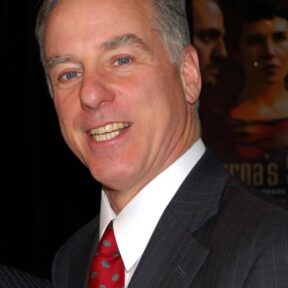
Howard Dean
Overview
* Former Democratic Governor of Vermont and 2004 Democratic failed presidential hopeful
* Outspoken opponent of the War in Iraq and the Patriot Act
* Supports racial preferences in employment and college admissions
* Supported a $2 trillion tax hike for social programs
* Served as DNC Chairman from February 2005 until January 2009
Howard Brush Dean III was born November 17, 1948 in East Hampton, New York. He graduated from Yale University in 1971 with a B.A. in Political Science. After completing a pre-med program at Columbia University, he went on to earn a medical degree from the Albert Einstein College of Medicine at Yeshiva University in 1978. Three years later he married Judith Steinberg, who was also a medical doctor. The couple has two children.
In 1980 Dean served as a volunteer for President Jimmy Carter‘s unsuccessful re-election campaign. In 1982 Dean won a seat in the Vermont House of Representatives, where he remained until he was elected as the state’s lieutenant governor in 1986. On August 14, 1991, Vermont’s then-governor Richard Snelling died suddenly of a heart attack. Dean replaced him in office and held the post until January 2003.
As governor of Vermont, Dean supported his state’s “civil unions” law allowing gay and lesbian couples to participate in a formal ceremony conferring on them all the legal benefits of marriage. He called the passage of this law “in many ways the most important event in my political life.”
Governor Dean was also a strong supporter of affirmative action in education. He opposed the school-testing demands of President Bush’s education plan, which focused on teacher and school accountability. Consequently, he urged his state not to accept $26 million in federal education money, so as to escape the accountability requirements attached to what he called Bush’s “terribly flawed bill.”
In 2003 Dean announced his candidacy for the Democratic Party’s 2004 presidential nomination. He ran chiefly on an anti-war platform that featured consistent denunciations of the Bush administration’s decision to invade Iraq, and in the early months of the race he was the party’s front-runner. Dean’s popularity was fueled, in large part, by his blunt, impulsive speaking style, which he employed to great effect in delivering many blistering attacks on President Bush.
Dean complained that the Bush administration’s unduly aggressive and irresponsible foreign policy had turned the “tidal wave of support and goodwill that engulfed us [Americans] after the tragedy of 9/11” into “distrust, skepticism, and hostility” that “could well take decades to repair.” Bitterly opposed to Operation Iraqi Freedom, Dean asserted that President Bush’s “rhetoric” fell well “short of making a credible case that Iraq present[ed] an imminent threat to vital U.S. interests.” “On my first day in [the President’s] office,” he pledged, “I will tear up the Bush doctrine [of pre-emptive war] and rebuild a foreign policy consistent with American values.”
Dean partially blamed the United States for having brought the wrath of Islamic terrorists upon itself. “One reason America has been targeted by terrorists,” he said, “is that our nation is the preeminent world power. With this power comes great responsibility. . . . The Bush Administration does not seem to understand that true leadership requires creating global institutions and arrangements that help lift people’s lives, improve prospects for peace, and enhance respect for the rule of law.” Dean stressed the importance of allowing “world opinion” to help shape foreign policy decisions, and exhorted American leaders to avoid “stirring resentment . . . especially in the Arab and Muslim worlds.”
During his campaign, Dean characterized Republicans as being inclined to trample on the civil rights of African Americans. At a fortieth-anniversary commemoration of Martin Luther King, Jr.’s 1963 March on Washington, he lamented that “Dr. King’s dream is being attacked by an administration that seeks to unravel the decades of improvements made on civil rights and gaining equal rights for all Americans . . . an administration that seeks to divide us once again by race, gender, sexual orientation, and income.”
Dean was also harshly critical of the Patriot Act — the anti-terrorism bill instituted after the 9/11 attacks — as a manifestation of President Bush’s “reckless disregard for our civil liberties.” He advocated reversing Bush’s tax cuts, characterizing them as benefiting primarily “the top 2 percent” of earners. “People know the Bush tax cuts were hooey,” Dean said.
As an alternative to those tax cuts, candidate Dean proposed a ten-year, $2 trillion tax hike whose revenues would be used chiefly to fund social welfare programs like his proposed universal health care plan that was projected to cost $88 billion per year. This would not have been Dean’s first sojourn into advocacy for socialized medicine. During his tenure as Vermont governor, he supported a “managed competition” plan similar to the one the Clinton administration was pushing for the country as a whole.
Dean dropped out of the presidential race in early 2004, when his poll numbers sank precipitously. On February 12, 2005, he won the chairmanship of the Democratic National Committee (DNC), beating out nearly a dozen rivals for the party’s top leadership position. In a meeting with members of the Congressional Black Caucus shortly after taking the reins of the DNC, Dean joked: “You think the Republican National Committee could get this many people of color in a single room? Only if they had the hotel staff in here.”
In his role as DNC chair, Dean devised and employed a so-called “50-State Strategy” that sought to make local Democrat candidates competitive in traditionally conservative states that his party had essentially conceded to Republicans in prior election years. This tactic was instrumental in helping Democrats regain control of both the House of Representatives and the Senate in 2006. Dean continued to serve as DNC chair until January 2009, when he was replaced by Virginia governor Tim Kaine.
In September 2009, when President Obama’s “green jobs czar,” Van Jones, resigned amid controversy over his longtime communist and anti-American background, Dean called Jones “a star” and described his resignation as “too bad for the country.”
On December 8, 2009, Dean enthusiastically reported that “cooperation” between European socialists and the Democratic Party had “intensified significantly” over the preceding several years and involved “regular contact” at “Congress, Senate, party and foundation levels.” He added that “efforts have been remarkable from both sides.”At a Northern Virginia town hall meeting in August 2009, Dean explained why Obamacare could not include a tort reform provision that, according to many experts, could save up to $40 billion in health care costs each year, and $400 billion over a decade. “Here’s why tort reform is not in the bill,” said Dean. “When you go to pass a really enormous bill like that, the more stuff you put into it, the more enemies you make. And the reason the tort reform is not in the bill is because the people who wrote it did not want to take on the trial lawyers in addition to everyone else they were taking on, and that is the plain and simple truth.”
On March 29, 2010, Dean was asked the following question vis a vis the recent passage of a massive health-care reform bill: “Do you think that, deep down, your party knows that perhaps our long-term growth rate could be hurt but were willing to accept that to live in a different type of society … more akin to Europe?” Dean replied:
“I think that depends how you measure growth rate. Inequality is a problem, and it has been exacerbated over the last, say, 20 or 30 years. So the question is, in a democracy, where does the right balance between those at the top … and those at the bottom [exist]?… When it gets out of whack, as it did in the Twenties and it has now, you need to do some redistribution. This is a form of redistribution. If you redistribute too much, then the system doesn’t work because you take the incentive out of it. So it’s like a machine. You [sic] always gotta tune it right.”
In December 2012, Dean appeared on MSNBC and said the following about Republicans:
“The fact of the matter is you cannot peddle hate of immigrants, gays and lesbians, and women by saying that God’s will was to make women pregnant when they were raped. You can’t — if that’s what you believe, if that’s what conservative principles are, you might as well go someplace else because this country has not bought it anymore. We’re done. The argument is over and these guys are going to have to change their philosophy, not just their ground game …They can win if they change themselves. They have to stop beating up on gays, stop beating up on immigrants, stop beating up on Muslims, and understand what America is really about. And it is really about opportunity. And the young people, who I think voted 65% for Obama, they would vote Republican if it was just on fiscal grounds. But they’re not going to vote Republican when Republicans are preaching hate with the people they grew up and who are their friends. That’s just not going to happen.”
In December 2012, as President Obama and the Democratic Party sought to impose higher tax rates on the top 2% of income earners, Howard Dean provided a glimpse into the Democrats’ long-range plan when he said on MSNBC:
“The only problem is — and this is initially going to seem like heresy from a progressive is — the truth is everybody needs to pay more taxes, not just the rich. And it’s a good start. But we’re not going to get out of this deficit problem unless we raise taxes across the board, to go back to what Bill Clinton had and his taxes.”
In a December 2013 television appearance, Dean spoke on the topic of whether religious institutions had a right to challenge Obamacare’s mandate that they provide their employers wit health-insurance plans that cover the costs of contraception and abortifacients, even if those employers object to such things on moral grounds. Said Dean: “So, you know, this is one country. We all have to live by a set of things that are passed in Washington and agreed to by the [Supreme] Court. We’ll see what the Court does, but I don’t think a particular employer has a right to decide what kind of health care their employees are going to get. That’s now in the hands of the federal government and that’s where it should be.”
At a May 2014 Democratic fundraiser in Colorado, Dean denounced the Republican Party:
“This is a Republican party that has decided they like power so much that they think it’s okay to win by taking away the right to vote…. They are not American. They could be more comfortable in the Ukraine or Russia but stay away from our country. This is based on the right to vote…. We have had enough of the politics of anger. We have had enough of the politics of hate. We have had enough of the politics of division.”
On the afternoon of May 14, 2022, an 18-year-old white man shot and killed 10 people in a Buffalo, New York supermarket located in the heart of a predominantly black community. Eleven of the 13 people who were shot, were black. In light of revelations showing that the gunman had previously, in a manifesto, articulated his contempt for so-called “replacement theory” — the idea that leftists were seeking to replace America’s existing white majority with nonwhites who could be relied upon to vote Democrat in the future — many leftists sought to blame conservatives like Fox News host Tucker Carlson for spreading disinformation about “replacement theory” and thereby fomenting white enmity against nonwhites. Against this backdrop, Dean made a May 19, 2022 appearance on MSNBC’s The Beat, where claimed that Fox News was the brand of “hate” and even “murder,” and that this constituted grounds for the deportation of Fox News founder Rupert Murdoch and his son Lachlan Murdoch, the current CEO of Fox.
Host Naftali Melber said to Dean, “I wanted to speak to you about something we talked about before, which is, of course, the gun problem in this country, the hate problem in this country, and where it all ties back to. The uproar over the replacement theory and the hate and the racism which was cited by the Buffalo shooting suspect.” Melber then quoted a Deadline interview in which Lachlan Murdoch had said, “We are not only in the news business. When you talk to our fans in middle America, they don’t see us as a news business either. They see us as an American media brand.”
Dean responded by saying: “I see the brand of Fox being hate, anger, dishonesty and now murder. That is the brand. That is the brand of the Murdochs have chosen to be their flagship communication. I agree with Biden, Murdoch has harmed this country more than any other human being in my lifetime, and he should never have been given citizenship. The one thing I would change about our immigration policy is to send Murdoch back to Australia and keep them there, the whole family. If you cause that much trouble, you spread lies and hate and anger and tear the United States apart with your crappy TV shows, simply to make money, you do not belong, you do not deserve American citizenship, period.”
During a July 5, 2022 appearance on MSNBC’s The Beat, Dean was asked by guest host Jason Johnson: “You now have some Republicans who are saying, hey, look, maybe Donald Trump shouldn’t run [for president] again. Maybe it will be a problem. Maybe, you know, him running with all these allegations and all this violence associated with him, maybe it ends up being damaging with the party. Do you think any of these potential allegations could influence when he will make an announcement [about possibly running again]? Or do you think it is just a done deal that the former president will run again in 2024?” Dean replied:
“I don’t think it is a done deal at all., and I have no idea what his calculation is. But you know, we [Democrats] won in Georgia, particularly in the Senate, because of Donald Trump. Because there were a number of Republican women, moderate Republican women in the suburbs who couldn’t stomach voting for this crook and this disgusting person. They just couldn’t. And that’s happening all over the country every day, the more stuff that comes out. So I’m actually hoping Trump does run. I think Trump’s calculation is mixed up with his illness, which is narcissism, acute narcissism, and is also mixed with a political congratulation that he’s not very good at. You know, there are a lot of younger people in that [Republican] party that are much scarier. [Florida Governor Ron] DeSantis, for one, who … just today announcing he’s going to require all students in Florida’s colleges to declare their political their views. I mean, this guy is a fascist. Trump is too narcissistic and ill to be a successful fascist even though he has all those instincts. I think he will be easier to beat than any of the other potential candidates.”