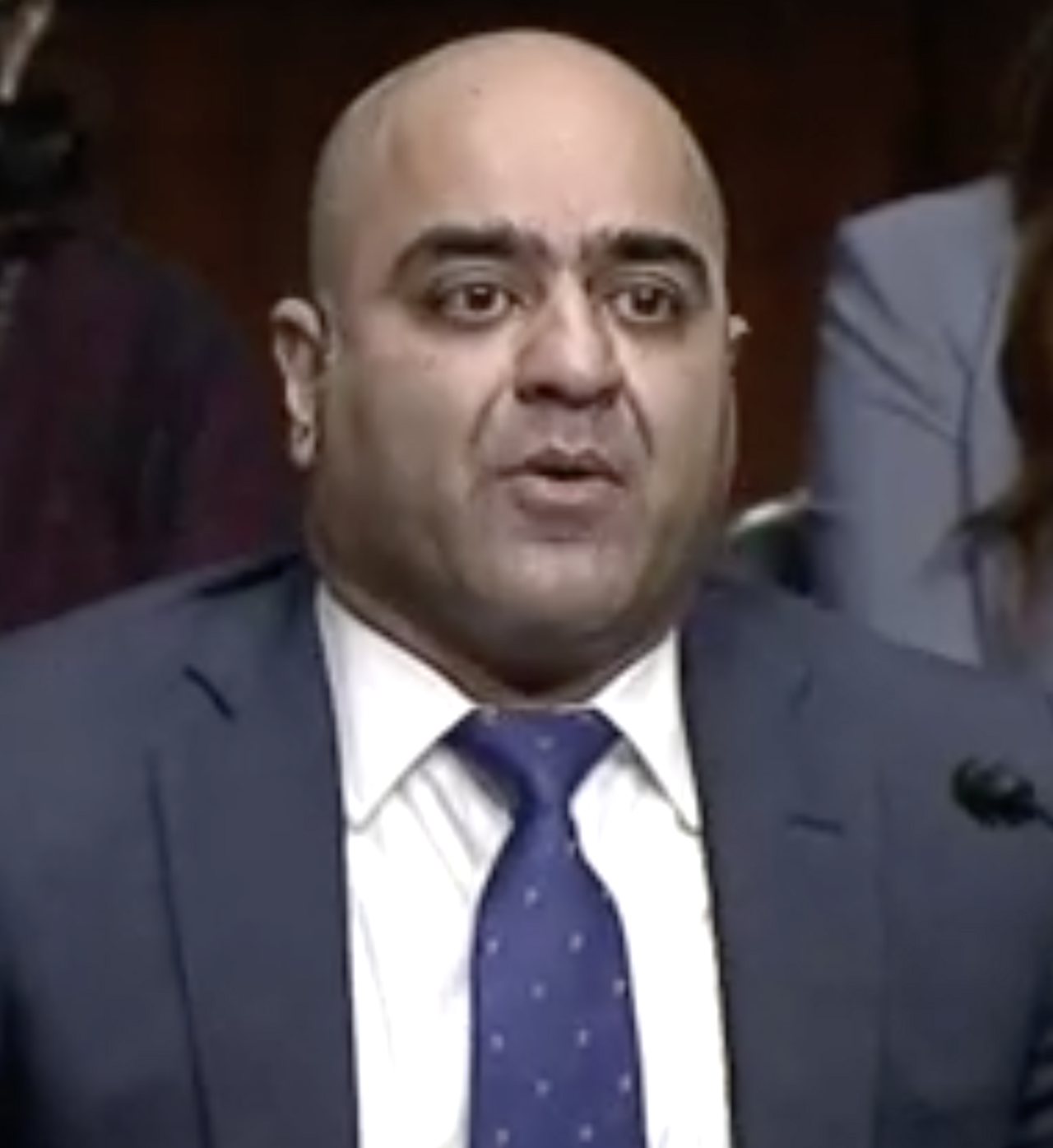
Zahid Nisar Quraishi
Copyright Information: Photo from Wikimedia Commons / Author of Photo: United States Senate Judiciary Committee / Source of Photo: https://www.judiciary.senate.gov/meetings/04/21/2021/nominationsOverview
Overview [1]
Zahid Nisar Quraishi was born in New York City on July 19, 1975. He was subsequently raised in Fanwood, New Jersey, by his mother, Shahida P. Quraishi, and his father, Dr. Nisar A. Quraishi— both of whom had immigrated to the United States from their native Pakistan.
Zaid Quraishi earned a BA degree from the John Jay College of Criminal Justice in 1997, and a JD from Rutgers Law School in 2000.
After completing his legal studies, Quraishi served as a law clerk to Judge Edwin H. Stern of the New Jersey Superior Court from 2000-2001. He subsequently worked as a litigation associate at the Newark, New Jersey-based law firm of LeBoeuf, Lamb, Greene & MacRae from 2002-2003.
In June 2003, Quraishi left private practice to serve in the U.S. Army Judge Advocate General’s Corps, the official legal arm of the United States Army, where he provided legal counsel to American commanders in Germany.
During the early stages of Operation Iraqi Freedom in 2004, Quraishi deployed to Tikrit, Iraq, to advise the U.S. military on matters like rules of engagement, military justice, and the handling of detainees. Later that year, he resumed his legal counsel duties in Germany until he was redeployed to Ramadi, Iraq in August 2006.
When Quraishi’s years of military service came to an end in 2007, he was honorably discharged at the rank of Captain, receiving both a Bronze Star and a Combat Action Badge.
Legal career
From 2007-2008, Quraishi served as an Assistant Chief Counsel in the Office of the Chief Counsel at the U.S. Immigration & Customs Enforcement (ICE) agency in New York City.
From 2008-2013, he was an Assistant United States Attorney for the District of New Jersey.
From 2013-2019, Quraishi served as an attorney at the Morristown, New Jersey law firm of Riker, Danzig, Scherer, Hyland & Perretti LLP, where he was a partner from 2016-2019. He was then named chair of the firm’s White Collar Criminal Defense and Investigations practice in 2019.
In the fall of 2020 and the spring of 2021, Quraishi taught courses on trial presentation at Rutgers Law School.
Federal Judicial Service
Quraishi served as a magistrate judge with the United States District Court for the District of New Jersey from June 3, 2019 through June 22, 2021 — a position that made him the first Asian-American ever to sit on the federal bench in New Jersey.
On April 19, 2021, Democrat U.S. President Joe Biden nominated Quraishi to serve as a judge on the United States District Court for the District of New Jersey. Nine days later, the Senate Judiciary Committee held a hearing on Quraishi’s nomination, which ultimately was confirmed by an 81–16 U.S. Senate vote on June 10, 2021. Senate Democrats supported his nomination by a unanimous margin, 47-0. Upon formally taking office, Quraishi became the first Muslim-American ever to serve on a federal district court.
Supporting Gun Rights
One of Quraishi’s more noteworthy rulings centered around NJ AB 1765, a 2022 New Jersey law that authorized the state’s Attorney General to bring civil lawsuits against gun companies for their failure to “establish, implement, and enforce reasonable controls regarding [their] manufacture, sale, distribution, importing, and marketing of gun related products.”
On November 23, 2022, the National Shooting Sports Foundation (NSSF) — a Connecticut-based, gun-industry trade group — sued to block the implementation of NJ AB 1765, claiming that the statute violated due process, the First and Second Amendments, and the Dormant Commerce Clause. NSSF also said that the statute was preempted by the federal Protection of Lawful Commerce in Arms Act (PLCAA), which Congress had enacted in 2005 to shield firearms manufacturers, distributors, and dealers from civil lawsuits seeking to hold them liable for the actions of people who misuse weapons for criminal or illegal purposes.
Quraishi sided with NSSF and granted a Preliminary Injunction to block the enforcement of NJ AB 1765. In his opinion of January 31, 2023, he wrote that the law was in “direct conflict” with the PLCAA:
“Congress’s intent here is clear. The PLCAA’s purpose is to ‘prohibit causes of action against manufacturers, distributors, dealers, and importers of firearms or ammunition products, and their trade associations, for the harm solely caused by the criminal or unlawful misuse of firearm products or ammunition products by others When the product functioned as designed and intended.’ A1765 does just the opposite.”
Judge Quraishi also argued that the state law seemed to violate the Supremacy Clause of the U.S. Constitution, which dictates that where federal laws and state laws conflict, the federal statutes take precedence.
In August 2023, a three-judge panel for the U.S. Court of Appeals for the Third Circuit issued a unanimous ruling vacating Judge Quraishi’s injunction, thereby permitting the New Jersey law to go back into effect. Writing for the panel, Judge Stephanos Bibas said that NSSF had “jumped the gun” in challenging the law because the attorney general had not yet enforced it. “The attorney general ‘might sue’ the foundation or its members, ‘but it might not,’” Bibas wrote. “With so much still vague and uncertain, a court should not weigh in.” Thus, Bibas vacated the lower court’s Preliminary Injunction and sent it back to the district court with instructions to dismiss it. “Federal courts are not forecasters,” he wrote. “The Constitution limits our jurisdiction to disputes that have ripened fully. We may not prejudge hypothetical cases or offer legal advice. Instead, parties must first be injured before coming to us for redress. Only then do we react.”
Reformatting the Ballots for Party Primary Elections
Judge Quraishi presided over Kim v. Hanlon, a February 2024 case brought by Democrat U.S. Senate candidate Andy Kim and two Democrat U.S. House candidates challenging the so-called “county line,” a design feature of the ballots that were in use for party primary elections in most New Jersey counties. Specifically, the “county line” permitted party leaders to place the names of primary candidates whom they personally endorsed, in the most desirable areas of the primary election ballots – i.e., a highly visible row or column – regardless of which offices they were seeking. By contrast, the names of candidates who lacked the support of party leaders tended to be randomly scattered throughout the right side of the ballots – an area that political analysts often referred to as “Ballot Siberia.” As the publication Planet Princeton wrote: “Studies have shown it is difficult for candidates who do not receive the line to win in the primary.” Arguing that the “county line” ballot design violated the First Amendment right to free association by forcing candidates to either “associat[e] with candidates with whom they may not wish to associate or fac[e] ‘Ballot Siberia,’” Kim and his fellow plaintiffs asked Quraishi to issue a Preliminary Injunction that would eliminate the “county line” from all ballots.
The Defendants in the case were Monmouth County Clerk Christine Hanlon and 18 additional New Jersey county clerks who were grouped collectively under her name.
On March 29, 2024, Quraishi ruled that the “county line” system violated candidates’ First Amendment right to free association. Asserting that the integrity of the democratic process itself was at stake, the judge issued a Preliminary Injunction mandating that all county clerks should immediately stop using “county line” ballots, and switch to ballots where the candidates’ names appeared randomly within their respective “office blocks” – i.e., where candidates’ names are grouped together according to which office they are mutually seeking. This directive, said Quraishi, should be implemented starting with the upcoming Democratic primary election of June 2024. The Third Circuit Court of Appeals quickly upheld the judge’s decision.
In early 2025 the New Jersey Legislature passed a new ballot law mandating that ballot design in all counties conform to the guidelines spelled out in Judge Quraishi’s March 2024 edict. Quraishi, however, noted that parts of the new law still permitted candidates to bracket together in ways other than by office blocks, thus the unconstitutional practices had not been entirely eliminated. Therefore, the litigation battles would continue.
Those battles came to an end in August 2026, when a final agreement was reached and was subsequently approved by Judge Quraishi. This settlement permanently ended the “county line” ballot system across the state and codified an office-block ballot structure for all future New Jersey primary elections. As The Jersey Vindicator reported just before the final agreement was made official:
“Under the proposed settlement, candidates would be grouped according to the office they are seeking. For example, all candidates for governor would appear together and all candidates for the state Assembly would appear together.
“The clerk also would conduct a separate random drawing for each office. Every candidate running for the same position would have an equal chance to appear first.
“Those rules would apply to all primary ballots, including mail-in ballots and ballots used at polling places.
“Bergen County could no longer use the result of a drawing for one race to determine where an entire group of party-endorsed candidates appears. It also could not place candidates for different offices together in one column or row.
“The clerk would be barred from separating a candidate from others seeking the same office or placing one candidate beneath or beside opponents who otherwise appear together.
“Candidates still could share a slogan on the ballot. But the clerk could not group them in a way that prevents their opponents from receiving an equal drawing and equal placement.”
Blocking Trump’s Deportation of Illegal Alien from El Salvador [2]
Another important case over which Judge Quraishi presided was the 2026 immigration case of Diana Elizabeth Cartagena Hueso, a married, 29-year-old illegal alien from El Salvador who had begun living in the United States a decade earlier, in August 2016. The U.S. Border Patrol apprehended Ms. Hueso immediately after she had unlawfully crossed America’s southern border in 2016, and then detained her for approximately two months. In October 2016, U.S. immigration authorities – believing that the woman’s professed fear of returning to her home country was credible — released Hueso and referred her for an asylum hearing. The woman subsequently proceeded to continue living in the United States for the next 10 years, and by 2026 she was raising a 5-year-old child to whom she had given birth in the U.S.
On January 27, 2026, Trump administration immigration authorities — invoking Section 235 of the Immigration and Nationality Act (INA), a law that allowed for the expedited removal of illegal border crossers — arrested both Ms. Hueso and her husband. But according to a New Jersey federal appeals court, that law applied only to newcomers who: (a) were just “arriving in the United States” via border crossings, and had not yet made their way into the American interior; (b) had been “encountered within 14 days of entry without inspection”; and (c) were still within 100 miles of an international border.
“An individual like Petitioner [Ms. Hueso] who has been released into the United States without parole is no longer considered to be standing at the border,” wrote Judge Quraishi. “Her status must be considered in light of the decade during which the Government permitted her to be at liberty within the United States.”
On February 14, 2026, Ms. Hueso filed a petition asking that she be released from custody. Three days later, Quraishi ordered that the government refrain from moving the woman out of New Jersey, and he ordered a bond hearing for her case. But by then, Ms. Hueso had already been transferred to Oklahoma. She was then transferred to Texas on February 17, and then back again to Oklahoma. Judge Quraishi reprimanded the Trump administration for: (a) not having alerted him to any of those transfers, and (b) arguing that it was not obligated to transfer the woman back to New Jersey, the state where the judge wanted her to be.
Quraishi said that the Trump administration’s handling of Ms. Hueso’s petition was “emblematic of its approach to immigration enforcement in this state.” “On the merits, its detentions are illegal,” the judge wrote. “The Government knows this.” Further, Quraishi defiantly declared that he would “not stand idly by and allow this intentional misconduct [by the Trump administration] to go on. It ends today.” He also asserted that in approximately 300 prior cases, the government’s use of Section 235 had already been rejected by federal judges. Thus, said Quraishi, any further arrests and detentions carried out under the banner of that statute would “likely trigger” the scheduling of a hearing at which individuals from the U.S. Attorney’s Office and the Homeland Security Department would be called to testify under oath about the cases in question.
Quraishi’s Contempt for Trump Leads Him to Browbeat NJ Prosecutors
Background of the Case
On March 24, 2025, President Trump named his former personal defense attorney, Alina Habba, as the Interim U.S. Attorney – i.e., the chief federal prosecutor — for the District of New Jersey. The period for which Habba would be able to hold that post would be restricted to 120 days by federal law, unless: (a) the District Court were to formally extend her tenure, or (b) she were to win confirmation from the U.S. Senate. The possibility of the latter occurring was remote, however, in light of the fact that New Jersey’s two senators, Democrats Andy Kim and Cory Booker, opposed her nomination. As Courthouse News Service reported on July 23, 2025: “Senate tradition stands in the way of Habba’s final confirmation — Kim and Booker have said that they will withhold blue slips on her nomination, a longstanding chamber courtesy that allows home state senators to blockade certain judicial nominees.”
On July 24, 2025 — following the expiration of Habba’s initial 120-day interim appointment – Trump named her as Acting U.S. Attorney for the District of New Jersey. However, three men who at that time were facing criminal charges in that state, argued that her new appointment violated the Federal Vacancies Reform Act (FVRA) – and that neither Habba nor any assistants working under her authority should be permitted to prosecute the defendants’ case.
In August 2025, U.S. District Judge Matthew Brann of Pennsylvania ruled that Habba’s appointment as Acting U.S. Attorney for the District of New Jersey indeed violated the FVRA; that she was serving “without lawful authority” and therefore “must be disqualified from participating in any ongoing cases.”
After the U.S. Court of Appeals for the Third Circuit issued a December 1, 2025 decision backing Judge Brann’s ruling, Habba formally stepped down from her role as U.S. Attorney on December 8, 2025.
Following Habba’s departure, U.S. Attorney General Pam Bondi replaced her by appointing Philip Lamparello, Jordan Fox and Ari Fontecchio – often referred to as a “triumvirate” — to divide the responsibilities of the U.S. Attorney’s role between the three of them.
But on March 9, 2026, Judge Brann ruled that Bondi’s decision to split the power of the Assistant U.S. Attorney’s office among three separate individuals was both unlawful and unconstitutional. Such a leadership structure “exceed[ed]” the Attorney General’s authority, said the judge, and represented a violation of the Appointments Clause of the United Sates Constitution. Warning that “any further attempts to unlawfully fill the office will result in dismissals of pending cases,” Brann wrote in his 130-page opinion: “One year into this administration, it is plain that President Trump and his top aides have chafed at the limits on their power set forth by law and the Constitution. To avoid these roadblocks, this administration frequently purports to have discovered enormous grants of executive power hidden in the vagaries and silences of the code.” Brann further asserted that instead of going through the “viable methods” of filling the vacancy left by Habba’s disqualification, “the Government tells us: the President doesn’t like that he cannot simply appoint whomever he wants,” irrespective of whether the Senate confirms them.
According to David Horowitz Freedom Center CEO Daniel Greenfield, Bondi’s appointment of the triumvirate was wholly “legitimate because Assistant U.S. Attorneys … are still deriving their authority from the Justice Department and Attorney General Pam Bondi.” “The law is quite clear.” he added. “…. U.S. attorneys are appointed by the president, they can be appointed on an interim basis for a temporary period, and district judges, especially, have no oversight over these appointments.”
Vis-à-vis the question of whether or not Alina Habba was still involved in running the office of U.S. Attorney for the District of New Jersey, Ms. Habba herself, who was now a senior advisor at the Justice Department, used her X social media account to characterize Judge Brann’s ruling as a “ridiculous” and unconstitutional” example of “complete overreach into the Executive Branch” by someone who “would rather have no U.S. Attorney than safety for the people of NJ.”
Quraishi Browbeats the NJ Prosecutors
Judge Quraishi became embroiled in controversy regarding the leadership structure of the aforementioned U.S. Attorney’s office for the District of New Jersey when, on March 16, 2026, he was presiding over the scheduled sentencing hearing of 39-year-old Francisco Villafane, who had: (a) begun grooming a 13-year-old girl into an online sexual relationship six years earlier; (b) been arrested for that crime in 2024; and (c) agreed in 2025 to plead guilty to possession of pornographic images of the female victim.
Early in the March 16, 2026 sentencing hearing, Quraishi became enraged by the presence of Mark Coyne, the longtime Chief of the Appeals Division for the U.S. Attorney’s Office for the District of New Jersey, who was accompanying the line prosecutor on the case, a relative newcomer named Daniel Rosenblum. Quraishi stated that because Coyne had not formally disclosed in advance that he would be appearing with Rosenblum at the hearing, he had no right to even be present in the courtroom that day – let alone to address the court directly. “I’m not going to hear from you, Mr. Coyne,” said the judge. “If you want to sit there for moral support or hand Mr. Rosenblum Post-its or whisper in his ear, I’ll let you do that as supervisor.”
Quraishi then proceeded to question Rosenblum about the details of Mr. Villafane’s plea agreement, alleging that the prosecutor – by having thus far failed to consider and present all the available incriminating evidence against the defendant — was irresponsibly preparing to allow the defendant to serve significantly less prison time than legal guidelines permitted. “How did the screw-up happen?” Judge Quraishi asked. “Was it your office, the U.S. Attorney’s office, the F.B.I. or both? How did you execute a plea agreement without knowing all the evidence?”
Next, Quraishi asked Rosenblum a series of questions about who was in charge of U.S. Attorney’s Office for the District of New Jersey, including whether Ms. Habba still held some type of leadership role there.
“None that I’m aware of,” Rosenblum replied.
“So she could be operating the office,” the judge retorted.
“She is not,” Coyne interjected, prompting Quraishi to tell Coyne: “You don’t get to blindside the court and do whatever it is you guys want to do. So if you continue to speak, you can leave.” When Coyne nonetheless proceeded to continue speaking, the judge directed security officers to take him out of the courtroom.
Quraishi then turned his attention back to Rosenblum, asking whether the latter knew for certain whether or not Ms. Habba was still “influencing the operations of your office.” When Rosenblum reiterated that he had no personal knowledge of Habba’s continued involvement, the judge declared that he: (a) was suspending the remainder of that day’s scheduled hearing, and (b) would call Habba’s three replacements — Philip Lamparello, Jordan Fox and Ari Fontecchio — to testify under oath regarding the existing leadership hierarchy of their office. “They’re going to testify,” said Quraishi, “and this court’s going to figure out who is currently operating this office before I proceed with today’s sentencing hearing. Generations of assistant U.S. Attorneys had built the goodwill of that office for your generation to destroy it within a year.”
Quraishi further instructed Rosenblum to inform his colleagues that “They’re not going to be able to just walk into this courtroom and say, ‘We just want to proceed.’” “You have lost the confidence and the trust of this court,” added the judge. “You have lost the confidence and the trust of the New Jersey legal community, and you are losing the trust and confidence of the public.”
According to a March 17, 2026 New York Times report: “Ms. Habba is now a senior adviser to the attorney general and supervises U.S. attorneys around the United States. She has been in the New Jersey office in recent weeks. It is unclear why. Her presence alone would not be inappropriate or out of the ordinary given her position. It is unclear what motivated Judge Quraishi’s questions.”
Moreover, Daniel Greenfield: (a) pointed out that all of the information Quraishi vowed to uncover was “completely unrelated to the case in front of him”; and (b) asserted that the judge was chiefly interested in carrying out “an unconstitutional judicial coup to seize power over an arm of the Department of Justice.” Added Greenfield:
“Zahid Quraishi is contending that he has the authority to deem the US Attorney’s office in New Jersey illegitimate, dispose of its cases, browbeat random federal prosecutors to demand that they restructure their office along the Biden appointee’s preferred lines, that he can mandate that its top officials testify under oath, sequestered, about their office (with penalties), and until then he will not allow a sentencing hearing for a child sex predator.”
Footnotes:
[1] https://en.wikipedia.org/wiki/Zahid_Quraishi
https://www.law.com/article/almID/1202664704977/
https://ballotpedia.org/Zahid_Quraishi
https://bidenwhitehouse.archives.gov/briefing-room/statements-releases/2021/03/30/president-biden-announces-intent-to-nominate-11-judicial-candidates/
https://www.judiciary.senate.gov/imo/media/doc/Quraishi%20Senate%20Judiciary%20Questionnaire.pdf
https://web.archive.org/web/20200729025054/
https://law.rutgers.edu/news/rutgers-law-grad-becomes-first-asian-american-federal-judge-new-jersey
[2] https://newjerseymonitor.com/2026/02/26/judge-excoriates-feds-migrant-detention-illegal/
https://www.nytimes.com/2026/02/26/nyregion/new-jersey-trump-immigration-federal-judge.html
https://www.rawstory.com/ice-2675342443/
https://newrepublic.com/post/207108/it-ends-today-judge-threatens-doj-dhs-officials-oath