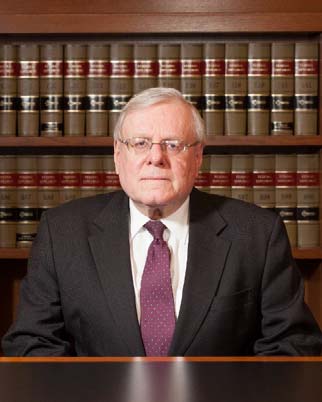
William G. Young
Copyright Information: Photo from Wikimedia Commons / Author of Photo: United States District Court for the District of MassachusettsOverview
Overview [1]
William G. Young was born in Huntington, New York, on September 23, 1940. He earned an AB degree from Harvard University in 1962, and a Bachelor of Laws (LL.B.) degree from Harvard Law School in 1967. He also served as a Captain in the United States Army from 1962-1964.
Young began his legal career as a law clerk for then-Chief Justice Raymond Wilkins of the Massachusetts Supreme Judicial Court from 1967-1968. He then worked as a private-practice attorney in Massachusetts from 1968 to 1972; a part-time Special Assistant Attorney General for the Commonwealth of Massachusetts from 1970-1972; and Chief Counsel to then-Massachusetts Governor Francis Sargent from 1972-1974.
Young then returned to private-practice legal work in Massachusetts for four years, until Governor Michael Dukakis appointed him as an Associate Justice of the Massachusetts Superior Court in 1978 – a position Young would hold until 1985.
Young also served for a number of years as a lecturer at Boston College Law School beginning in 1968; at Boston University Law School starting in 1979; and at Harvard Law School from 1979-1990.
President Ronald Reagan nominated Young to a judgeship with the United States District Court for the District of Massachusetts on September 11, 1984. When the nomination lapsed without a Senate vote, Reagan renominated Young on March 8, 1985. The United States Senate eventually confirmed Young on April 3, 1985, and he went on to hold that position for the next 36 years. For six of those years – 1999 to 2005 — he was the Chief Judge in the District Court of Massachusetts.
Young retired from regular active service on July 1, 2021, and he assumed the status of a senior judge at that point.
Some Notable Cases
As a state and federal judge, Young has presided over numerous patent cases pertaining to areas like biotechnology, pharmaceuticals, and patent infringement.
He also has presided over high-profile criminal cases such as:
- The “Big Dan” case involving a Massachusetts woman who was gang-raped in a barroom by four men in 1983: Rejecting defense attorneys’ effort to blame the victim for being alone in the bar where she was attacked, Young handed out concurrent prison terms of 6 to 12 years for the four men whom the jury convicted of aggravated rape.
- The shoe bomber case involving Muslim terrorist Richard Reid’s December 2001 attempt to blow up an American Airlines flight by detonating homemade bombs hidden in his shoes: Young sentenced Reid to three consecutive life terms plus 80 years in prison without parole; he also fined the defendant $2 million.
- The 2001 case of Albert DeSalvo, the so-called “Boston Strangler,” who in 1965 confessed to having raped and murdered 13 women in the Boston area from 1962-1964: This 2001 lawsuit was initiated long after the confession and subsequent 1973 death of DeSalvo, when the families of DeSalvo and his final victim, Mary Sullivan, collaborated in a joint effort to prove that DeSalvo was innocent, on the theory that the real killer was still at large. Young instructed the Massachusetts Attorney General’s office to provide investigators with all the pertinent forensic materials at their disposal.
Upholding a State Ban on “Assault Weapons” & “Large-Capacity Magazines” (LCMs)
Another notable case over which Judge Young presided was Worman v. Healey. This case originated on January 23, 2017, when the lead plaintiff, Donald Worman, filed a lawsuit along with a number of Massachusetts-based gun owners, gun dealers, and a firearm advocacy association. Citing what they described as their “unfettered” Second Amendment right to possess certain “assault weapons” and LCMs (magazines holding more than ten rounds) for purposes of self-defense in their homes, the plaintiffs challenged the constitutionality of a 1998 Massachusetts law – entitled “An Act Relative to Gun Control in the Commonwealth” — barring the possession of such guns and magazines across the state. The plaintiffs also claimed that the statute infringed upon their rights to the due process guaranteed by the Fourteenth Amendment to the U.S. Constitution.
The principal defendant in the case was Massachusetts Attorney General Maura Healey; other Massachusetts-based defendants included Governor Charles Baker, Public Safety & Security Secretary Daniel Bennett, State Police Superintendent Richard McKeon, and the Massachusetts State Police as an organization.
On April 5, 2018, Judge Young – citing the U.S. Supreme Court’s 2008 decision in District of Columbia v. Heller — ruled that the 1998 Massachusetts law in question did not violate anyone’s Second Amendment rights. In Heller, the Supreme Court had ruled that while the Second Amendment barred prohibitions on handguns, “weapons that are most useful in military service — M-16 rifles and the like [–] are not protected under the Second Amendment and may be banned.” Wrote Young: “The undisputed facts in this record convincingly demonstrate that the AR-15 and LCMs banned by the [1998] Act are ‘weapons most useful in military service.'” “As a matter of law,” he added, “these weapons … fall outside the scope of the Second Amendment and may be banned.”
In 2019 the plaintiffs in Worman v. Healey appealed Judge Young’s decision to the U.S. Court of Appeals for the First Circuit, which affirmed Young’s ruling.
AAUP v. Rubio: Challenging “Ideological Deportation” by Trump [2]
Another highly noteworthy case over which Judge Young presided was known as American Association of University Professors v. Rubio. The case was centered around a lawsuit that the Knight First Amendment Institute at Columbia University – whose stated mission is to “promote a system of free expression that is open and inclusive” — initiated on March 25, 2025 in the U.S. District Court for the District of Massachusetts. As the Knight Institute explained, the suit — which was filed on behalf of the American Association of University Professors (AAUP) and the Middle East Studies Association (MESA) — “challeng[ed] the [Donald] Trump administration’s policy” of “combating antisemitism” by “arresting, detaining, and deporting noncitizen students and faculty who participate[d] in pro-Palestinian activism.” The plaintiffs argued that the administration’s crackdown on illegal immigration had become corrupted by widespread “ideological deportation” – i.e., the removal of illegals because of their political rhetoric and activism, particularly on university campuses. “A climate of repression and fear,” the plaintiffs charged, was now preventing noncitizens from freely speaking their minds on matters of import to them. The Trump policies “have sent chills through the community of noncitizen students and faculty on campuses around the country,” added the lawsuit, “causing some to pull out of academic conferences, stay home from protests, and withdraw from other forms of public advocacy and engagement.”
One of the most prominent individuals whose detention by immigration authorities prompted the plaintiffs to file their suit was Columbia University graduate student Mahmoud Khalil, a Syrian national born to Palestinian parents. Deeply contemptuous of Jews, Khalil helped lead a series of highly visible, often-menacing, anti-Israel protests on the Columbia campus during 2024-2025. He was also a leader of the university’s “Apartheid Divest” organization, which explicitly advocated for the “total eradication of Western civilization.” Moreover, Khalil was accused of having committed fraud on his 2024 Green Card application.
The defendants named in the lawsuit were the U.S. Department of State (headed by Secretary of State Marco Rubio), the U.S. Department of Homeland Security, the U.S. Immigration and Customs Enforcement agency (ICE), and President Trump.
Judge Young called AAUP v. Rubio “perhaps the most important [case ever] to fall within the jurisdiction of this district court.” From the outset, he believed that President Trump was guilty of trying to undermine the First Amendment in multiple ways.
For one, the judge was troubled by the contents of Trump’s Executive Order 14188, which was titled Additional Measures To Combat Anti-Semitism and was issued on January 29, 2025. That Order stated, among other things:
- “On December 11, 2019, I issued Executive Order 13899, my first Executive Order on Combating Anti-Semitism, finding that students, in particular, faced anti-Semitic harassment in schools and on university and college campuses…. The prior [Biden] administration effectively nullified Executive Order 13899 by failing to give the terms of the order full force and effect throughout the Government. This order [14188] reaffirms Executive Order 13899 and directs additional measures to advance the policy thereof in the wake of the Hamas terrorist attacks of October 7, 2023, against the people of Israel. These attacks unleashed an unprecedented wave of vile anti-Semitic discrimination, vandalism, and violence against our citizens, especially in our schools and on our campuses. Jewish students have faced an unrelenting barrage of discrimination; denial of access to campus common areas and facilities, including libraries and classrooms; and intimidation, harassment, and physical threats and assault.”
- “It shall be the policy of the United States to combat anti-Semitism vigorously, using all available and appropriate legal tools, to prosecute, remove, or otherwise hold to account the perpetrators of unlawful anti-Semitic harassment and violence.“
- “Within 60 days of the date of this order, the head of each executive department or agency shall submit a report to the President … identifying all civil and criminal authorities or actions within the jurisdiction of that agency, beyond those already implemented under Executive Order 13899, that might be used to curb or combat anti-Semitism, and containing an inventory and analysis of all pending administrative complaints … against or involving institutions of higher education alleging civil-rights violations related to or arising from post-October 7, 2023, campus anti-Semitism.“
Second, Young objected to Trump’s issuance — in conjunction with Executive Order 14188 — of a fact sheet “explaining that the Department of Justice would take ‘immediate action’ to, among other things, ‘investigate and punish anti-Jewish racism in leftist, anti-American colleges and universities.’” Added Young: “[Trump] also made the following statement in that fact sheet: ‘To all the resident aliens who joined in the pro-jihadist protests, we put you on notice: come 2025, we will find you, and we will deport you. I will also quickly cancel the student visas of all Hamas sympathizers on college campuses, which have been infested with radicalism like never before.’”
Third, Young noted that under Trump, the Department of Justice (DOJ) had announced, on February 3, 2025, the creation of a Task Force to Combat Anti-Semitism, whose “first priority will be to root out anti-Semitic harassment in schools and on college campuses.”
Fourth, Young suggested that when Trump’s EO 14149 — titled Restoring Freedom of Speech and Ending Federal Censorship and issued on January 20, 2025 — pledged to defend “the constitutionally protected speech rights of American citizens across the United States,” the President was making it “clear that, in his view, the First Amendment’s protection of freedom of speech applies to American citizens alone, and to an unconstitutionally narrow view of citizenship at that.”
In amicus briefs that were filed during April 2025, the AAUP, Human Rights First, and the Knight First Amendment Institute argued in support of the plaintiffs’ motion for a Preliminary Injunction against the Trump deportation policies — on grounds that restrictions on the speech and free-association rights of people because of their political views, constituted violations of First Amendment rights, academic freedom, and international human-rights standards.
Judge Young presided over a bench trial for this case on ten separate days between July 7 and July 21, 2025, followed by a period during which both parties filed additional briefs into early autumn.
Young’s Ruling in AAUP v. Rubio [3]
On September 30, 2025, Judge Young ruled that the defendants’ policy of thwarting the speech and actions of pro-Palestinian protesters was, as the Knight Foundation phrased it, “impermissibly viewpoint discriminatory in violation the First Amendment and contrary to constitutional right and arbitrary and capricious in violation of the Administrative Procedure Act.”
In his decision, Young addressed the question of “whether non-citizens lawfully present here in United States actually have the same free speech rights as the rest of us.” He concluded that “unequivocally ‘yes, they do,’” explaining that “The First Amendment does not draw President Trump’s invidious distinction [between the free-speech rights of citizens and non-citizens,] and it is not to be found in our history or jurisprudence.”
“Congress,” added Young, “has clarified that a non-citizen is generally not ‘excludable or subject to restrictions or conditions on entry into the United States’ on account of the non-citizen’s ‘past, current, or expected beliefs, statements, or associations, if such beliefs, statements, or associations would be lawful within the United States, unless the Secretary of State personally determines that the [non-citizen’s] admission would compromise a compelling United States foreign policy interest.’”
“No one’s freedom of speech is unlimited, of course, but these limits are the same for both citizens and non-citizens alike,” Young wrote. “The president’s palpable misunderstanding that the government simply cannot seek retribution for speech he disdains poses a great threat to Americans’ freedom of speech.”
In a footnote, Young stated that efforts to intimidate non-citizen students was just one aspect of the Trump administration’s “full-throated assault on the First Amendment across the board under the cover of an unconstitutionally broad definition of Anti-Semitism.”
Some additional key excerpts from Judge Young’s decision:
- “[T]his Court finds as fact and concludes as matter of law that Secretaries Kristi Noem [Homeland Security] and Rubio and their several agents and subordinates acted in concert to misuse the sweeping powers of their respective offices to target noncitizen pro-Palestinians for deportation primarily on account of their First Amendment protected political speech. They did so in order to strike fear into similarly situated non-citizen pro-Palestinian individuals, pro-actively (and effectively) curbing lawful pro-Palestinian speech and intentionally denying such individuals (including the plaintiffs here) the freedom of speech that is their right. Moreover, the effect of these targeted deportation proceedings continues unconstitutionally to chill freedom of speech to this day.”
- “Having carefully considered the entirety of the record, this Court finds by clear and convincing evidence that the Secretary of Homeland Security Kristi Noem and the Secretary of State Marco Rubio, together with the subordinate officials and agents of each of them, deliberately and with purposeful aforethought, did so concert their actions and those of their two departments intentionally to chill the rights to freedom of speech and peacefully to assemble of the non-citizen plaintiff members of the plaintiff associations.”
Young also found that the Trump policy constituted an “arbitrary” and “capricious” departure from previous agency policy, and thereby violated the Administrative Procedure Act.
Moreover, Young condemned Immigration and Custom Enforcement (ICE) officials for their practice of wearing masks while arresting people like Mahmoud Khalil on immigration-related charges. “ICE goes masked for a single reason — to terrorize Americans into quiescence,” the judge wrote. “To us, masks are associated with cowardly desperados and the despised Ku Klux Klan. In all our history we have never tolerated an armed masked secret police. Carrying on in this fashion, ICE brings indelible obloquy to this administration and everyone who works in it.”
Young’s Hostility Toward Israel
Also in his AAUP v. Rubio ruling, Judge Young said that “demonstrations on college campuses across the United States” had been prompted by the fact that Israel, in its military response to the Hamas atrocities of October 7, 2023, “had killed more than 21,000 Palestinians and injured more than 56,000 by the end of the year, displaced the vast majority of Palestinians in Gaza, and resulted in a severe humanitarian crisis.” Further, Young rebuked the Trump administration for “following in virtual lock-step the foreign policy of the State of Israel.”
Young’s Personal Contempt for Trump
Young’s ruling in AAUP v. Rubio also made clear his deep personal contempt for Donald Trump, describing the President and his rhetoric variously as ‘bellicose,” “coarse,’ ‘scandalous,’ ‘defamatory,’ and ‘cruel.’
An entire section of the ruling was headlined Justice in the Trump Era, claiming that the AAUP v. Rubio case was intimately related to “the nature of our President himself.” In this section, Young wrote:
“In other proceedings involving the Trump administration, this Court has already set forth its understanding of what may be called ‘the unitary presidency’ and I repeat it here:
“… We’ve never had a President like President Trump. He espouses, [and] he’s the first President in our history to espouse, a concept of the unified Presidency. The idea is that the President of the United States … is the single, superior, executive, motive force for all federal employees employed under Article II. [T]here’s issues about whether that actually works out with the Federal Reserve and the like, but none of it’s before this Court, and I make no comment on it. Nor do I make any comment on the wisdom of this approach, it’s not for me, but it’s fair to say that that’s his view, or it appears to me to be his view. Now, though he’s not been in office all that long, a couple of things are evident here.
“One is that the approach to innovation is entirely different. We’re not looking to the various Cabinet Secretaries, agencies, divisions, departments, to innovate and create new ways to serve the public. I’m not saying there’s no innovation, but it’s all got to go through or appear to go through or emanate from the President himself. That’s one thing.
“The second thing is that the President, this President, expresses his view — and he’s certainly transparent — he expresses his view through orders, through directives, through requirements. So the idea of ‘reasoned discourse,’ in the sense of Lincoln’s ‘Team of Rivals’ or FDR combating the Depression or mobilizing for World War II and creating these bureaucratic empires that sparred with one another under his final decision, that’s absent from our discourse today. I mean I ask you, we’re not seeing wonky white papers out of this Administration.”
Also in the section titled Justice in the Trump Era, Young wrote:
- “The Constitution, our civil laws, regulations, mores, customs, practices, courtesies — all of it; the President simply ignores it all when he takes it into his head to act. A broad swath of our people find this refreshing in what they may feel is an over regulated society. After all, lawyers seem to have a penchant for telling you what you can’t do. President Trump simply ignores them. This is not to suggest that he is entirely lawless. He is not. As an experienced litigator he has learned that –- at least on the civil side of our courts -– neither our Constitution nor laws enforce themselves, and he can do most anything until an aggrieved person or entity will stand up and say him ‘Nay,’ i.e. take him to court. Now that he is our duly elected President after a full and fair election, he not only enjoys broad immunity from any personal liability,… he is prepared to deploy all the resources of the nation against obstruction. Daunting prospect, isn’t it?”
- “[A]nd he keeps bullying on. Whether it’s social media, print, or television, President Trump is the master communicator of our time. His speech dominates today’s American idiom. Indeed, it may be said to define it. It is triumphal, transactional, imperative, bellicose, and coarse. It seeks to persuade –- not through marshaling data driven evidence, science, or moral suasion, but through power. While the President naturally seeks warm cheering and gladsome, welcoming acceptance of his views, in the real world he’ll settle for sullen silence and obedience. What he will not countenance is dissent or disagreement. He recognizes, of course, that there are legislative and judicial branches to our government, co-equal even to a unitary Presidency. He meets dissent from his orders in those other two branches by demonizing and disparaging the speakers, sometimes descending to personal vitriol. Dissent elsewhere among our people is likewise disfavored, often in colorful scurrilous terms. All this the First Amendment capaciously and emphatically allows. When he drifts off into calling people ‘traitors’ and condemning them for ‘treason,’ however, he reveals an ignorance of the crime and the special burden of proof it requires. More important, such speech is not protected by the First Amendment; it is defamatory.”
- “Everything above in this section is necessary background to frame the problem this President has with the First Amendment. Where things run off the rails for him is his fixation with ‘retribution.’ ‘I am your retribution,’ he thundered famously while on the campaign trail. Yet government retribution for speech (precisely what has happened here) is directly forbidden by the First Amendment. The President’s palpable misunderstanding that the government simply cannot seek retribution for speech he disdains poses a great threat to Americans’ freedom of speech. It is at this juncture that the judiciary has robustly rebuffed the President and his administration.”
Young Ignores a Call for Him to Recuse Himself from AAUP v. Rubio
On October 3, 2025, one Joshua Hall — a non-party to the case of AAUP v. Rubio — sent Young an eight-page handwritten letter in which he asserted taxpayer standing and implored the judge to recuse himself from the case because of what Hall perceived to be Young’s bias against Trump and the administration. Young did not respond to the letter, and several months later he would rule that Hall’s motion to have him removed from the case was moot.
Remedial Order Against the Trump Deportation Policy
On January 22, 2026, Judge Young issued a remedial order that invalidated the Trump administration’s deportation policy as an unconstitutional violation of the Administrative Procedure Act. The order also imposed a “sanction” permitting members of the AAUP and MESA to challenge any adverse changes to their immigration status in an expedited fashion. But the U.S. Court of Appeals for the First Circuit placed that sanction on hold, pending further order.
Footnotes:
[1] https://en.wikipedia.org/wiki/William_G._Young
https://www.mad.uscourts.gov/boston/young.htm
https://ballotpedia.org/William_G._Young_(Massachusetts)
[2] https://knightcolumbia.org/cases/aaup-v-rubio
https://clearinghouse.net/case/46288/