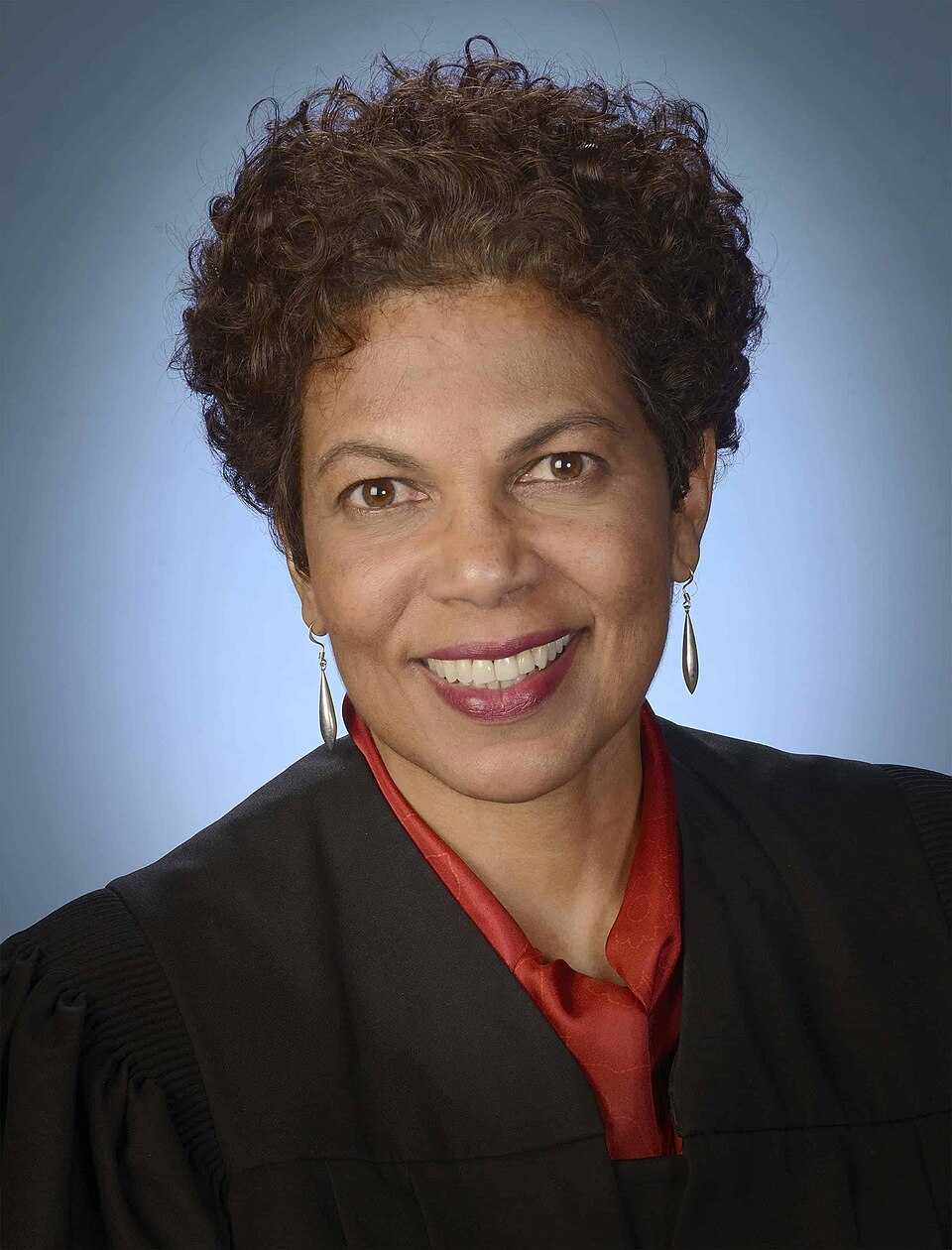
Tanya Chutkan
Copyright Information: Photo from Wikimedia Commons / Author of Photo: United States District Court for the District of ColumbiaOverview
Background [1]
Tanya Sue Chutkan was born in Kingston, Jamaica in July 1962.
Her father, Winston Chutkan, was a doctor, and her mother, Noelle, was a leading performer with the National Dance Theatre Company of Jamaica.
Both of Tanya Chutkan’s paternal great-grandparents were brought from India to Jamaica to work as indentured laborers on sugar plantations.
Chutkan’s maternal grandfather was Frank Hill, a Jamaican Marxist revolutionary who was briefly incarcerated by the island’s British governor during World War II for suspected “subversive activities.” In 1954 Hill was expelled from the People’s National Party of Jamaica, a social democratic entity, because of his communist views.
After obtaining a B.A. in Economics from George Washington University in 1987, Chutkan went on to earn a Juris Doctor from the University of Pennsylvania Law School, where she was a Legal Writing Fellow and an Associate Editor of the Pennsylvania Law Review.
Upon the completion of her legal education, Chutkan worked as a private-practice attorney from 1987 to 1990 with the Washington, D.C.-based law firm Hogan & Hartson. She then worked at yet another D.C. law firm — Donovan, Leisure, Rogovin, Huge & Schiller — from 1990-1991.
Next, Chutkan spent 11 years as a trial attorney and supervisor with the Public Defender Service for the District of Columbia from 1991-2002. During a portion of that same time period (1996-2000), she was a member of the steering committee for the Criminal Law & Individual Rights Section of the District of Columbia Bar.
Links to Trump Enemies & Hunter Biden
From 2002-2014, Chutkan worked for the New York City-based law firm Boies, Schiller, & Flexner LLP (BSF), where she specialized in litigation and white-collar criminal defense; she was a partner with the firm during her final seven years there.
• In 2015-2016, this same law firm, BSF, would represent Huma Abedin in the investigation of former Secretary of State Hillary Clinton’s email server.
• In the spring of 2015, BSF hired Fusion GPS, a private opposition-research and strategic-intelligence firm based in the District of Columbia, to conduct corporate opposition research on behalf of the healthcare technology company Theranos, which was a client of BSF. (For details about the role that Fusion GPS played in falsely smearing and defaming Donald Trump during his first presidential campaign, see Footnote #2.)[2]
• Hunter Biden — the notoriously corrupt, drug-addicted son of then-Vice President Joe Biden — also worked for BSF for several years. He was “of counsel” to the firm from 2010 until 2014. In 2014 as well, Hunter Biden was famously appointed to the directors’ board of the Ukrainian natural-gas company Burisma Holdings. For details on how the younger Biden was appointed to that board — a position that paid him anywhere from $50,000 to $83,000 per month even though he had no background or expertise in either Ukrainian matters or natural gas — see Footnote #3.[3] The Daily Caller describes how Hunter Biden exploited his BSF connections to assist Burisma:
“Hunter quickly brought BSF partners into the fold to assist Burisma with its efforts to influence U.S. officials, according to emails on Hunter Biden’s laptop.
“In April 2014, Hunter Biden and business associate Devon Archer spoke about how BSF could give them ‘protection’ and work with government officials on Burisma’s behalf…. Shortly after his correspondence with Archer, Biden set up a call with BSF partners including Christopher Boies and Heather King…. King communicated with the State Department on behalf of Burisma founder Mykola Zlochevsky and strategized with Burisma on how to handle the press and influence government officials….”
Devoted Democrat
Chutkan made 7 separate donations to Barack Obama’s presidential campaigns in 2008 and 2012. She also donated once in 2008 to Kirsten Gillibrand, whom then-New York Governor David Patterson would soon appoint to fill the U.S. Senate seat that Hillary Clinton vacated when she resigned in 2009 to become U.S. Secretary of State.
Obama Nominates Chutkan as a Federal Judge
On December 19, 2013, President Obama nominated Chutkan to serve as a federal judge with the United States District Court for the District of Columbia. Her nomination was confirmed in a 95-to-0 vote by the U.S. Senate on June 4, 2014.
Mandating “Equity in IDEA” Regulations
On December 12, 2016, the U.S. Department of Education issued — under Part B of the Individuals With Disabilities Education Act (IDEA) – a set of new regulations known as “Equity in IDEA,” which were “aimed at promoting equity by targeting widespread disparities in the treatment of students of color with disabilities.” Specifically, these regulations sought to reduce or eliminate the “significant disproportionality in the identification, placement, and discipline of students with disabilities based on race or ethnicity.” As U.S. Secretary of Education John B. King Jr. said:
- “Children with disabilities are often disproportionately and unfairly suspended and expelled from school and educated in classrooms separate from their peers.”
- “Children of color with disabilities are overrepresented within the special education population, and the contrast in how frequently they are disciplined is even starker.”
But in 2017, the incoming Trump administration sought, under Secretary of Education Betsy DeVos, to delay the implementation of “Equity in IDEA” until 2020, arguing that because the new regulations had the potential to result in “racial quotas,” more deliberation was needed before putting them into effect. “The Secretary is concerned that the regulations will create an environment where children in need of special education and related services do not receive those services because of the color of their skin,” said the Trump-Devos Department of Education.
In 2019, while Judge Chutkan was presiding over a lawsuit that centered on “Equity in IDEA” regulations, she examined the rationale for, and the legality of, Devos’ delay in implementing them.
On March 7, 2019, Chutkan ruled that DeVos’ decision to delay the start of “Equity in IDEA” constituted an “arbitrary,” “capricious,” and illegal violation of the Administrative Procedure Act. She further stated that DeVos had failed to provide a “reasoned explanation” for the delay; that DeVos’ professed concerns about the specter of racial quotas “did not have adequate support in the rulemaking record”; and that the new regulations should take effect immediately.
Mandating the Provision of Abortion Services for an Illegal-Alien Teenager
Judge Chutkan presided over the case of Garza v. Hargan, which centered around a pregnant seventeen-year-old girl — whom the court referred to as “Jane Doe” — who had illegally crossed the southern U.S. border into Texas in early September 2017. The girl was initially housed in a shelter that was under contract with the Office of Refugee Resettlement (ORR), a federal agency tasked with helping to unite unaccompanied migrant children with “qualified parents, guardians, relatives or other adults, referred to as ‘sponsors.’” Upon arriving at the ORR shelter, Jane Doe made it known that she wished to terminate her pregnancy. Though Texas required parental consent before a minor (below age 18) could undergo an abortion, a local judge granted the girl a judicial bypass on September 25, 2017. But ORR – citing a March 2017 directive by which the Trump administration had barred federally funded shelters from taking “any action that facilitates” abortions without the ORR director’s approval — refused to permit the girl to leave the shelter for the purpose of ending her pregnancy.
Rochelle Garza, Jane Doe’s court-appointed guardian, filed suit in the D.C. District Court on behalf of the girl and other young illegals facing similar circumstances. The defendants in the lawsuit were three officials of the Department of Health and Human Services (HHS), including Acting Secretary Eric Hargan. On October 18, 2017,Judge Chutkan issued a Temporary Restraining Order (TRO): (a) stating that Jane Doe would likely suffer “irreparable injury” if she were to be denied access to an abortion, and (b) directing HHS to permit the girl to promptly undergo the pre-abortion counseling required by Texas law, followed by the abortion procedure itself.
The Trump administration appealed Chutkan’s TRO in the D.C. District Circuit, filing an emergency motion to stay the order. After hearing arguments from both sides on October 20, 2017, a three-judge panel from the D.C. Circuit Court released a per curiam order that: (a) vacated the portion of the TRO that gave permission for Jane Doe’s abortion procedure to take place, and (b) stated that ORR would not be required to facilitate the abortion if the girl could be placed in a sponsor’s custody by the end of October.
But before the three-judge panel’s ruling could play out, the D.C. Circuit Court reheard the case en banc and denied the appellants’ emergency stay, remanding the case to the District Court so that a firm date could be set for Jane Doe’s abortion. In the District Court, Judge Chutkan issued an amended TRO on October 24, 2017, again stating that the girl’s abortion should happen “promptly and without delay.” And indeed, it did take place the very next day.
The Case of Imran Awan
In the summer of 2017, Judge Chutkan presided over the felony bank-fraud case against Imran Awan, a Pakistani-born Information-Technology (IT) worker who had spent 13 years as a shared employee for numerous Democrats in the U.S. House of Representatives, most notably Debbie Wasserman Schultz. Though the median annual salary for Capitol Hill staffers at that time was approximately $43,000, Awan was paid approximately four times that amount.
Awan then used his Washington connections to get IT jobs on Capitol Hill for five people who were very close to him: his wife, Hina Alvi; his best friend, Rao Abbas; his younger brothers, Jamal and Abid Awan; and Abid Awan’s wife, Natalia Sova.
By 2016, Imran Awan and his five recruits had done work for at least three-dozen House Democrats. They ranked among the highest-paid staffers on Capitol Hill, each earning between $157,000 and $168,000 per year.
Former federal prosecutor Andrew C. McCarthy noted how strange it was that Imran Awan and his five IT recruits had been paid such high salaries, and that they had been given security clearance by the government, even though they had been implicated in a number of ethical transgressions. Wrote McCarthy:
“Why were they paid so much for doing so little? … Why were they given access to highly sensitive government information? Ordinarily, that requires a security clearance, awarded only after a background check that peruses ties to foreign countries, associations with unsavory characters, and vulnerability to blackmail. These characters could not possibly have qualified…. [T]he family, which controlled several properties, was involved in various suspicious mortgage transfers. Abid Awan, while working ‘full-time’ in Congress, ran a curious auto-retail business … through which he was accused of stealing money and merchandise. In 2012, he discharged debts in bankruptcy (while scheming to keep his real-estate holdings). Congressional Democrats hired Abid despite his drunk-driving conviction a month before he started at the House, and they retained him despite his public-drunkenness arrest a month after. Beyond that, he and Imran both committed sundry vehicular offenses. In civil lawsuits, they are accused of life-insurance fraud.”
In March 2016, auditors from the House’s Chief Administrative Office noticed invoices for numerous pieces of computer equipment whose purchase prices had been falsely recorded as $499.99 each; this was significant because it was mandatory that all items valued at $500 or more be inventoried and carefully tracked. Some of these items eventually ended up in the homes of the Awan brothers.
In October 2016 the Inspector General’s Office tracked the computer login activities of Imran Awan and his five recruits, and found what investigators described as “massive” amounts of data that was being accessed, some of which was being stored outside of the House of Representatives’ computer network.
In early February 2017, House security services informed Members of Congress that Imran Awan and his wife were the subjects of a criminal investigation in which they were accused of having stolen hundreds of thousands of dollars worth of computers and servers, and of having violated network security regulations. At that point, all five of Imran Awan’s IT recruits were fired from their Capitol Hill jobs, though Awan himself was permitted to stay on Debbie Wasserman Schultz’s payroll.
On March 5, 2017, Imran Awan’s wife, Hina Alvi, suddenly took her three children out of school (without informing Virginia education officials) and boarded a plane bound for Pakistan. An FBI affidavit revealed that Alvi also brought with her a large amount of luggage as well as $12,400 in American currency. (It is a felony to export more than $10,000 in currency from the U.S. without filing a currency transportation report, which Alvi did not file.) Moreover, waiting for Alvi in Pakistan was a sum of $283,000 that she and her husband had wired there three months earlier.
In July 2017, Imran Awan booked a round-trip ticket to Pakistan, with a projected return date of January 2018. But when he arrived at Dulles Airport on July 24 to board his flight, he was arrested by the FBI. Awan was indicted on charges of conspiracy, making false statements, bank fraud, and unlawful monetary transactions. Judge Chutkan was assigned to preside over their case in court.
Between November 2017 and July 2018, Chutkan postponed Awan’s court hearing in U.S. District Court six times. As political analyst Lloyd Billingsley noted, “one of the key players” in the Awan case was “California attorney general Xavier Becerra, a former congressman once on Hillary Clinton’s short list as a running mate.” “As head of the House Democratic Caucus,” wrote Billingsley, “Becerra was in charge of the server that Awan accessed…. Chutkan conveniently delayed the … hearing until after the June primary, which Becerra duly won. So judge Chutkan clearly had the mid-terms in mind.”
On August 21, 2018, Chutkan gave Awan a lenient sentence consisting of time served plus three months of supervised release – and no jail time whatsoever.
Favoring Freedom for an ISIS Terrorist, in Defiance of Trump
In 2017 and 2018, Judge Chutkan ruled in favor of an unnamed, American-born, Muslim terror suspect who was a dual citizen of both Saudi Arabia and the United States. This individual was captured on September 12, 2017 by a Syrian Kurdish militia which promptly handed him over to U.S. military personnel stationed in Iraq. The Americans, in turn, proceeded to interrogate the man on suspicion that he was a member of the genocidal Islamic State terrorist organization (ISIS). The suspect told his U.S. interrogators that he had been kidnapped by ISIS 30 months earlier while he was in Syria working as a freelance journalist, and that he was now working for ISIS as a condition of regaining his freedom.
But the Trump administration found the suspect’s story implausible, saying that when he was apprehended he was in possession of a Koran, $4,200 in cash, a flash drive with instructions for making improvised explosive devices (IEDs), and a spreadsheet titled “Islamic State Spoils and Booty Bureau.” Moreover, the administration had obtained ISIS records showing the man to be registered as a fighter with the organization.
A CNN report said: “Between January 2014 and March 2015, according to the Defense Department, [the suspect] looked up ISIS videos on YouTube 859 times. He sent 22 tweets to an Islamic State propaganda account, posting pictures of the group’s flag and denouncing ‘infidels.’ In one tweet, he declared, ‘Let’s unite that the word of God may be realized in us and that we may cut off the hand and cut out the tongue of the troublemakers.’”
The Trump administration sought to send this suspect back to his home in Saudi Arabia. But when he objected to such a course of action, the administration held him in detention without formal charges and without access to a lawyer — a state of affairs that Judge Chutkan described in December 2017 as “remarkable and troubling.”
That same month, Judge Chutkan ordered the United States Department of Defense to grant the American Civil Liberties Union (ACLU) “immediate and unmonitored access” to the detainee. Once the ACLU had established contact with the detainee, it filed a habeas corpus lawsuit challenging his indefinite detention.
In April 2018, Judge Chutkan issued a Preliminary Injunction that blocked the Trump administration from transferring the detainee to any other country without first proving that his detention was legal. Further, the judge demanded that the administration either charge the man with a specific crime, or release him unconditionally.
The Trump DOJ appealed Judge Chutkan’s ruling, but the D.C. Circuit Court of Appeals ultimately sided with Chutkan. Thus,the suspect was released to a third country — Bahrain — in 2019.
Blocking Trump’s Effort to Restore Federal Death-Penalty Executions
On July 25, 2019, President Trump’s Attorney General, William Barr, announced that the Trump administration was planning to resume the practice of federal executions for some of America’s “worst criminals.” There had not been a single federal execution in the United States since 2003, at which time the mechanism for capital punishment was a three-drug “cocktail.” The new protocol, said Barr, would entail the use of just a single drug, pentobarbital.
“In the wake of Barr’s announcement,” reported Politico, “a series of death row prisoners joined a long-dormant legal challenge to that previous method and asked Judge Chutkan to block their execution under the new protocol until their legal challenges to it were fully adjudicated.” Chutkan granted their request. On November 20, 2019, she issued a Preliminary Injunction blocking the resumption of federal executions. Her ruling held that the Justice Department’s new, single-drug protocol: (a) carried a high risk of causing “extreme pain and needless suffering,” thereby potentially violating the Eighth Amendment ban on cruel and unusual punishment; and (b) violated the Federal Death Penalty Act (FDPA) of 1994, which stipulated that federal executions should be performed in the “manner prescribed by the law of the State in which the sentence is imposed,” rather than by means of a single federal procedure that applied uniformly to all 50 states. “[T]his court finds that the FDPA does not authorize the creation of a single implementation procedure for federal executions,” wrote the judge in her November 20 ruling. “There is no statute that gives the [Bureau of Prisons] or DOJ the authority to establish a single implementation procedure for all federal executions,” she added.
Further, Judge Chutkan argued that the implementation of her Preliminary Injunction was particularly essential in light of the fact that the “Plaintiffs have clearly shown that, absent injunctive relief, they will suffer the irreparable harm of being executed under a potentially unlawful procedure before their claims can be fully adjudicated.”
Later in November 2019, the DOJ filed an emergency application in the D.C. Circuit Court of Appeals, asking a three-judge panel of that court to vacate or stay enforcement of Judge Chutkan’s Preliminary Injunction. On December 2, 2019, the three judges unanimously declined to disturb the Injunction, stating that the “Appellants [DOJ and the Bureau of Prisons] have not satisfied the stringent requirements for a stay pending appeal.”
Just hours after the appellate court’s decision was announced on December 2, the Trump DOJ asked the U.S. Supreme Court to get involved in the matter and immediately lift Judge Chutkan’s Injunction. Four days later, the Supreme Court denied the DOJ’s request, but also ordered the D.C. Circuit Court to address not only the procedural Injunction as formulated by Judge Chutkan, but also the legality of the new, single-drug, federal execution protocol.
On January 15, 2020, a three-judge panel of the D.C. Court of Appeals heard nearly two hours of arguments in an effort to determine whether the federal government could resume death-penalty executions in 2020. On April 7, 2020, the panel voted 2-1 to vacate Judge Chutkan’s Preliminary Injunction of November 20.
But even after this turn of events, Chutkan in July 2020 issued additional Injunctions aimed at preventing federal executions of convicted murderers. “The public is not served by short-circuiting legitimate judicial process,” the judge explained.
Conservative political analyst and author Daniel Greenfield has enumerated some of the beneficiaries of Chutkan’s efforts to block the executions of brutal, remorseless killers:
“Chutkan has worked to protect the worst monsters imaginable. Among Judge Chutkan’s beneficiaries were Daniel Lewis Lee, a white supremacist gang member who had tortured an 8-year-old girl with a cattle prod before making her watch while he murdered her mother and then suffocated her with a plastic bag; Wesley Ira Purkey, a crackhead previously released for good behavior, who raped and murdered a 16-year-old and beat to death an 80-year-old widow with a claw hammer; and William Emmett LeCroy, a child molester obsessed with witchcraft, who had raped and murdered a local nurse.
“Judge Chutkan repeatedly abused her authority to try and spare these human monsters the death penalty and deprive their victims of justice.”
Portraying BLM Rioters as More Noble Than the Capitol Protesters of January 6
Judge Chutkan was one of multiple federal judges presiding over the trials of defendants accused of unlawfully entering the U.S. Capitol building during the infamous pro-Trump protest of January 6, 2021.
In 2021, Chutkan dismissed the complaints of observers who claimed that the American criminal-justice system had dealt much more harshly with those Capitol protesters than with the Black Lives Matter (BLM) rioters who, in response to the highly publicized 2020 death of George Floyd in Minneapolis, tore entire cities apart that spring and summer. In the 2020 riots, Chutkan said, “people gathered all over the country … to protest the violent murder by the police of an unarmed man.” “But to compare the actions of people protesting, mostly peacefully, for civil rights,” she added, “to those of a violent mob [at the Capitol] seeking to overthrow the lawfully elected government, is a false equivalency and ignores a very real danger that the Jan. 6 riot posed to the foundation of our democracy.”
In 2022, Judge Chutkan said of the January 6 protesters: “[T] the people who mobbed that Capitol were there in fealty, in loyalty to one man [Trump], not to the Constitution, of which most of the people who come before me seem woefully ignorant; not to the ideals of this county and not to the principles of democracy. It’s blind loyalty to one person who, by the way, remains free to this day.”
When one of the January 6 defendants moved, in April 2022, to have his trial held outside of D.C. because he feared that he would be unable to get a fair hearing in that Democratic Party bastion, Chutkan turned down his request. The defendant’s characterization of the city’s political makeup, the judge said, was “misleading and ultimately unavailing.”
As of July 2023, each and every one of the 38 sentences that Chutkan had imposed on January 6 protesters, involved jail time. In 9 of those cases, she demanded more prison time than even the Biden Justice Department had requested for the defendants. As The New York Times reported in October 2023: “In numerous cases she [Chutkan] has brushed aside the government’s recommendation of probation or home detention and has instead ordered jail time for those who entered the Capitol that day. ‘There have to be consequences for participating in an attempted violent overthrow of the government, beyond sitting at home,’ she declared while issuing a 45-day prison sentence to a defendant in October 2021.”
And while sentencing yet another January 6 defendant on October 31, 2023, Judge Chutkan criticized him for failing to show “remorse for the collective trauma this country has suffered” as a result of the actions in which he and his fellow protesters had engaged.
Viewing Herself as a Victim of Prejudice & Bigotry
Chutkan spoke at a February 8, 2022 program that the Judiciary’s Defender Services Office hosted mainly for the benefit of court-appointed criminal-defense attorneys. In the course of her remarks, she said: “For a lot of people, I seem to check a lot of boxes: immigrant, woman, Black, Asian. Your qualifications are always going to be subject to criticism and you have to develop a thick skin.”
U.S. House Resolution Accusing Chutkan of “Open Bias & Partisanship”
In August 2023, Republican U.S. House Member Matt Gaetz of Florida introduced a resolution stating that in light of Judge Chutkan’s track record of making comments supportive of BLM, she should be “censured and condemned” for her “open bias and partisanship in the conduct of her official duties as a judge for the United States District Court for the District of Columbia.” Chutkan’s biases, said the resolution, were evident in:
- her “expressed support for the violent protests in the summer of 2020,” support that constituted “conduct unbecoming a judge”
- the fact that she had “donated thousands of dollars to elect Barack Obama”
- her October 2022 lament that Donald Trump ‘‘remains free to this day’’
Stating that “such partisan commentary by Judge Chutkan has been ongoing and calls into question her fitness as a judge,” the resolution declared: “Chutkan’s comments and activities on and off the bench violate all 5 canons of the Code of Conduct for United States Judges; namely, calling into question the integrity and independence of the judiciary; presenting impropriety and the appearance of impropriety; failing to perform the duties of the office fairly, impartially, and diligently; engaging in extrajudicial activities inconsistent with the obligations of the office; and engaging in political activity.”
Refusal to Recuse Herself from the Trump Election-Interference Case
On August 1, 2023, a federal grand jury indicted Donald Trump on four felony counts related to allegations that, despite knowing he had lost the 2020 presidential election, he had used “dishonesty, fraud and deceit to obstruct the nation’s process of collecting, counting, and certifying the results of the [November 2020] presidential election” on January 6, 2021. Democrat Special Counsel Jack Smith brought the indictment, claiming that Trump had: (a) knowingly spread false claims that the election was “stolen”; (b) organized alternate slates of electors in key states to replace legitimate ones; and (c) pressured state officials and especially Vice President Mike Pence to reject certified electoral votes.
On August 1, 2023 as well, Judge Chutkan — who had imposed prison terms on each and every one of the 38 defendants whom she had already sentenced for their roles in the January 6 protests at the U.S. Capitol — was assigned to preside over this new election-interference case against Trump.
Trump pleaded not guilty to the charges against him, arguing that: (a) in the aftermath of the 2020 election, he had merely tried to exercise his rights of free speech and political advocacy; and (b) he should be immune from prosecution because his actions on, and after, January 6 fell under the umbrella of his official duties as president – a claim that would gain additional legitimacy when the Supreme Court ruled in July 2024 that former presidents have absolute immunity for some official acts, as well as presumptive immunity for other official actions.
Moreover, Trump and his allies publicly stated that Chutkan, because of her obvious biases against Trump and the January 6 protesters, had an obligation to recuse herself from the election-interference case. But the judge refused to do so, pledging that she would keep politics out of the proceedings. She also instructed Trump’s lawyer, John Lauro, to persuade Trump that he should “take special care” when making any “public statements about this case.” “Your client’s defense is supposed to happen in this courtroom, not on the internet,” the judge said, adding: “I will take whatever measures are necessary to safeguard the integrity of these proceedings.”
In August 2023 as well, Judge Chutkan made it clear that strict limitations would be placed on Trump’s rights of free speech and expression as the election-interference case proceeded. Said Chutkan:
- “Mr. Trump, like every American, has a First Amendment right to free speech. But that right is not absolute. In a criminal case such as this one, the defendant’s free speech is subject to the rules.”
- “What the defendant is currently doing — the fact that he’s running a political campaign, has to yield to the orderly administration of justice. If that means he can’t say exactly what he wants to say about witnesses in this case, that’s how it has to be.”
Later in August 2023, Judge Chutkan announced that Trump’s election-interference trial in Washington, D.C. would begin on March 4, 2024 — one day before Super Tuesday, the highly crucial day in a presidential election year when the largest number of states hold their respective primary contests. Arguing that there was no need to abide by Trump’s wish to delay the trial’s start until after the November 2024 election, she buttressed her position by likening the Capitol protest of January 6 to the 9/11 terrorist attacks of 2001 and the Boston Marathon terrorist bombing of 2013. “The trial will start three years, one month, and 27 days after the events of January 6, 2021,” she said. “The trial involving the Boston Marathon bombing began less than two years after the events. The trial involving Zacarias Moussaoui for his role in the September 11 attacks was set to begin one year after the attacks; but due to continuances, appeals, and voluminous discovery, it began roughly four years later.”
In September 2023, Chutkan refused a motion from Trump’s legal team asking that she recuse herself from the trial.
In an October 2023 hearing, Chutkan, in compliance a request by Biden administration special counsel Jack Smith, issued a gag order that officially barred Trump from conducting a “pre-trial smear campaign.” In short, the order blocked Trump from being able to defend himself against attacks or defamations by: Smith and his team of prosecutors or their families; the Biden Department of Justice; potential witnesses; court personnel; or even the Judge Chutkan herself, whose long track record of political bias was a matter of public record. When Trump’s lawyers characterized Chutkan’s gag order as one of many tools that President Biden and his administration were using “to silence his top political candidate in the middle of an election season,” Chutkan said that Trump was not entitled to have “unfettered First Amendment rights.”
In late November 2023, Chutkan wrote: “Whatever immunities a sitting President may enjoy, the United States has only one Chief Executive at a time, and that position does not confer a lifelong ‘get-out-of-jail-free’ pass. Former Presidents enjoy no special conditions on their federal criminal liability. Defendant may be subject to federal investigation, indictment, prosecution, conviction, and punishment for any criminal acts undertaken while in office.” She added that Trump’s “four-year service as Commander in Chief did not bestow on him the divine right of kings to evade the criminal accountability that governs his fellow citizens.”
When Trump’s lawyers asked Chutkan to dismiss the four election-interference charges because Trump had been trying to “ensure election integrity” in his role as president and therefore was “absolutely immune from prosecution,” Chutkan rejected that argument, writing on December 1, 2023, that “to the contrary, America’s founding generation envisioned a Chief Executive wholly different from the unaccountable, almost omnipotent rulers of other nations at that time.” Instead, she added, the prospect of a president’s future criminal liability was likely to “encourage the kind of sober reflection that would reinforce rather than defeat important constitutional values.” “If the specter of subsequent prosecution encourages a sitting President to reconsider before deciding to act with criminal intent, that is a benefit, not a defect,” Chutkan wrote.
Though Trump’s election-interference trial was originally scheduled to begin on March 4, 2024, Judge Chutkan announced on February 2, 2024 that it would be postponed indefinitely — perhaps until sometime in the late summer or fall — so as to allow time for the the U.S. Supreme Court to determine whether a former president could be prosecuted for actions taken while in office. Ultimately, the Supreme Court ruled on July 1, 2024, that former presidents have absolute immunity for some official acts, as well as presumptive immunity for other official actions.
In early September 2024, Chutkan ruled that prosecutors in Trump’s election-interference case could file the first brief on presidential immunity, thereby enabling the Biden DOJ to bring previously unseen evidence to the attention of the public shortly before the November election. It also gave special counsel Jack Smith an opportunity to be the first to comment upon – in a brief that he was slated to provide by September 26 — the Supreme Court’s July 1 decision on presidential immunity. In an objection filed on September 5, 2024, Trump’s defense attorney argued that by allowing prosecutors to be the first to file a brief, Judge Chutkan was giving the government an opportunity to shape the initial narrative of Trump’s alleged guilt and thereby gain the upper hand during a very “sensitive time.”
But Judge Chutkan was not persuaded by their arguments, and she unsealed Jack Smith’s 165-page report on October 2, 2024 — just 34 days before Election Day. In the October 2 order by which she formally allowed prosecutors to release the report, Chutkan accused Trump’s legal team of engaging in “bad-faith partisan bias” that was part of “a pattern of defense filings focusing on political rhetoric rather than addressing the legal issues at hand.” “Not only is that focus unresponsive and unhelpful to the court,” the judge continued, “but it is also unbefitting of experienced defense counsel and undermining of the judicial proceedings in this case.”
Breitbart.com described Jack Smith’s brief as follows:
“Under local criminal rule 47(e) of the U.S. District Court for the District of Columbia, motions of this type are limited to 45 pages. Yet Chutkan allowed Smith to file a mammoth 165-page motion, which Smith used to rehash – in official court documents – political attacks and Democrat grievances against Trump yet to be proven in court.
“Smith’s motion includes one-sided allegations that turn on Trump’s state of mind, repeating that Trump’s claims regarding the election were knowingly false and deceitful without allowing the possibility that Trump believed what he said….
“The 165-page document is unusual in other respects, including the timing and manner of its release. Chutkan could have kept the motion under seal until after the election. Instead, she released a lightly redacted motion that appears to have redacted little other than names.”
The case against Trump ultimately fell apart, however, after he won the November 2024 election, prompting the Justice Department to follow its traditional policy not to prosecute a sitting president. Thus, Jack Smith moved for dismissal of the case, and Judge Chutkan dismissed it without prejudice.
Footnotes:
[1] https://www.dcd.uscourts.gov/content/district-judge-tanya-s-chutkan
https://abcnews.com/Politics/tanya-chutkan-judge-assigned-latest-trump-case/story?id=101922597
https://www.presidentialprayerteam.org/2025/02/20/judge-tanya-chutkan-district-of-columbia-u-s-district-court/
[2] InfluenceWatch.org explains how Fusion GPS was intimately involved in smearing Donald Trump during his first presidential campaign:
“In April 2016 Marc Elias, a partner at the law firm Perkins Coie who represented the Democratic Party during the 2016 election, retained Fusion GPS on behalf of the Hillary Clinton campaign and the Democratic National Committee to provide a ‘no-stones-unturned’ evaluation of then-Presidential candidate Donald Trump.
“Fusion was originally hired to investigate Trump by the conservative news website Washington Free Beacon, which was financially supported by Republican donor Paul Singer. After Trump won the Republican nomination, Fusion found Democratic donors to fund and expand the effort.
“Perkins Coie paid Fusion GPS $1.02 million for its research against then candidate-Trump in 2016. Fusion GPS hired former British spy Christopher Steele to research any connections between then-candidate Trump and the Russian government. Steele was based in Russia in the 1990s and now runs an intelligence firm in London.
“Steele produced a 35-page largely unverified dossier based on memos he compiled from June through December 2016. The Steele dossier was passed around D.C. for months before BuzzFeed made the controversial decision to publish it in its entirety shortly before President-elect Trump’s inauguration.
“Steele has acknowledged that information in his dossier was ‘merely a compilation of bits of raw intelligence that were unverified and that he passed along because they warranted further investigation.’
“The Steele dossier has grown in importance in the wake of subsequent allegations that the Justice Department relied on parts of it to obtain a FISA warrant ‘to conduct surveillance on Trump associate Carter Page’ and that former President Barack Obama was briefed on the dossier by then-CIA Director John Brennan.”
[3] In February 2014, Hunter Biden was discharged from the U.S. Navy Reserve after testing positive for cocaine use. On April 21-22, 2014, Vice President Joe Biden, in his role as overseer of the Obama administration’s policy towards Ukraine, visited that country to urge its government to increase its natural gas production. That same month, British officials who were investigating allegations of money laundering by Burisma Holdings, froze a number of London bank accounts containing $23 million that belonged to Burisma owner and president Mykola Zlochevksy.
On May 13, 2014 — just three weeks after Joe Biden’s visit to Ukraine — Hunter Biden was appointed to the Burisma board of directors. That position paid him approximately $50,000 per month — and sometimes as much as $83,000 per month — even though he had no background or expertise in either Ukrainian matters or natural gas.
In August 2014, Ukrainian Prosecutor General Vitaly Yarema opened a corruption investigation into Burisma. Ukraine, the United Kingdom, and the United States were partners in this probe. In February 2015 Yarema was succeeded as Prosecutor General by Viktor Shokin, who continued the Ukrainian investigation into Burisma.
In March 2016 – while Prosecutor General Shokin was still actively investigating Burisma’s alleged corruption – Vice President Biden threatened to withhold $1 billion in U.S. loan guarantees to the Ukrainian government unless it agreed to fire Shokin immediately. Because the revocation of American aid would have been devastating to Ukraine, President Petro Poroshenko caved to Biden’s threat and fired Shokin on March 29, replacing him with Yuriy Lutsenko. At the time of Shokin’s termination, he and other Ukrainian prosecutors were in the midst of preparing a request to interview Hunter Biden about his activities and the funds he was receiving from Ukraine.
In a sworn affidavit prepared for a European court, Shokin later testified that he had been told that the reason for his firing was that Joe Biden was troubled by the Burisma investigation.