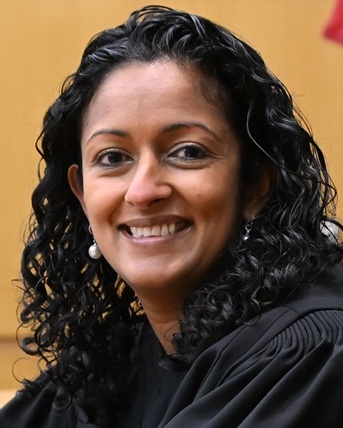
Sparkle Sooknanan
Copyright Information: Photo from Wikimedia Commons / Author of Photo: United States District Court for the District of ColumbiaOverview
Overview [1]
Sparkle L. Sooknanan was born in 1983 in the city of San Fernando, located on the southwestern coast of Trinidad. She earned a bachelor’s degree from St. Francis College in 2002, an M.B.A. from Hofstra University in 2003, and a Juris Doctor from Brooklyn Law School in 2010. She also became a U.S. citizen in 2009.
After completing her legal education, Sooknanan held the following positions:
- 2010-2011: law clerk for Judge Eric Vitaliano of the United States District Court for the Eastern District of New York
- 2011-2012: law clerk for Judge Guido Calabresi of the United States Court of Appeals for the Second Circuit
- 2012-2013: appellate staff attorney for the Civil Division of the U.S. Department of Justice
- 2013-2014: law clerk for U.S. Supreme Court Justice Sonia Sotomayor
- 2014-2021: private practice attorney in Washington, D.C.
- 2021-2023: Deputy Associate Attorney General with the U.S. Department of Justice
- 2023-2024: Principal Deputy Assistant Attorney General in the Civil Rights Division of the U.S. Department of Justice
On February 27, 2024, President Joe Biden nominated Sooknanan to replace Florence Pan as a federal judge on the United States District Court for the District of Columbia, as Pan had recently been elevated to the United States Court of Appeals for the District of Columbia Circuit. The U.S. Senate confirmed Sooknanan’s nomination on December 3, 2024, by a vote of 50 to 48. (Senate Democrats supported Sooknanan by a margin of 47 to 0; Independents supported her by a margin of 3 to 0; and Republicans opposed her by a margin of 0 to 48.)
Blocking President Trump’s Firing of a Federal Labor Relations Authority Chairwoman
On February 10, 2025, President Donald Trump fired Federal Labor Relations Authority (FLRA) chair Susan Tsui Grundmann, who had been nominated for that post in 2021 by then-President Joe Biden. Trump’s decision to terminate Grundmann was part of his broad-based effort to replace Democrat appointees who occupied key positions in various federal agencies. Upon notification that she was being fired, Grundmann, who still had 5 months remaining in her term as FLRA chair, argued that by law she could only be removed if, in a formal hearing, she were to be found guilty of inefficiency, neglect of duty, or malfeasance. Thus, Grundmann filed a lawsuit against the Trump administration on February 14, 2025, seeking a preliminary injunction and summary judgment against her dismissal. Judge Sooknanan was assigned to preside over this case, which became known as Grundmann v. Trump.
In March 2025, Sooknanan ruled that President Trump’s decision to fire Ms. Grundmann had unlawfully violated the FLRA’s governing statute, and she reinstated Grundmann to her position as the agency’s chair. Asserting that the Trump administration had wrongly usurped Congress’ power by taking this action against Grundmann, Sooknanan wrote in her ruling: “The Government’s arguments paint with a broad brush and threaten to upend fundamental protections in our Constitution. But ours is a system of checks and balances. Our Founders recognized that the concentration of power in one branch of government would spell disaster.”
The Trump administration appealed Sooknanan’s decision, arguing that Grundmann’s firing was permissible because the U.S. Constitution vested all executive power in the President. Sooknanan countered by citing multiple instances where the Supreme Court had endorsed protections against statutory removal.
Further, the Trump administration contended that in this case the district court was not authorized to provide anything more than back pay as relief for Ms. Grundmann, and that if Grundmann were to use Sooknanan’s court order as justification for defying the President’s will, that would constitute an assault on the principle of separation-of-powers. Sooknanan, in turn, claimed that this interpretation of the law meant that even if a President were to transgress in the most egregious manner the bounds of power allotted to him by the Constitution, courts would be powerless to compensate the injured party in any meaningful way. “It is the Government’s own argument that raises grave separate on-of-powers concerns,” Sooknanan wrote. “Ms. Grundmann is entitled to relief that would redress her injury and allow her to continue her work on the FLRA.”
In July 2025, the D.C. Circuit Court of Appeals – citing prior Supreme Court decisions that had given the President broad authority to dictate who should serve as the heads of government agencies – (a) concluded that Grundmann’s firing was legally permissible, and (b) reversed the order by which Judge Sooknanan had reinstated Grundmann. This appellate court ruling effectively drained the life out of Grundmann’s fight for redress, and she dropped her lawsuit against the Trump administration in January 2026.
Blocking Trump’s Deportation of Illegal-Alien Children Back to Guatemala
At approximately 2:35 a.m. on the morning of Sunday, August 31, 2025 – the middle of Labor Day weekend — Judge Sooknanan was assigned as the emergency-duty judge to preside over a case in which the National Immigration Law Center (NILC) had just filed an emergency motion to place a 14-day block on the Department of Homeland Security’s (DHS) scheduled deportation of some illegal-alien Guatemalan children back to their homeland. According to the complaint, if the children in question were to be sent to Guatemala they would not only be “at risk of persecution, torture, or death,” but also would “lose the opportunity to seek permanent status in the United States in immigration court.” Because the NILC filing was made during a holiday weekend, when most judges were unavailable, Sooknanan’s assignment to this case was merely a temporary, stopgap measure that would end on September 2, at which point Judge Timothy J. Kelly – also of the United States District Court for the District of Columbia — would be formally assigned to the case for the long term.
At approximately 4:00 a.m. on August 31, 2025, Judge Sooknanan – asserting that the “exigent circumstances” referenced in the NILC lawsuit warranted immediate action “to maintain the status quo until a hearing can be set” — issued a Temporary Restraining Order (TRO) to halt – for 14 days — the removal of 10 specific children who reportedly were already in Texas aboard planes that were scheduled to take off for Guatemala within a short time. “I have the government attempting to remove minor children from the country in the wee hours of the morning on a holiday weekend, which is surprising, but here we are,” Sooknanan said at the early-morning hearing. “I have conflicting narratives from both sides here,” she added, explaining that the plaintiffs’ account of things “doesn’t quite line up with what I’m getting from the government.”
Several hours later — during an emergency hearing that was held at 12:30 p.m. that Sunday afternoon – Judge Sooknanan expanded the scope of her earlier TRO, now declaring that her order applied to all of the 600 to 700 unaccompanied Guatemalan minor children who at that time were in U.S. custody without final removal orders, and who, by the judge’s telling, constituted a “protected class.” Sooknanan instructed Drew Ensign, the Justice Department lawyer representing the Trump administration, to quickly inform all relevant administration officials that any plans to deport any illegal-alien children to Guatemala had to halted, and that any planes holding such youngsters should remain on the ground. (One plane that already had taken off for Guatemala returned in accordance with Sooknanan’s newly announced order, and the children aboard the aircraft were placed in the custody of DHS.
Ensign, in turn, argued that the proposed transfers of the Guatemalan children in question were not deportations at all, but were actually efforts to reunify the youngsters with their parents back home. “These are not removals under the statute,” Ensign said. “These are repatriations. … It’s outrageous that the plaintiffs are trying to interfere with these reunifications.”
In a similar vein, Trump deputy chief of staff Stephen Miller wrote in a social media post on X: “These smuggled migrant children were orphaned in America by the Biden Administration. The minors have all self-reported that their parents are back home in Guatemala. But a Democrat judge is refusing to let them reunify with their parents.” “The government of Guatemala has formally requested their return,” Miller added. “And there are tens of thousands more smuggled minors orphaned in America by the Biden Administration that Democrats are refusing to allow back home with their families.”
In a September 4, 2025 interview with Fox News, George Washington University law professor Jonathan Turley offered the following thoughts regarding Judge Sooknanan’s TRO:
“Well, it does seem to run against the grain. The Supreme Court has really put a shot across the bow now of multiple district courts and said, ‘You should not do these national injunctions unless you can establish a national class action.’ And even then, some justices have said we’re going to scrutinize that closely. This seems to be bucking that order. The problem with this is that ultimately I can’t imagine the injunction can stand with regard to virtually all of these individuals, these children. They are being reunited with their parents.
“Many of these children were sent over the border unaccompanied, and they are being sent back, and the parents have been contacted. So it’s on pretty darn thin ice for the district court. Now, there could be a delay, and there can be a requirement of some due process. But this is not what you would consider an ordinary deportation case. You have minors who ideally belong with their parents.”
Blocking Trump from Using Guantanamo Bay to Hold Illegal Aliens Slated for Deportation
In February 2025, the Trump administration began the practice of using the Guantánamo Bay detention facility in Cuba to house some criminal migrants who had received final deportation orders, before shipping them out to their respective destinations.
In a lawsuit submitted to the United States District Court for the District of Columbia on March 1, 2025, the American Civil Liberties Union (ACLU), the Center for Constitutional Rights (CCR), and the International Refugee Assistance Project (IRAP) asked the court to urgently intervene and “put a stop” to what they characterized as the Trump administration’s “cruel, unnecessary, and illegal transfers” of migrants to Guantánamo. Such transfers, the plaintiffs explained in a press release, were “without any legal authority, in violation of federal law and the U.S. Constitution.” A March 5, 2025 New York Times report stated that according to the ACLU, “detainees are held [in Guantanamo] in a form of limbo between deportation and detention on U.S. soil, where they have greater rights.”
Judge Sooknanan was assigned to preside over this case.
The aforementioned March 1 lawsuit was submitted on behalf of ten named individuals who had received final deportation orders — seven Venezuelans, an Afghan, a Pakistani and a Bangladeshi — and who theretofore had been held by the U.S. Immigration and Customs Enforcement agency (ICE) in detention facilities located in Texas, Virginia and Arizona. Specifically, the suit argued that in Guantanamo the detainees had no assurance that they would be afforded the protections guaranteed by the U.S. Constitution and by American law, most notably the Immigration and Nationality Act and the Administrative Procedure Act.
On December 5, 2025 – by which time a total of approximately 710 illegal-alien detainees had been held at the Guantanamo facility at various times during that calendar year — Judge Sooknanan issued a landmark ruling on this matter. In that ruling:
- She described Guantanamo as “the site of one of our country’s most notorious detention facilities,” adding: “Over two decades ago, it was opened to hold suspected terrorists in the aftermath of the horrific terrorist attacks of Sept. 11, 2001. Since then, Guantánamo has been synonymous with pervasive mistreatment and indefinite detention.”
- She maintained that the Trump administration’s use of Guantánamo to hold migrants with final deportation orders was illegal under the Immigration and Nationality Act, and was also “impermissibly punitive” as a violation of the Due Process Clause of the U.S. Constitution’s Fifth Amendment.
- She stated that “the facts, accepted as true, from the Plaintiffs’ Complaint,” discredited the government’s initial claims that it was detaining only “the worst of the worst” and “high threat” criminals at Guantánamo.
- She denounced the high cost of holding migrants at Guantánamo — “approximately $100,000 per day per detainee,” compared to “an average of $165 per day per detainee” on the U.S. mainland.
Judge Sooknanan also condemned what she said were the deplorable conditions in which the migrant detainees lived. For instance, she claimed to believe allegations stating that many of the detainees:
- were “not told the time of day, nor [were] they informed about their immigration cases, what [would] happen to them, or where they [would] be taken next”;
- were “provided no way to make medical requests”;
- received “insufficient food”;
- were “permitted only one hour per day of recreation in an indoor cage”;
- were “physically harmed” and deprived of water “as a form of punishment”; and
- were “invasively searched,” “including a pat down of their genitals,” and were “insult[ed] and taunt[ed]” by guards who sometimes “threatened to shoot them.”