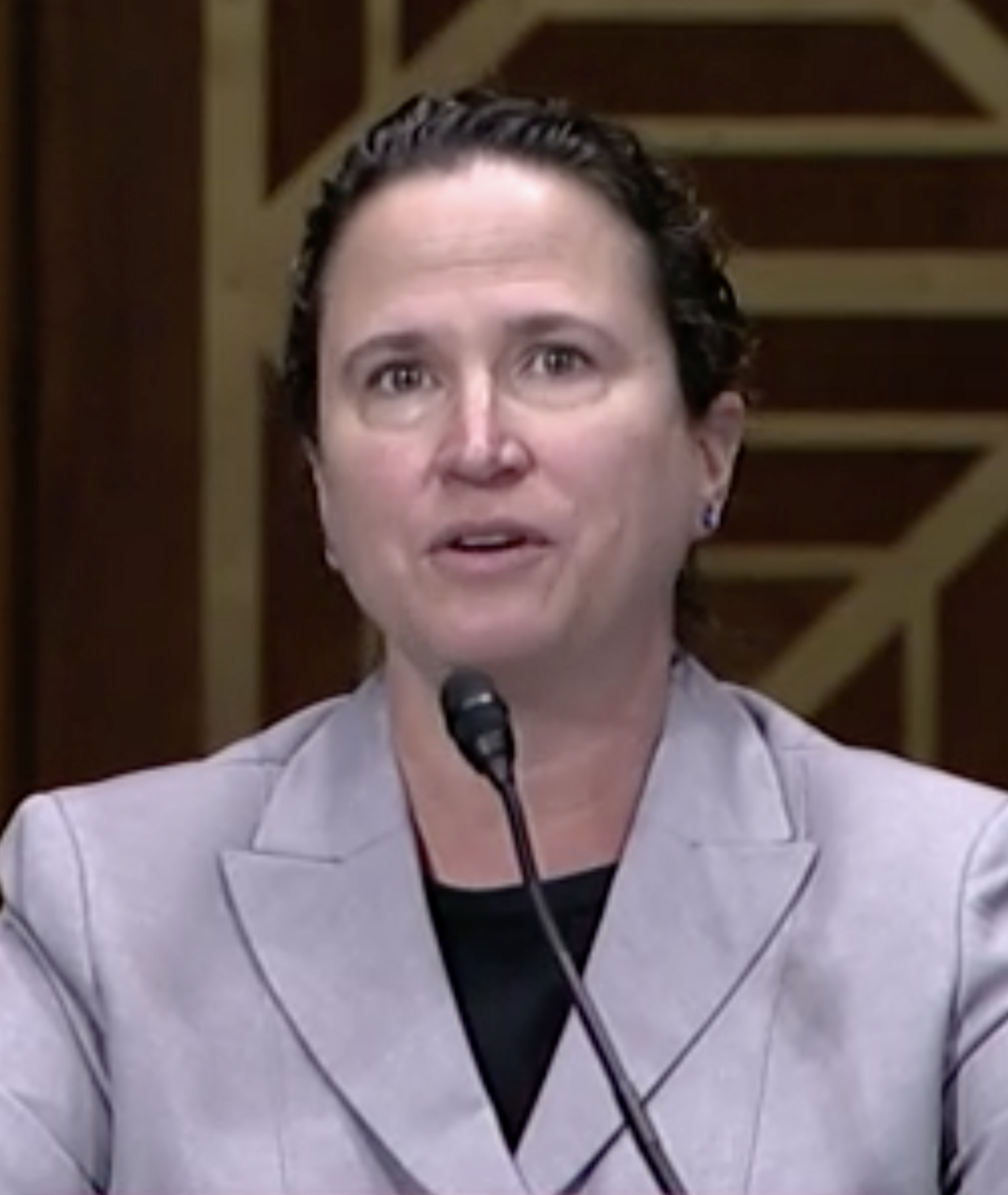
Katherine Menendez
Copyright Information: Photo from Wikimedia Commons / Author of Photo: United States Judiciary CommitteeOverview
Overview[1]
After earning a B.A. degree from the University of Chicago in 1993 and a J.D. from New York University Law School in 1996, Katherine Menendez launched a career in the legal profession by working as a law clerk for Judge Samuel Ervin of the Fourth Circuit Court of Appeals (located in Richmond, Virginia) from 1996-1997.
Menendez then worked for the Office of the Federal Defender (OFD) in the District of Minnesota from 1997 to 2016 — starting by way of a fellowship program, then becoming Assistant Federal Defender in 1999, and eventually serving a ten-year stint as OFD’s Chief of Training from 2006-2016. She litigated two cases before the U.S. Supreme Court during that period, including Johnson v. United States in 2015. In that case, Menendez helped persuade the Court to invalidate a portion of the Armed Career Criminal Act, a 1984 “three strikes” law that imposed a minimum prison sentence of 15 years on anyone illegally possessing a firearm if they had previously been convicted of 3 or more violent felonies or serious drug offenses. Menendez successfully argued that the statute’s definition of what constituted “violent felonies” was unconstitutionally vague and thus enabled prosecutors to unfairly impose long sentences even on defendants whose previous “strikes” may not all have merited inclusion in that category.
On April 28, 2016, Menendez was appointed as a federal magistrate judge in the District of Minnesota, a position she went on to hold until 2021.
On September 20, 2021, President Joe Biden nominated Menendez to replace Judge Joan Ericksen, who had recently assumed senior status (semi-retirement), on the United States District Court for the District of Minnesota. The U.S. Senate confirmed Menendez’s nomination on December 18, 2021, by a Yay-Nay vote of 49-21 (30 senators did not cast a vote).
Blocking Trump’s Crackdown on Illegal Aliens in Minneapolis
In early December 2025 the Trump administration launched “Operation Metro Surge” (OMS), a major immigration-enforcement initiative that deployed approximately 3,000 federal agents from ICE, CBP, and DHS to apprehend illegal aliens in the Minneapolis-Saint Paul area of Minnesota. Among OMS’s high-value targets were members of the local Somali immigrant community, which recently had made bold headlines because of their participation in a multibillion-dollar fraud campaign that siphoned rivers of taxpayer cash into the coffers of Somali thieves.[2] In response to OMS, hordes of leftwing agitators took to the streets in protest – in many cases impeding the actions of the federal agents or violently assaulting them, and sometimes provoking a necessarily forceful physical response.
On December 17, the American Civil Liberties Union (ACLU) represented a group of 6 Minnesota-based plaintiffs in filing a class action lawsuit against the Department of Homeland Security (DHS), alleging that its agents were conducting a “campaign of constitutional violations” that: (a) infringed on the Minneapolis protesters’ First Amendment right to free speech; (b) violated their Fourth Amendment protection against unreasonable seizures; and (c) “violently subdued” them by means of gratuitously brutal tactics. Presiding over the case was Judge Katherine Menendez of the United States District Court for the District of Minnesota.
Meanwhile, the ongoing street chaos continued to escalate until, as was inevitable, it claimed its first fatality on January 7, 2026 when an ICE agent fatally shot Renee Nicole Good, a 37-year-old white woman from Minneapolis. According to DHS Secretary Kristi Noem, Ms. Good had been “stalking and impeding” the work of ICE agents for some time by “blocking them in” with her Honda Pilot SUV and “shouting at them” while they were actively trying to carry out their mission. Just before Ms. Good was shot, an ICE agent approached her and demanded that she get out of her vehicle, which was blocking traffic. But instead of complying, the woman briefly shifted the SUV into reverse and then accelerated forward, physically striking a male agent in a collision that caused the latter to suffer internal bleeding in his torso. Fearing for his life, that agent fired one shot through the windshield of Ms. Good’s SUV, and then two more through the open driver’s-side window as the vehicle sped past him before it crashed into a nearby parked car. The event was widely recorded and subsequently shared by onlookers with cell-phone cameras, and was aggressively exploited by the Left as a rallying point for the further escalation of anti-ICE aggression. Thousands of protesters held vigils and memorial gatherings in Minneapolis, while a host of demonstrations spread quickly across the state of Minnesota.
After Ms. Good’s death, the six plaintiffs who had sued DHS in December sent a letter to Judge Menendez, seeking immediate emergency action in their case. “Peaceful observers and protesters turned out again today, they will turn out again tomorrow, and they will continue turning out every day until Operation Metro Surge is over,” they wrote. “These Minnesotans who are peacefully exercising their core constitutional rights to speak and gather continue to be met with unconstitutional and terrifying violence … And things appear to be getting worse, not better.”
On January 12, 2026, Minnesota Attorney General Keith Ellison, who described President Trump’s immigration operation in Minnesota as an “invasion,” issued a press release announcing that he was: (a) joining the cities of Minneapolis and Saint Paul in filing “a federal lawsuit against the Department of Homeland Security (DHS) and related agencies and officials,” and (b) “asking the court to end the unprecedented surge of DHS agents into the state and declare it unconstitutional and unlawful.” This suit was filed in the U.S. District Court for the District of Minnesota, with Judge Menendez again presiding. Ellison and his fellow plaintiffs — citing “the immediate harm the state and cities are facing” — further asked Menendez to issue a Temporary Restraining Order shutting down OMS.
While raucous and violent protests against ICE and the Trump administration continued on a daily basis, on January 14 in North Minneapolis a DHS officer shot Julio Cesar Sosa-Celis, a 24-year-old illegal alien from Venezuela whom the Biden administration had released into the United States in 2022. The incident began with the officer attempting to make a targeted traffic stop of Sosa-Celis’ car. But the suspect tried to flee the scene in his vehicle before crashing into a parked car and then violently assaulting the officer as the latter attempted to arrest him. Two other male illegal aliens soon emerged from a nearby apartment and began striking the officer with a snow shovel and a broom handle, prompting him to fire a defensive gunshot that struck Sosa-Celis in the leg and resulted in a non-life-threatening injury. This shooting again sparked immediate unrest by leftists in the community, with more than 100 protesters gathering in the streets and targeting law-enforcement authorities with various projectiles and fireworks.
In light of the tense circumstances in Minneapolis, President Trump threatened to invoke the Insurrection Act, an 1807 statute that allows for the U.S. President to deploy military troops in order to suppress a rebellion or enforce federal laws.
On January 15, the ACLU of Minnesota filed a class-action lawsuit against the Trump administration, alleging racial profiling and Fourth Amendment violations.
On January 16, Judge Menendez – in regard to the December 17, 2025 lawsuit filed by the ACLU and six plaintiffs — issued an 83-page order that barred all Operation Metro Surge agents from: (a) “using pepper-spray or similar nonlethal munitions and crowd dispersal tools against persons engaging in peaceful and unobstructive protest activity”; (b) placing such “peaceful protesters” under arrest; and (c) stopping or detaining local drivers or passengers for whom there was “no reasonable articulable suspicion” that they were obstructing law-enforcement operations, even if their vehicles were seen in the vicinity of an active protest. Additionally, the judge prohibited all federal agents from employing any physical measures against any driver who intentionally followed an agent’s vehicle on the roads — so long as the follower maintained “an appropriate distance” from the agent’s car. “There may be ample suspicion to stop cars, and even arrest drivers engaged in dangerous conduct while following immigration enforcement officers, but that does not justify stops of cars not breaking the law,” Menendez wrote.
DHS Assistant Secretary Tricia McLaughlin reacted to Judge Menendez’s order by emphasizing that “rioting” is not an activity protected by the First Amendment. “We remind the public that rioting is dangerous—obstructing law enforcement is a federal crime, and assaulting law enforcement is a felony,” she said in a statement. “Rioters and terrorists have assaulted law enforcement, launched fireworks at them, slashed the tires of their vehicles, and vandalized federal property. Others have chosen to ignore commands and have attempted to impede law enforcement operations and used their vehicles as weapons against our officers.”
White House spokesperson Abigail Jackson, meanwhile, issued a statement deriding Menendez for accepting the plaintiffs’ portrayal of the demonstrators in Minneapolis as “peaceful.” “This absurd ruling embraces a dishonest, left-wing narrative,” she said. “Here’s the truth: federal agents have acted lawfully to protect themselves and ensure the integrity of their operations when individuals attempt to intervene. The Trump Administration will always enforce the law.”
“This isn’t a protest — it’s an operation,” added Fox News correspondent Alexis McAdams in a social media post. “Anti-ICE activists in Minneapolis rapidly track, doxx, and harass anyone they believe is tied to ICE. They take pics of you, your license plate, & upload to their ‘data base.’ Follow you, harass you, & try to stop active investigations.”
Footnotes:
- https://ballotpedia.org/Katherine_Menendez
https://demandjustice.org/wp-content/uploads/2021/09/Kate-Menendez-Key-Facts.pdf - – In 2022, the U.S. Justice Department charged a number of Somali immigrants in Minnesota with having misused a coronavirus relief program run by Feeding Our Future (FOF) – a nonprofit organization ostensibly designed to provide food for needy schoolchildren during the COVID-19 pandemic – as a vehicle for perpetrating the nation’s largest COVID-related fraud By vastly overstating the number of free meals they had served at some 50 locations across Minnesota, the perpetrators collected at least $250 million in federal taxpayer funds under false pretenses. They then used the federal dollars that they received, to purchase things like jewelry, luxury automobiles, houses, and coastal resort properties abroad.
– In late 2025, it was reported that in recent years billions of taxpayer dollars had been funneled into fraudulent Medicaid-funded programs ostensibly designed to help needy communities in Minnesota. For instance, many licensed Child Care Assistance Program (CCAP) facilities in Minneapolis and its vicinity were invariably vacant and inactive during daily business hours — without even a single child present at any time.
– In addition to the childcare fraud scheme were similar allegations of Medicaid-funded programs falsely claiming to service individuals with developmental and behavioral needs – e.g., children with autism.
– Yet another systemically corrupt Medicaid-funded program in Minnesota was an initiative purportedly designed to make housing more accessible to senior citizens and people with disabilities. But that program was shuttered in August 2025 after it was found to be infested by “large-scale fraud” — to the tune of more than $100 million in the form of “fake and inflated bills.”