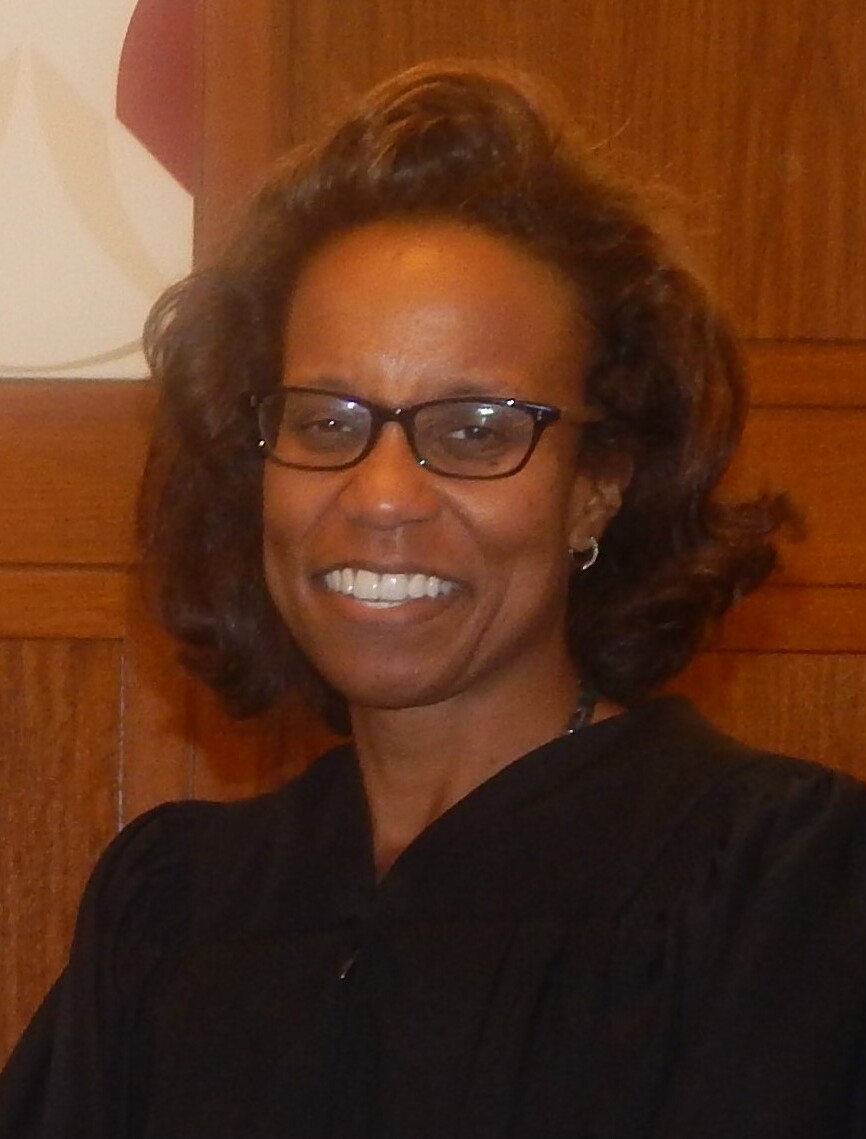
Denise Casper
Copyright Information: Photo from Wikimedia Commons / Author of Photo: US District Court for the District of MassachusettsOverview
Overview[1]
Denise Jefferson Casper was born on January 9, 1968, in East Patchogue, New York. She earned a B.A. degree from Wesleyan University in 1990, and a J.D. from Harvard Law School in 1994.
After completing her formal education, Casper started her professional career as a law clerk for Associate Justices Edith W. Fine and J. Harold Flannery of the Massachusetts Appeals Court in 1994-1995.
From 1995-1998, she was a civil-litigation attorney with the Boston-based law firm of Bingham McCutchen.
From 1999-2005, Casper was an Assistant U.S. Attorney for the District of Massachusetts. This included a stint as Deputy Chief of the Organized Crime Drug Enforcement Task Force starting in 2004.
From 2005-2007, she was an instructor of legal writing at the Boston University School of Law.
From 2007-2010, Casper was a Deputy District Attorney in Middlesex County, Massachusetts.
On April 28, 2010, President Barack Obama nominated Casper for a judgeship on the United States District Court for the District of Massachusetts. The U.S. Senate confirmed her on December 17, 2010. Casper continues to hold that position to this day, and she has been the district’s Chief Judge since 2025.
Blocking Trump’s Executive Order Regarding Voter-Registration Standards
On March 25, 2025, President Donald Trump issued an Executive Order titled “Preserving and Protecting the Integrity of American Elections,” which, among other things:
- required people to provide documentary proof of citizenship when registering to vote;
- required federal voter-registration agencies to “assess” the citizenship of public-assistance recipients before providing them with voter-registration forms;
- set Election Day as the national deadline by which all local election offices could receive and tabulate mail-in ballots;
- required the U.S. Election Assistance Commission to revamp the certification standards for voting machines; and
- called for the withholding of federal funds from states failing to use voting machines that complied with the new standards.
On April 3, 2025, Democrat Attorneys General (AGs) in 19 states — Arizona, California, Colorado, Connecticut, Delaware, Hawaii, Illinois, Maine, Maryland, Massachusetts, Michigan, Minnesota, Nevada, New Jersey, New Mexico, New York, Rhode Island, Vermont, and Wisconsin – jointly filed a lawsuit challenging the aforementioned elements of the President’s Executive Order. The case was known as State of California v. Donald Trump, and the litigation was led by Rob Bonta and Aaron Ford, the AGs of California and Nevada, respectively.
The April 3rd lawsuit was filed in the United States District Court for the District of Massachusetts and was assigned to Judge Casper. The plaintiffs claimed that Trump’s Executive Order “interferes with States’ inherent sovereignty and their constitutional power to regulate the time, place, and manner of federal elections.” Moreover, they asked Casper to declare the challenged provisions of the Executive Order null-and-void, and to bar federal officials from enforcing those provisions.
On June 13, 2025, Judge Casper, siding with the plaintiffs, issued a Preliminary Injunction against the Trump Executive Order. Some key excerpts from her ruling included the following:
- “[T]he challenges by the States to certain provisions of the Executive Order … are ripe for review.”
- “The States have a likelihood of success on the merits as to their challenges to both sections. There is no dispute (nor could there be) that U.S. citizenship is required to vote in federal elections and the federal voter registration forms require attestation of citizenship. The issue here is whether the President can require documentary proof of citizenship where the authority for election requirements is in the hands of Congress.”
- “The States have also shown the risk of irreparable harm in the absence of an injunction where the challenged sections of the Executive Order would burden the States with significant efforts and substantial costs to revamp voter registration procedures and would impede the registration of eligible voters, many of whom lack ready access to documentary evidence of citizenship (e.g., U.S. passport and other forms of identification that reflect citizenship). In light of the likelihood of success on the merits of their challenges to these aforementioned sections of the Executive Order, the risk of irreparable harm in the absence of the relief sought and having considered the balance of equities and the public interest in granting such relief, the Court ALLOWS the States’ motion for a preliminary injunction.”
- “The Executive Branch insists that ‘states arbitrarily treat some people’s votes differently when they permit absentee votes to be received after Election Day,’ noting that ‘[i]f postmarks are unenforced, for example, absentee voters have several extra days after Election Day to cast their votes.’ To underscore this threat, the Executive Branch points to an Illinois statute permitting certain ballots without postmarks to be counted even if they are received after Election Day. But the Executive Branch has offered no evidence suggesting that this statute, or others, result in the counting of votes cast after Election Day. Nor do they explain why this hypothetical risk justifies the potential disenfranchisement of voters whose ballots may not be received by Election Day, simply because of mailing delays outside of their control.”
- “The documentary proof of citizenship requirements, the assessment of citizenship prior to distribution of the Federal Form to enrollees in public assistance programs and the requirements related to ballot receipt deadlines pose the risk of irreparable harm to the States for at least three reasons: (1) compliance with these provisions will require significant time, cost and effort; (2) … the States may lose funding based upon their non-compliance with what this Court has determined is likely an unconstitutional condition and (3) these provisions threaten to chill voter registration and participation […] The States’ expectation is that as a result of the documentary proof of citizenship requirement, fewer of their eligible citizens will become registered to vote. This is unquestionably a harm to the States […] According to the States, many otherwise eligible voters ‘lack ready access to the necessary citizenship documents.’ […] This likelihood of disenfranchisement is a serious harm because ‘[t]he right to vote freely for the candidate of one’s choice is of the essence of a democratic society, and any restrictions on that right strike at the heart of representative government.’”
- “The Executive Branch asserts that the ‘Executive Order seeks to increase [] confidence [in federal elections] by directing executive officials to carry out their statutory duties to prohibit foreign nationals from participating in elections and [by] enforc[ing] the Election Day statutes.’ But there is little evidence in the record suggesting the Executive Order would accomplish these goals.”
Casper’s ruling further stated that “only Congress has the power to adjust state election rules,” and that the “Defendants cannot point to any source of authority for the President to impose” the new requirements enumerated in the Executive Order, “particularly where the Elections Clause gives power over federal elections to Congress.”
According to Votebeat.com: “Casper specified that the part of the order blocking enforcement of the Election Day ballot receipt provisions applies to 13 of the 19 states that filed the challenge.”
When Judge Casper issued a September 17, 2025 decision denying the Trump administration’s motion to dismiss in State of California v. Donald Trump, California Attorney General Bonta said in a statement: “I’ve said it before, and I’ll say it again: Donald Trump is not king. He cannot unilaterally impose voting restrictions across the country — that’s why my fellow attorneys general and I took him to court earlier this year. I’m pleased that the U.S. District Court for the District of Massachusetts has now emphatically rejected the Trump Administration’s effort to dismiss our lawsuit. We continue to believe in the strength of our case and remain as committed as ever to protecting the right to vote.”
On June 24, 2026, Judge Casper converted her Preliminary Injunction of June 13 into a permanent ban against the provisions of the Trump Executive Order. Specifically:
- She wrote that while “the Constitution vests the President with ‘executive Power’ and commands him to ‘take Care that the Laws be faithfully executed,’” “it does not grant the President any specific powers over elections.” “As a result,” she added, “the President ‘plays no direct role in the process’ of appointing electors, ‘nor does he have authority to control the state officials who do.’”
- She characterized several of the Executive Order’s provisions as “unconstitutional and void because they are ultra vires and violate the separation of powers under the United States Constitution.”
- She stated that the provisions requiring proof-of-citizenship would “conflict with the will of Congress” and “can pose a significant barriers for otherwise eligible voters.”
- She wrote that the mail-in ballot provision would “disproportionately harm military voters, elderly voters, voters with disabilities and voters in rural areas, all of whom face unique obstacles.”
- She wrote that “there is no evidence … of widespread ‘illegal voting, discrimination, fraud, and other forms of malfeasance and error’ within American elections, which the Executive Order purports to safeguard against.”
Footnotes:
[1] https://ballotpedia.org/Denise_Casper
https://en.wikipedia.org/wiki/Denise_J._Casper