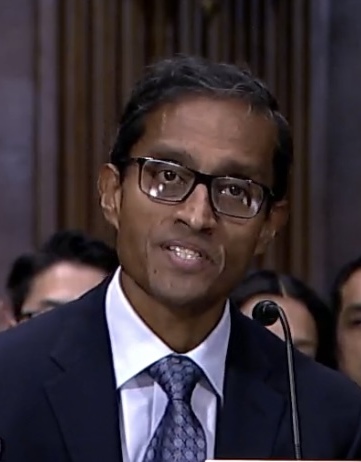
Arun Subramanian
Copyright Information: Photo from Wikimedia Commons / Author of Photo: U.S. Senate Judiciary CommitteeOverview
Overview [1]
Arun Subramanian was born in Pittsburgh, Pennsylvania in 1979. His parents were Tamils who had immigrated from India to the United States in the early 1970s. The father was employed as a control systems engineer, and the mother worked as a bookkeeper, among other jobs.
Arun Subramanian earned a BA degree in 2001 from Case Western Reserve University, and a Juris Doctor in 2004 from Columbia Law School, where he was the executive articles editor of the Columbia Law Review.
After completing his legal studies, Subramanian served as a law clerk for: Judge Dennis Jacobs of the U.S. Court of Appeals for the Second Circuit (2004-2005); Judge Gerard E. Lynch of the Southern District of New York (2005-2006); and Supreme Court Justice Ruth Bader Ginsburg (2006-2007).
From 2007 to 2023, Subramanian was a private-practice attorney at the New York City law firm Susman Godfrey LLP, where he chaired a pro bono practice and specialized in consumer protection cases, antitrust law, commercial class actions, and contract and tort litigation. Click here to view a list of cases, as compiled by Alliance For Justice, representative of Subramanian’s career as an attorney.
On the recommendation of Democrat U.S. Senator Charles Schumer, in September 2022 President Joe Biden nominated Subramanian for a judgeship with the United States District Court for the Southern District of New York. The nomination was confirmed in a 59 to 37 vote by the United States Senate on March 7, 2023, making Subramanian the first South Asian judge ever to serve on that court. Senate Democrats supported him in the vote by a margin of 45 to 0; Independents supported him by a margin of 3 to 0; and Republicans opposed him by a margin of 11 to 37.
In addition to his work as an attorney and a judge, Subramanian has served as: (a) a Board of Directors member for South Asian Youth Action (SAYA); (b) a Board of Directors member for The Fund for Modern Courts, Inc., a New York City-based “nonpartisan, nonprofit, statewide court reform organization which helps ensure a fair, efficient and accessible court sydonations stem for all New Yorkers”; and (c) a Director of the Columbia Law Review Association since 2008.
Devoted Democrat Donor
During the 15 years before he became a federal judge, Subramanian donated more than $58,000 to Democratic Party candidates and causes. His donations included, among others: $10,000 to Kathy Hochul‘s 2022 gubernatorial campaign in New York; $5,700 to Raphael Warnock‘s 2021 U.S. Senate campaign in Georgia; $2,900 to Charles Schumer‘s 2022 U.S. Senate bid in New York; $2,800 to Jon Ossoff‘s 2021 U.S. Senate run in Georgia; $2,800 to Pete Buttigieg‘s presidential campaign in 2020; $1,000 to Michael Capuano‘s 2018 U.S. House bid in Massachusetts; $2,500 to Al Franken‘s 2014 U.S. Senate run in Minnesota; $1,000 to Cory Booker‘s 2014 U.S. Senate campaign in New Jersey; and $250 to Barack Obama‘s presidential campaign in 2008.
Blocking the Trump Administration from Freezing Welfare Funds
In early January 2026, the administration of President Donald Trump– citing allegations of fraud and misuse of government funds — froze approximately $10 billion in federal welfare and social-service outlays that had been earmarked for five Democrat-led U.S. states—California, Colorado, Illinois, Minnesota, and New York. Trump’s action affected three major programs in particular — Child Care and Development Funds (from which the President withheld $2.4 billion), Temporary Assistance for Needy Families ($7.4 billion), and Social Services Block Grants ($870 million). “For too long,” said Department of Health & Human Services (HHS) spokesperson Emily Hilliard in a statement on January 6, “Democrat-led states and Governors have been complicit in allowing massive amounts of fraud to occur under their watch. Under the Trump Administration, we are ensuring that federal taxpayer dollars are being used for legitimate purposes. We will ensure these states are following the law and protecting hard-earned taxpayer money.”
In response to the Trump administration’s announcement, the Attorneys General of the five targeted Democrat-led states — seeking an emergency injunction — filed an emergency lawsuit on January 8, 2026 in the U.S. District Court for the Southern District of New York. “The importance of these programs [whose federal funding was being frozen by Trump] cannot be overstated—they provide cash assistance and fund services to help low-income and vulnerable families,” said the suit. “Without these programs, there will be immediate and devastating impacts in Plaintiff States.”
The plaintiffs also argued that: (a) HHS possessed neither the statutory nor constitutional authority to block the allocation of funds that Congress had already appropriated, and (b) the Trump funding freeze was politically motivated and was not grounded in any tangible evidence. “Defendants have no statutory or constitutional authority to do this,” the suit said in reference to the imposition of the welfare funding freeze. “Nor do they have any justification for this action beyond a desire to punish Plaintiff States for their political leadership. The action is thus clearly unlawful many times over.”
Assigned to preside over this case was Judge Subramanian, who, on January 9, 2026, issued a Temporary Restraining Order (TRO) that paused the Trump funding freeze for 14 days, during which time the court would seek to weigh more fully the various legal arguments involved in the case. “In his brief order,” reported the Indiana Tribune, “Judge Subramanian said the [plaintiff] states had demonstrated sufficient grounds for emergency relief. He cited their likelihood of success on the merits, the risk of irreparable harm to families who rely on the programs, and the public interest in maintaining uninterrupted aid. Importantly, the judge did not rule on the administration’s fraud allegations, instead preserving the status quo while legal proceedings continue.”
New York State Attorney General Letitia James, who led the lawsuit on behalf of the five affected states, called Judge Subramanian’s ruling a “critical victory for families whose lives have been upended by this [Trump] administration’s cruelty.”
On February 6, 2026, U.S. District Court Judge Vernon Broderick of New York approved a longer-term injunction that would continue to block the Trump administration’s funding freeze for the duration of the lawsuit.
Temporarily Opposing Trump’s Effort to Punish Columbia U. for Tolerating Anti-Semitism
On February 13, 2025, the Republican-led U.S. House Committee on Education and the Workforce sent Columbia University a letter explaining that “Columbia’s continued failure to address the pervasive antisemitism that persists on campus is untenable, particularly given that the university receives billions in federal funding.” In light of this allegation, the House Committee directed Columbia to “[p]lease produce,” by February 27, 2025, “[a]ll disciplinary records” related to 11 specific incidents of anti-Israel activism that had taken place on campus between April 2024 and January 2025. Compliance with this demand would require Columbia “to turn over entire private files of hundreds of its students, faculty, and staff,” containing “demographic, academic, and financial information, and at most, personally identifying information, student group affiliations and associations, and related private information …”
When Columbia produced its first responsive documents for the House Committee on February 27, 2025, the university emphasized that it “welcome[d] further conversations with [Committee] staff to provide updates” regarding its “ongoing” investigation. The following week, officials of the U.S. Department of Justice (DoJ), U.S. Department of Education (DoE), U.S. Department of Health and Human Services (HHS), and General Services Administration (GSA) jointly issued a press release announcing their plan to “conduct a comprehensive review of the more than $5 billion in federal grant commitments to Columbia University to ensure the university is in compliance with federal regulations, including its civil rights responsibilities.” A few days later, on March 7, these same four entities formally “canceled or paused” approximately $400 million in federal grants to Columbia, citing the school’s “failure to protect Jewish students from antisemitic harassment.”
On March 13, 2025, officials of the DoJ, DoE, HHS, and GSA together sent Columbia officials a letter outlining “a set of policy changes as a precondition for continued federal funding,” and demanding compliance within one week. To demonstrate such compliance, Columbia would be required to “[f]ormalize, adopt, and promulgate a definition of antisemitism,” “enforce existing disciplinary policies,” and “centralize all disciplinary processes under the Office of the President.”
Also on March 13, the New York chapter of the Council on American-Islamic Relations (CAIR-NY) filed a lawsuit — which became known as Khalil v. The Trustees of Columbia University — on behalf of Columbia graduate student Mahmoud Khalil, a green-card holder who had led pro-Hamas protests on the university’s campus, and other students whose names were not publicly disclosed. The lawsuit aimed to stop Columbia from complying with the U.S. House Committee’s recent demands regarding student disciplinary records. The plaintiffs argued that the House Committee’s effort to obtain those records was in essence a politically motivated campaign to suppress pro-Palestinian speech. “The records demanded by the Committee are not substantially related to antisemitism,” said the lawsuit. “Rather, the Committee has instrumentalized accusations of antisemitism to attack ideas it ideologically opposes. It traffics in anti-Palestinian, anti-Arab, and Islamophobic dog whistles to justify unjustifiable intrusions on First Amendment rights.”
Judge Subramanian was assigned to preside over this case. On March 20, 2025, he ordered Columbia to temporarily pause any impulse it may have felt to release the student records in question, at least until he could hold a formal hearing where he could determine — in a deliberate, methodical manner — whether or not to issue a preliminary injunction that could block the release of such records for a longer period of time.
On March 25, 2025, the House Committee issued a social media post asserting that “nothing in the Constitution requires duly-elected Members of Congress to sit idly by as a wave of antisemitism sweeps over our nation’s college campuses, leading to discrimination against Jewish students at institutions of higher education receiving billions of dollars in federal funds.”
On April 4, 2025, Subramanian denied the plaintiffs’ request for a Temporary Restraining Order (TRO) that would have barred Columbia from providing the House Committee with the student disciplinary records it sought. The plaintiffs, said the judge, had failed to meet certain crucial “threshold requirements” such as demonstrating that they: (a) had the standing necessary to file their suit, or (b) were at risk of suffering “irreparable harm” if their student records were to be disclosed to the House Committee. Moreover, Subramanian noted that the university had already furnished government authorities with a number of student records, and that the court obviously was powerless to enjoin such actions that had already taken place.
In a measure that favored the plaintiffs, however, Subramanian ruled that Columbia would thenceforth be required to provide both the plaintiffs and the court with 30 days’ notice before making any further student records or identities available to Congress.