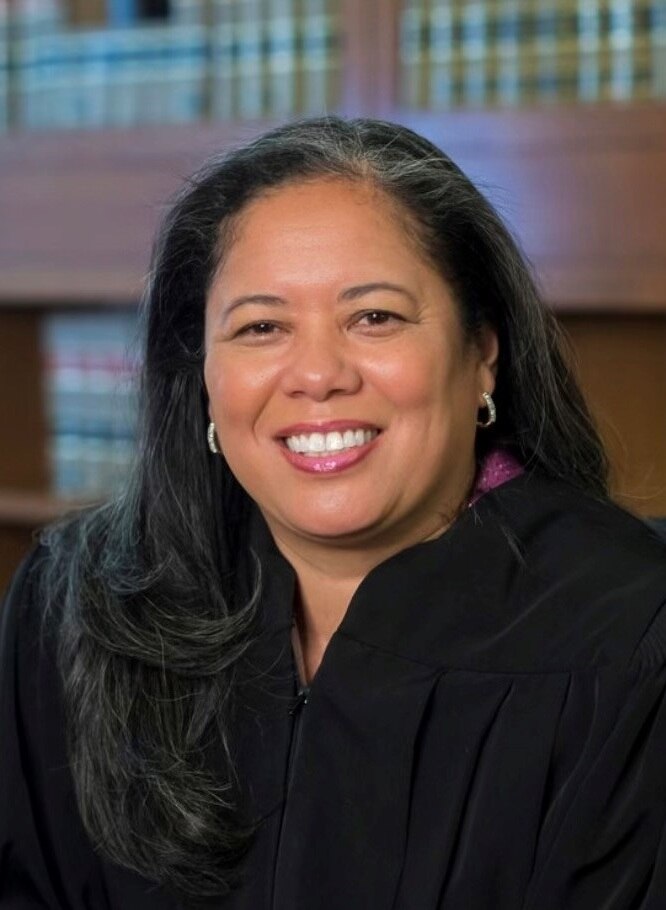
Angel Kelley
Copyright Information: Photo from Wikimedia Commons / Author of Photo: United States District Court for the District of Massachusetts / Source of Photo: https://www.mad.uscourts.gov/history/judges-timeline.htmOverview
Overview[1]
Angel Kelley was born in 1967 in New Rochelle, New York. She earned a BA degree from Colgate University in 1989, and a JD degree from the Georgetown University Law Center in 1992.
After completing her formal legal education, Kelley was employed as a part-time instructor at Columbia University from 1992-2005.
She began her legal career as a staff attorney in the Juvenile Rights Division of The Legal Aid Society in Brooklyn, New York, where she worked from 1993-1997.
From 1997-2005, Kelley served as an attorney for the Port Authority of New York and New Jersey.
She was a part-time instructor at New York University from 2004-2005, and a clinical instructor at Harvard Law School from 2005-2007.
From 2007-2009, Kelley served as an Assistant United States Attorney in the United States Attorney’s Office for the District of Massachusetts.
Massachusetts’ Democrat Governor Deval Patrick appointed Kelley to the Brockton District Court in 2009, and she was sworn in to that post on September 17, 2010.
In January 2013 Governor Patrick appointed Kelley as an Associate Justice of the Massachusetts Superior Court, where she went on to serve until 2021.
On May 12, 2021, President Joe Biden nominated Kelley for a judgeship with the United States District Court for the District of Massachusetts. Her nomination was confirmed by the U.S. Senate in a 52-44 vote on September 14, 2021, and she received her commission the following day.
Over the years, Kelley has also worked as a part-time adjunct professor at Suffolk University Law School, a volunteer instructor at Emory University School of Law, and a part-time adjunct professor at Boston University School of Law.
Political Activist
Though Kelley told Republican questioners during her Senate confirmation process that in her view it was “not appropriate” for a judge to engage in “judicial activism,” Democrat Senator Elizabeth Warren observed in June 2021 that the judge “has made it a personal mission to bring about change through her role on the bench, both in her courtroom and in those of her colleagues.”
Diversity, Equity, and Inclusion (DEI) practices — with their embrace of tribalism, identity politics, and perpetual grievance — have played a major role in Kelley’s professional career from its earliest days. Indeed, President Biden took pains to emphasize that her African American and Asian American ancestry were major reasons why he appointed her as a district court judge — particularly in light of his administration’s “push to expand diversity on the federal bench.” Embracing critical race theory and the premise that “there is systemic racism in almost all systems, particularly the court system,” Kelley candidly and proudly uses DEI criteria to guide and inform her own personal decisions when hiring law clerks. “Diversity is very important to me,” she said during a Berkeley Law Judges-in-Residence program. “I want people who bring different life experiences and diversity can mean any number of things — race, gender, geography, socio-economic, work experience, all of it.”
Kelley’s Position on the Freedom to Speak Critically about George Floyd
In February 2021, Massachusetts police officer Brian Hussey of the Cambridge Police Department (CPD) used his personal Facebook page – whose content was visible only to his friends — to repost an Internet article about “the George Floyd Act,” a federal police-reform bill named after the black Minneapolis man who had died shortly after his infamous encounter with a white police officer on May 25, 2020.[2] Hussey’s comment accompanying the reposted article said: ‘This is what its come to: ‘honoring’ a career criminal, a thief and druggie … the future of this country is bleak at best.’” After Hussey’s Facebook page was screenshotted and shared with the local NAACP as well as the local police commissioner and many others in the community, the officer was placed on administrative leave by the CPD. A subsequent investigation by the CPD concluded that Hussey’s post about George Floyd was in violation of department policies regarding courtesy and professionalism, and the officer was given a four-day unpaid suspension.
Arguing that his suspension was an unconstitutional act of retaliation against him for merely exercising his First Amendment free-speech rights, Hussey filed suit against the City of Cambridge and the CPD’s commissioner in the United States District Court for the District of Massachusetts. Angel Kelley presided over the case. In her decision, she granted summary judgment in favor of the police department, explaining that the CPD’s need to cultiuvate public trust and maintain civil tranquility – particularly in the emotionally charged environment that followed George Floyd’s death — took precedence over the officer’s speech rights. Some notable excerpts from Judge Kelley’s 33-page opinion:
“The value of Hussey’s speech is lessened by the inflammatory and insulting manner in which his post was written…. The post called George Floyd ‘a career criminal, a thief and druggie.’ The term ‘druggie’ may be subject to differing interpretations; however, in both its common understanding and in the manner it was used in the Facebook post, the term is employed as a pejorative to disparage its subject as a person. Even if the term itself is not inherently derogatory, here it was used in a derogatory fashion. The terms ‘thief’ and ‘a career criminal’ are similarly insulting, even though they reflect the fact that, for a ten-year period in Floyd’s life from 1997 until 2007, he participated in criminal activity that included offenses related to theft and robbery. More relevant than the particular terms used was the fact that the thrust of the message disparaged George Floyd as being unworthy of being honored in that manner because of his past criminal conduct and substance abuse issues. It dismissed the reasons why George Floyd’s life and tragic death inspired the legislation….
“Hussey’s speech could be categorized as insensitive, disparaging, or dehumanizing …, particularly by those concerned with helping individuals with substance use challenges or those who sought to honor Floyd as an emblematic Black victim of police brutality. However, even if the Court agreed with that assessment, it would not diminish Hussey’s interest in being able to share his opinion on the topic. Offensive speech can still be protected speech if an employer retaliates against the employee because of their objections to the content of that speech, rather than their concern for the speech’s impact on public functions. …
“However, the Court does not find in Hussey’s favor because, even if it viewed his post in the light most favorable to him and resolved any factual disputes about its content or context in his favor, his interest would be outweighed by the strong interest the Cambridge Police Department had here in restricting his speech.… [T]he Court is persuaded that the Defendants’ strong interest in maintaining public trust outweighs the interest Hussey had in making his Facebook post. The timing here is a crucial factor — Hussey’s statements came mere months after Floyd’s killing galvanized public criticism of policing and racial disparities, including in the City of Cambridge and the greater Boston area. The vast majority of protests were peaceful, yet departments across the country met many of those same protests with tear gas, arrests, flash grenades, and more-sometimes with fatal consequences for demonstrators. Some of the protests turned violent and the ensuing riots set ablaze local businesses, restaurants, news buildings, and even a police department building. A number of police officers sustained injuries during such incidents. In the weeks that followed, as the names of more Black persons, like Breonna Taylor, became synonymous with police brutality and impunity, it poured fuel on the collective fury against police departments and ignited new rounds of protests. These demonstrations were often accompanied by calls to reform, defund, and even abolish police departments. It is thus understandable that in the months that followed, the Cambridge’s Police Department’s sensitivity to public perception was heightened, especially regarding discussions related to victims of police violence. …
“The community complaints about the Facebook post provide the necessary evidence to justify Defendants’ perception that Hussey’s comments could have undermined public trust….”
Opposing a Reduction of NIH Funding for “Indirect Costs” in Research Grants
On February 7, 2025, the office of National Institutes of Health (NIH) director Matthew J. Memoli – acting in accordance with the Trump administration’s effort to slash billions of dollars in waste from America’s federal budget — introduced a Notice stating that the NIH would thenceforth (beginning on February 10) pay the “indirect costs” associated with college and university research grants at a fixed level of 15%, instead of the much higher percentages that previously had been in effect. Indirect costs include institutional overhead expenses that are not tied to any specific project — e.g., costs of utilities, research facility maintenance and upgrades, Information Technology, administrative and support staff salaries, equipment maintenance, depreciation, laboratory operation, utility charges, accounting, research compliance, and legal expenses.
On February 10, a coalition of Democrat Attorneys General for 22 U.S. states sued the NIH in an effort to block the new 15% cap from being enforced.
On February 10 as well, Judge Kelley, who was assigned to preside over this case, granted a Temporary Restraining Order fulfilling the wishes of those 22 AGs. “Defendants and their officers, employees, servants, agents, appointees, and successors are hereby enjoined from taking any steps to implement, apply, or enforce the Rate Change Notice … within Plaintiff States until further order is issued by this Court,” Kelley’s order stated.
Then, in response to yet another lawsuit filed by university associations and major research centers, Kelley on March 5 expanded her February 10 decision by issuing a Nationwide Preliminary Injunction blocking indefinitely the enforcement of the 15% cap at all institutions across the United States — for however long the litigation might take. In this new ruling, the judge wrote: “Considering the irreparable harm likely to befall similarly situated nonparties, the chaos that would result both for institutions and NIH from a patchwork of injunctions, the diffuse nature of the Plaintiffs, and the nature of the suit, a nationwide preliminary injunction is the appropriate and reasonable remedy.”
On April 4, 2025, Kelley issued a Permanent Injunction barring the 15% cap on federal reimbursements for “indirect costs” associated with NIH research grants. As The New York Times reported, this latest ruling by Judge Kelley “made an earlier temporary order by her permanent.”
Blocking Trump’s Call for Ending the TPS Status of Sudanese Migrants
In 1990, the U.S. Congress established “Temporary Protected Status” (TPS) as a designation to shield certain migrants who were in the United States without legal status from being deported to their home countries, if such relocations were likely to place them in danger.[3] According to U.S. Citizenship & Immigration Services (USCIS):
“The Secretary of Homeland Security may designate a foreign country for TPS due to conditions in the country that temporarily prevent the country’s nationals from returning safely, or in certain circumstances, where the country is unable to handle the return of its nationals adequately…. The Secretary may designate a country for TPS due to the following temporary conditions in the country: ongoing armed conflict (such as civil war); an environmental disaster (such as earthquake or hurricane), or an epidemic; other extraordinary and temporary conditions.
“During a designated period, individuals who are TPS beneficiaries or who are found preliminarily eligible for TPS upon initial review of their cases … are not removable from the United States; can obtain an employment authorization document (EAD); may be granted travel authorization…. TPS is a temporary benefit that does not lead to lawful permanent resident status or give any other immigration status.”
USCIS designated people from the Republic of South Sudan as eligible for TPS in 2011 when, after that nation gained independence from Sudan, a catastrophic civil war erupted that resulted in nearly 400,000 deaths over the ensuing seven years.
As of December 2025, approximately 300 individuals from South Sudan faced the prospect of the U.S. possibly beginning to deport them back to their native land by January 6, 2026. This was because the Trump administration had determined that because conditions in South Sudan were no longer as dire as they once had been, it was now an appropriate time to revoke those people’s TPS status. As USCIS said in late 2025: “Based on the [Homeland Security] Department’s review, the Secretary [Kristi Noem] has determined the situation in South Sudan no longer meets the criteria for an ongoing armed conflict that poses a serious threat to the personal safety of returning South Sudanese nationals. While there is inter/intra-communal violence linked to border disputes, cross-border violence, cyclical and retaliatory attacks, and ethnic polarization, return to full-scale civil war, to-date, has been avoided.”
In response to the Trump administration’s announcement, a number of South Sudanese individuals with TPS status joined forces with African Communities Together, an immigrant rights organization, to sue the Department of Homeland Security (DHS) in late December 2025. The plaintiffs argued that the proposed deportations of South Sudanese people would not only constitute violations of proper administrative procedure, but would also be unconstitutional because they sought to “significantly reduce the number of non-white and non-European immigrants in the United States” on the basis of race.
District Judge Patti B. Saris was originally assigned to the case when it was filed on December 22, 2025. But within a week or so, Angel Kelley replaced Saris as the presiding judge. On December 30, Kelley wrote a court order temporarily blocking the federal government from deporting the Sudanese TPS beneficiaries. Noting that such deportations could potentially cause irreversible harm to the people directly affected, Kelley wrote in her four-page ruling: “These significant and far-reaching consequences not only deserve, but require, a full and careful consideration of the merits by the Court.” “Because of the serious consequences at stake,” she added, “both for the Plaintiffs and the Defendants, the Court finds an administrative stay appropriate, as it would ‘minimize harm,’ while allowing the assigned District Court Judge the time this case deserves.”
Kelley’s ruling concluded by saying:
“[T]he effective date of the decision issued on November 6, 2025 … to terminate the designation of Temporary Protected Status for South Sudan, effective as of 12:00 A.M. on January 6, 2026, is hereby STAYED subject to further Order of this Court or higher courts. During the period of the STAY of the termination, the termination shall be null, void, and of no legal effect. Thus, the legal consequences of being in TPS status based on South Sudan’s designation shall continue to apply, including being eligible for work authorization and having protection against deportation and detention based on TPS status. The legal consequences of having a pending TPS application based on South Sudan’s designation shall also continue to apply, including eligibility for work authorization and having protection against deportation based on a pending TPS application.”
On December 30, 2025, DHS Assistant Secretary Tricia McLaughlin issued a statement denouncing Judge Kelley’s order: “Yet another lawless and activist order from the federal judiciary who continues to usurp the President’s constitutional authority. Under the previous administration Temporary Protected Status was abused to allow violent terrorists, criminals, and national security threats into our nation…. Now is the right time to conclude what was always intended to be a temporary [TPS] designation.”
Footnotes:
- https://ballotpedia.org/Angel_Kelley
https://www.mad.uscourts.gov/boston/djakelley.htm
https://bidenwhitehouse.archives.gov/briefing-room/statements-releases/2021/05/12/president-biden-announces-third-slate-of-judicial-nominees/
https://www.bostonherald.com/2021/05/12/biden-nominates-bay-state-judge-angel-kelley-to-federal-court/ - The George Floyd Act was never actually passed into law.
- As of late 2025, people from South Sudan, Ethiopia, Cameroon, Afghanistan, Nepal, Myanmar, Syria, Haiti, Venezuela, Nicaragua, and Honduras were in the United States under the protection of TPS status.