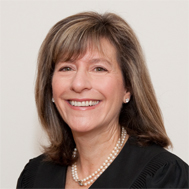
Amy Berman Jackson
Copyright Information: Photo from Wikimedia Commons / Author of Photo: United States Government / Source of Photo: http://www.dcd.uscourts.gov/dcd/sites/www.dcd.uscourts.gov.dcd/files/ajackson.jpgOverview
Overview[1]
Amy Sauber Berman Jackson was born on July 22, 1954, in Baltimore, Maryland. Her father, Barnett Berman, was a physician at Johns Hopkins Hospital.
After earning an A.B. degree from Harvard College in 1976 and a J.D. degree from Harvard Law School in 1979, Jackson served as a law clerk for Judge Harrison Lee Winter of the United States Court of Appeals for the Fourth Circuit from 1979-1980.
From 1980-1986, Jackson was an Assistant U.S. Attorney in the District of Columbia.
She then joined the private sector, working first as an associate and then as a partner at the Washington, D.C.-based law firm Venable, Baetjer, Howard and Civiletti from 1986-1994.
From 1995-2000, Jackson took a family-leave break away from her legal practice.
She resumed her career in 2000 as a member of the D.C.-based law firm Trout Cacheris & Solomon PLLC, where she went on to spend the next 11 years.
On June 17, 2010, President Barack Obama nominated Jackson to fill a vacant judge’s seat on the United States District Court for the District of Columbia. After Jackson’s nomination lapsed at the end of the 111th Congress, Obama renominated her on January 5, 2011, at the start of the 112th Congress. The United States Senate confirmed Jackson for the position on March 17, 2011, by a 97–0 vote.
Striving to Enforce Obamacare’s Contraceptive Mandate
One of the more controversial aspects of the Affordable Care Act of 2010 — a.k.a. Obamacare — was a mandate requiring all employers to offer their workers health insurance plans that covered the costs of various forms of contraception — including sterilization and a “morning-after” abortifacient pill. This mandate gave no exemption to religious institutions—such as Catholic schools, charities, and hospitals—whose moral principles might oppose such practices or products. The only exemptions were given to Catholic organizations that served Catholics exclusively, meaning churches.
In January 2012, the Obama administration reaffirmed that every entity other than churches — meaning religious hospitals, schools, charities and other health and social-service providers — would be required to provide “free” abortifacient pills, sterilizations and contraception on demand in their insurance plans—even if doing so violated their moral codes and the teachings of their churches. In response to harsh pushback from critics, Department of Health and Human Services (HHS) Secretary Kathleen Sebelius decreed that a “religious institution” — in order to sidestep the requirements of Obamacare — would have to show that it had “the inculcation of religious values as its purpose.” But as conservative political columnist Charles Krauthammer pointed out: Under Obamacare, Catholic charities and Catholic hospitals that existed not to inculcate people with religious values but “to give succor to the poor” regardless of their religious backgrounds, could “be required, among other things, to provide free morning-after abortifacients.”
On February 10, 2012, the Obama administration, reacting to continued public criticism, made an “accommodation” that unilaterally altered the ACA so that, instead of forcing religious employers to pay for contraceptives and abortifacients, it would require insurance companies to make those items available free-of-charge to all women, regardless of where they worked: “If a woman works for religious employers with objections to providing contraceptive services as part of its health plan, the religious employer will not be required to provide contraception coverage but her insurance company will be required to offer contraceptive care free of charge.” Pro-life Rep. Chris Smith pointed out the obvious duplicity of this HHS accommodation:
“The so-called new policy is the discredited old policy, dressed up to look like something else. It remains a serious violation of religious freedom. Only the most naïve or gullible would accept this as a change in policy…. The White House Fact Sheet … states, for example, that religious employers ‘will not’ have to pay for abortion pills, sterilization and contraception, but their ‘insurance companies’ will. Who pays for the insurance policy? The religious employer.”
In the 2012 case of Roman Catholic Archbishop of Washington v. Sebelius, the Archbishop of Washington and affiliated plaintiffs filed a lawsuit in the D.C. District Court challenging the federal government’s contraceptive mandate. They argued that: (a) the mandate violated their religious beliefs and infringed upon their rights under the First Amendment and the Religious Freedom Restoration Act, and (b) the new so-called “accommodation” did not eliminate the infringement on their religious exercise.
Judge Jackson presided over this case in court, and in December 2013 she ruled in favor of HHS/Sebelius and against the Roman Catholic Diocese of Washington. As the Insurance Journal reported on December 23: “U.S. District Judge Amy Jackson … rejected arguments made by the Roman Catholic Archbishop of Washington, and schools within its jurisdiction, that the requirement that employers provide cost-free coverage for contraceptive services is contrary to their religious beliefs, and violates the Religious Freedom Restoration Act and their constitutionally protected free-speech rights.”
Dismissing a Wrongful Death Lawsuit against Hillary Clinton
In May 2017, Judge Jackson dismissed a wrongful death lawsuit filed against Hillary Clinton by the parents of Tyrone Woods and Sean Smith — two of the four American men who had been killed on the night of September 11, 2012, when the U.S. mission in Benghazi, Libya was attacked by a large group of heavily armed Islamic terrorists. The lawsuit alleged that the attack had occurred, in part, because Mrs. Clinton, who in 2012 was the U.S. Secretary of State, was illegally using an unsecured private email server for her government-related communications, thereby making it possible for terrorist hackers to access information potentially useful to their nefarious efforts. Said the suit:
“As a direct result of Defendant Clinton’s reckless handling of this classified, sensitive information, Islamic terrorists were able to obtain the whereabouts of Ambassador Christopher Stevens and thus the U.S. State Department and covert and other government operations in Benghazi, Libya and subsequently orchestrate, plan, and execute the now infamous September 11, 2012 attack.”
In her 29-page decision, Jackson said that the question of whether or not Mrs. Clinton’s email use was appropriate was not relevant to the case. Wrote the judge:
“The Court finds that Secretary Clinton was acting in the scope of her employment when she transmitted the emails that are alleged to give rise to her liability. The untimely death of plaintiffs’ sons is tragic, and the Court does not mean to minimize the unspeakable loss that plaintiffs have suffered in any way. But when one applies the appropriate legal standards, it is clear that plaintiffs have not alleged sufficient facts to rebut the presumption that Secretary Clinton was acting in her official capacity when she used her private email server.”
Jackson also dismissed the parents’ assertion that Mrs. Clinton defamed them in the press after the three had met with one another following the Benghazi attack and subsequently given differing accounts of their conversation to reporters. According to the judge:
“Secretary Clinton did not refer to plaintiffs as liars. Plaintiffs may find the candidate’s statements in her own defense to be ‘unpleasant or offensive,’ but Secretary Clinton did not portray plaintiffs as ‘odious, infamous, or ridiculous….’ To the contrary, the statements portray plaintiffs as normal parents, grieving over the tragic loss of their loved ones.”
Presiding over the Criminal Case against Paul Manafort and Rick Gates
On October 30, 2017, Judge Jackson was assigned to preside over the criminal case that Special Counsel Robert Mueller brought against a pair of Republican political consultants: (a) Paul Manafort, who had served a stint as Donald Trump’s presidential campaign manager in 2016, and (b) Manafort’s longtime business associate Rick Gates. Mueller’s probe was focused on the allegation that the 2016 Trump campaign had colluded with Russian operatives to influence the U.S. presidential election — an allegation that was eventually proven to be wholly fictitious. Accepting the defendants’ pleas of “not guilty” to charges of conspiracy and obstruction of justice, Jackson granted bail to both defendants, confiscated their passports, and sentenced each of them to house arrest. She also instructed their defense attorneys not to discuss the case outside of court, saying: “This is a criminal trial, not a public relations campaign.”
On November 8, 2017, Judge Jackson issued a gag order that prohibited “all interested participants in the matter, including the parties, any potential witnesses, and counsel for the parties … from making statements to the media or in public settings that pose a substantial likelihood of material prejudice to this case.”
In a February 23, 2018 plea bargain, Gates pled guilty to one count of false statements and one count of conspiracy against the United States while agreeing to cooperate with the Mueller investigation.
On June 4, 2018, the prosecution accused Manafort of attempted witness tampering while under house arrest. Eleven days later, Jackson revoked Manafort’s bail and ordered that he be incarcerated until his upcoming federal trials.
In a September 2018 plea bargain, Manafort admitted to money laundering, tax fraud, and illegal foreign lobbying.
On February 13, 2019, Jackson determined that Manafort had lied to Mueller’s office, to the FBI, and to a grand jury after having pleaded guilty regarding his interactions with Konstantin Kilimnik, a political operative who the FBI believed was linked to Russian intelligence agencies. According to a CNN report issued that same day: “The ruling [by Jackson] partly relates to a meeting between Manafort and Kilimnik at a Manhattan cigar bar on August 2, 2016. Thanks to a botched legal filing last month by Manafort’s lawyers, it has emerged that Mueller believes Manafort shared polling data and spoke about Russia-Ukraine policy with Kilimnik.”
At that point, Jackson ruled that because Manafort had “made false statements and thereby breached the plea agreement in good faith,” “the Office of Special Counsel is no longer bound by its obligations under the plea agreement, including its promise to support a reduction of the offense level in the calculation of the U.S. sentencing guidelines for acceptance of responsibility.” Moreover, Jackson determined that Manafort had also lied about two additional matters: (a) a $125,000 payment he had received for legal services, and (b) an unspecified separate investigation by the DOJ.
On March 13, 2019 — just a few days after he had been sentenced by a Virginia court to 47 months in prison for financial fraud convictions — Judge Jackson sentenced Manafort to an additional 43 months behind bars on federal conspiracy charges, bringing his total prison term for the two separate cases to seven and a half years. “This defendant is not public enemy No. 1, but he’s not a victim either,” said Jackson. The judge also said that Manafort’s frequent assertions that there had been no collusion between the Trump campaign and Russia had no bearing on the charges against Manafort. “The ‘no collusion’ mantra is simply a non sequitur,” she said.
Sentencing Alex van der Zwaan
On April 3, 2018, Judge Jackson sentenced Alex van der Zwaan, a Belgian-born Dutch lawyer who practiced in London, to one month in prison and a $20,000 fine for having pled guilty to one count of making a false statement to federal investigators about his contacts with 2016 Trump campaign official Rick Gates during Special Counsel Robert Mueller’s probe into the aforementioned Trump-Russia collusion allegations. Said Jackson about van der Zwaan: “This is not something that happened to him. This was something he did.”
Sentencing Roger Stone
In January 2019, Jackson was assigned to handle the case of Roger Stone — who had served as an informal advisor to presidential candidate Donald Trump in 2016 — after a grand jury indicted Stone on seven counts that included making false statements, obstruction of justice, and witness tampering. Specifically, Stone had: (a) attempted to persuade WikiLeaks to release the contents of emails that had been stolen from Hillary Clinton’s Democratic presidential campaign in 2016; and (b) lied to the House Intelligence Committee when he denied having talked to the Trump campaign about the matter.
On February 15, 2019, Jackson imposed a limited gag order on Stone — who had been on a media blitz of interviews and social media posts ever since his January 25 arrest — and his attorneys. She decreed that lawyers “for the parties and the witnesses must refrain from making statements to the media or in public settings that pose a substantial likelihood of material prejudice to this case.” Noting also “the size and vociferousness of the crowds that have already been attracted to these proceedings,” the judge voiced concern about “the risk that public pronouncements by the participants may inflame those gatherings.”
On February 18, 2019, Stone posted an Instagram photo of Judge Jackson accompanied by the words “Corruption Central” and an image of crosshairs next to her head; he deleted it shortly thereafter.
On February 21, 2019, Jackson made the terms of Stone’s gag order more exacting, saying, “From this moment on, the defendant may not speak publicly about this case—period. No statements about the case on TV, radio, print reporters or internet. No posts on social media.”
On February 20, 2020, Jackson sentenced Stone to 40 months in federal prison and a $20,000 fine. “He was not prosecuted, as some have complained, for standing up for the president,” Jackson said in her closing remarks. “He was prosecuted for covering up for the president.”
Sentencing a January 6 Rioter to 7 Years in Prison
In September 2022, Jackson sentenced a 38-year-old Iowa man named Kyle Young — who allegedly had assaulted a police officer during the infamous Capitol riot in Washington, D.C. on January 6, 2021 — to more than seven years in prison. “You were not prosecuted for being a Trump supporter,” Jackson explained to Young. “You were not arrested or charged, and you will not be sentenced, for exercising your First Amendment rights. You are not a political prisoner…. You were trying to stop the singular thing that makes America America, the peaceful transfer of power. That’s what ‘Stop the Steal’ meant.”
Deriding “high-ranking members of Congress and state officials” for being “so afraid of losing their power” that they considered it “heresy” to voice doubt about Trump’s claims of fraud in the 2020 presidential election, Jackson said: “The judiciary … has to make it clear: It is not patriotism, it is not standing up for America to stand up for one man [Trump] — who knows full well that he lost — instead of the Constitution he was trying to subvert,”
In addition, Jackson said that Trump and his supporters were using ominous rhetoric about what horrors might result if any of the multiple criminal probes targeting Trump were to end unfavorably for the former president. “Some prominent figures in the Republican Party … are cagily predicting or even outright calling for violence in the streets if one of the multiple investigations doesn’t go his way,” Jackson said.
Dismissing a Lawsuit against D.C. Policy That Allowed Noncitizens to Vote & Run in Local Elections
In an opinion issued on March 21, 2024, Judge Jackson dismissed a lawsuit in which a group of seven plaintiffs — all of whom were U.S. citizens registered to vote in Washington, D.C. — argued that their Fifth Amendment rights were being violated by the city’s “Local Resident Voting Rights Amendment Act of 2022,” which allowed noncitizens to cast ballots in local municipal elections, run for D.C. government positions, and serve on the city’s Board of Elections. Filed against D.C.’s Board of Elections, the suit alleged that the aforementioned Act “dilutes the vote of every U.S. citizen voter in the District,” thereby infringing on their fundamental right to vote and the “constitutional right to citizen self-government.” The plaintiffs asked Jackson to stop the Board of Elections not only from registering noncitizens to vote, but also from counting whatever ballots they may already have cast.
Jackson, however, determined that the plaintiffs were “simply raising a generalized grievance” and had failed to demonstrate that the Act in question harmed or “diminished” them in any tangible way. “They may object as a matter of policy to the fact that immigrants get to vote at all,” said the judge, “but their votes will not receive any less weight or be treated different[ly] than noncitizens’ votes; they are not losing representation in any legislative body; nor have citizens as a group been discriminatorily gerrymander[ed], ‘packed,’ or ‘cracked’ to divide, concentrate or devalue their votes.”
Accusing Trump of “Tyranny” & “Authoritarianism”
In early December 2024, just a few weeks after Donald Trump’s electoral victory in the previous month’s presidential race, Judge Jackson said: “The lie that the [2020] election was stolen is still being disseminated.” The January 6, 2021 storming of the U.S. Capitol “at the direction of a disappointed candidate,” she added, was “the definition of tyranny and authoritarianism.”
Blocking Trump’s Effort to Shrink the CFPB
Early in 2025, the Trump administration — as part of its effort to streamline and shrink the federal government — indicated a desire to either shut down or dramatically downsize the Consumer Financial Protection Bureau (CFPB), an agency whose creation Congress had authorized in 2010 as part of the Dodd-Frank Act that grew out of the 2008 financial crisis. Characterizing CFPB as an agency that “has long functioned as another woke, weaponized arm of the bureaucracy that leverages its power against certain industries and individuals disfavored by so-called ‘elites,’” the administration publicly enumerated the following assertions on February 10, 2025:
- “CFPB used its slush fund — collected from targeting financial institutions — to support radical advocacy groups. One such group is the Soros–backed Mississippi Center for Justice, which advocates for “racial and economic justice,” targets religious liberty, and assists illegal immigrants seeking to skirt our nation’s laws. Another is The Legal Aid Society of the District of Columbia, whose board features senior left-wing officials and has lobbied hundreds of times for more welfare spending.”
- “CFBP threatened banks for refusing to lend to illegal immigrants.”
- “CFPB targeted a Chicago small business after it complained about the city’s rampant crime.”
- “CFPB was accused of mining American citizens’ personal financial information — with a 2017 inspector general’s report raising significant concerns about its data security.”
- “CFPB granted itself broad new powers in the waning hours of the lame duck Biden administration. Described as classic “government overreach,” the agency gave itself the authority to regulate Americans’ checking accounts by dictating government price controls and unilaterally buried $50 billion in medical debt.”
Later in February 2025, the union representing CFPB employees joined forces with the City of Baltimore as well as a number of leftwing organizations — most notably the National Treasury Employees Union, the NAACP, the National Consumer Law Center, and the Economic Action Maryland Fund — to file a lawsuit aiming to preserve CFPB’s existence.
In response, Judge Jackson on March 28, 2025 issued a preliminary injunction designed to keep the agency solvent until such time as she could rule on the merits of the aforementioned lawsuit. When issuing her order, Jackson characterized the Trump administration’s plan to gut the CFPB as “completely in violation of law” and indicative of a “complete disregard” for the role of Congress.
According to ABC News, Jackson’s March 28 injunction “requires the Trump administration to reinstate any terminated CFPB employees, rescind the cancellation of any contracts, allow the workforce to access their computers and return to the office, resume statutorily required work and maintain any records held by the organization.” “If the defendants are not enjoined,” wrote Jackson in her 112-page opinion, “they will eliminate the agency before the Court has the opportunity to decide whether the law permits them to do it, and as the defendants’ own witness warned, the harm will be irreparable.” “[T]he Court cannot look away or the CFPB will be dissolved and dismantled completely in approximately thirty days, well before this lawsuit has come to its conclusion,” Jackson added. She also blocked the destruction of any CFPB records and ordered the recission of any “wholesale” contract cancellations that had been made since February 11.
On April 11, 2025, a three-judge panel from the U.S. Court of Appeals for the District of Columbia Circuit pared back Judge Jackson’s March 28 injunction and declared that Trump officials could — after conducting a “particularized assessment” of each individual CFPB worker’s abilities — fire any employees who they felt were not needed to fulfill the agency’s legally mandated duties. In an April 11 court filing, CFPB chief legal officer Mark Paoletta stated that after careful consideration, he and a team of fellow attorneys had concluded that only about 200 of the bureau’s 1,700 employees were actually essential. Slashing CFPB’s staff by by approximately 90 percent, he concluded, would “right-size” an agency where “vast waste” was the dominant theme.
In response to that finding, the Trump administration on April 17 sent layoff notices to approximately 1,483 CFPB employees.
The very next day — April 18, 2025 — Judge Jackson issued an oral and written order to block the mass firings, which were slated to take effect within a few hours. Her order called for the status quo to be preserved for ten days — until April 28 — at which time Jackson would hold a hearing to determine if the planned layoffs would violate her previous injunction of March 28.
On August 15, 2025, the United States Court of Appeals for the District of Columbia Circuit issued a 2-1 decision that reversed Jackson’s March 28 injunction. According to the appellate court, a lower court could not prevent the Trump administration from laying off workers whom it deemed unnecessary.
Blocking Trump’s Firing of Special Counsel Hampton Dellinger
On February 7, 2025, the Trump administration fired Hampton Dellinger, the Biden-appointed head of the Office of the Special Counsel, just one year into his scheduled five-year term in that position. Dellinger responded by filing a lawsuit three days later in the United States District Court for the District of Columbia, arguing that his firing was illegal since the Office of the Special Counsel was an independent agency whose leader, by law, could only be terminated by the President “for cause” – i.e., “inefficiency, neglect of duty, or malfeasance in office.” Asserting that he had committed none of those infractions and had not been told a reason for his dismissal, Dellinger asked the D.C. district court to declare his firing unlawful and restore him to his position.
In response to Dellinger’s request, Jackson granted a temporary administrative stay preventing the plaintiff’s firing; the judge then extended that stay two days later. The federal government appealed both stays to the United States Court of Appeals for the District of Columbia Circuit, which dismissed both appeals.
On March 1, 2025, Jackson issued a temorary restraining order (TRO) stating that Dellinger’s firing was in fact unlawful, and that he should be fully reinstated. “It is DECLARED that plaintiff Hampton Dellinger is the Special Counsel of the Office of Special Counsel,” read Jackson’s TRO, and he “shall be the Special Counsel of the Office of Special Counsel for the remainder of his five-year term unless and until he is removed in accordance with 5 U.S.C. §1211(b).”
The Trump administration appealed the ruling to the U.S. Court of Appeals for the District of Columbia Circuit shortly thereafter. On March 5, 2025, this appellate court lifted the stay imposed by Jackson in the district court, thereby allowing for Dellinger’s dismissal. Dellinger accepted this verdict and dropped his lawsuit the following day.