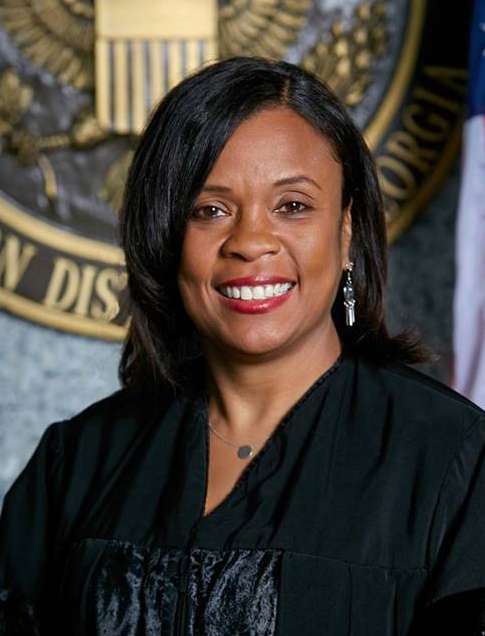
Eleanor Ross
Copyright Information: Photo from Wikimedia Commons / Author of Photo: Eleanorlross (Own Work)Overview
Overview [1]
Eleanor Louise Ross (née Barnwell) was born on December 8, 1967, in Washington, D.C. She earned a B.A. degree from American University in 1989, and a Juris Doctor degree from the University of Houston Law Center in 1994.
After completing her legal education, Ross went on to serve as a/an:
- Assistant District Attorney in Tarrant County, Texas, from 1994-1996
- Assistant Solicitor-General in DeKalb County, Georgia, from 1997-1998
- Senior Assistant District Attorney in Fulton County, Georgia, from 1998-2002
- Assistant U.S. Attorney for the Northern District of Georgia, from 2002-2005
- Executive Assistant District Attorney in Fulton County, Georgia, from 2007-2011
- Judge in Georgia’s DeKalb County State Court from 2011-2014
On December 19, 2013, President Barack Obama nominated Ross for a judgeship with the U.S. District Court for the Northern District of Georgia. But because the nomination was issued so late in the calendar year, the Senate Judiciary Committee did not have enough time to process the paperwork, hold hearings, and schedule a confirmation vote before the end of that congressional session. Thus, no Senate vote was held on whether or not to confirm her.
Obama subsequently renominated Ross to a seat on that same Georgia court on November 18, 2014. This time the Senate confirmed her, and her commission was issued on November 20.
Ruling Against Georgia’s “Exact Match” Law for Voter Registrations
On November 2, 2018, Judge Ross ruled against Brian Kemp – Georgia’s then-Secretary of State (SoS) and Republican Party gubernatorial nominee — whose SoS office had placed some 50,000 voter-registration applications on hold because they failed to meet the standards of Georgia’s “exact-match” law requiring that personal information on those applications match the information on state databases. As Time.com reported:
“U.S. District Judge Eleanor Ross granted an injunction, ordering Kemp to allow people previously flagged as ineligible to vote if they present proof of citizenship to county election officials. If the person shows up to the polls without proper documentation then officials must let them come back with proof or allow them to cast a provisional ballot, giving them until the Friday after the election to return with proof of citizenship. The suit was brought by the Georgia Coalition for the People’s Agenda, protesting Kemp’s use of the state’s ‘exact match’ law in his capacity as secretary of state…. Over 50,000 voters in Georgia have been flagged as ineligible, due to errors with their voter registration information. Applications that did not exactly match the information on file with the Georgia Department of Driver Services or the Social Security Administration were put on hold. The state barred these voters from voting, claiming they could not confirm their citizenship, leading … the voting rights group to sue the state.”
In her November 2 ruling, Ross said that allowing such people of questionable credentials to vote would, by definition, expand voting rights and thereby serve “the public’s interest”:
“These individuals will suffer irreparable harm if they lose the right to vote, this harm outweighs any harm to the Defendant, and granting an injunction is in the public’s interest. The Court recognizes the administrative burden the Court’s order may place on Defendant, particularly this close to the election. However, the Court finds that this burden – disseminating information about who may check proof of citizenship and training poll managers how to do so, as set forth below – is minimal compared to the potential loss of a right to vote altogether by a group of people.”
Ruling in Favor of Extending Ballot-Receipt Deadline
In August 2020, Ross presided over a lawsuit in which The New Georgia Project — a voter-registration group dedicated to boosting voter turnout among traditionally pro-Democrat supporters like blacks, Hispanics, and young people — demanded an extension of the deadline by which absentee ballots could be received and counted by local county election offices. When the litigation came to a close, Ross ordered Georgia to extend that deadline — which traditionally had been on Election Day — by an additional three days. In her order, she wrote:
“The Court notes it is reluctant to interfere with Georgia’s statutory election machinery. However, where the risk of disenfranchisement is great, as is the case here, narrowly tailored injunctive relief is appropriate. Consequently, the Court finds that extending the absentee ballot receipt deadline by three … business days is appropriate. The Court emphasizes that the equitable relief it provides is limited to the November 2020 election during these extraordinary times.”
In response to the ruling, Georgia Deputy Secretary of State Jordan Fuchs said in a statement: “Extending the absentee ballot receipt deadline is a bad idea that will make it nearly impossible for election officials to complete their required post-election tasks in the timeline that is required by law. We plan to immediately appeal Judge Ross’s decision.”
In a split decision issued on October 2, 2020, a three-judge panel of the U.S. Court of Appeals for the Eleventh Circuit stayed Judge Ross’ decision and tacitly rebuked her order. In the majority opinion, Circuit Judge Britt Grant wrote that the authority of federal judges “does not extend to second-guessing and interfering with a State’s reasonable, nondiscriminatory election rules.”
Judicial Misconduct
After one of Judge Ross’ law clerks reported examples of misconduct by Ross to William H. Pryor Jr., Chief Circuit Judge of the United States Court of Appeals for the Eleventh Circuit, Pryor — on September 30, 2025, — appointed a Special Judicial Committee to investigate the allegations. Several additional clerks sebsequently followed with claims of their own regarding Ross. The Committee proceeded to release a 20-page Final Report on December 10, 2025, asserting that between 2023-2025 Ross had committed such transgressions as:
(a) becoming involved in an extramarital sexual relationship in her courthouse offiuce with Atlanta deputy police chief Kelley Collier during business hours;
(b) attending a partisan, pro-Democrat political event promoting the Fulton County District Attorney campaign of Democrat Fani Willis, who in in August 2023 had obtained an indictment falsely accusing President Trump of participating in a corrupt scheme to overturn Georgia’s 2020 presidential election results; and
(c) repeatedly lied to investigators who were looking into her conduct.
The Summary of the Committee’s December 10, 2025 report read as follows:
“In September of 2025, the chief judge of the Subject Judge’s court received information indicating that the Subject Judge [Eleanor Ross] had engaged in judicial misconduct by, among other things, engaging in an extramarital affair with a law enforcement officer and, in the course of the affair, having sexual intercourse in the Subject Judge’s office during work hours and within hearing distance of the judge’s clerks. The chief judge of the district court relayed the information to Chief Judge Pryor and he asked the Subject Judge to respond to the allegations. The Subject Judge promptly denied them. Thereafter, Chief Judge Pryor identified a complaint of judicial misconduct under the Judicial Conduct and Disability Act and appointed a special committee to investigate the complaint. The special committee retained counsel to assist in the investigation. During its investigation, the special committee corroborated the primary allegation regarding the affair and the sexual activity in chambers. In the midst of the investigation, the Subject Judge recanted the initial denial and admitted to the affair with a law enforcement officer, including sexual intercourse in the judge’s office during working hours. The Subject Judge also eventually admitted another allegation—that the Subject Judge attended a partisan political event. In light of the information gathered during the investigation, including the Subject Judge’s admissions, the special committee finds that the Subject Judge engaged in misconduct by: (1) engaging in the above-described affair and sexual activity in chambers; (2) attending the partisan political event; and (3) making false statements to, among others, Chief Judge Pryor.”
Upon learning that the foregoing allegations had first been conveyed by one of her own law clerks, Ross suggested that the informant’s “outrageous” and “baseless” claims were a form of work-related retaliation against her.
In May 2026, the Judicial Council of the Eleventh Circuit issued a private reprimand to Ross in light of the investigation that had confirmed her extensive misconduct. The decision was affirmed on May 22 by the Committee on Judicial Conduct and Disability of the Judicial Conference of the United States.
Ultimately, the Committee required Ross to send letters of apology – “sufficiently specific so as to make clear to the recipient the sexual misconduct for which the judge is apologizing” — to each of the six law clerks who had spoken to investigators.
The letters she sent, dated May 27, were a mere three sentences long, and identical. “Thank you for your contributions to our court during your clerkship,” Judge Ross wrote. “I convey my deepest apology for not taking steps to ensure that it was a more positive experience. I wish you all the best in your future legal endeavors and in life.”
Three of the six clerks who received that letter from Ross told The New York Times that the letter was, in their estimation, so vague as to be wholly inadequate – indeed, even offensive to them.
Shortly after Chief Circuit Judge William Pryor — along with numerous media outlets — disparaged Ross’ “apology” as a travesty, Ross wrote a revised letter specifically to the clerk whom she had first accused of fabricating the allegations about her various transgressions. In this revision, Ross conceded that her previous letter had been “entirely deficient, as I did not take full accountability for my actions, and I failed to give you the apology that you deserve.” Stating that her “actions were patently wrong, and there is no excuse,” Ross added: “You deserved better than to have your experience marred by my own offensive conflict. I also want to convey my deepest apologies to you for my false accusation against you. Again, I have no excuse and immensely regret my behavior.”
Impeachment Resolutions Against Ross
On June 8 and June 9, 2026, U.S. Reps. Clay Fuller and Andrew Clyde — both Republicans — filed separate Impeachment Resolutions against Judge Ross.
Fuller’s Resolution
Rep. Fuller’s resolution read as follows:
Article I: Misleading and False Statements
Judge Eleanor L. Ross made material false and misleading statements as follows:
Between October 2023 and October 2025, Judge Ross engaged in sexual intercourse with a high-ranking official of the Atlanta Police Department inside her Federal courthouse chambers during regular business hours, while actively presiding over criminal cases.
These activities were conducted within earshot of her judicial staff.
On September 30, 2025, Eleventh Circuit Chief Judge William Pryor identified a complaint about this behavior from a law clerk in Judge Ross’s office and appointed a Special Committee to investigate the complaint.
The Special Committee determined that Judge Ross lied to Chief Judge Pryor as well as to Chief Judge of the Northern District of Georgia Leigh Martin May regarding this sexual activity in her private office.
Specifically, Judge Ross falsely claimed that she had never engaged in sexual intercourse in [her] office, nor anywhere else in the Courthouse, and that she was not sure who this allegation concerns or whether it is alleged to have occurred with different individuals.
Even though Judge Ross later admitted her falsehoods to the Special Committee, this occurred after the Special Committee had taken significant actions including a review of security camera footage and sign-in logs; background research on the Officer; interviews of five of the Judge’s former clerks; inspection of the layout of the Judge’s chambers; and laboratory testing of furnishings of the Judge’s chamber.
The Special Committee concluded that Judge Ross engaged in misconduct including sexual conduct in her office during business hours, and made material false and misleading statements to Chief Judge Pryor and Chief District Judge May that had a detrimental affect [sic] on the investigation of misconduct and the administration of the district court.
Her actions exhibit a reckless disregard for her professional obligations, proving her wholly unfit to continue holding the office of a Federal judge.
Wherefore, Judge Ross is guilty of high crimes and misdemeanors and should be removed from office.
“The American people expect and deserve a judiciary system that operates with the highest level of integrity, professionalism, and accountability,” Fuller stated. “Judge Ross has no place on the federal bench.”
Clyde’s Resolution
Rep. Clyde’s Resolution, which had 14 co-sponsors, contained the following 3 Articles of Impeachment:
ARTICLE I
Incident to her position as a United States District Court Judge, Eleanor Louise Ross has engaged in conduct with respect to improper sexual activity in chambers with a law enforcement officer that is incompatible with the trust and confidence placed in her as a judge, as follows:
(1) For a period of roughly 2 years, from around October 2023 through October 2025, Judge Ross participated in an extramarital affair with high-ranking Atlanta Police Department officer, Kelley Collier.
(2) Mr. Collier was undoubtedly involved in numerous criminal and civil cases being litigated in the Northern District of Georgia.
(3) Judge Ross did not disclose the affair to any other judge, court staff member, or litigating party.
(4) The undisclosed affair created the possibility that Judge Ross would be assigned to handle a case in which Mr. Collier or his employing police department had an interest, thus creating or appearing to create a conflict of interest.
(5) Further, Judge Ross and Mr. Collier, while in Judge Ross’ chambers and during business hours, engaged in intimate contact, including, by admission of Judge Ross, sexual intercourse.
(6) At least 3 of Judge Ross’ former clerks heard sounds resulting from the intimate contact coming from Judge Ross’ chambers, thereby adversely affecting those staff members.
(7) Judge Ross’ conduct regarding the relationship demonstrated a gross lack of judgment and created an uncomfortable and troubling workplace for staff members.
(8) Moreover, the undisclosed affair left Judge Ross vulnerable to extortion, as the Officer’s spouse and Judge Ross’ spouse were both unaware of the relationship, and the relationship could be used as leverage against a sitting Federal judge.
(9) Judge Ross’ behavior violated multiple provisions of the Code of Conduct for United States Judges, including—
(A) Canon 2, which provides that “a judge should avoid impropriety and the appearance of impropriety in all activities”;
(B) Canon 2(A), which adds that “A judge should respect and comply with the law and should act at all times in a manner that promotes public confidence in the integrity and impartiality of the judiciary”; and
(C) the commentary to Canon 2(A), which further explains that “public confidence in the judiciary is eroded by irresponsible or improper conduct by judges, including harassment and other inappropriate workplace behavior.”
Wherefore, Judge Eleanor Louise Ross is guilty of high crimes and misdemeanors and should be removed from office.
ARTICLE II
Eleanor Louise Ross engaged in judicial misconduct by attending a partisan political event, as follows:
(1) Judge Ross attended an event hosted by Fulton County District Attorney Fani Willis’ campaign, as conceded by Judge Ross during the investigation.
(2) Judge Ross attended the event the evening before she was scheduled to preside over a criminal revocation proceeding in her own courtroom.
(3) The following morning, Judge Ross stated to court interns and staff that she had consumed “too many martinis” the night before at an event hosted by the district attorney’s campaign.
(4) Judge Ross violated the Code of Conduct for United States Judges, including—
(A) Canon 5, which states that “a judge should refrain from political activity”; and
(B) Canon 5(A)(1)(3), which explicitly prohibits a judge from attending “a dinner or other event sponsored by a political organization or candidate” and a “political organization” includes “a group affiliated with a political party or candidate for public office”.
Wherefore, Judge Eleanor Louise Ross is guilty of high crimes and misdemeanors and should be removed from office.
ARTICLE III
Eleanor Louise Ross corruptly obstructed, influenced, or impeded an official proceeding, as follows:
(1) In September 2025, the Chief Circuit Judge of the Eleventh Circuit received a complaint against Judge Ross based on a memorandum received from the Chief District Judge of Judge Ross’ court that suggested possible misconduct by Judge Ross.
(2) On September 29, 2025, the Chief Circuit Judge notified Judge Ross of the report made by the Chief District Judge and requested that Judge Ross respond to the allegations in the Chief District Judge’s memo no later than October 20, 2025.
(3) Later the same day, Judge Ross submitted a response that denied each allegation and characterized the allegations as “outrageous” and “baseless”.
(4) The same day, Judge Ross also sent an email to the Chief District Judge denying the allegations and denying that Judge Ross knew the identity of the alleged visitor to her chambers.
(5) On September 30, 2025, after receiving Judge Ross’ response, the Chief Circuit Judge appointed a special committee to investigate the allegations in the complaint. The special committee subsequently retained experienced counsel to assist in conducting the investigation.
(6) The special committee found that Judge Ross made numerous, material false statements to the Chief Circuit Judge and the Chief District Judge when initially responding to the allegations.
(7) Specifically, Judge Ross falsely stated “I have never engaged in sexual intercourse in my office, nor anywhere else in the Courthouse.” Judge Ross further falsely stated that she was “not sure who this allegation concerns or whether it is alleged to have occurred with different individuals,” and that she was “astounded and confused, and have no idea what this clerk is referring to”.
(8) Judge Ross did not recant these false statements until October 10, 2025, 11 days after making them, by which time the special committee had already gathered significant corroborating evidence. The special committee found that Judge Ross’ recantation came only after she likely knew her false statements had been, or were about to be, exposed, and declined to treat the recantation as absolution.
(9) Rule 4(a)(5) of the Judicial-Conduct Rules states that cognizable misconduct includes “refusing, without good cause shown, to cooperate in the investigation of a complaint”.
(10) Judge Ross’ failure to truthfully respond to Chief Judge Pryor’s inquiry constituted a failure to cooperate in the investigation of the complaint and thus an instance of cognizable judicial misconduct.
(11) Not only did Judge Ross fail to fulfill her duty to self-report under Rule 4(a)(6), but her false statements to Chief Judge Pryor and to the Chief District Judge constituted affirmative attempts to prevent the Chief Judges from learning of her misconduct, thereby obstructing the judicial conduct process established by Congress.
(12) Further, under Section 1001 of Title 18, United States Code (18 U.S.C. 1001), it is a felony to “knowingly and willfully” make “any materially false, fictitious, or fraudulent statement or representation” on any “matter within the jurisdiction of the executive, legislative, or judicial branch” of the Federal Government.
(13) In making numerous, material false statements to the Chief Circuit Judge and the Chief District Judge, Judge Ross’ conduct would constitute a felony in violation of 18 U.S.C. 1001 in any other Federal context, reflecting the gravity of the misconduct and the degree to which it subverted the integrity of an official proceeding.
Wherefore, Judge Eleanor Louise Ross is guilty of high crimes and misdemeanors and should be removed from office.
On the same day that Clyde filed his Impeachment Resolution, he wrote on social media that Ross’ actions proved her to be “incapable of displaying integrity or impartiality.”
Footnotes:
[1] https://www.fjc.gov/history/judges/ross-eleanor-louise
https://www.fjc.gov/node/1394656
https://obamawhitehouse.archives.gov/the-press-office/2013/12/19/president-obama-nominates-eight-serve-united-states-district-courts