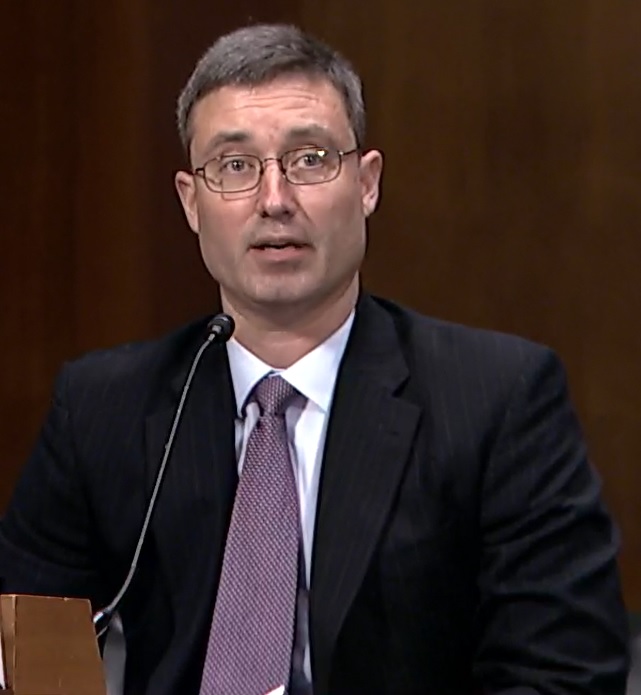
Brian Murphy
Copyright Information: Photo from Wikimedia Commons / Author of Photo: United States Senate Committee on the JudiciaryOverview
Overview[1]
Born in Columbia, Maryland, in 1979, Brian Edward Murphy earned a BA degree from the College of the Holy Cross in 2002, and a Juris Doctor from Columbia Law School — where he was editor-in-chief of the Columbia Human Rights Law Review — in 2006.
Upon completing his legal education, Murphy embarked on a law career where he was employed as:
- a public defender at the Massachusetts Committee for Public Counsel Services (2006-2009)
- an associate attorney with the Boston-based law firm of Todd and Weld LLP (2009-2011)
- a partner at another Massachusetts-based law firm, Murphy & Rudolf LLP (2011-2024) [2]
- a supervising attorney for the Worcester County Bar Advocates (2015-2019)
In March 2024, President Joe Biden – on the recommendation of Democrat Senators Elizabeth Warren and Ed Markey — nominated Murphy to replace Judge Patti B. Saris, who had announced her intent to assume senior status upon confirmation of a successor, on the United States District Court for the District of Massachusetts. On December 2, 2024, the U.S. Senate voted to confirm Murphy’s nomination by a 47–45 margin.[3]
Board Member of the Massachusetts Association of Criminal Defense Lawyers
From 2014 to 2024, Murphy served as a Board of Directors member for the Massachusetts Association of Criminal Defense Lawyers (MACDL), whose mission is “to eradicate flaws, inequities and systemic racism in the criminal legal system; and work to ensure that every individual facing prosecution has access to vigorous, effective, and just representation.” During Murphy’s time on the MACDL Board:
MACDL signed a public letter on June 15, 2022 titled: “In Reply to the Justices of the Supreme Judicial Court.” Among other things:
- The letter argued to “eliminate arrests for all alleged minor infractions such as using a counterfeit $20 bill to buy cigarettes, as happened to George Floyd, but also for fraught and unnecessary police encounters involving possessory offenses, assault and battery, breaking and entering, and similar offenses.”
- The letter argued that eliminating arrests for all misdemeanors and nonviolent offenses “would not only prevent a majority of the police violence against Black lives, but would dramatically reduce false complaints of resisting arrest and assault and battery on a police officer—charges that are often a smoke screen for police brutality”
- The letter argued that “Rules regarding composition of the venire should be amended so that defendants can be tried before peers from their community rather than a county-wide jury that too often lacks racial diversity.”
- The letter argues that “After trial, no defendant should be sentenced until a future date when the judge shall receive from the defense a social worker’s report that describes the defendant’s background and circumstances, including how structural racism has impacted the defendant’s life.”
In May 2020, MACDL stated: “Judges should embrace a ‘presumption of release’ when making bail decisions due to ‘concerns about institutional racism.’”
In May 2020 as well, MACDL issued a statement calling to: “Repeal legislation that gives police officers and prosecutors immunity from civil liability.”
MACDL once wrote in a legal brief that “the word illegal . . . is inherently prejudicial, conjuring and activating implicit associations between race, ethnicity, otherness, and criminality.”
Another MACDL brief said that “mandatory minimum sentences impose a racially disparate impact on [b]lack and Hispanic defendants.”
Opposing the Trump Administration’s Policy on Vaccines
In July 2025, the American Academy of Pediatrics (AAP) and some other leading medical organizations collaborated to file a lawsuit against the U.S. Department of Health & Human Services (HHS), in an effort to block the implementation of HHS Secretary Robert F. Kennedy Jr.’s decision to discontinue the federal policy of recommending that COVID vaccines be administered to healthy children and pregnant women. The suit was later amended in January 2026 after HHS announced that it was reducing, from 17 to 11, the total number of recommended childhood vaccines. According to the Center for Infectious Disease Research and Policy: “The lawsuit argued that these moves, along with Kennedy’s appointment of vaccine skeptics to the Advisory Committee on Immunization Practices (ACIP) after firing 17 previously appointed members, bypassed the scientific process and didn’t follow proper administrative procedures.”[4] By Kennedy’s telling, ACIP had been “plagued with persistent conflicts of interest” and had evolved into nothing more than a rubber stamp for virtually any and all vaccines.
Judge Murphy was assigned to preside over this case, and on January 6, 2026 he denied a motion by which the Trump administration sought to have the lawsuit against HHS dismissed.
On March 6, 2026, Murphy, asserting that Kennedy and ACIP had made “arbitrary and capricious” decisions regarding vaccine policy, said the plaintiffs were justified in voicing their concern that the newly reconstituted committee now included an overrepresentation of vaccine skeptics and had become “neither fairly balanced nor free of inappropriate influence” – a development that “undermined the integrity of its actions.” Thus the judge sided with the plaintiffs and granted a preliminary injunction that stayed – i.e., paused – implementation of the revised childhood immunization schedule favored by Kennedy and HHS. Also invalidating 13 of the new ACIP appointments that Kennedy had made, Murphy ruled that the removal and replacement of their predecessors likely constituted a violation of the Administrative Procedure Act and the Federal Advisory Committee Act. Moreover, Murphy voided any votes that the newly reconstituted panel had already registered.
Mark Gorton, president of the Kennedy-aligned MAHA Institute [Make America Healthy Again Institute] – whose mission is focused on “reforming the political, regulatory, and legislative environment to end corporate capture of government and restore its focus on the health of the American people” – said: “You’ve had all sorts of ACIP decisions for decades, and you never had a judge standing up and saying that his judgment is superior to that of the panelists, even though the ACIP members for years have been incredibly corrupt and incredibly conflicted.”
Blocking Trump’s “Third Country” Deportation Policy
In March 2025 the Trump administration enacted a policy stipulating that federal immigration officers, when seeking to deport illegal-alien hardened criminals whose native homelands refused to accept them back within their borders, could instead send such individuals to a “third country” other than America or their nation of origin. To lay the groundwork for the implementation of this alternative, the administration negotiated agreements with a number of countries – mostly in Latin America and Africa — to accept such deportees in exchange for financial payments. Among these nations were Antigua and Barbuda, Belize, Cameroon, Costa Rica, Dominica, El Salvador, Equatorial Guinea, Eswatini, Ghana, Guatemala, Guyana, Honduras, Kosovo, Liberia, Libya, Mexico, Palau, Panama, Paraguay, Poland, Rwanda, Saint Kitts and Nevis, Saint Lucia, South Sudan, Uganda, and Uzbekistan.
Under the aforementioned Trump policy, U.S. immigration authorities were not required to give deportable aliens: (a) advance notice of their removal, or (b) an opportunity to contest their removal to a third country — so long as the government of that third country assured American authorities that the deportees would not be persecuted or tortured there. The policy did allow for deportees “to challenge their removal” from the United States, but only if they were to articulate, on their own and without prompting, a fear of going to any particular country; the policy stated that immigration officers “will not affirmatively ask whether the alien is afraid of being removed.”
In an effort to derail the Trump third-country policy, a group of four noncitizen migrants collaborated to file a federal class action lawsuit against the U.S. Department of Homeland Security (DHS).
Presiding over the case was Judge Murphy, who on March 28, 2025, issued a nationwide temporary restraining order against the policy, ruling that it failed to provide the accused with “meaningful notice” and due process.
On April 18, 2025, Murphy issued a preliminary injunction that built upon his restraining order of the prior month. Said the injunction:
“Defendants argue that the United States may send a deportable alien to a country not of their origin, not where an immigration judge has ordered, where they may be immediately tortured and killed, without providing that person any opportunity to tell the deporting authorities that they face grave danger or death because of such a deportation. All nine sitting justices of the Supreme Court of the United States, the Assistant Solicitor General of the United States, Congress, common sense, basic decency, and this Court all disagree.”
Lamenting that Trump administration officials “have applied and will continue to apply the alleged policy of removing aliens to third countries without notice and an opportunity to be heard on fear-based claims — in other words, without due process,” Murphy said that his injunction was intended to address the possibility that deportees might face “irreparable harm” upon arriving in the nations to which they were sent. “The irreparable harm factor … weighs in Plaintiffs’ favor,” he wrote in the injunction. “Here, the threatened harm is clear and simple: persecution, torture, and death. It is hard to imagine harm more irreparable.”
Murphy added that the Trump policy’s “purported ‘assurances’” that the deportees would not be subject to persecution or torture in the designated third country were essentially meaningless. “Whom do they cover?” he asked. “What do they cover? Why has the Government deemed them credible? How can anyone even know for certain that they exist? These are basic questions that the Constitution permits a person to ask before the Government takes away their last and only lifeline.”
To address the foregoing concerns, Murphy’s injunction held that American immigration officials should be required to provide migrants with “written notice of the third country” to which they were slated to be sent, as well as a “meaningful opportunity” to “raise fears of torture,” persecution, or death that might be awaiting them in their new environs.
On May 21, 2025, Murphy denounced the Department of Homeland Security’s decision to deport eight violent criminal migrants hailing from five different countries — Mexico, Cuba, Laos, Burma, and Vietnam — to South Sudan because their home countries would not accept them. All eight – whose rap sheets included convictions for murder, robbery, rape, assault, kidnapping, and child sex predation — had already been served with final deportation orders issued by immigration-court judges. Said Judge Murphy: “The department’s actions in this case are unquestionably violative of this court’s [April 2025] order. To the degree that violation implicates criminal obstruction is a question perhaps resolved for another day. Based on what I have learned, I don’t see how anybody could say that these individuals had a meaningful opportunity to object.” Therefore, Murphy argued, the federal government had a duty to “maintain custody and control of class members currently being removed to South Sudan or any other third country, to ensure the practical feasibility of return if the Court finds that such removals were unlawful.”
The Trump White House responded to Murphy’s remarks by characterizing them as “another attempt by a far-left activist judge to dictate the foreign policy of the United States — and protect the violent criminal illegal immigrants President Donald J. Trump and his administration have removed from our streets.”
Vice President JD Vance, for his part, told The New York Times:
“A small but substantial number of courts are making it very, very hard for us to deport illegal aliens. We have an obligation to treat people humanely, but I do think that a lot of these illegal immigrants have to go back to where they came from … the amount of [legal] process that is due, how you enforce those legislative standards and how you actually bring them to bear, is, I think, very much an open question.
“I remember when I was in law school, there were all of these people who were wanting to become immigration lawyers … There was this idea that you could use the asylum claim process, you could use the refugee process, you could use all of these other tools of the immigration enforcement regime to actually make it harder to deport illegal aliens.…
“We think the president has extraordinary plenary power. You need some process to confirm that these illegal aliens are, in fact, illegal aliens and not American citizens … We’re trying to comply with it as much as possible and actually do the job that we were left [by the Biden administration].”
In May 2025 as well, Murphy ordered the Trump administration to either: (a) fly the eight aforementioned illegal aliens back to the U.S. from South Sudan, or (b) offer them an opportunity for a “reasonable fear interview” wherein they could challenge their deportation. Said the judge:
“DHS, in its discretion, may elect to provide this process to the six individuals either within the United States—should it choose to return them to the United States—or abroad, if at all relevant times DHS retains custody and control over the individuals in conditions commensurate to those the individuals would be housed in were they still in DHS’s custody within the United States. This Order reflects a remedy, in light of the Court’s finding of a violation of its Preliminary Injunction …”
In response to Judge Murphy’s order, DHS Assistant Secretary Tricia McLaughlin issued the following remarks on May 21, 2025:
- “Today, DHS released the rap sheets for eight of these uniquely monstrous, criminal illegal aliens who have final deportation orders that the U.S. government is actively trying to deport. The American public should know the heinous crimes of these murderers, rapists, and pedophiles that this activist district court judge is trying to bring back to American soil. As he spits in the face of victims, this Massachusetts district court judge is stalling the final removal of these barbaric individuals from the country and wants taxpayers to continue to foot the bill to keep these criminals in DHS custody overseas. It is deranged.”
- “These depraved individuals have all had their day in court and been given final deportation orders. A reminder of who was on this plane: murderers, child rapists, an individual who raped a mentally & physically disabled person. The message this activist judge is sending to victims and their families is, ‘we don’t care.’ President Trump and Secretary Noem are working every day to get vicious criminals out of our country while activist judges are fighting to bring them back onto American soil.”
In a 6-3 decision issued on June 23, 2025, the U.S. Supreme Court lifted the order by which Judge Murphy had previously blocked the Trump administration from deporting illegal aliens to alternative countries without “due process.” Justices Sonia Sotomayor, Elena Kagan, and Ketanji Brown Jackson dissented.
Later on June 23, Murphy responded to the Supreme Court’s ruling by posting an online statement saying that the Court’s decree would not in any way affect how he would manage the case of the eight migrants who had been sent to South Sudan.
Murphy’s recalcitrance prompted Republican Senator Eric Schmitt of Missouri to describe him on June 24 as “an activist judge [who] just defied the Supreme Court to try to keep seven criminal aliens in the USA.” That same day, Chad Mizzelle, chief of staff to U.S. Attorney General Pam Bondi, posted a social media message that said: “When a single district judge immediately and flagrantly defies the Supreme Court, that is not the rule of law — it is an Article III insurrection.”
On June 24 as well, the Trump Justice Department filed a legal brief that said:
“This motion addresses the district court’s unprecedented defiance [under Judge Murphy] of this [Supreme] Court’s authority. Yesterday evening, just hours after this [Supreme] Court stayed the preliminary injunction in this case, the district court issued an order asserting that its related ruling enforcing that injunction ‘remains in full force and effect,’ ‘notwithstanding todays [sic] stay of the Preliminary Injunction.’ The district court claimed that the several ‘individuals’ whose removal it previously halted mid-flight … remain subject to its order enforcing the very injunction that this [Supreme] Court stayed yesterday. That is untenable. […] The district court’s ruling of last night [by Judge Murphy] is a lawless act of defiance that … disrupts sensitive diplomatic relations and slams the brakes on the Executive’s lawful efforts to effectuate third-country removals. For over two months now, the Executive has labored under an injunction that this [Supreme] Court yesterday deemed unenforceable. This [Supreme] Court should immediately make clear that the district court’s enforcement order has no effect, and put a swift end to the ongoing irreparable harm to the Executive Branch and its agents….”
On February 25, 2026, Murphy – still openly defying the Supreme Court’s June 2025 ruling in support of the Trump administration’s “third country” policy – insisted that the policy was actually illegal and unconstitutional. As the Washington Examiner reported:
“A federal judge [Murphy] ruled this week that the Trump administration’s policy of deporting illegal immigrants to third countries is unlawful, despite the Supreme Court allowing the policy to continue last year. U.S. District Judge Brian Murphy … ruled on Wednesday [February 25] that the Department of Homeland Security’s policy of deporting illegal immigrants to countries other than their own is ‘not fine, nor is it legal.’ Murphy ruled it is unlawful for the administration to deport illegal immigrants to third countries without notice or an opportunity to object to where they are being sent.”
In March 2026, a three-judge panel for the 1st Circuit Court of Appeals placed an administrative stay – or “pause” — on Murphy’s February ruling. “The appellate court’s decision authorizes the Trump administration to move forward with its deportation policy as litigation on the matter continues,” said The Federalist on March 12.
Footnotes:
- https://ballotpedia.org/Brian_Murphy_(Massachusetts)
- The firm was known as Murphy & Vander Salm LLP from 2012-2016.
- Democrats backed Murphy by a 46-0 margin; the lone Independent supported him as well; and Republicans opposed him, 0 to 45.
- ACIP’s recommendations to the U.S. Centers for Disease Control and Prevention (CDC) shape U.S. vaccine practices and insurance coverage.