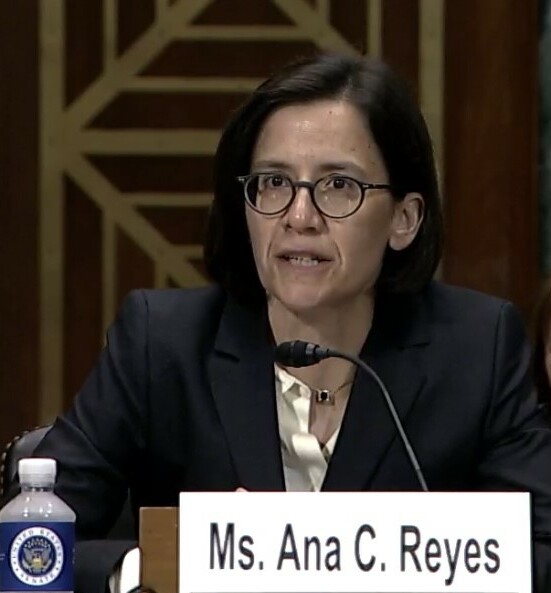
Ana Reyes
Copyright Information: Photo from Wikimedia Commons / Author of Photo: U.S. Senate Judiciary CommitteeOverview
Overview [1]
Ana Cecilia Reyes was born in 1974 in Montevideo, Uruguay. Her family immigrated to Spain when she was an infant, and later settled in Louisville, Kentucky when the girl was 5 years old.
Reyes earned a B.S. degree from Transylvania University in Kentucky in 1996, a Juris Doctor from Harvard Law School (where she was an editor of the Harvard Law Review) in 2000, and a Master’s Degree in International Public Policy from the Johns Hopkins School of International Studies in 2014.
In 1996, Reyes worked for the Feminist Majority Foundation‘s (FMF) failed effort to defeat Proposition 209 – a.k.a. the California Civil Rights Initiative — which called for state governmental institutions in California to terminate their use of affirmative action policies in the areas of public employment, public contracting, and public education. She later deepened her ties with FPM, serving as a board member of the organization from 2014 until at least 2023.
In 2000-2001, Reyes clerked for Judge Amalya Kearse of the United States Court of Appeals for the Second Circuit, whose jurisdiction included New York State, Connecticut, and Vermont.
In 2001, Reyes joined the Washington, D.C.-based law firm of Williams & Connolly LLP, where she focused on cross-border legal issues and international arbitration while also performing pro bono work for asylum seekers and refugee organizations. She was an associate with the firm from 2001-2009, and a partner from 2009-2022.
In 2017, the Women’s Bar Association of the District of Columbia named Reyes as its “Woman Lawyer of the Year.”
On May 19, 2022, President Joe Biden nominated Reyes to replace Judge Colleen Kollar-Kotelly, who had announced her intent to assume senior status upon the confirmation of a successor, as a judge with the United States District Court for the District of Columbia. The U.S. Senate confirmed Reyes for this post on February 15, 2023, by a vote of 51-to-47.[2]
Lifelong Democrat
Throughout her adult life, Reyes has been a strong and consistent supporter of Democratic Party causes and candidates. Before becoming a judge, she donated more than $38,000 to Democrat campaigns — including $5,600 to Joe Biden’s presidential run in 2020; $2,700 to Hillary Clinton’s White House bid against Donald Trump in 2016; $4,500 to Kamala Harris’ failed run for the Democratic presidential nomination in 2019; and $200 to “Alexandria Ocasio-Cortez for Congress” in 2019, one year after the congresswoman’s first successful run for the U.S. House of Representatives.
Notable Cases as a Lawyer
On behalf of the Center for Gender and Refugee Studies — an organization dedicated to “defend[ing] the human rights of courageous refugees seeking asylum in the United States” — Reyes in 2008 filed a legal brief in support of three Guinean women who, claiming to have been victims of the barbaric practice of female genital mutilation in their homeland, wished to relocate to America.
In 2018, Reyes was a member of the legal team that challenged a Trump administration policy that made newcomers ineligible for asylum if they entered the United States without passing through a legal port of entry. When the Obama-appointed U.S. District Judge Randolph Moss ruled against the Trump policy in a 77-page opinion, Reyes said: “The ruling is a victory for refugees who want to live safely with their families. We’re grateful that the court carefully considered all the issues …”
Notable Rulings as a Judge
Trump Tax-Return Whistleblower Case
In January 2024, Reyes imposed a 5-year prison sentence on 39-year-old Charles E. Littlejohn, an Internal Revenue Service contractor who in 2019 had unlawfully leaked 15 years’ worth of Donald Trump’s personal tax returns to The New York Times and ProPublica, the former of which eventually published details from those returns in a series of articles that appeared during the closing stages of the presidential election season that pitted the incumbent Trump against Democrat challenger Joe Biden. Characterizing Littlejohn’s decision to leak Trump’s tax returns as “an attack on our constitutional democracy,” Reyes stated: “When you target the sitting president of the United States, you’re targeting the office and when you’re targeting the office of the president of the United States, you’re targeting democracy — you’re targeting our constitutional system of government.” Emphasizing that Mr. Trump was under no legal obligation to release his tax filings, the judge added: “It cannot be open season on our elected officials — it just can’t.”
Ban on Transgenders in the Military
In February 2025, Reyes presided over the case of Talbott v. Trump, a federal lawsuit in which the plaintiffs – eight self-identified “transgender” individuals represented by GLBTQ Legal Advocates & Defenders (GLADLAW) and the National Center for LGBTQ Rights (NCLR) – asked the U.S. District Court for the District of Columbia to issue a preliminary injunction blocking the implementation of President Trump’s January 27, 2025 Executive Order 14183, which banned transgenders from serving in any capacity in the U.S. military. Some excerpts from Trump’s Executive Order:
- “The United States military has a clear mission: to protect the American people and our homeland as the world’s most lethal and effective fighting force. Success in this existential mission requires a singular focus on developing the requisite warrior ethos, and the pursuit of military excellence cannot be diluted to accommodate political agendas or other ideologies harmful to unit cohesion.”
- “Recently, however, the Armed Forces have been afflicted with radical gender ideology to appease activists unconcerned with the requirements of military service like physical and mental health, selflessness, and unit cohesion. Longstanding Department of Defense (DoD) policy … provides that it is the policy of the DoD to ensure that service members are ‘[f]ree of medical conditions or physical defects that may reasonably be expected to require excessive time lost from duty for necessary treatment or hospitalization.’ As a result, many mental and physical health conditions are incompatible with active duty, from conditions that require substantial medication or medical treatment to bipolar and related disorders, eating disorders, suicidality, and prior psychiatric hospitalization.”
- “Consistent with the military mission and longstanding DoD policy, expressing a false ‘gender identity’ divergent from an individual’s sex cannot satisfy the rigorous standards necessary for military service. Beyond the hormonal and surgical medical interventions involved, adoption of a gender identity inconsistent with an individual’s sex conflicts with a soldier’s commitment to an honorable, truthful, and disciplined lifestyle, even in one’s personal life. A man’s assertion that he is a woman, and his requirement that others honor this falsehood, is not consistent with the humility and selflessness required of a service member.”
- “It is the policy of the United States Government to establish high standards for troop readiness, lethality, cohesion, honesty, humility, uniformity, and integrity. This policy is inconsistent with the medical, surgical, and mental health constraints on individuals with gender dysphoria. This policy is also inconsistent with shifting pronoun usage or use of pronouns that inaccurately reflect an individual’s sex.”
Both the plaintiffs and defendants in Talbott v. Trump presented their respective cases during hearings before Judge Reyes on February 18-19, 2025, and again the following month on March 13. During the February 18 session in court, Reyes stated that Executive Order 14183: (a) betrayed an “unadulterated animus” towards transgender people; (b) was “frankly ridiculous” in asserting that pronoun usage could have any bearing on military readiness; and (c) unjustifiably classified all transgenders in the military as “dishonest, dishonorable, undisciplined, immodest” people who lacked “integrity” – even though they had “taken an oath to defend this country” and had “taken fire for this country.”
In February 2025, then-Department of Justice (DoJ) chief-of-staff Chad Mizelle filed a judicial misconduct complaint claiming that during the early hearings in Talbott v. Trump, Judge Reyes had “engaged in hostile and egregious misconduct” that “compromised the dignity of the proceedings and demonstrated potential bias, raising serious concerns about her ability to preside impartially in this matter.” NBC San Diego provided the following specifics underlying the DoJ complaint:
“The complaint to the chief judge of Washington’s federal court accuses U.S. District Judge Ana Reyes of inappropriately questioning a government lawyer about his religious beliefs and trying to ‘embarrass’ the attorney with a rhetorical exercise during an exchange about discrimination…. During the rhetorical exercise, Reyes told the attorney that she changed the rules in her courtroom to bar graduates of the University of Virginia law school from appearing before her because they are all ‘liars and lack integrity.’ She instructed the government attorney, a graduate of the school, to sit down.
“In another exchange cited in the complaint, the judge asked the attorney what ‘Jesus would say to telling a group of people that they are so worthless, so worthless that we’re not going to allow them into homeless shelters?’ She continued, ‘Do you think Jesus would be, Sounds right to me? Or do you think Jesus would say, WTF? Of course, let them in!”
The DoJ complaint was eventually dismissed by Chief Judge Sri Srinivasan of the U.S. Court of Appeals for the District of Columbia Circuit on September 29, 2025.
In accordance with Executive Order 14183, a Department of Defense (DoD) memo in late February 2025 required the U.S. military to identify and remove — with honorable separations, so long as such designations were merited — all transgender service members with “a current diagnosis or history of, or … symptoms consistent with, gender dysphoria.”[3]
On March 18, 2025, Judge Reyes, ruling that Trump’s executive order was discriminatory and therefore violated the Equal Protection clause of the United States Constitution, issued a nationwide preliminary injunction that blocked the order from taking effect. Asserting that Trump’s proposed ban on transgenders in the military was “soaked in animus and dripping with pretext,” Reyes wrote that “its language is unabashedly demeaning, its policy stigmatizes transgender persons as inherently unfit, and its conclusions bear no relation to fact.” “[T]he cruel irony,” she added, “is that thousands of transgender servicemembers have sacrificed — some risking their lives — to ensure for others the very equal protection rights the Military Ban seeks to deny them.” “The president and defendants could have crafted a policy that balances the nation’s need for a prepared military and Americans’ right to equal protection,” Reyes wrote in her ruling as well. “They still can. The military ban, however, is not that policy.”
A spokesperson for the Trump DoJ described Reyes’ injunction as “the latest example of an activist judge attempting to seize power at the expense of the American people who overwhelmingly voted to elect President Trump.”
On March 21, 2025, the Trump administration filed a motion to dissolve Reyes’ injunction.
On March 22, 2025, Defense Secretary Pete Hegseth used the social media platform X to post the following sardonic response to the Reyes injunction: “Since ‘Judge’ Reyes is now a top military planner, she/they can report to Fort Benning at 0600 to instruct our Army Rangers on how to execute High Value Target Raids…after that, Commander Reyes can dispatch to Fort Bragg to train our Green Berets on counterinsurgency warfare.”
On March 26, 2025, Judge Reyes rejected the Trump administration’s March 21 motion on grounds that “defendants cannot evade discriminating against transgender people simply by labeling the policy as addressing gender dysphoria.” Her order blocking the government from enforcing the ban on transgenders in the military took effect at 7 p.m. on Friday, March 28.
Opposing the Termination of “Temporary Protected Status” for Haitians in the U.S.
In 1990 the United States Congress established “Temporary Protected Status” (TPS) as a designation to shield certain migrants who were in the United States without legal status, from being deported to their home countries if such relocations were likely to place them in danger. According to the U.S. Citizenship & Immigration Services (USCIS) agency:
“The Secretary of Homeland Security may designate a foreign country for TPS due to conditions in the country that temporarily prevent the country’s nationals from returning safely, or in certain circumstances, where the country is unable to handle the return of its nationals adequately…. The Secretary may designate a country for TPS due to the following temporary conditions in the country: ongoing armed conflict (such as civil war); an environmental disaster (such as earthquake or hurricane), or an epidemic; other extraordinary and temporary conditions.
“During a designated period, individuals who are TPS beneficiaries or who are found preliminarily eligible for TPS upon initial review of their cases … are not removable from the United States; can obtain an employment authorization document (EAD); may be granted travel authorization…. TPS is a temporary benefit that does not lead to lawful permanent resident status or give any other immigration status.”
The Obama administration determined that the Caribbean nation of Haiti was eligible for TPS in 2010 after it had suffered a devastating earthquake. That status was extended repeatedly thereafter – in 2011, 2013, 2015, 2017, 2021, 2023, 2024, and finally 2025, by which time the number of Haitian nationals protected by TPS in the United States exceeded 350,000. In 2025 as well, the Trump administration concluded that conditions in Haiti no longer met the criteria for TPS, and that the continuation of that status would not be in America’s national interest.
On July 30, 2025, five Haitian nationals who held TPS status and wished to block President Trump’s decision to terminate the TPS program for Haiti, filed suit against the Trump administration in the U.S. District Court for the District of Columbia. The case was known as Lesly Miot et al v. Trump, and Judge Reyes was assigned to preside over it.
On February 3, 2026, Reyes issued an 83-page opinion in favor of the plaintiffs. In her ruling, she accused Department of Homeland Security (DHS) Secretary Kristi Noem of “preordaining” her decision to terminate TPS for Haitians “because of [her] hostility to nonwhite immigrants” – a hostility that Reyes claimed had been evident in a December 1, 2025 social media post wherein Noem wrote:
“I just met with the President.
“I am recommending a full travel ban on every damn country that’s been flooding our nation with killers, leeches, and entitlement junkies.
“Our forefathers built this nation on blood, sweat, and the unyielding love of freedom—not for foreign invaders to slaughter our heroes, suck dry our hard-earned tax dollars, or snatch the benefits owed to AMERICANS.
“WE DON’T WANT THEM. NOT ONE.” (Emphasis in original)
“The plaintiffs are five Haitian TPS holders,” Reyes wrote in rebuke of Noem’s sentiments. “They are not, it emerges, ‘killers, leeches, or entitlement junkies.’ They are instead: Fritz Emmanuel Lesly Miot, a neuroscientist researching Alzheimer’s disease, Rudolph Civil, a software engineer at a national bank, Marlene Gail Noble, a laboratory assistant in a toxicology department, Marica Merline Laguerre, a college economics major, id., and Vilbrun Dorsainvil, a full-time registered nurse.”
Reyes further wrote that while Ms. Noem surely had a First Amendment right “to call immigrants killers, leeches, [and] entitlement unkies,” the Constitution and federal law required her to “apply faithfully the facts to the law in implementing the TPS program.” “The Government does not cite any reason termination must occur post haste,” added the judge. “Secretary Noem complains of strains unlawful immigrants place on our immigration-enforcement system. Her answer? Turn 352,959 lawful immigrants into unlawful immigrants overnight.”
“The statutory design is straightforward,” Reyes wrote as well. “TPS exists because threats to life exist; when the threat persists, so should TPS protection, unless the Secretary articulates a well-reasoned and well-supported national interest to the contrary.”
In response to Reyes’ ruling, DHS Assistant Secretary Tricia McLaughlin released a statement accusing the judge of engaging in “lawless activism.” “Haiti’s TPS was granted following an earthquake that took place over 15 years ago,” said McLaughlin. “It was never intended to be a de facto amnesty program, yet that’s how previous administrations have used it for decades. Temporary means temporary and the final word will not be from an activist judge legislating from the bench.”
In a similar vein, Republican Senator Bernie Moreno of Ohio said: “When a Democrat president can create a TEMPORARY program and an unelected Democrat judge can unilaterally block a duly-elected Republican president from ever undoing it, we do not live in a democracy. This outrageous decision cannot stand.” (Emphasis in original)
Footnotes:
- https://ballotpedia.org/Ana_Reyes
https://grokipedia.com/page/Ana_C._Reyes - Democrats supported Reyes’ nomination by a margin of 46 to 0; Republicans opposed her by a margin of 2-to-47; and Independents supported her 3-to-0.
- Psychiatry.org defines gender dysphoria as “a psychiatric diagnosis that refers to the psychological distress that results from an incongruence between one’s sex assigned at birth and one’s gender identity.”