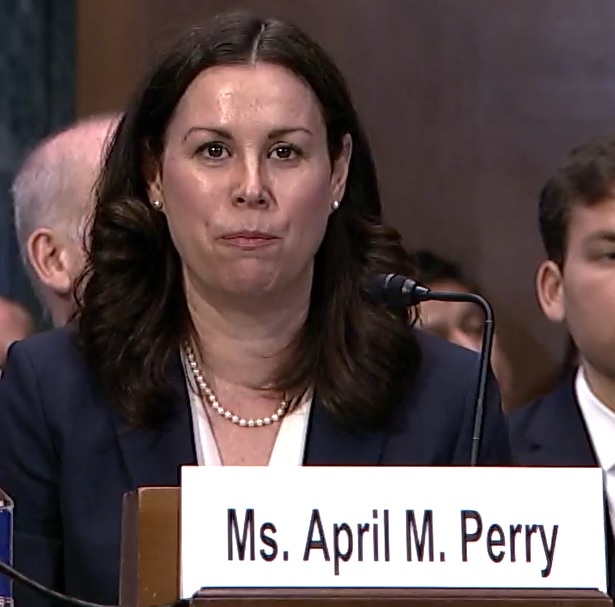
April Perry
Copyright Information: Photo from Wikimedia Commons / Author of Photo: United States Senate Committee on the Judiciary / Source of Photo: https://www.judiciary.senate.gov/committee-activity/hearings/07/31/2024/nominationsOverview
Overview[1]
April Michelle Perry was born in 1979 in San Diego, California. She eaned a Bachelor of Science degree in 2000 from Northwestern University, and a Juris Doctor degree in 2003 from the Northwestern University Pritzker School of Law.
After completing her formal legal education, Perry served from 2003-2004 as a law clerk for Judge Joel Flaum of the United States Court of Appeals for the Seventh Circuit.
From 2004-2016, she was an assistant United States Attorney in the U.S. Attorney’s Office for the Northern District of Illinois. During her tenure in that post, she served as:
- deputy chief of the Narcotics and Gangs Section from 2010-2011
- Project Safe Childhood coordinator from 2010-2016
- supervisory litigation counsel from 2011-2016
- Civil Rights and Hate Crimes coordinator from 2014-2016
After leaving the U.S. Attorney’s Office, Perry went on to become:
- chief deputy state’s attorney and chief ethics officer for Cook County State’s Attorney Kim Foxx from 2017-2019
- general counsel for Ubiety Technologies, an artificial-intelligence technology startup, from 2019-2022
- senior counsel of global investigations and fraud-and-abuse prevention at GE HealthCare from 2022-2024
On June 28, 2023, President Joe Biden announced his intent to nominate Perry – whose name had been submitted to the White House by Democrat Senators Dick Durbin and Tammy Duckworth — for the post of United States Attorney for the Northern District of Illinois. On January 3, 2024, Perry’s nomination to the district court was returned to the President under Rule XXXI, Paragraph 6 of the United States Senate. She was then renominated on January 11, 2024, but that nomination was blocked by Republican Senator J.D. Vance in protest of the federal indictments that congressional Democrats had levied against former President Donald Trump.
On April 24, 2024, President Biden announced that he planned to nominate Perry as a United States District Judge for the United States District Court for the Northern District of Illinois. Her nomination was sent to the U.S. Senate on July 11, 2024, and she was eventually confirmed by a 51–44 vote on November 12, 2024.
Blocking President Trump’s Deployment of National Guard to Chicago
Starting in early September 2025, President Donald Trump — citing high rates of shootings and violent crimes in Chicago — announced that he intended to send National Guard troops to that city in an effort to help quell its rampant lawlessness. One of the President’s foremost objectives was “to protect federal personnel and property” in Chicago “from violent resistance against the enforcement of federal immigration laws.” Indeed, there had recently been a spate of violent attacks directed specifically against federal agents in Chicago who were attempting to enforce “Operation Midway Blitz” as part of the Trump administration’s crackdown on illegal immigration. Trump followed through on his pledge when, on October 6, 2025, he authorized the deployment of 300 National Guard troops to the Windy City. As Scotusblog.com explained: “In deploying 300 members of the National Guard to Chicago…, Trump relied on a federal law that allows the president to call up the National Guard for federal service when there is an invasion or a rebellion or danger of rebellion, as well as when he cannot ‘with the regular forces … execute the laws of the United States.’”
On October 6, 2025 as well, the Democrat Governor of Illinois, JB Pritzker — stating that ultimately, some 300 Illinois National Guard troops were slated to be federalized and deployed to Chicago along with 400 others from Texas — sued the Trump administration in an effort to derail what the governor described as the latter’s “unlawful and unwarranted plans to deploy armed military troops to Chicago.” Asserting that “local and state law enforcemt are on the job and managing what they need to,” Pritzker accused Trump of “using our sevice members as political props and as pawns in his illegal effort to militarize our nation’s cities.”
On October 9, 2025, PBS.org reported: “Some National Guard members ordered to Illinois by President Donald Trump now are protecting federal property near Chicago ahead of [an October 9th] court hearing on their deployment. That same day, some 200 Texas National Guard troops plus another 300 from Illinois arrived at a U.S. Army Reserve Center in Elwood, southwest of Chicago, to start a 60-day assignment.
Presiding over this Chicago case was Judge April Perry, who, in response to Pritzker’s lawsuit, issued a Temporary Restraining Order on October 9 that would bar, for two weeks, the federal government from “ordering the federalization and deployment of the National Guard of the United States within Illinois.” Explaining how she had arrived at this ruling, Perry wrote that she had found no palpable evidence of a “danger of rebellion” threatening to impede Trump’s immigration crackdown. The deployment of the National Guard to Illinois, she said, would “only add fuel to the fire that they [Trump administration officials] started” and was “likely to lead to civil unrest.”
In her ruling, Perry wrote that she had observed “a troubling trend of Defendants’ declarants equating protests with riots and a lack of appreciation for the wide spectrum that exists between citizens who are observing, questioning, and criticizing their government, and those who are obstructing, assaulting, or doing violence.” “The unrest Defendants complain of,” Perry added, “has consisted entirely of opposition (indeed, sometimes violent) to a particular federal agency and the laws it is charged with enforcing. That is not opposition to the authority of the federal government as a whole. Defendants have offered no explanation supporting the notion that widespread opposition to immigration enforcement constitutes the makings of a broader opposition to the authority of the federal government.”
On October 10, Perry issued a 51-page opinion to accompany her order of the previous day. In this opinion, the judge wrote that although she did “not doubt that there have been acts of vandalism, civil disobedience, and even assaults on federal agents,” she rejected the notion that the political atmosphere in Chicago amounted to the kind of “danger of rebellion” that would warrant having a President invoke federal law to deploy the National Guard. Nor, Perry added, was Trump justified in calling up the National Guard because he was “unable with the regular forces to execute the laws of the United States.” “Here,” the judge wrote, “Defendants have made no attempt to rely on the regular forces before resorting to federalization of the National Guard, nor do Defendants argue (nor is there any evidence to suggest) that the President is incapable with the regular forces of executing the laws.”
Meanwhile, the Trump administration quickly turned to the 7th U.S. Circuit Court of Appeals and filed an appeal vis-a-vis Perry’s ruling. On October 16, the 7th Circuit Court refused to vacate Judge Perry’s order. “The spirited, sustained, and occasionally violent actions of demonstrators in protest of the federal government’s immigration policies and actions, without more, does not give rise to a danger of rebellion against the government’s authority,” said the Court, adding: “We conclude that the district court’s factual findings at this preliminary stage were not clearly erroneous, and that the facts do not justify the president’s actions in Illinois … even giving substantial deference to his assertions. The administration remains barred from deploying the National Guard of the United States within Illinois.”
On October 17, 2025, U.S. Solicitor General D. John Sauer asked the Supreme Court to pause Perry’s order, claiming that her ruling “cause[s] irreparable harm to the Executive Branch by countermanding the President’s authority as Commander in Chief.” Sauer also argued that federal courts had no rightful role in deciding whether the President could deploy the National Guard, and he criticized “the type of second-guessing, judgment-substituting, effective-retrial of the factual basis that the lower courts here engaged in.”
While waiting for the Supreme Court to render a decision on the matter, Judge Perry extended her October 9 order indefinitely, so as to keep it in place for however long the high court would need to review the case.
Eventually, on December 23, the Supreme Court announced that it was denying the Trump administration’s request for Perry’s October 9 order to be overturned.
In a December 31, 2025 post to his Truth Social platform, President Trump announced that, at least for the time being, he was stopping his push to deploy National Guard troops in Chicago as well as Los Angeles and Portland. The President vowed to revisit the issue again, however — “perhaps in a much different and stronger form” — in what he described as the highly likely event that crime metrics in any of those cities should happen to “soar” in the future, “It is hard to believe,” he added, “that these Democrat Mayors and Governors, all of whom are greatly incompetent, would want us to leave, especially considering the great progress that has been made.”
Footnotes:
Additional Resources:
- https://vettingroom.org/2024/05/09/april-perry/#comments
https://news.law.northwestern.edu/news/president-biden-taps-april-perry-jd-03-for-district-court-judge/
https://bidenwhitehouse.archives.gov/briefing-room/statements-releases/2023/06/28/president-biden-names-thirty-fifth-round-of-judicial-nominees-and-one-new-nominee-to-serve-as-u-s-attorney/