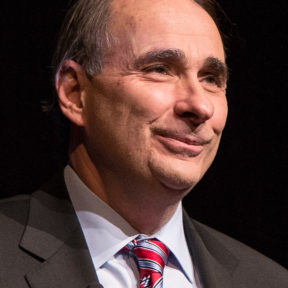
David Axelrod
: Photo from Wikimedia Commons / Author of Photo: Lauren Gerson / Source of Photo: https://www.flickr.com/photos/lbjlibrarynow/16034426473/Overview
* Longtime Democratic political consultant
* President Barack Obama’s closest advisor
David M. Axelrod was born on February 22, 1955. His father, Joseph Axelrod, was a psychologist who committed suicide in 1974. And David’s mother, Myril Bennett Axelrod, wrote for PM, a leftist New York newspaper whose ranks were penetrated by communists seeking to advance the Stalinist line. Among PM‘s staffers were several Marxists like Leo Huberman), a number of Communist Party USA members, a former editor and a former staff cartoonist from the CPUSA newspaper Daily Worker, a former editor of The Communist, a leader of the Young Communist League USA, and a Soviet government official. Moreover, PM‘s Washington, D.C. correspondent I. F. Stone was later identified as a CPUSA member and a Soviet spy.
David Axelrod would later describe his parents as “your classic New York leftist Democrats.” He grew up in Manhattan and, from an early age, engaged passionately in politics. At age ten, Axelrod canvassed for New York City mayoral candidate John Lindsay. When Axelrod was thirteen, he sold campaign buttons and bumper stickers promoting Robert Kennedy for President.
Axelrod graduated from New York’s Stuyvesant High School in June 1972 and enrolled, that fall, at the University of Chicago, where he majored in political science and wrote for the student newspaper. In late 1973 or early 1974, he secured a job as a political columnist for the Hyde Park Herald, a local weekly newspaper. His work at the Herald caught the attention of two particularly noteworthy individuals, David Canter (the son of a lifelong communist) and Don Rose (a member of a Communist Party front group). For further details about Canter and Rose, who became mentors to the young Axelrod and helped shape his political development, see footnote #1 below.[1]
Axelrod completed his B.A. in political science at the University of Chicago in 1977. That same year, Canter and Rose used their influence to help Axelrod secure an internship at the Chicago Tribune. “I … wrote a reference letter for him,” Rose recalls, “that helped him win an internship at the Tribune, which was the next step in his journalism career.” Axelrod was promoted in 1982, becoming the Tribune’s youngest chief political writer.
In 1984, however, Axelrod, dissatisfied with his career and with the “corporatization of journalism” in general, left the Tribune and sought to establish himself as an advisor/consultant for Democrat political campaigns. In his massive autobiography published 31 years later — Believer: My Forty Years in Politics — Axelrod would explain that he left journalism and entered politics because he “felt more comfortable, and proficient at, telling stories.”
His first big opportunity came when he worked for the Senate campaign of Illinois Representative Paul Simon. Originally hired as Simon’s communications director, Axelrod was promoted to co-manager of the entire campaign within two months. In this role, he worked closely with a 25-year-old Rahm Emanuel, who would go on to become President Barack Obama’s chief of staff a quarter-century later.
Following Simon’s successful Senate bid, Axelrod in 1985 founded a political consultancy called Axelrod & Associates, later known as AKP&D Message and Media,[2] which specialized in “representing Democratic candidates and progressive causes.”
Axelrod quickly cultivated a reputation for his aggressive use of negative messaging to discredit his clients’ political rivals. A Chicago Magazine profile from December 1987 dubbed Axelrod a “Hatchet Man” who was ever-prepared to “blast the dickens” out of an opponent. Reflecting Axelrod’s constancy in this regard, a Tribune profile two decades later described him as a “ferocious” competitor who was unafraid to use “venom” to poison the campaigns of rivals, or “brass knuckles” to “bludgeon” his foes.
Further, Axelrod was heralded as a “five-tool consultant,” adept at: (1) writing speeches, press releases, and statements; (2) crafting a campaign message; (3) plotting strategy; (4) producing radio and television spots; and (5) acting as a spokesman for candidates.
In 1987, Axelrod’s company was hired to run the re-election campaign of Harold Washington, the incumbent African-American mayor of Chicago who had close ties to the Democratic Socialists of America. Here, Axelrod worked with Don Rose and David Canter. It is also possible that he met Barack Obama, who was then emerging as a community organizer in Chicago, during this period. Certainly by 1992, Axelrod and Obama knew one another. They became acquainted when Obama led a Project Vote voter-registration drive in Chicago that year. Liberal lore maintains that the two men were introduced in 1992 by Bettylu Saltzman, one of Chicago’s leading left-wing Democrats.
Having successfully directed Mayor Washington’s re-election campaign, Axelrod’s political consultancy was propelled into the political limelight. In the years that followed, a number of African-American candidates flocked to Axelrod, in hopes that he might similarly help them win political office. Most prominent among these were Carol Moseley-Braun, who in 1992 became the first black woman elected to the U.S. Senate, and Deval Patrick, the first African-American elected governor of Massachusetts (in 2006).
Other top-echelon Democrats whom Axelrod advised included Patrick Kennedy (congressional campaign in Rhode Island), Rod Blagojevich (gubernatorial campaign in Illinois), Hillary Clinton (2000 U.S. Senate campaign in New York), Eliot Spitzer (2006 gubernatorial campaign in New York), Chris Dodd (U.S. Senate campaign in Connecticut), John Edwards (2004 presidential campaign), and Rahm Emanuel (House of Representatives campaign in 2002). Moreover, Axelrod was Emanuel’s chief political advisor when Emanuel helped stage the Democratic takeover of the House of Representatives in 2006. Between 2001 and 2007, the candidates whom Axelrod’s consulting firm represented won 33 of their 42 races.
Axelrod and his consultancy were hired not only by scores of Democratic politicians, but also by the Democratic National Campaign Committee, the Democratic Congressional Campaign Committee, the Democratic Governors Association, the AFL-CIO, the AFSCME, the SEIU, and the Working Families Party.
From the same Chicago address that AKP&D occupies, Axelrod also runs ASK Public Strategies,[3] which he founded in 2002. ASK focuses not on political candidates but on organizations and corporate clients seeking to swing negative public opinion in their favor. For more information about ASK, see footnote #4 below.[4]
In September 2002, the aforementioned Bettylu Saltzman — a leading left-wing Democrat in Chicago and a longtime admirer of Barack Obama — convened a group of “progressives” that included, among others, the longtime radical Marilyn Katz. Together, these progressives organized an entity called Chicagoans Against the War in Iraq (CAWI), under whose banner they planned to stage an anti-war, anti-President Bush rally the following month in Chicago’s Federal Plaza. Saltzman contacted Barack Obama and asked him to speak at the event. Before accepting Saltzman’s invitation, Obama called Axelrod and sought his advice. Axelrod urged Obama to give a speech that would appeal to the liberal Chicago base, while being careful not to alienate voters of other persuasions. Doing precisely as Axelrod suggested, Obama emerged from his Federal Park address as a public figure whom many Americans (previously unfamiliar with him) found intriguing.
When Obama ran for the U.S. Senate in 2004, Axelrod served as his chief adviser. Reflecting, eight years later, on that campaign, Axelrod remarked: “This is a really special guy and, if you could get him elected to the Senate, if you could be a part of that, that would be something to be proud of for the rest of your life.” Obama himself had indicated that his close partnership with Axelrod was based upon a deep ideological affinity: “You know, he and I share a basic worldview … I trust his basic take on what the country should be and where we need to move towards—not just on specific policy but how politics should be able to draw on our best and not our worst.” Axelrod agreed completely, saying of Obama: “He’s not just a client. He’s a very good friend of mine. We share a worldview.”
Bestselling author Ann Coulter has detailed how Axelrod and his former employer, the Chicago Tribune, helped get Obama elected to the Senate in 2004 by unsealing documents pertaining to his opponents’ private lives:
Obama became a U.S. senator only by virtue of David Axelrod’s former employer, the Chicago Tribune, ripping open the sealed divorce records of Obama’s two principal opponents. One month before the 2004 Democratic primary for the U.S. Senate, Obama was down in the polls, about to lose to Blair Hull, a multimillionaire securities trader. But then the Chicago Tribune leaked the claim that Hull’s second ex-wife, Brenda Sexton, had sought an order of protection against him during their 1998 divorce proceedings. Those records were under seal, but as The New York Times noted: “The Tribune reporter who wrote the original piece later acknowledged in print that the Obama camp had ‘worked aggressively behind the scenes’ to push the story.” Many people said Axelrod had “an even more significant role — that he leaked the initial story.”
Both Hull and his ex-wife opposed releasing their sealed divorce records, but they finally relented in response to the media’s hysteria — 18 days before the primary. Hull was forced to spend four minutes of a debate detailing the abuse allegation in his divorce papers, explaining that his ex-wife “kicked me in the leg and I hit her shin to try to get her to not continue to kick me.” After having held a substantial lead just a month before the primary, Hull’s campaign collapsed with the chatter about his divorce. Obama sailed to the front of the pack and won the primary. Hull finished third with 10 percent of the vote.
As luck would have it, Obama’s opponent in the general election had also been divorced! Jack Ryan was tall, handsome, Catholic … He went to Dartmouth, Harvard Law and Harvard Business School, made hundreds of millions of dollars as a partner at Goldman Sachs, and then, in his early 40s, left investment banking to teach at an inner city school on the South Side of Chicago. Ryan would have walloped Obama in the Senate race. But at the request of — again — the Chicago Tribune, California Judge Robert Schnider unsealed the custody papers in Ryan’s divorce five years earlier from Hollywood starlet Jeri Lynn Ryan, the bombshell Borg on Star Trek: Voyager.
Jack Ryan had released his tax records. He had released his divorce records. But both he and his ex-wife sought to keep the custody records under seal to protect their son. Amid the 400 pages of filings from the custody case, Jack Ryan claimed that his wife had had an affair, and she counterclaimed with the allegation that he had taken her to “sex clubs” in Paris, New York and New Orleans, which drove her to fall in love with another man…. Ryan had vehemently denied her allegations at the time, but it didn’t matter. The sex club allegations aired on “Entertainment Tonight,” “NBC Nightly News,” ABC’s “Good Morning America,” “The Tonight Show With Jay Leno,” and NBC’s “Today” show. CNN covered the story like it was the first moon landing….
Four days after Judge Schnider unsealed the custody records, Ryan dropped out of the race for the horror of (allegedly) propositioning his own wife and then taking “no” for an answer. Alan Keyes stepped in as a last-minute Republican candidate. And that’s how Obama became a U.S. senator. He destroyed both his Democratic primary opponent and his Republican general election opponent with salacious allegations about their personal lives taken from “sealed” court records.
When Obama decided, early in2007, to run in the following year’s presidential election, Axelrod orchestrated the formal announcement of his candidacy. Notably, Axelrod selected Springfield, Illinois—where Abraham Lincoln had launched his own political career—as the venue for that announcement. In a speech heavily influenced by Axelrod, Obama proceeded to invoke Lincoln six times while touching upon such themes as the “failure of leadership” plaguing not only the U.S. but the world at large. Moreover, it was Axelrod who conceived the “hope and change” and “Yes, we can!” slogans that became the battle cries of the Obama campaign.
Once the campaign was underway, Axelrod said of Obama: “I think he’s unique, and he offers something very special and important in these times. He can heal this country and move it forward in a way that perhaps no one else can.”
Axelrod’s strategy for the Obama campaign was to project a public image that was transcendent, larger than life. Historian and bestselling author Paul Kengor explains:
“In January 2007, Axelrod zeroed in on the Obama image and message. He hired a camera crew to tail the candidate everywhere, the kind of video work at which Axelrod’s firms excel. He then went into seclusion with hours upon hours of video footage to craft five-minute messages. From all this tape, the New York Times noted, Axelrod ‘hoped to wring transcendence.’ He did not want a ‘conventional candidacy.’ He wanted Obama to be set apart not only from the Republican nominee but from Hillary Clinton, the Democratic Primary challenger, and a good friend of Axelrod.”
In the 2008 election season, Axelrod’s AKP&D consultancy and a Washington-based firm called GMMB received a combined $343.3 million to handle advertising for Obama’s White House run. It was their task to present Obama to the American people in whatever way was likely to engender positive emotions about the candidate.
At one point during the 2008 presidential campaign, the media asked Axelrod to comment on the controversial political and ideological alliance that Obama had once had with former Weather Undeground terrorist Bill Ayers. Minimizing the significance of that alliance, Axelrod said: “Bill Ayers lives in his [Obama’s] neighborhood. Their kids attend the same school. They’re certainly friendly, they know each other, as anyone whose kids go to school together.” At the time of Axelrod’s statement, Ayers’ three children were in their late twenties and early thirties, whereas Obama’s two daughters, Sasha and Malia, were aged six and nine, respectively.
Some critics noted that Axelrod, like Obama, also possessed a number of radical associations. His early communist mentors, for instance, were discussed earlier in this profile. In addition, Axelrod sat on the finance board of Chicago’s Saint Sabina Catholic Church, where Michael Pfleger—a longtime supporter of Barack Obama, Jeremiah Wright, and Louis Farrakhan—served as pastor. Saint Sabina’s official website listed Axelrod as a member of its “Raise the Roof” committee; alongside Axelrod’s name was an open letter from Pfleger asking for $1 million in contributions.
After Obama’s electoral victory in November 2008, Axelrod, who had been the president and sole shareholder of AKP&D since 1985, sold his interest in the company and became a senior advisor to President Obama. As such, his influence over Obama continued to grow. The Politico reported: “There are no limits on his roles inside the Obama administration…. Axelrod is now a pillar for Barack Obama.” The New York Times referred to Axelrod as Obama’s “Protector,” his “narrator,” and the man “who sits closest to the Oval Office.”
During the healthcare-reform debates of 2009-10, AKP&D profited greatly from Obama’s effort to pass the legislation. In 2009 alone, Health Economy Now, a coalition that was promoting an overhaul of America’s healthcare system, paid AKP&D and GMMB a combined $12 million for their services (producing and placing political ads).
On January 28, 2011, Axelrod left his advisory post in the White House in order to become the communications director for Obama’s re-election bid. Announcing that this would be the final political campaign for which he would work as an advisor, Axelrod told the media: “I have one campaign left, and it is going to be to try to elect a guy who I think is a great president.” Vis à vis the strategy he planned to employ on Obama’s behalf, Axelrod pledged from the outset: “I’m going to do exactly what I did last time.” He was true to his word. When former Massachusetts Governor Mitt Romney eventually emerged as the Republican challenger, Axelrod aggressively portrayed him as the living embodiment of heartless greed: “He [Romney] was very, very good at making a profit for himself and his partners but not nearly as good [at] saving jobs for communities. He is very much the profile of what we’ve seen in the last decade on Wall Street.” Axelrod further derided Romney as a “corporate raider” who had outsourced “tens of thousands of jobs,” “closed down more than 1,000 [businesses],” taken “twelve companies to bankruptcy,” and “made hundreds of millions of dollars” for himself in the process.
On July 4, 2012, Axelrod posted the following four items on Twitter, for the purpose of raising suspicions about the ethics of Republican presidential candidate Mitt Romney:
- “Astonishing story about Mitt’s Bermuda tax shelter and his efforts to keep it secret, apparently skirting MA law.”
- “A Swiss bank account. A dozen funds in the Cayman Islands. And now, a Bermuda tax shelter he failed to report.”
- “How many of these revelations will it take for the media to demand a full accounting of Mitt’s tax returns and finances?”
- “Or will his campaign continue to stonewall and keep him secure within the MPP–the Mittness Protection Program?”
Axelrod had some noteworthy links to allegations of sexual misconduct that were brought against Republican presidential primary hopeful Herman Cain in the fall of 2011 by four separate women, two of whom remained anonymous. Illinois Restaurant Association (IRA) president Sheila O’Grady — who was close with Axelrod and was former Chicago Mayor Richard M. Daley’s chief of staff — unearthed Cain’s personnel records from the National Restaurant Association (NRA), a close affiliate of her IRA. Notably, Cain’s brief, three-year stint at NRA was the only period in his decades-long professional career during which allegations of sexual misconduct ever surfaced. One of Cain’s accusers, Sharon Bialek, lived in the very same Chicago building as Axelrod. Within 24 hours after the press conference in which Bialek went public with her story, friends and acquaintances of hers publicly described the woman as a “gold-digger” who had twice filed for bankruptcy and had constantly been in financial trouble.
In January 2013, two months after Barack Obama’s re-election as U.S. President, Axelrod was named as an advisor to the newly formed Organizing For Action.
In January 2013 as well, Axelrod became the founder and director of an Institute of Politics at the University of Chicago.
On February 19 2013, NBC News hired Axelrod as a senior political analyst to contribute to broadcasts on both NBC News and the cable network MSNBC.
Also in 2013, Axelrod helped Italian Prime Minister Mario Monti with his election campaign, which ultimately was unsuccessful.
In 2014, Axelrod was appointed senior strategic adviser to the British Labour Party.
In 2015, Axelrod began hosting a podcast titled The Axe Files, a series of interviews with various political figures.
Early that same year, Axelrod objected strenuously when Republican House Speaker John Boehner invited Israeli Prime Minister Benjamin Netanyahu to speak to Congress on March 3rd about the gravity of the growing Iranian nuclear threat and his “profound disagreement” with the nuclear deal that the Obama Administration was pursuing with Tehran. (For details about that agreement, click here and here,) Axelrod characterized Netanyahu’s speech as “shameful 11th-hour demagoguery.”
In September 2015, Axelrod joined CNN as a senior political commentator.
In June 2019, Axelrod and co-host Mike Murphy launched the podcast Hacks on Tap, featuring news and discussions pertaining to the 2020 presidential campaign trail.
In February 2022, Axelrod announced that he planned to retire from his position as director of the Institute of Politics at the University of Chicago in January 2023. He would thereafter serve as a senior fellow and advisory board chairman at the Institute.
Additional Information
Each year from 1991 to 2002, Axelrod and his wife donated money to the New Israel Fund.
Footnotes:
-
● David Canter (1923-2004) was the son of Harry Jacob Canter, a lifelong communist who: served as secretary of the Boston Communist Party; ran for governor of Massachusetts on the Communist Party ticket in 1930; earned a special invitation to Joseph Stalin‘s USSR in 1932; worked in Moscow as an official translator of Lenin’s writings; and later taught at the Abraham Lincoln School, an infamous Chicago-based front that indoctrinated students in the teachings of Marx and Lenin. Like his father, David Canter was also a lifelong communist. He was educated in Stalin’s Soviet Union from 1932-37, before returning with his family to the United States. He later became an attorney and developed ties to the National Lawyers Guild. In the Guide to Subversive Organizations and Publications, an exhaustive Congressional analysis compiled between 1955 and 1968, Canter’s name appeared 25 times. On July 12, 1962, Canter was subpoenaed to testify before the House Committee on Un-American Activities (HUAC), where he was questioned about the agendas of Translation World Publishers, the pro-Soviet, Soviet-subsidized publishing house he had co-created with LeRoy Wolins, a well-known communist. Canter refused to answer any HUAC questions about his past or present membership in the Communist Party USA (CPUSA).
● Canter’s associate, Don Rose (who is still alive), was never proven to be a CPUSA member. He was, however, a member of the National Mobilization Committee to End the War in Vietnam, an organization replete with communists and Sixties radicals. He also belonged to the Alliance to End Repression (a suspected Communist Party front), and he did some press work for the Students for a Democratic Society. In the 1960s, Rose and Canter collaborated to establish a far-left, pro-communist community newspaper called Hyde Park-Kenwood Voices, which echoed CPUSA propaganda. - In the name of Axelrod’s company, AKP&D Message and Media: The “A” in the firm’s acronym was for Axelrod. The “K” was for John Kupper, a former Capitol Hill press secretary. The “P” was for David Plouffe, who would serve as campaign manager to Senator Barack Obama. And the “D” was for John Del Cecato, a longtime press secretary.
- In the name of Axelrod’s other company, ASK Public Strategies: The “A” is for Axelrod, the “S” for Eric Sedler, and the “K” is for John Kupper.
- ASK Public Strategies has mastered the use of front-groups, as political science professor Paul Kengor explains in The American Spectator:
“A well-known, somewhat notorious example of this front-group tactic is the company ComEd, which sought a palatable way to seek higher electricity prices in Illinois. ComEd sought ASK’s advice. ASK advised ComEd to form a group called Consumers Organized for Reliable Electricity (CORE), which in turn described itself as a ‘coalition of individuals, businesses, and organizations.’ The group then ran ads—written by ASK—direly warning of blackouts if electricity rates were not hiked…. ComEd later acknowledged that it had bankrolled the entire $15 million effort….
“ComEd is just one example of work done by ASK. [There was also] the remarkable case of New York’s Cablevision, which owns Madison Square Garden. Cablevision hired ASK to stop the New York Jets from building a new stadium in nearby Manhattan. Again, a front-group was formed, calling itself the New York Association for Better Choices, which, in turn, ran ads and materials opposing construction. According to records, Cablevision paid ASK $1.2 million in 2004-05.”
The foregoing information about ComEd and Cablevision was derived from public records. As a rule, however, Axelrod and his ASK partners refuse to reveal the identity of any of their clients. According to Business Week magazine, the secrecy surrounding ASK masks a significant crossover of Axelrod’s political connections and his corporate business. For instance, ComEd and its parent company, Exelon, contributed $181,711 to Barack Obama’s 2008 presidential campaign, a sum greater than what was contributed by any other company in Illinois.