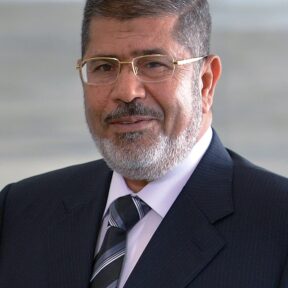
Mohammed Morsi
: Photo from Wikimedia Commons / Author of Photo: Wilson Dias/ABrOverview
* Longtime leading member member of the Muslim Brotherhood
* Strong supporter of strict Sharia Law
* Was elected president of Egypt in 2012
* Was deposed from the presidency on July 3, 2013
* Died on June 17, 2019
Born in August 1951 in Egypt’s Sharqiya province, Mohammed Morsi studied engineering at Cairo University, where he earned a bachelor’s degree in 1975 and a master’s degree three years later. He then immigrated to the U.S. and received a PhD in engineering from the University of Southern California in 1982. After working as an assistant professor at California State University from 1982-85, Morsi returned to Egypt and taught engineering at Zagazig University until 2010. He was also a founder of the Egyptian Resist the Zionist Project Committee.
From 2000-2005, Morsi served in the Egyptian Parliament, where he developed a reputation as a strong advocate of strict Sharia Law. After leaving Parliament, he became a hardline member of the Muslim Brotherhood‘s highest authority (essentially its executive committee), known as the Guidance Bureau. In 2007 Morsi co-authored the Brotherhood’s party platform, which argued not only that Islamic clerics should have a role in approving all new legislation in Egypt, but also that women and Christians should not be permitted to run for the office of president.1
In 2007 Morsi called for the assemblage of “a huge scientific conference that is devoted to analyzing what caused” the 9/11 attacks, stating that the U.S. “has never presented any evidences [sic] on the identity of those who committed that incident.” On CNN in 2011, Morsi said that the Muslim Brotherhood would stand against the perpetrators of 9/11 “if you can prove who really did this.”
The Middle East Media Research Institute (MEMRI) reports that in two separate speeches which Morsi delivered in 2010 (when he was still a member of the Muslim Brotherhood’s Guidance Bureau), he made a host of crude and incendiary statements about Israel, Jews, and the United States. For example:
- During one anti-Semitic diatribe, Morsi referred to “the Zionists” as “bloodsuckers,” “warmongers,” and “the descendants of apes and pigs.” He also called for “military resistance within the land of Palestine.”
- “The Zionists have no right to the land of Palestine. There is no place for them on the land of Palestine. What they took before 1947-8 constitutes plundering, and what they are doing now is a continuation of this plundering. By no means do we recognize their Green Line. The land of Palestine belongs to the Palestinians, not to the Zionists.”
- “We must confront this Zionist entity. All ties of all kinds must be severed with this plundering criminal entity, which is supported by America and its weapons, as well as by its own nuclear weapons, the existence of which is well known. It will bring about their own destruction. The peoples must boycott this entity and avoid normalization of relations with it. All products from countries supporting this entity — from the U.S. and others — must be boycotted.”
Also in 2010, Morsi said the following: “We must never forget, brothers, to nurse our children and our grandchildren on hatred for them: for Zionists, for Jews. [Egyptian children] must feed on hatred; hatred must continue … the hatred must go on for Allah and as a form of worshiping him.”
Morsi was arrested numerous times by the regime of longtime Egyptian president Hosni Mubarak, which regularly imprisoned members of the Brotherhood. Perhaps Morsi’s most notable arrest occurred on January 28, 2011, when he and other Brotherhood leaders were taken into custody by government authorities during the Egyptian Revolution’s infamous “Friday of Anger.” Morsi eventually emerged as chairman of the Freedom and Justice Party, a political entity that the Brotherhood formed soon after Mubarak was deposed in February 2011.
In a 2011 interview on CNN, Morsi was asked whether the Brotherhood, if one of its candidates were to win the Egyptian presidency in the elections slated for 2012, would recognize Israel’s right to exist. “This is a heavy question,” Morsi replied ambiguously. “It’s out of faith. It’s ridiculous to ask about the future…. Let us stop the bloodshed of the Palestinians and then talk about such matters in the future.” When asked to address the subject of Palestinian terrorist attacks against Israel, Morsi said: “We do not use violence against anyone. What’s going on on the Palestinian land is resistance. The resistance is acceptable by all mankind and it’s the right of people to resist imperialism.”
In early 2012, as Egypt’s presidential election drew near, the country’s election commission disqualified candidate Khairat el-Shater, a Muslim Brotherhood operative running on the Freedom and Justice Party ticket, because of his previous incarcerations during the Mubarak regime. At that point, Morsi emerged as a replacement candidate.
During Morsi’s campaign, a hardline cleric named Safwat Hegazy spoke at a pro-Morsi rally and declared, “We are seeing the dream of the Islamic Caliphate,” whose “capital” would be Jerusalem, “come true at the hands of Mohammed Morsi.” Morsi, standing just a few feet away, nodded his head in agreement. At the same rally, another Morsi supporter performed a song exhorting Muslims to “brandish your weapons” and “say your prayers” because “all the lovers of martyrdom are Hamas.”
Also during the campaign, Morsi was candid about his preference for Sharia-based governance. In a 2011 interview, for instance, he told the _Washington Post _that Saudi Arabia’s ultra-fundamentalist version of Sharia could serve as a good model for Egypt in the post-Mubarak era. And in a May 13, 2012 speech, Morsi passionately recited the pledge of the Muslim Brotherhood, which states: “Jihad is our path. And death for the sake of Allah is our most lofty aspiration.” Adding that “the Koran was and will continue to be our constitution,” Morsi shouted: “I take an oath before Allah and before you all that regardless of the actual text [of the constitution]… Allah willing, the text will truly reflect [Sharia], as will be agreed upon by the Egyptian people, by the Islamic scholars, and by legal and constitutional experts.” On another occasion during the campaign, Morsi vowed that under his leadership, Egyptian law would be “the sharia, then the sharia, and finally, the sharia.”
In June 2012, Morsi won the first free presidential election in Egyptian history. After being sworn into office on June 30, he announced that Egypt’s peace treaty with Israel would eventually have to be “revise[d]”; he blasted Egypt’s military leaders for having recently dissolved the nation’s Islamist-dominated parliament; he asserted that his eagerness to develop closer ties with Iran was “part of my agenda” to “create a strategic balance in the region”; he pledged to seek the release of Sheik Omar Abdel-Rahman, serving a life sentence in a U.S. federal penitentiary for his role in numerous terrorist plots; and he pledged that the new Egyptian constitution would be founded on the Koran and a strict version of Sharia law.
Also upon taking office, Morsi opened the Egyptian border with Gaza and allowed the free flow of missiles and other offensive weapons to the Hamas government in Gaza. Hamas terrorists, for their part, were deployed to Egypt as shock troops to defend Morsi and his regime.
In August 2012, Morsi removed a major check on his power — Defense Minister Mohammed Hussein Tantawi, leader of the Supreme Council of the Armed Forces (SCAF) which had been running Egypt since Mubarak was ousted in February 2011, and which had countered the influence of the Islamists. (Tantawi was replaced by General Abdel Fattah al-Sissi, a well-known Muslim Brotherhood sympathizer.) Also sacked were Tantawi’s fellow Council members, the acting chiefs of Egypt’s military branches. Morsi then annulled SCAF’s constitutional declarations that had kept him from exercising legislative power. As The Christian Science Monitor reported, Morsi “now theoretically holds all the formal political power in the Arab world’s largest country. He can legislate, nominate members of the constitutional drafting committee, set foreign policy, and apparently shuffle the senior ranks of the military at will.”
Around the same time, Morsi went after newspapers that were not following the Muslim Brothers’ line. Editions of Al-Dustour, one of the few publications not run by the government, were removed from newsstands for “fueling sedition” and “harming the president through phrases and wording punishable by law,” according to Egypt’s official news agency. This followed the shutting down of a television network, el-Faraeen, and the Muslim Brothers-dominated parliament’s move to replace the editors of the state-run newspapers.
Then, in mid-August 2012, Morsi targeted the Egyptian judiciary, seeking to limit the courts’ power and remove anti-Islamist judges. The president of the Lawyers’ Syndicate, Sameh Ashour, pointed out the obvious intent behind Morsi’s actions: “These are monopolistic plans. The Brotherhood wants to control all aspects of the state.”
In September 2012, Morsi said that in order for the U.S. to repair its relations with the Arab world, America would need to show greater respect for Arab values and traditions. Vis a vis America’s request that Egypt honor its peace treaty with Israel, Morsi said that Washington also should live up to its own Camp David commitment to promote Palestinian self-rule. When asked if he considered the United States an ally, Morsi, deliberately echoing Barack Obama‘s recent response to that same question, said: “That depends on your definition of ally.”
In November 2012 Morsi continued to expand his political authority, issuing constitutional amendments that rendered all his political decisions immune from judicial review; ordering the retrial of Mubarak regime leaders for the killing of protesters in the 2011 Egyptian Revolution; and summarily dismissing the Mubarak-era prosecutor general. In response to Morsi’s ever-escalating power grab, tens of thousands of protesters gathered in Cairo’s Tahrir Square and chanted, “Morsi is Mubarak.” Others derided Morsi as Egypt’s “new pharaoh.”
Also in November 2012, Morsi brokered a peace agreement between Israel and the Hamas-led government of Gaza. Just prior to the truce, Israel had carried out numerous air strikes against key Hamas strongholds in retaliation for Hamas’s incessant campaign of rocket attacks against southern Israel. Moreover, Israel was preparing tens of thousands of troops to launch a ground invasion into Gaza to cripple Hamas. But Morsi’s deal blocked that invasion. It also barred the Jewish state from continuing to target Hamas leadership figures with air strikes. And it imposed no impediment to the efforts of Hamas jihadists in Gaza to rearm for their next round of attacks against Israel.
In December 2012, Morsi and his colleagues in the Egyptian parliament amended the Egyptian constitution in a manner that would have transformed the country into an Islamic state governed by Sharia law, while rendering Muslim Brotherhood rule permanent.
On December 9, 2012, The Daily Caller reported that according to Mohamad Jarehi, a journalist for the privately owned Egyptian newspaper Al-Masry Al-Youm, the Muslim Brotherhood was operating (in the words of The Daily Caller) “a carefully controlled network of torture chambers designed to violently dehumanize opponents of Egyptian President Mohammed Morsi.”
By early 2013, Morsi was becoming increasingly unpopular with the Egyptian public, which complained about his growing authoritarianism and his inability to revive Egypt’s foundering economy.
During this period, a key source of support for Morsi was Muhammad Zawahiri (MZ), the brother of Ayman al-Zawahiri and a leader of al Qaeda in Sinai, the region from which Morsi had previously summoned thousands of foreign jihadis to come to his aid whenever necessary. At one point MZ was arrested and interrogated—only to be ordered released by a presidential order from Morsi. Now, as Morsi faced increasing opposition, MZ declared that al-Qaeda would wage a jihad to save the president and his plans to bring Sharia Law to Egypt. True to his word, Zawahiri launched reprisal operations against Morsi’s adversaries throughout the country. In the course of those reprisals, Egypt’s Coptic Christians, who were scapegoated by the Muslim Brotherhood and al-Qaeda, were victimized by many brutal attacks.
Scholar and author Raymond Ibrahim has expressed his belief in the veracity of what he terms “longstanding accusations that Morsi and his Muslim Brotherhood party worked with foreign terrorist organizations, including al-Qaeda, against the national security of Egypt.” To view details about highly significant recorded conversations between Morsi and the al Qaeda-affiliated MZ, click here.
At the end of June and the beginning of July, the Egyptian people staged massive protests calling for Morsi and his Muslim Brotherhood party to step down from power. Egyptian military representatives estimated that as many as 14 million demonstrators (out of a total population of 84 million) took to the streets on June 30 alone.
On July 3, 2013, Egypt’s armed forces ousted Morsi in a military coup and installed a temporary civilian government, suspending the constitution and calling for new elections. Army chief General Abdel-Fattah el-Sissi announced that Adli Mansour, chief justice of the Supreme Constitutional Court, would serve as interim president. Soon thereafter, Morsi was imprisoned.
On June 17, 2019, Morsi collapsed in a Cairo courtroom where he was being tried for having engaged in espionage on behalf of Hamas. He died shortly thereafter; the cause of his death was a heart attack.
NOTE:
1 When journalist Jeffrey Goldberg asked Morsi about this in 2011, the latter refused to provide a clear answer and ridiculed Goldberg’s “nonsense question[s].”