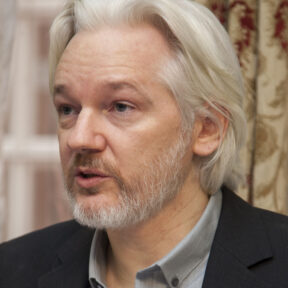
Julian Assange
: Photo from Wikimedia Commons / Author of Photo: Cancillería del EcuadorOverview
* Founder and head of WikiLeaks
* Longtime computer hacker with a history of infiltrating secret government information systems
* Seeks to “bring down” governments, particularly that of the United States, through information leaks
Julian Assange is the founder and head of WikiLeaks, an Internet website dedicated to publishing confidential government documents and images, which are typically obtained illegally through computer hacking.
Born in Australia in 1971, Assange had established a reputation as a sophisticated computer programmer who could break into even the most well-protected networks by the time he was a teenager. Around 1987, he joined with two fellow hackers to form a group that became known as the International Subversives, and the trio broke into computer systems from Europe to North America — including, most notably, networks belonging to the U.S. Defense Department and the Los Alamos National Laboratory. In a book to which he contributed – Underground: Tales of Hacking, Madness and Obsession on the Electronic Frontier – Assange tried to create an aura of morality around this activity, defining what he called the Golden Rules of the hacker subculture: “Don’t damage computer systems you break into (including crashing them); don’t change the information in those systems (except for altering logs to cover your tracks); and share information.”
Hacking remained an obsession for Assange throughout his late teens. Pursued by authorities, he developed a nomadic lifestyle, moving from place to place, maintaining no real home, for fear that international governmental agencies — particularly those in the U.S. — may have targeted him for reprisal for the data leaks he had orchestrated.
In September 1991, Assange hacked into the master terminal that the Canadian telecom company Nortel maintained in Melbourne, Australia. Soon thereafter, he was caught by federal investigators and was charged with 31 counts of hacking and related offenses. Facing a potential sentence of a decade behind bars, Assange pled guilty to 25 charges, 6 of which were dropped. At his final sentencing, the judge was lenient with him and he escaped with the lightest of penalties — the payment of a small fine.
After the hacking trial, Assange lived below the radar in Melbourne for a number of years, working variously as a computer programmer and software developer, among other pursuits. He also studied physics and math at the University of Melbourne. Then, in 2006, he began the process of creating WikiLeaks, a website that would publish confidential government documents and images. His inspiration for WikiLeaks was the infamous Daniel Ellsberg, who in 1971 — the year of Assange’s birth — had published the Pentagon Papers. Assange has described WikiLeaks as “an activist organization” whose “method is transparency,” and whose “goal is justice.”
Shortly after getting WikiLeaks off the ground, Assange flew to Kenya to attend the World Social Forum — a yearly symposium dedicated to the redistribution of wealth and the eradication of capitalism — where he delivered a presentation about his new enterprise.
Contending that the primary objective of WikiLeaks was to expose injustice wherever it might reside, Assange told potential collaborators in 2006: “Our primary targets are those highly oppressive regimes in China, Russia and Central Eurasia, but we also expect to be of assistance to those in the West who wish to reveal illegal or immoral behavior in their own governments and corporations.” Assange further suggested that a “social movement” to expose incriminating classified information had the potential to “bring down many administrations that rely on concealing reality—including the U.S. administration.” Indeed, it has been the U.S. — rather than Russia and China — that WikiLeaks has targeted most intensively.
At a London ceremony in June 2009, Amnesty International honored Assange with its Media Award, in recognition of his expose of hundreds of recent extrajudicial assassinations in Kenya.
In April 2010, WikiLeaks became an international sensation when it publicized a classified video that showed civilians, who were mistaken for insurgents, being attacked by the U.S. military during the Iraq War. Over the rest of that year, Assange and his website sparked additional massive controversy on three separate occasions: In July, Assange released 77,000 secret files pertaining to the Afghan War. In October, he released nearly 400,000 pages of classified documents on the Iraq War. And in November, he released hundreds of thousands of classified State Department communications, many of which contained sensitive information on major U.S. diplomatic relations.
Among the more noteworthy items that Assange published in 2010 were documents that included the Social Security numbers of American soldiers. While acknowledging that leaks like these could ultimately harm innocent people, Assange rationalized such possibilities as mere “collateral damage, if you will,” and added that he could not be expected to calculate, in advance, the importance of every bit of information that might eventually find its way onto WikiLeaks.
Also in 2010, Assange published the results of an Army test which had found that certain electromagnetic devices designed to prevent IED explosives from detonating, also tended to compromise the performance of communication systems used by American soldiers. When asked if he would consider not releasing this information, given its potential for being exploited by terrorists intent on killing U.S. troops, Assange replied that in spite of his “harm-minimization policy,” his uncompromising commitment to transparency might ultimately cause him and his fellow WikiLeaks insiders to get “blood on our hands.”
In December 2010, after the November “data dump” of U.S. diplomatic cables had touched off an international furor, Assange — who was in hiding — was placed on INTERPOL’s “wanted” list for his alleged involvement in “sex crimes” against two women he had met in Sweden that summer. Assange denied the allegations, but he surrendered to London police on December 7, 2010. A WikiLeaks spokesman said that Assange‘s arrest would not prevent the organization from releasing additional secret documents.
In the aftermath of the arrest, Assange sympathizers — calling themselves Internet “hacktivists” — launched an all-out hacking attack (dubbed “Operation Payback“) against the computer systems of companies considered hostile to WikiLeaks. Among these were Mastercard, Visa, Amazon.com, PayPal Inc., and EveryDNS. These companies had cut ties to WikiLeaks in recent days amid intense pressure from the U.S. government.