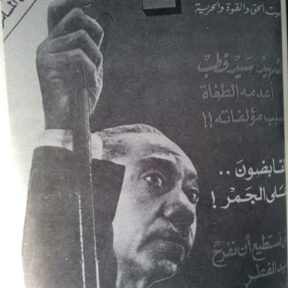
Sayyid Qutb
: Photo from Wikimedia Commons / Author of Photo: Olivier Carré et Gérard MichaudOverview
* Leading theorist of the Muslim Brotherhood
* Father of Islamic fundamentalism
* Was executed by hanging on August 29, 1966
Born in October 1906, Sayyid Ibrahim Husayn Shadhili Qutb, known popularly as Sayyid Qutb, was raised in the Egyptian village of Musha. In the early 1930s, he took a job as a teacher in Egypt’s Ministry of Public Instruction. In 1939, he became part of the Ministry of Education.
Qutb is commonly referred to as “the father of modern [Islamic] fundamentalism.” Along with Hasan al-Banna, he is one of the Muslim Brotherhood’s two great theorists. Of the two, Qutb is the more influential today. His writings can be found easily in Islamic bookstores all across the United States.
From 1948 to 1950, Qutb lived in the United States on a scholarship to study the American educational system; he attended Colorado State College of Education (now the University of Northern Colorado). Also during his time in the U.S., Qutb worked in a number of different institutions including what was then-Wilson Teachers’ College (in Washington, DC), Colorado State College for Education, and Stanford University.
Qutb wrote about his experiences in America in revealing ways. While hospitalized for a respiratory ailment in Washington, DC in February 1949, he heard about the assassination of al-Banna, an event which, he later claimed implausibly, set the hospital staff to open rejoicing.
Qutb’s disgust with the gaudy materialism of postwar America was intense. He wrote to an Egyptian friend of his loneliness: “How much do I need someone to talk to about topics other than money, movie stars and car models.”
Moving to Greeley, Colorado, Qutb was impressed by the number of churches in the city, but not with the piety they engendered: “Nobody goes to church as often as Americans do. . . . Yet no one is as distant as they are from the spiritual aspect of religion.” He was thoroughly scandalized by a dance after an evening service at a local church: “The dancing intensified. . . . The hall swarmed with legs . . . Arms circled arms, lips met lips, chests met chests, and the atmosphere was full of love.” The pastor further scandalized Qutb by dimming the lights, creating “a romantic, dreamy effect,” and playing a popular record of the day: “Baby, It’s Cold Outside.” Qutb regarded American popular music in general with a gimlet eye: “Jazz is the favorite music [of America]. It is a type of music invented by [American] Blacks to please their primitive tendencies and desire for noise.”
Ultimately Qutb concluded: “I fear that when the wheel of life has turned and the file on history has closed, America will not have contributed anything.” Qutb did not find American prosperity to be matched by a corresponding wealth of spirit: “I am afraid that there is no correlation between the greatness of the American material civilization and the men who created it. . . . In both feeling and conduct the American is primitive (bida’a).”
When he returned to Egypt, Qutb characterized the influence of the West in the Muslim world as an unmitigated evil. He derided “American Islam,” a counterfeit of the religion that was designed only to combat Communism in Egypt. Even before his stay in the United States, Qutb cautioned that “Islam is a comprehensive philosophy and an homogeneous unity, and to introduce into it any foreign element would mean ruining it. It is like a delicate and perfect piece of machinery that may be completely ruined by the presence of an alien component.”
This chief alien component was secularism. Qutb regarded Western secularism not as the solution to the problems of the Islamic world but as the major source of the problem: it destroyed the fundamental unity of Islam by separating the religious sphere from that of daily life.
With Gamal Abdel Nasser’s revolutionary seizure of power in Egypt in 1954, the Muslim Brotherhood split into two factions. One, led by Hasan al-Hudaybi, favored working with Nasser’s secular government in an effort to gradually move the country toward Islamic fundamentalism. A more radical faction, led by Qutb, advocated armed revolution against corrupt (i.e., non-Islamist regimes in the Middle East and, more broadly, against unbelievers in Western nations.
Qutb declared that Egyptian society under the secular Nasser was contrary to authentic Islam. Asserting that the Prophet Mohammad himself would have rejected such a government, Qutb claimed that Muslims had both a right and an obligation to resist it. Qutb’s writings — which challenged the views of mainstream Sunni theologians, who extolled the Islamic tradition of deference to the state and ruler — are now cited by many scholars as some of the first formulations of political Islam.
The attempted assassination of Nasser in 1954 caused the Egyptian government to imprison Qutb and many other Brotherhood members for their vocal opposition to government policies. During his ten years of incarceration, Qutb would pen his two most important works: In the Shade of the Qur’an (a 30-volume commentary on Islam’s holy scriptures), and Milestones (a manifesto of political Islam). (All told, Qutb authored 24 books during his lifetime.)
With passion and vigor, Qutb’s influential book Milestones explicitly positions Islam as the true source of societal and personal order. “Mankind today is on the brink of a precipice,” he asserted in this Cold War-era manifesto, “not because of the danger of complete annihilation which is hanging over its head — this being just a symptom and not the real disease — but because humanity is devoid of those vital values which are necessary not only for its healthy development but also for its real progress.” Perhaps with his time in America in mind, he continued: “Even the Western world realizes that Western civilization is unable to present any healthy values for the guidance of mankind. It knows that it does not possess anything which will satisfy its own conscience and justify its existence.”
To Qutb, both capitalism and communism were spent forces:
“Democracy in the West has become infertile to such an extent that it is borrowing from the systems of the Eastern bloc, especially in the economic system, under the name of socialism. It is the same with the Eastern bloc. Its social theories, foremost among which is Marxism, in the beginning attracted not only a large number of people from the East but also from the West, as it was a way of life based on a creed.”
With noteworthy prescience for a man writing in 1964, when Marxism looked to many observers to be still positioned at the vanguard of history, Qutb proclaimed that “now Marxism is defeated on the plane of thought, and if it is stated that not a single nation in the world is truly Marxist, it will not be an exaggeration.” He asserted that Marxism was doomed to fail because “on the whole this theory conflicts with man’s nature and its needs. This ideology prospers only in a degenerate society or in a society which has become cowed as a result of some form of prolonged dictatorship.” A quarter-century before the fall of the Soviet Union, Qutb described “the failure of the system of collective farming” as just part of “the failure of a system which is against human nature.” He concluded: “It is essential for mankind to have new leadership!”
That new leadership, Qutb, proposed, would come from Islam. To Qutb, what the Muslim umma needed was a restoration of Islam in its fullness and purity, including all the rules of the Sharia for regulating society. He said:
“If we look at the sources and foundations of modern ways of living, it becomes clear that the whole world is steeped in Jahiliyyah [Ignorance of the Divine guidance], and all the marvelous material comforts and high-level inventions do not diminish this ignorance. This Jahiliyyah is based on rebellion against God’s sovereignty on earth. It transfers to man one of the greatest attributes of God, namely sovereignty, and makes some men lords over others.”
True freedom could come to man only by restoring the divine sovereignty — that is, the Sharia. To further this end, Qutb formally joined the Muslim Brotherhood shortly after his return to Egypt from the United States.
In articulating his vision for a resurgent Islam that would lead the way to a restoration of civilization and true values in the world, Qutb made one great departure from the thought of other Muslim intellectuals of his day: He classified not only non-Muslim lands but also large portions of the Muslim world as lands of jahiliyyah, the Muslim term for the pre-Islamic period of unbelief, ignorance, and darkness. He based this assessment on the fact that most Muslim lands did not follow the Sharia either in whole or part, writing in Milestones that “it is necessary to revive that Muslim community which is buried under the debris of the man-made traditions of several generations, and which is crushed under the weight of those false laws and customs which are not even remotely related to the Islamic teachings, and which, in spite of all this, calls itself the ‘world of Islam.’”
Qutb advanced Islam as “a challenge to all kinds and forms of systems which are based on the concept of the sovereignty of man; in other words, where man has usurped the Divine attribute. Any system in which the final decisions are referred to human beings, and in which the sources of all authority are human, deifies human beings by designating others than God as lords over men.”
Islam, said Qutb, in response to this wrongful deification of human beings, must “proclaim the authority and sovereignty of God” and thereby “eliminate all human kingship and to announce the rule of the Sustainer of the universe over the entire earth. In the words of the Qur’an: ‘He alone is God in the heavens and in the earth’ (43:84). ‘The command belongs to God alone. He commands you not to worship anyone except Him. This is the right way of life.’ (12: 40)”
In practice, this meant implementation of the Sharia. Qutb therefore despised democracy for subjecting society to manmade laws that were the product of deliberation by the electorate or the legislature. The laws of Allah were not a matter for majority vote. He advocated active and all-encompassing resistance to governments in Muslim lands that did not implement the Sharia. He insisted: “We must also free ourselves from the clutches of jahili society” — that is, society ordered according to human laws (literally, those of ignorance) rather than divine ones — “jahili concepts, jahili traditions and jahili leadership. Our mission is not to compromise with the practices of jahili society, nor can we be loyal to it. Jahili society, because of its jahili characteristics, is not worthy to be compromised with. Our aim is first to change ourselves so that we may later change the society.”
This resistance, said Qutb, must be international, in accord with the traditional Islamic view that religion transcends nationality:
“A Muslim has no country except that part of the earth where the Sharia of God is established and human relationships are based on the foundation of relationship with God; a Muslim has no nationality except his belief, which makes him a member of the Muslim community in Dar-ul-Islam; a Muslim has no relatives except those who share the belief in God, and thus a bond is established between him and other Believers through their relationship with God.”
The idea that Muslim governments lose their legitimacy if they do not enforce the Sharia has recurred throughout Islamic history. The famous medieval scholar Ibn Taymiyya (1263-1328) “declared that a ruler who fails to enforce the shari’a rigorously in all aspects, including the conduct of jihad (and is therefore insufficiently Muslim), forfeits his right to rule.” Nevertheless, such a view was relatively unheard-of among the secularized, Western-influenced Muslims of Qutb’s day; thus it has led numerous analysts of Islamic radicalism to label him an innovator and to contrast his views with those of “traditional Islam.”
But Qutb’s views of the Sharia were not innovative at all. And he argued that they were not extremist, but simply the rule of Islamic law:
“The way to establish God’s rule on earth is not that some consecrated people — the priests — be given the authority to rule, as was the case with the rule of the Church, nor that some spokesmen of God become rulers, as is the case in a ‘theocracy’. To establish God’s rule means that His laws be enforced and that the final decision in all affairs be according to these laws.”
Of course, the distinction between the rule of the Sharia and that of a theocratic ruling elite is exceedingly fine, as one can see in Iran today. Egypt’s Arab Socialist ruler, Gamel Abdel Nasser, was well aware of the theocratic implications of Qutb’s writings and had him subjected to ten years of imprisonment and torture, and finally ordered him executed in 1966. A year before that, Qutb wrote from his prison cell: “The whole of Egypt is imprisoned. . . . I was arrested despite my immunity as a judge, without an order of arrest . . . my sole crime being my critique of the non-application of the Sharia.”
Nasser might have been most concerned with Qutb’s exhortations to jihad. These were predicated on the idea that the establishment of Allah’s rule would not be without obstacles:
“Since this movement [that is, Islam] comes into conflict with the Jahiliyyah which prevails over ideas and beliefs, and which has a practical system of life and a political and material authority behind it, the Islamic movement had to produce parallel resources to confront this Jahiliyyah.”
Chief among those resources was jihad:
“This movement uses the methods of preaching and persuasion for reforming ideas and beliefs and it uses physical power and Jihad for abolishing the organizations and authorities of the Jahili system which prevents people from reforming their ideas and beliefs but forces them to obey their erroneous ways and make them serve human lords instead of the Almighty Lord.”
Viewing armed struggle, or jihad, as a necessity, Qutb said:
“The establishing of the dominion of God on earth, the abolishing of the dominion of man, the taking away of sovereignty from the usurper to revert it to God, and the bringing about of the enforcement of the Divine Law (Shari’ah) and the abolition of man-made laws cannot be achieved only through preaching. Those who have usurped the authority of God and are oppressing God’s creatures are not going to give up their power merely through preaching; if it had been so, the task of establishing God’s religion in the world would have been very easy for the Prophets of God! This is contrary to the evidence from the history of the Prophets and the story of the struggle of the true religion, spread over generations.”
Muslims, Qutb said, must not only preach, but also
“strike hard at all those political powers which force people to bow before them and which rule over them, unmindful of the commandments of God, and which prevent people from listening to the preaching and accepting the belief if they wish to do so. After annihilating the tyrannical force, whether it be in a political or a racial form, or in the form of class distinctions within the same race, Islam establishes a new social, economic and political system, in which the concept of the freedom of man is applied in practice.”
Qutb’s reference to the history of the prophets was one indication of how firmly his view of jihad was based on a close and careful reading of the Qur’an, and on study of the example of the Prophet Muhammad. In Milestones he quoted at length from the great medieval scholar Ibn Qayyim (1292-1350), who, said Qutb, “has summed up the nature of Islamic Jihad.” Ibn Qayyim outlined the stages of the Muhammad’s prophetic career:
“For thirteen years after the beginning of his Messengership, he called people to God through preaching, without fighting or Jizyah, and was commanded to restrain himself and to practice patience and forbearance. Then he was commanded to migrate, and later permission was given to fight. Then he was commanded to fight those who fought him, and to restrain himself from those who did not make war with him. Later he was commanded to fight the polytheists until God’s religion was fully established.”
Qutb summarized the stages: “Thus, according to the explanation by Imam Ibn Qayyim, the Muslims were first restrained from fighting; then they were permitted to fight; then they were commanded to fight against the aggressors; and finally they were commanded to fight against all the polytheists.”
That these stages of jihad can be found in Qutb, as well as in the writings of the contemporary jihadis and medieval Muslim scholars, underscores the traditional character of today’s jihad. Modern mujahedin are not “hijacking” Islam; they are — at least in their own view — restoring it. Ibn Qayyim, as quoted by Qutb, went on to outline the conditions of post-jihad society, i.e., dhimmitude:
“After the command for Jihad came, the non-believers were divided into three categories: one, those with whom there was peace; two, the people with whom the Muslims were at war; and three, the Dhimmies. . . . It was also explained that war should be declared against those from among the ‘People of the Book’ who declare open enmity, until they agree to pay Jizyah or accept Islam. Concerning the polytheists and the hypocrites, it was commanded in this chapter that Jihad be declared against them and that they be treated harshly.”
Ultimately, Qutb explained, those with whom the Muslims were at peace or had treaties, became Muslims themselves,
“[S]o there were only two kinds left: people at war and Dhimmies. The people at war were always afraid of [Muhammad]. Now the people of the whole world were of three kinds: One, the Muslims who believed in him; two, those with whom he had peace and three, the opponents who kept fighting him.”
In line with this, Qutb said that if someone rejects Islam, “then it is the duty of Islam to fight him until either he is killed or until he declares his submission.”
Qutb spoke harshly of modernist and moderate Muslims who would recast jihad as a struggle for self-defense. Even while they “talk about Jihad in Islam and quote Qur’anic verses,” he said, they “do not . . . understand the nature of the various stages through which this movement develops, or the relationship of the verses revealed at various occasions with each stage.” In other words, they do not understand that Allah gradually revealed the Muslim’s responsibility to wage jihad, as outlined above by Ibn Qayyim.
This leads to further errors:
“Thus, when they speak about Jihad, they speak clumsily and mix up the various stages, distorting the whole concept of Jihad and deriving from the Qur’anic verses final principles and generalities for which there is no justification. This is because they regard every verse of the Qur’an as if it were the final principle of this religion.”
This is probably something like what Qutb would say to contemporary Muslim spokesmen who quote the Qur’an’s “tolerance verses” without making any mention of the stages of development in the holy book’s teachings about jihad.
Qutb ascribed the growth of the idea that jihad was only a struggle for self-defense to a defeatist attitude:
“This group of thinkers, who are a product of the sorry state of the present Muslim generation, have nothing but the label of Islam and have laid down their spiritual and rational arms in defeat. They say, ‘Islam has prescribed only defensive war’! and think that they have done some good for their religion by depriving it of its method, which is to abolish all injustice from the earth, to bring people to the worship of God alone, and to bring them out of servitude to others into the servants of the Lord.”
Qutb inveighed against attempts by “these defeatist-type people [who] try to mix the two aspects,” that is, forced conversion and the struggle to establish the sovereignty of Allah alone, and who try to “confine Jihad to what today is called ‘defensive war.’ The Islamic Jihad has no relationship to modern warfare, either in its causes or in the way in which it is conducted.” Anyone who understands that jihad is actually a struggle to establish Allah’s sovereignty, said Qutb, “will also understand the place of Jihad bis saif (striving through fighting), which is to clear the way for striving through preaching in the application of the Islamic movement. He will understand that Islam is not a ‘defensive movement’ in the narrow sense which today is technically called a ‘defensive war.’”
Who was ultimately responsible for this misrepresentation of jihad? Qutb blamed “orientalists,” Western interpreters of Islam. (Ironically, this is the very same camp blamed by Edward Said — the famous Princeton professor, Palestinian activist, and author of Orientalism — for caricaturing jihad as a struggle on the battlefield.) Said Qutb:
“This narrow meaning is ascribed to it by those who are under the pressure of circumstances and are defeated by the wily attacks of the orientalists, who distort the concept of Islamic Jihad. It was a movement to wipe out tyranny and to introduce true freedom to mankind, using resources according to the actual human situation, and it had definite stages, for each of which it utilized new methods. If we insist on calling Islamic Jihad a defensive movement, then we must change the meaning of the word ‘defense’ and mean by it ‘the defense of man’ against all those elements which limit his freedom. These elements take the form of beliefs and concepts, as well as of political systems, based on economic, racial or class distinctions.”
In other words, Qutb would allow for a “defensive jihad” if that meant defending mankind from democracy, capitalism, communism, racism, and so on. His views on offensive and defensive jihad were not innovative: he followed the Shafi’i school of Sunni jurisprudence, which mandates that “jihad had for its intent the waging of war on unbelievers for their disbelief and not merely when they entered into conflict with Islam.” This Shafi’i school still holds sway at Cairo’s prestigious al-Azhar University.
Orientalists, said Qutb, had distorted the idea of jihad by confusing it with forced conversion; but Muslim scholars had not responded properly:
“The orientalists have painted a picture of Islam as a violent movement which imposed its belief upon people by the sword. These vicious orientalists know very well that this is not true, but by this method they try to distort the true motives of Islamic Jihaad. But our Muslim scholars, these defeated people, search for reasons of defensive [war] with which to negate this accusation. They are ignorant of the nature of Islam and of its function, and that it has a right to take the initiative for human freedom.”
To support his contention that jihad is not solely for the defense of Muslim lands, Qutb again invoked the early Islamic period:
“As to persons who attempt to defend the concept of Islamic Jihad by interpreting it in the narrow sense of the current concept of defensive war, and who do research to prove that the battles fought in Islamic Jihad were all for the defense of the homeland of Islam — some of them considering the homeland of Islam to be just the Arabian peninsula — against the aggression of neighboring powers, they lack understanding of the nature of Islam and its primary aim. Such an attempt is nothing but a product of a mind defeated by the present difficult conditions and by the attacks of the treacherous orientalists on the Islamic Jihad. Can anyone say that if [the first three Caliphs] Abu Bakr, ‘Umar or ‘Othman had been satisfied that the Roman and Persian powers were not going to attack the Arabian peninsula, they would not have striven to spread the message of Islam throughout the world? How could the message of Islam have spread when it faced such material obstacles as the political system of the state, the socio-economic system based on races and classes, and behind all these, the military power of the government?”
After quoting a number of Qur’anic verses on jihad, Qutb added:
“With these verses from the Qur’an and with many Traditions of the Prophet — peace be on him — in praise of Jihad, and with the entire history of Islam, which is full of Jihad, the heart of every Muslim rejects that explanation of Jihad invented by those people whose minds have accepted defeat under unfavorable conditions and under the attacks on Islamic Jihad by the shrewd orientalists.”
Those who fall for such ideas, said Qutb, are (at best) too soft and (at worst) traitors to Islam:
“What kind of a man is it who, after listening to the commandment of God and the Traditions of the Prophet — peace be on him — and after reading about the events which occurred during the Islamic Jihaad, still thinks that it is a temporary injunction related to transient conditions and that it is concerned only with the defense of the borders?”
Qutb’s disgust for this point of view showed through in many passages of Milestones. He contrasted it with the internationalist outlook that Muslims should have:
“Those who would say that Islamic Jihaad was merely for the defense of the ‘homeland of Islam’ diminish the greatness of the Islamic way of life and consider it less important than their ‘homeland.’ This is not the Islamic point of view, and their view is a creation of the modern age and is completely alien to Islamic consciousness. What is acceptable to Islamic consciousness is its belief, the way of life which this belief prescribes, and the society which lives according to this way of life. The soil of the homeland has in itself no value or weight. From the Islamic point of view, the only value which the soil can achieve is because on that soil God’s authority is established and God’s guidance is followed; and thus it becomes a fortress for the belief, a place for its way of life to be entitled the ‘homeland of Islam,’ a center for the movement for the total freedom of man.”
Perhaps with the pan-Arab movements of Nasser and others in mind, Qutb emphasized Islam’s universal character and call:
“This religion is not merely a declaration of the freedom of the Arabs, nor is its message confined to the Arabs. It addresses itself to the whole of mankind, and its sphere of work is the whole earth. . . . This religion wants to bring back the whole world to its Sustainer and free it from servitude to anyone other than God.”
But what about the Qur’an’s command to Muslims not to “begin hostilities”? In his monumental, multi-volume commentary on the Qur’an, In the Shade of the Qur’an, completed in Nasser’s prison, Qutb explained Sura 2:190 (“begin not hostilities. Lo! Allah loveth not aggressors”) not as a command to Muslims to avoid attacking their opponents, as it was interpreted by many who taught that jihad was only defensive. Said Qutb:
“‘Aggression implies attacks on non-combatants and peaceful, unarmed civilians who pose no threat to Muslims or to their community as a whole. This includes women, children, the elderly, and those devoted to religious activity, such as priests and monks, of all religious and ideological persuasions. Aggression would also entail exceeding the moral and ethical limits set by Islam for fighting a just war.”
Qutb pointedly avoided saying that this verse limits jihad to self-defense.
In fact, according to Qutb the very nature of the call to Islam rules out the idea that jihad could only be for self-defense:
“Since the objective of the message of Islam is a decisive declaration of man’s freedom, not merely on the philosophical plane but also in the actual conditions of life, it must employ Jihad. It is immaterial whether the homeland of Islam — in the true Islamic sense, Dar ul-Islam — is in a condition of peace or whether it is threatened by its neighbors.”
What, then, did Qutb say about non-Muslim countries that do not attack the Muslims? Can they be left alone? Only if they pay the non-Muslim poll-tax (jizya), the crowning symbol of dhimmitude and submission:
“It may happen that the enemies of Islam may consider it expedient not to take any action against Islam, if Islam leaves them alone in their geographical boundaries to continue the lordship of some men over others and does not extend its message and its declaration of universal freedom within their domain. But Islam cannot agree to this unless they submit to its authority by paying Jizyah, which will be a guarantee that they have opened their doors for the preaching of Islam and will not put any obstacle in its way through the power of the state.”
Indeed, said Qutb, it is “a basic human right to be addressed with the message of Islam. No authority should deny mankind that right and under no circumstances should any obstacles be allowed to prevent that Divine Message from being delivered.” Commenting on Sura 2:191 (“persecution is worse than slaughter”), Qutb said: “Islam considers religious persecution and any threat to religion more dangerous for the future stability and existence of Islam than actual war. According to this great Islamic principle, the survival and prosperity of the faith take precedence over the preservation of human life itself.”
For Qutb, violent jihad was a necessary part of establishing true peace, which equaled the supremacy of the Sharia:
“When Islam strives for peace, its objective is not that superficial peace which requires that only that part of the earth where the followers of Islam are residing remain secure. The peace which Islam desires is that the religion (i.e. the Law of the society) be purified for God, that the obedience of all people be for God alone, and that some people should not be lords over others. After the period of the Prophet — peace be on him — only the final stages of the movement of Jihad are to be followed; the initial or middle stages are not applicable.”
That is, as Ibn Qayyim put it, there are now only two kinds of non-Muslims: those at war with Islam and those who have submitted to it. In a report on “the roots of jihad,” BBC Middle East analyst Fiona Symon implied that Qutb was breaking with tradition by classifying “all non-Muslims [as] infidels — even the so-called ‘people of the book,’ the Christians and Jews.” But Ibn Qayyim makes it clear that in this, Qutb was in full agreement with Islamic tradition. Not only is the call to Islam universal; it is eternal. “This struggle,” said Qutb, “is not a temporary phase but an eternal state — an eternal state, as truth and falsehood cannot co-exist on this earth.”
While he insisted that jihad was not solely for self-defense, Qutb did not deny that defense of Islam was a part of the Muslim’s duty — especially given the contemporary state of world affairs: “Today, Muslims continue to be the target of religious persecution under a host of Christian, Zionist and secular regimes in many parts of the world. This situation makes jihad an incumbent duty on Muslims.” But the goal of this jihad, as he made clear in Milestones and elsewhere, was not simply the ending of persecution, but the establishment of the Sharia everywhere. This absolutist perspective is the view of jihadis today.
Qutb’s Final Years and His Legacy:
Qutb was released from prison at the end of 1964 at the behest of Iraq’s prime minister but was rearrested in August 1965, on suspicion of plotting to assassinate the President and other Egyptian officials. Qutb’s trial resulted in a death sentence for him and six other members of the Muslim Brotherhood. On August 29, 1966, Qutb was executed by hanging.
Today Qutb is a widely revered figure in the Islamic world, and his books are easily available in Islamic bookstores even in the United States. Milestones is offered for sale by most online Muslim bookstores. The Muslim Brotherhood counts Qutb and Hasan al-Banna (who was assassinated in 1949) as its two leading lights, and Muslims worldwide hail the two as shahids, or martyrs. Some Muslims even consider Qutb the leading Sunni thinker of the twentieth century. Zafar Bangash, director of the Institute of Contemporary Islamic Thought in London, calls Qutb “a man of impeccable Islamic credentials [who] made an immense contribution to Muslim political thought at a time when the Muslim world was still mesmerised by such western notions as nationalism, the nation-State and fathers of nations.” Qutb’s biographer claims that his subject is “the most famous personality of the Muslim world in the second half of the 20th century.”
Most of this profile is adapted from “Sayyid Qutb and the Virginia Five,” by Robert Spencer (December 17, 2009).