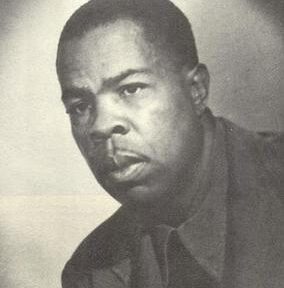
Frank Marshall Davis
: Photo from Wikipedia / Author of Photo: http://mediamatters.org/blog/2012/10/25/dynamite-foxs-crowley-endorses-film-alleging-ob/190904Overview
* Communist writer and poet (1905-1987)
* Friend of Paul Robeson
* Mentor to a young Barack Obama in the 1970s
* Dedicated supporter of the Soviet Union and enemy of America
* Died in July 1987
Frank Marshall Davis was born in Arkansas City, Kansas on December 31, 1905. For periods of time in the 1920s he attended Friends University and, later, Kansas State Agricultural College, studying industrial journalism but never compiling enough credits to graduate. Davis suffered the sting of considerable racism during these years, and he was particularly impacted by the 1921 Tulsa Race Riot, where mobs of white residents attacked black residents and businesses of the Greenwood District in Tulsa, Oklahoma. He prayed that God might bring retribution upon the guilty whites who had destroyed so many black lives; but when no physical retribution came, Davis began to turn toward atheism.
Also during the Twenties, Davis started to write poetry. In 1927 he moved to Chicago and worked for the Chicago Evening Bulletin and the Chicago Whip, both African-American newspapers. In addition, Davis spent some time working for the Indiana-based Gary American.
In 1931 Davis relocated to Atlanta to become managing editor of the Atlanta Daily World, a semi-weekly black newspaper. He dramatically increased the publication’s sales and profitability, turning it into the nation’s first successful black daily. During this period, Davis took an interest in the Scottsboro Boys case, where nine black teenagers were falsely accused of raping two white women aboard a train in Alabama. The involvement of the Communist Party USA (CPUSA) in the case is what first drew Davis’s attention to the Party, which was, in fact, usurping the boys’ defense and dragging out the case for propaganda purposes.
In 1933, The Crisis (the official publication of the NAACP) asked Davis to articulate his opinions regarding communism. He wrote: “It is a fact that the Negro, getting the dirty end of the economic[,] social and political stick, finds in Communistic ideals those panacea he seeks.” “And yet,” Davis quickly lamented, “I believe that were our government adjusted according to Red standards, few members of the kaleidoscopic race would have sense enough to take advantage of it.”
In 1934 Davis returned to Chicago, where he served as executive editor of the Associated Negro Press (ANP), a news service for black newspapers. He would remain with ANP until 1947.
When Davis later discussed his return to Chicago in his memoirs, the first two names that appeared were both prominent African-American communists: Langston Hughes and Richard Wright. Davis knew both men on a first-name basis. Wright, whom Davis met in Chicago in 1936, would leave the Party permanently in 1940 and would eventually describe his disenchantment in the huge bestseller, The God That Failed. Davis characterized Wright’s defection as an “act of treason in the fight for our rights” — an act that “aided only the racists who were constantly seeking any means to destroy cooperation between Reds and blacks.”
During his tenure with ANP, Davis was occasionally asked by the FBI to assess the character of applicants for government jobs in Washington, DC. Davis deliberately lied to his questioners, as he would explain decades later in a 1987 interview:
“I often had the FBI contacting me at the Associated Negro Press. They … wanted to find out whether such-and-such a person who had applied for a job in Washington was a good risk. So I had determined that if this brother who applied for this job in Washington was an Uncle Tom, then I would tell the FBI that this person was … a risk, and he was no good, and so I, I used to work this in the reverse, and if a person … was officially militant, I would praise them the highest. I would say he is completely in favor of the Constitution [and] he supports the entire Constitution and so forth, so it would have just things. I hoped it would have just the opposite effect on the FBI.”
Throughout the Thirties, Davis continued to write and publish poems. When the Chicago socialite Frances Norton Manning became aware of Davis’ work, she introduced him to the publisher Norman Forgue, whose Black Cat Press produced Davis’s first book, Black Man’s Verse, in the summer of 1935.
Davis was, at this time, much more political than when he had left Chicago in 1931. In the intervening years, he had been exposed to a number of major African-American communists, including Angelo Herndon and Ben Davis, Jr., among others.
In 1936 Davis was listed as a contributing editor to the Spokesman, the official organ of the Youth Section of the National Negro Congress, which the U.S. government had identified as a Communist-front organization.
In 1940, Davis became involved with the American Peace Mobilization (APM), which the House Committee on Un-American Activities described as “one of the most notorious and blatantly communist fronts ever organized in this country” and “one of the most seditious organizations which ever operated in the United States.” Historian Paul Kengor called APM a “hideous Communist front” that “supported or opposed Hitler based entirely on whether he was signing non-aggression pacts with Joseph Stalin’s USSR or invading Stalin’s USSR.” APM’s objective at that time was to prevent the United States from entering World War II against Nazi Germany, because Hitler had signed a non-aggression pact with Stalin, to whom American communists swore their unwavering allegiance.
Davis joined the Communist Party in the early 1940s; his Communist Party card number was 47544. In a letter he sent to a friend during this time period, Davis wrote: “I’ve never discussed this with you and don’t know whether you share the typical American uninformed concepts of Marxism or not, but I am risking such a reaction by saying that I have recently joined the Communist party.”
The FBI first began tracking Davis in 1944, after having identified him as member of the Communist Party’s Dorie Miller Club in Chicago. Over a nineteen-year span (1944-63), the Bureau compiled a 601-page file on Davis. One document therein suggests that Davis’s CPUSA affiliations had begun as early as 1931. Moreover, the FBI listed Davis in its security index, meaning that he could be arrested or detained in the event of a national emergency.
In early 1945, the FBI identified Davis as a member of the Carver Second Ward West of the Communist Political Association. The following year, the Bureau identified him as a member of the Carver Club of the Communist Party. Davis’ wife, meanwhile, was a member of the Paul Robeson Club of the Communist Party of Chicago.
From 1944-47, Davis served as vice chairman of the Chicago Civil Liberties Committee, a Communist front. He then spent a year as a national board member of the Civil Rights Congress, also a Communist front.
In 1946 Davis began a two-year stint as the founding executive editor of the Chicago Star, a weekly publication secretly controlled by the Communist Party. The Star was unabashedly pro-Communist, consistently echoing the CPUSA/Soviet party line. Indeed, the paper would periodically print statements on U.S. domestic politics from Joseph Stalin, or carry an exclusive interview with Vyacheslav Molotov, the high-ranking Soviet politician and diplomat. In addition to his editorial duties, Davis wrote a weekly column for the Star, titled “Frank-ly Speaking,” which endorsed every conceivable Soviet foreign-policy initiative while accusing all anti-communists of fascism and racism. In a July 20, 1946 commentary titled “A-Bombs for Russia,” Davis heaped praise upon Stalin’s Russia: “I salute the Soviet Union. I admire Russia for wiping out an economic system which permitted a handful of rich to exploit and beat gold from the millions of plain people…. As one who believes in freedom and democracy for all, I honor the Red nation.”
Davis’s writing was also replete with rich veins of anti-Americanism. On November 9, 1946, for example, he wrote: “I’m tired of being beaned with those double meaning words like ‘sacred institutions’ and ‘the American way of life’ which our flag-waving fascists and lukewarm liberals hurl at us day and night.”
And in a September 29, 1949 piece titled “Challenge to the Church,” Davis imagined Judgment Day, where anti-communist Christians would be punished for their failings: “On your Judgment Day, when the Lord will ask you for an account of your stewardship, will … your answer be, ‘Lord I was too busy Redbaiting”? “The Christian churches, and the Catholic church in particular,” Davis elaborated, “are making a grievous error in their shortsighted belief that the major enemy of Christianity is Communism.”
Also in the 1940s, Davis wrote for the left-wing Chicago Defender, a publication heavily influenced by the CPUSA.
From 1946-48, Davis attended Communist Party Cultural Club meetings in Chicago. During this period, he taught a course at Chicago’s Abraham Lincoln High School, which was run by the CPUSA and had been cited by the U.S. government as a subversive organization and a Communist front.
Additional Communist-front organizations with which Davis was affiliated in the Forties were: the Chicago Committee for Spanish Freedom, American Youth for Democracy (which was the youth wing of the CPUSA), the National Association for Constitutional Liberties, the League of American Writers, and the National Negro Congress.
In 1947 Davis was a signatory to a petition urging Congress to abolish the House Un-American Activities Committee (HUAC), branding the latter as an entity whose “undemocratic” work would inevitably result in “the ultimate suppression of all traditional American civil liberties.”
In 1948 Davis published his most ambitious poetry collection, entitled 47th Street: Poems, chronicling life on Chicago’s South Side.
In April 1948 Davis was listed as a member of the Citizens’ Committee to Aid Packing-House Workers, a Chicago-based organization dominated by the CPUSA.
Also in 1948, Davis’ good friend Paul Robeson, who himself was a dedicated Stalinist, persuaded Davis to move to Honoloulu, Hawaii.
Beginning in May 1949, Davis wrote the column “Frankly Speaking” for the Honolulu Record, the International Longshore & Warehouse Union’s Communist-line newspaper. (During WWII, the Record‘s editor and its largest shareholder both worked as informants for Mao Zedong in Yenan, China.)
According to Davis’ FBI file, his column in the Record “constantly reflect[ed] the CP [Communist Party] line” and was “devoted to unrelenting and unmitigated complaints of racial discrimination in the United States.” Added the FBI file: “Davis has revealed himself to be a bitter opponent of capitalism and a staunch defender of … prominent Communists and Communist sympathizers.” Specifically, his weekly columns expressed support for the National Lawyers Guild, Soviet Russia’s foreign policy in Southeast Asia, U.S. recognition of Communist China, the airing of black Americans’ grievances before the United Nations, American disarmament, and the acquittal of Soviet spies Julius and Ethel Rosenberg. Moreover, Davis opposed the Smith Act of 1940, a federal statute that set criminal penalties for advocating the overthrow of the U.S. government.
In the January 26, 1950 edition of Honolulu Record, Davis published an article titled “Free Enterprise or Socialism?” which, on the premise that America had reached an economic tipping point, began with the statement: “Before too long, our nation will have to decide whether we shall have free enterprise or socialism.” He then quoted the chairman of the Congressional Committee on Small Business, who, by Davis’s telling, had warned that “at the present rate, either the giant corporations will control all our markets, the greatest share of our wealth, and eventually, our government, or the government will be forced to intervene with some form of direct regulation of business.” Articulating his contempt for the greedy, “tentacled” millionaires and billionaires who ran “big business,” Davis wrote: “Alfred Sloan of General Motors announced that his gigantic company made a profit last year of $600,000,000, more than any other corporation in history. Over the years, General Motors has swallowed up or knocked out car manufacturer after car manufacturer so that today less than a handful of competitors remain. Free enterprise, eh?”
In the same piece, Davis falsely claimed that unrestrained free enterprise had caused the Great Depression: “For many years now we have been living under the virtual dictatorship of Big Business which all but drove us to ruin in 1929.” He voiced gratitude that former President Franklin Delano Roosevelt, “by curbing the excesses of the giant corporations that had led to the economic crisis,” had been “able to save the system from complete collapse.” “And yet the moneyed men who were bailed out by [Roosevelt’s] New Deal program,” Davis lamented, “were our late president’s [FDR’s] biggest enemies. They have refused to see that in order to preserve their hides, they had to hand out a few drops of gravy to the common man.”
Davis further blamed American capitalism for starting World War II — precisely the party line that Joseph Stalin had issued in his February 1946 Bolshoi Theatre speech. “This bolstering of a sick economy ended at the outset of World War II,” wrote Davis. “Multi-billion-dollar expenditures for the means of killing fellow humans brought added profits, and Big Business emerged stronger than ever before in history after V-J Day.”
A few weeks later, in a March 2, 1950 column in the Honolulu Record, Davis, lamenting the inability of poor Americans to purchase “a decent home,” approvingly quoted former President Woodrow Wilson’s assertion that “the masters of the government of the United States are the combined capitalists and manufacturers of the United States.” To amplify that message, Davis borrowed a 1935 quote attributed to the then-governor of Pennsylvania: “I warn you that our civilization is in danger if we heed the deceptive cries of special privilege, if we permit our men of great wealth to send us on a wild goose chase after so-called radicals while they continue to plunder the people …. We are constantly told of the evils of Socialism and Communism. The label is applied to every man, woman and child who dares to say a word which does not have the approval of Wall Street.”
In the same piece, Davis branded conservatives as racists: “If I were conservative, that would mean automatically that I think we have gone too far in trying to break the yoke of color bondage and that I am in favor of greater discrimination … not less.” He also vowed not “to be frightened into submission to the status quo” by fear-mongers who might try to tar him as a “Red engaged in subversive operations,” or “an agent of Moscow.”
Davis would continue writing for the Honolulu Record until May 1957.
In the late 1940s, Davis attempted to lead a hostile CPUSA takeover of the NAACP. In 1950 Edward Berman, a member of the NAACP’s Honolulu branch, testified to HUAC that Davis had “sneaked” into local NAACP meetings to “propagandize” the organization’s members about America’s “racial problems,” with “the avowed intent and purpose of converting it into a front for the Stalinist line.”
Davis was identified unequivocally as a CPUSA member in a 1951 report by the Commission on Subversive Activities to the Legislature of the Territory of Hawaii (CSALTH), which, like HUAC, charged that Davis was affiliated with a number of Communist-front organizations.
In May 1953 Davis was elected president of the Hawaii Civil Rights Congress, an affiliate of the Civil Rights Congress (which, as noted above, had already been cited by the U.S. government as a subversive organization).
Also in the early Fifties, Davis chaired the defense committee for the “Honolulu Seven,” a group of Communists who were charged with Smith Act violations and were convicted in 1953 of advocating the overthrow of the U.S. government by force and violence.
On December 5, 1956, Davis appeared in executive session before a U.S. Senate Subcommittee investigation of “the scope of Soviet activity in the United States,” and invoked his Fifth Amendment right when asked about his Communist Party membership.
According to the FBI, Davis in 1957 “championed the policies of Soviet Russia.”
In 1959 an FBI source who was close to Davis reported that Davis had been having conflict with his comrades at the ILWU and the Honolulu Record, because Davis was a “haole [Caucasian] hater.”
In 1968 Davis, under the pseudonym Bob Green, authored the book Sex Rebel: Black (Memoirs of a Gash Gourmet), an explict, pornographic autobiography published in San Diego by Greenleaf Classics. Emphasizing that “all incidents I have described here [in the book] have been taken from actual experiences,” Davis openly acknowledged that he lived the life of a sexual swinger: “I admit, however, that my sex syndrome may be more complex than that of many swingers and swappers…. Under certain circumstances I am bi-sexual…. I’m also a voyeur and exhibitionist. Occasionally I am mildly interested in sado-masochism.” Further, the book described sexual encounters which the fictional Greene and his wife had experienced with underage children of both sexes.
In the fall of 1970, Davis met a nine-year-old Barack Obama, whose mother had sent the boy to live with his grandparents in Hawaii. Obama’s grandfather, Stanley Armour Dunham, arranged for Davis to become the boy’s mentor and advisor. From approximately 1971-79, Davis had considerable influence on the young Obama, particularly during the last four of those years. (Notably, Davis once sat on a union-publicity committee with Chicago Sun-Times reporter Vernon Jarrett, father-in-law of Valerie Jarrett, the latter of whom would later become a close confidante and advisor to President Barack Obama).
In the early Seventies, Davis sold marijuana and cocaine from a hot-dog cart which he operated near his home in Waikiki. Though Davis was generally content to live in Hawaii, he lamented in his posthumously published (1992) memoir, Livin the Blues, that: “There are not enough [black] souls here to wield political or economic power. There is no ghetto, hence no potential Black Power.”
In his 1995 book, Dreams From My Father, Barack Obama writes about Davis but does not reveal the latter’s full name, identifying him only as “a poet named Frank” — a man with much “hard-earned knowledge” who had known “some modest notoriety once” and was “a contemporary of Richard Wright and Langston Hughes during his years in Chicago,” but was now “pushing eighty.” (Several sources — including Professor Gerald Horne, Dr. Kathryn Takara, and libertarian writer Trevor Loudon — have confirmed that Obama’s “Frank” was indeed Frank Marshall Davis.)
Obama in his book recounts how, just prior to heading off to Occidental College in 1979, he spent some time with “Frank and his old Black Power dashiki self.” Obama writes that “Frank” told him that college was merely “an advanced degree in compromise,” and cautioned him not to “start believing what they tell you about equal opportunity and the American way and all that sh–.” Davis also told Obama: “What I’m trying to tell you is your [white] grandma’s right to be scared…. She understands that black people have a reason to hate. That’s just how it is. For your sake, I wish it were otherwise. But it’s not. So you might as well get used to it.”
Davis penned many poems during his lifetime. One of them, titled “To the Red Army,” hailed the Soviet revolution and condemned the “rich industrialists” in Washington DC and London who allegedly wanted Hitler and the Nazis to “wipe Communism from the globe.”
Davis also wrote poems mocking traditional Christianity. In some of those compositions, he called Christ “a Dixie Nigger” who was nothing more than “another New White Hope”; he derided Christians as hypocrites “who buy righteousness like groceries”; and he spoke of Africans being killed with a “Christian gun” by missionaries following “the religion of Sweet Jesus,” rather than by a spear.
Another Davis poem, “Peace Quiz for America,” condemns “Uncle Sam” for having sent him to fight “against Axis foes in the death-kissed foxholes of New Guinea and Europe, without shielding my back from the sniping Dixie lynchers in the jungles of Texas and Florida.”
Davis died of a heart attack in Honolulu in July 1987.
Additional Resources:
Full Text of the FBI File on Frank Marshall Davis
The Frank Marshall Davis FBI File (Selected Pages)
“Who Was Frank Marshall Davis?”
By Cliff Kincaid and Herbert Romerstein
VIDEO:
The Unvetted
By Cliff Kincaid
2012
Paul Kengor Speaking about Frank Marshall Davis
July 19, 2012
(Scroll down to the 2nd video on the page)
BOOK:
Communist, The: Frank Marshall Davis: The Untold Story of Barack Obama’s Mentor
By Paul Kengor
Further Reading: “Frank Marshall Davis” (Kansas State University, KeyWiki.org); “Full Text of the FBI File on Frank Marshall Davis” (Internet Archive); “Dreams from Frank Marshall Davis” (by Paul Kengor, 10-30-2008); “Obama’s Communist Mentor” (by Obama’s Red Mentor Praised Red Army” (by Frank Marshall Davis: Obama’s Communist Mentor on the Catholic Church” (by Paul Kengor, 10-12-2012).