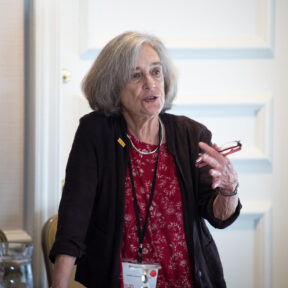
Ellen Schrecker
: Photo from Creative Commons / Author of Photo: AAUPOverview
* Professor of American history at Yeshiva University
* Self-described radical
* Author of several books about McCarthyism
* Says that many Communist spies were merely “internationalists whose political allegiances transcended national borders”
* Claims that leftwing professors are tyrannized for their politics
Born on August 4, 1938 in Philadelphia, Pennsylvania, Ellen Schrecker holds a BA degree from Radcliffe College (1960), as well as an MA (1962) and a Ph.D. (1974) in history, both from Harvard University. In 1987 she became a professor of American history at Yeshiva University, where she is currently a professor emerita. Between 1975 and 1996, Schrecker also taught for brief periods at Harvard, Columbia, the New School for Social Research, New York University, the Union Institute, and Princeton. From 1998-2002, she was the editor of Academe, the journal of the American Association of University Professors, where she served as a National Council member. Shrecker is best known for her work on the history of McCarthyism and the Cold War.
Describing herself as both a “radical” and a “card-carrying member of the American Civil Liberties Union,” Schrecker says she “undertook the study of McCarthyism precisely because of my opposition to its depredations against freedom of speech.” Claiming that “McCarthyism did more damage to the Constitution than the American Communist Party ever did,” she derides anti-Communists generally as conspiratorial McCarthyites who are “misguided or worse.”
Schrecker feels no more esteem for the anti-Communist liberals of the Cold War era, than for the McCarthyites of that time. The “anti-Communist crusade,” she has written, “tapped into something dark and nasty in the human soul.” Schrecker believes that if any harm was caused by “Soviet-sponsored spies,” it was “dwarfed by McCarthy’s wave of terror.” She describes the executed spies Julius and Ethel Rosenberg not as traitors, but rather, as people possessed of a “non-traditional patriotism” that ultimately caused a “grotesquely disproportionate punishment” to be “inflicted on them.” Numerous other Communist spies, adds Schrecker, were merely “internationalists whose political allegiances transcended national borders.” Agnostic regarding the actual guilt of either the Rosenbergs or Alger Hiss, Schrecker laments, above all else, that these individuals “reinforced the [negative] image of Communists as Russian spies.” And even while acknowledging the vast extent of Soviet espionage during the Cold War, she asks: “Were these activities so awful?” “As Communists,” Schrecker answers, “these people did not subscribe to traditional forms of patriotism; they were internationalists whose political allegiances transcended national boundaries. They thought they were building a better world for the masses, not betraying their country.”
With the American Communist Party‘s “demise” following the Cold War, says Schrecker, “the nation lost the institutional network that had created a public space where serious alternatives to the status quo could be presented.” She contends that it was anti-Communism which was “undermining” American democracy, not the Communist true-believers who betrayed America to serve Soviet interests. In keeping with that analysis, Schrecker regards the Cold War as the “most extensive episode of political repression in American history.”
Schrecker asserts that even in the post-Cold War era, political repression remains a mainstay of American academic life. Professors are still being tyrannized for their politics, she says, only today the targets of the witch-hunt are not Communists but academics who are perceived to be “radical, one-sided, and hostile to Israel and the United States.” As evidence of this claim, Schrecker once cited the University of South Florida’s 2001 dismissal of Professor Sami Al-Arian, a leader of the Palestinian Islamic Jihad and a fundraiser for Islamic terrorism. Portraying him as a victim of political persecution, Schrecker said that al-Arian’s firing confirmed that “universities are going back to political correctness,” which “[is] really political repression.” “Just as charges of communist sympathies in the 1950s destroyed the careers of people who studied China,” wrote Schrecker, “so today the Arab-Israeli conflict plagues scholars who come from or study the Middle East…. [Al-Arian’s] summary dismissal … is a classic violation of academic freedom: It involved his off-campus political activities.”
In April 2002 Schrecker lent her name to a “This Is Not Our War: A Letter from United States Citizens to Friends in Europe,” first published in Le Monde. The letter’s signatories charged that “U.S. power has more often than not been used to prop up the remnants of colonial regimes and unpopular dictators, to impose devastating commercial and financial conditions, to support repressive armed forces, to overthrow or cripple by sanctions relatively independent governments, and finally to send bombers and cruise missiles to rain down death and destruction” on innocent populations around the world. Schrecker’s co-signatories included, among others, Anthony Arnove, Stanley Aronowitz, Medea Benjamin, William Blum, Ward Churchill, John Bellamy Foster, H. Bruce Franklin, Thomas Gumbleton, Robert Jensen, Gabriel Kolko, Joel Kovel, Robert McChesney, Norman Solomon, Paul Sweezy, Gore Vidal, and Howard Zinn.
Claiming that advocates of greater intellectual pluralism in the university are essentially revivalists of Cold War-era “McCarthyism,” Schrecker has derided academic freedom campaigns designed to prevent the imposition of any political, ideological or religious orthodoxy on professors or students. She claims that such initiatives are “worse than McCarthyism” because they seek “to impose outside political controls over core educational functions like personnel decisions, curricula, and teaching methods”—a practice that “not only endangers the faculty autonomy that traditionally protects academic freedom, but … also threatens the integrity of American higher education.”
In a January 2017 article which she wrote for The Nation, Schrecker said it was possible that the “fiercely reactionary” administration of incoming U.S. President Donald Trump would attempt to “revive the political repression of the 1940s and ’50s,” a repression that “treated dissent as disloyalty, punished thousands of law-abiding Americans, and scared millions more into silence.” “During the McCarthy era,” wrote Schrecker, “the supposed threat to the USA was the international communist conspiracy; now [under Trump] it’s Islamic extremists, racial and ethnic minorities, immigrants, and left-wing professors.”
Shrecker revisited this theme in a May 2018 piece for The Nation, wherein she wrote that “like McCarthy, Trump is a sociopathic personality whose aberrant behavior facilitated a right-wing campaign against core democratic values”; that “Trump’s erratic behavior endangers all living creatures”; and that the president’s “crudity and flagrant racism” was providing “encouragement” to “contemporary fascism.” Moreover, notwithstanding the fact that mainstream media coverage of Trump and his administration had been overwhelmingly negative, Schrecker wrote that “McCarthy, like the current president, played the media with panache. The press loved him. He fed its members juicy stories. They asked few questions.”
Among the books Schrecker has published are: No Ivory Tower: McCarthyism and the Universities (1986); Many Are the Crimes: McCarthyism in America (1998); The Age of McCarthyism (2001); and The Lost Soul of Higher Education (2010).
For additional information on Ellen Schrecker, click here.
Further Reading: “Ellen Schrecker” (Yeshiva University, Organization of American Historians); “Ellen Schrecker’s McCarthyite Crusade” (by Jacob Laksin, Front Page Magazine, 2-16-2006); “Comments on John Earl Haynes’, ‘The Cold War Debate Continues’” (by Ellen Schrecker, Winter 2000); “A Fresh View of the Cold War” (by Ronald Radosh, 4-22-2010); “Setting the Record on Joe McCarthy Straight” (by Harvey Klehr, 12-3-2013); “Worse Than McCarthy” (by Ellen Schrecker, 2-10-2006); “This Is Not Our War: A Letter from United States Citizens to Friends in Europe” (Rights vs. Public Safety after 9/11: America in the Age of Terrorism, 2003, pp. 123-125); “A Lesson on How to Survive Trumpism—From the McCarthy Era” (by Ellen Schrecker, The Nation, 1-9-2017); “Trumpism Is the New McCarthyism” (by Ellen Schrecker, The Nation, 5-21-2018).