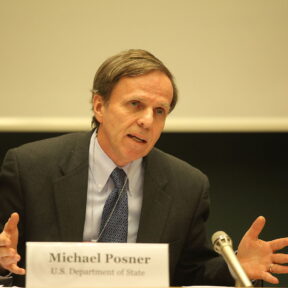
Michael Posner
: Photo from Wikimedia Commons / Author of Photo: United States Mission GenevaOverview
* Founding head of Human Rights First
* Was appointed Assistant Secretary of State for Democracy, Human Rights and Labor in 2009
* “Apologized” to China for Arizona’s 2010 immigration law
* Views the United States as one of the world’s foremost human-rights violators
Born in November 1950, Michael Posner grew up in Chicago, Illinois. He earned a B.A. in history from the University of Michigan in 1972 and a J.D. from UC Berkeley three years later. In 1978 he collaborated with Jerome Shestack and James Silkenat to establish the Lawyer’s Committee on Human Rights, which was renamed Human Rights First (HRF) in 2003. Posner served as executive director of that organization from 1978-2006, and as its president from 2006-2009. He remains a member of the HRF board of directors to this day.
Posner helped shape aspects of the Refugee Act of 1980, which became the first U.S. law to provide for political asylum. Under his leadership, HRF evolved into the world’s foremost provider of free legal representation for asylum seekers.
Posner lectured at Yale Law School from 1981-84 and has been a visiting lecturer at Columbia University Law School since 1984.
In 1991, Posner drafted and campaigned for the Torture Victim Protection Act (TVPA). Passed by Congress the following year, this legislation gave individuals (regardless of their nationality) the ability to file suit in U.S. courts against anyone who, acting in an official capacity for any foreign country, had ever subjected them to torture. It also permitted individuals to sue American agents or military personnel who allegedly had inflicted torture upon them. The U.S. Justice Department resisted TVPA because its definition of torture was open to various interpretations, and because it had the potential to interfere with American foreign policy and U.S. relations with other countries.
In 1992 Posner helped musician/activist Peter Gabriel establish Witness, an organization that uses video and online technologies to “open the eyes of the world to human-rights violations.”
In 1998 Posner led an HRF delegation to the Rome conference at which the statute of the International Criminal Court was adopted.
In the aftermath of the September 11, 2001 terrorist attacks, Posner complained that President Bush’s war on terror was creating “a loss of liberties and a serious undermining of the rule of law.” The Bush administration’s effort “to concentrate government powers with the executive branch,” Posner added, was responsible for “a dramatic loss of personal privacy, the reversal of the principle of open government, and discriminatory policies toward immigrants and refugees.” Condemning national-security measures like the PATRIOT Act, Posner asserted that the U.S.’s post-9/11 treatment of Middle Easterners was akin to the internment of Japanese Americans during World War II.
Particularly appalling to Posner during the Bush years was the government’s practice of holding suspected terrorists such as al Qaeda operatives Yaser Hamdi and Jose Padilla in military detention indefinitely and without access to legal counsel. From the time of Padilla’s arrest in 2002, Posner and HRF were deeply engaged in the defendant’s case and they filed the first amicus brief on his behalf in July 2003. Poser argued that such “so-called ‘enemy combatant’ cases demonstrate most dramatically the change in the relationship between our government and its people.”
Posner also called for the closure of the of the Guantanamo Bay detention center and for an end to the practice of adjudicating terrorism cases in military tribunals.
In 2004, Posner and HRF launched the End Torture Now campaign “to pressure the U.S. government and military to put an end to the unjust detention and abuse of detainees.” On March 1, 2005, Posner and HRF joined the American Civil Liberties Union and a private law firm in filing a lawsuit against Defense Secretary Donald Rumsfeld on behalf of Iraqi and Afghan civilians who allegedly had been tortured while in U.S. custody. Posner accused the U.S. government of committing crimes “against mankind, against humanity.” In March 2006, a judge dismissed the case against Rumsfeld.
In the mid-2000s, Posner¯along with such luminaries as Eric Foner, Henry Louis Gates, George Soros, and Anthony Romero¯served as an advisor vis-à-vis the International Freedom Center (IFC) which was slated to be built at the site of New York’s Ground Zero. Funded and supported by the Open Society Institute, HRF, and the ACLU, the IFC¯under the counsel of Posner et al¯initially planned to serve not as a memorial to either the victims or the heroes of 9/11, but rather as a multimedia tutorial about man’s inhumanity to man throughout the ages (with some emphasis on American transgressions). Public outrage over this proposal eventually forced New York Governor George Pataki to axe it.
In July 2009, the Obama administration nominated Posner to serve as Assistant Secretary of State for Democracy, Human Rights and Labor. Two months later, Posner praised President Obama for deciding to have the U.S. join the United Nations Human Rights Council.
In May 2010, Posner headed the American delegation to a “U.S.-China Human Rights Dialogue,” a two-day affair held in Washington, DC. During a meeting with the Chinese delegation, Posner and his fellow American representatives repeatedly made reference to the recently enacted Arizona immigration-law-enforcement bill (SB 1700) as an example of America’s own human-rights failures¯”a troubling trend in our society, and an indication that we have to deal with issues of discrimination or potential discrimination.” Posner and his team also lamented the “treatment of Muslim Americans in an immigration context,” as well as the problem of “racial discrimination” in the United States.
For additional information on Michael Posner, click here.