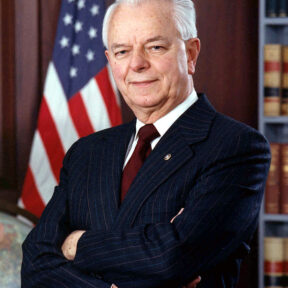
Robert Byrd
Photo from Wikimedia Commons / Author of Photo: United States GovernmentOverview
* Democratic Senator representing West Virginia from 1958 to 2010
* Former member of the Ku Klux Klan
* Former segregationist
* Opposed the 1964 Civil Rights Act
* Consistently opposed legislation seeking to open Alaska’s ANWR region to oil exploration
* Died on June 28, 2010
The longest-serving member in the congressional history, Robert Byrd was a Democratic U.S. Senator (representing West Virginia) from January 1959 through June 2010. He led the Democratic caucus as Senate Majority Leader from 1977-81 and 1987-89, and as Senate Minority Leader from 1981-87. Byrd cast a record 18,680 votes during the course of his Senate career.
Byrd was born Cornelius Calvin Sale, Jr., in November 1917 in North Wilkesboro, North Carolina. A year after his birth, Byrd’s mother died of influenza and the child was sent to live with his aunt and uncle, Vlurma and Titus Byrd, who renamed him Robert Carlyle Byrd and raised him in southern West Virginia.
Enamored of the Ku Klux Klan parades that he witnessed in his youth, Byrd joined the KKK in 1942 and was eventually elected Exalted Cyclops of his local chapter. In his 2005 memoir, _Robert C. Byrd: Child of the Appalachian Coalfields_, Byrd describes the Klan as a fraternal assembly of “upstanding people” who at no time engaged in, or preached violence against, blacks, Jews, or Catholics. He adds that it was a Klan official who first persuaded him to seriously consider a career in politics.
In 1945 Byrd penned a letter to Mississippi’s segregationist senator Theodore Bilbo, wherein he expressed anger over the Truman administration’s efforts to integrate the U.S. military. Wrote Byrd:
“I shall never fight in the armed forces with a Negro by my side … Rather I should die a thousand times, and see Old Glory trampled in the dirt never to rise again, than to see this beloved land of ours become degraded by race mongrels, a throwback to the blackest specimen from the wilds.”
Byrd’s relationship with the KKK continued through the late 1940s. In 1947 he wrote a letter to a Grand Wizard, stating, “The Klan is needed today as never before and I am anxious to see its rebirth here in West Virginia and in every state in the nation.”
In 1952, however, as he was running for the U.S. House of Representatives, Byrd severed his ties with the Klan. He later expressed remorse about his participation in the organization. “I know now I was wrong,” Byrd said. “Intolerance had no place in America. I apologized a thousand times … and I don’t mind apologizing over and over again. I can’t erase what happened.”
In 1952 Byrd was elected to the U.S. House of Representatives, where he served for six years. In 1958 he was elected to his first term in the Senate.
Byrd maintained his pro-segregation stance into the mid-1960s. Most notably, he and other Democrats attempted to obstruct the Civil Rights Act of 1964 by means of a filibuster; Byrd personally filibustered the bill for more than 14 hours. As the floor manager for the segregationists, Byrd made the argument that the writers of the Declaration of Independence “did not intend that these words should be taken literally to be true” when they wrote that “all men are created equal.” “Men and races of men differ in appearance, ways, physical power, mental capacity, creativity, and vision,” Byrd added. “One man is born blind. Another is born lame. Geniuses are not made; they are born. Between two individuals, as between two races, there are broad differences.”
Also in his 1964 filibuster, Byrd introduced a “study” by Frank Boaz, whose book _The Mind of Primitive Man _stated that white people’s brains weighed a few grams more than black people’s brains, and that whites were thus more intelligent. At another point, Byrd cited biblical scripture to make his case for segregation: “In Leviticus, chapter 19, verse 19, we find the words: ‘Ye shall keep my statutes. Thou shalt not let thy cattle gender with a diverse kind: thou shalt not sow they field with mingled seed.’ God’s statutes, therefore, recognize the natural order of the separateness of things.”
According to Washington Post journalist Eric Pianin, Byrd, after the 1964 Civil Rights Act was enacted despite his efforts to derail it, “like other southern and border-state Democrats of his time … came to realize that he would have to temper his blatantly segregationist views and edge toward his party’s mainstream if he wanted to advance on the national stage.”
Byrd felt great antipathy for Martin Luther King, Jr. and his successful nonviolent civil-rights tactics. Seeking to discredit King in any way possible, Byrd initiated contact with the FBI in early 1968 and suggested that he could give a speech condemning King on the floor of the Senate. He said it was time that Dr. King “met his Waterloo.” The FBI, however, declined to avail itself of Byrd’s offer.
Controversy over racial issues would follow Byrd for decades thereafter. For instance, in a March 4, 2001 interview on Tony Snow’s Fox News Sunday program, Byrd said the following about race relations in the United States:
“They’re much, much better than they’ve ever been in my lifetime … I think we talk about race too much. I think those problems are largely behind us … I just think we talk so much about it that we help to create somewhat of an illusion. I think we try to have good will. My old mom told me, ‘Robert, you can’t go to heaven if you hate anybody.’ We practice that. There are white niggers. I’ve seen a lot of white niggers in my time. I’m going to use that word. We just need to work together to make our country a better country, and I’d just as soon quit talking about it so much.”
Shortly after the interview, Byrd released a statement which said: “I apologize for the characterization I used on this program [Fox News Sunday]. The phrase dates back to my boyhood and has no place in today’s society.”
While some denounced Byrd’s comment (then-NAACP-President Kweisi Mfume called it “repulsive”), Byrd was largely given a pass by the media and members of his own party. Some African Americans observed that had a conservative leader made the same remarks, the criticism generated would have been far greater.
Byrd was a staunch supporter of the 1973 War Powers Resolution, which stated that the President could send troops into combat abroad only by authorization of Congress. Yet he voted in favor of the 1964 Gulf of Tonkin Resolution, which gave Byrd’s political mentor, President Lyndon Johnson, authorization to use military force in Southeast Asia without a formal declaration of war by Congress. “I was the last one that ran out of Vietnam,” Byrd once stated. “I supported President Johnson to the end.”
By contrast, Byrd opposed most of President Reagan’s military initiatives in the 1980s. The senator voted against fighting the Communist insurgents in Central America, and against the development of a missile defense system to protect the U.S. from a nuclear attack.
Byrd’s distaste for Republican-led military action continued during the administration of President George H.W. Bush (1989-1993), when, in 1990, he voted against authorizing the use of force against Iraq in what would become known as the 1991 Persian Gulf War.
Yet during the presidency of fellow Democrat Bill Clinton, Byrd voted for the use of American military force in Haiti, Bosnia, and Kosovo.
In 2002 Byrd said, “We are confident that [Iraqi President] [Saddam Hussein][21] retains some stockpiles of chemical and biological weapons, and that he has … embarked on a crash course to build up his chemical and biological warfare capabilities. Intelligence reports indicate that he is seeking nuclear weapons.” Nevertheless, after the November 2002 elections Byrd was a vocal opponent of the resolution authorizing the use of force in Iraq, and he publicly accused the Bush administration of “playing hide-and-seek” with the real costs of the conflicts in Iraq and Afghanistan.
By 2003 Byrd was branding members of the Bush administration as liars. In remarks delivered on the Senate floor in June 2003, the senator stated: “Iraq’s weapons of mass destruction remain a mystery and a conundrum. What are they, where are they, how dangerous are they? Or were they a manufactured excuse by an administration eager to seize a country?”
In the ensuing years, Byrd remained one of the Senate’s most outspoken critics of the Iraq War. In 2004 he published a book on the subject, titled Losing America: Confronting a Reckless and Arrogant Presidency.
Byrd called the Iraq conflict “a war that should not have been fought, a war in the wrong place, at the wrong time, for the wrong reasons.” He mocked President Bush for his “Mission Accomplished” speech of October 2003; he excoriated the Bush administration for its intelligence failures (regarding Iraq’s presumed possession of weapons of mass destruction); and he accused the White House of having made America less safe than it had been prior to the invasion of Iraq. In 2007 Byrd voted “Yes” on two measures seeking the swift withdrawal of U.S. troops out of Iraq.
In March 2005, Illinois Senator Barack Obama joined MoveOn.org’s political-action committee in an effort to raise funds for Byrd’s 2006 reelection campaign. In 2008, Byrd would return the favor by endorsing Obama in the Democratic presidential primary.
For an overview of Byrd’s voting record on key pieces of legislation during his years in the Senate, click here.
On June 27, 2010, Byrd was admitted to Inova Fairfax Hospital in Virginia, for what was initially assumed to be heat stroke and dehydration. But soon thereafter, it became apparent that the senator was seriously ill. He died early the following morning.