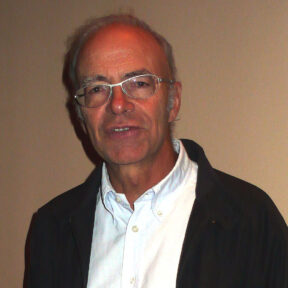
Peter Singer
: Photo from Wikimedia Commons / Author of Photo: TimVickersOverview
* Professor of philosophy and bioethics
* Founder of the modern animal-rights movement
* Characterizes the denial of animals’ basic “rights” as “speciesism,” comparable to racism & sexism
* Likens the animal-rights movement to the slavery abolition movement and the WWII-era fight against Hitler
* Supporter of eugenics
* Believes that parents should be permitted to kill their handicapped newborns during their first 28 days of life
* Claims that people who have lost most physical and mental capacities “are non-persons” whose lives are worth little
Background & Overview
Peter Albert David Singer was born on July 6, 1946 in Melbourne, Australia, the son of Austrian Jews who had fled Nazi-occupied Vienna in 1938, just before the Holocaust. He attended Scotch College in Victoria before transferring to the University of Melbourne, where he earned both a B.A. and an M.A. in philosophy (in 1967 and 1969, respectively). He then obtained a B.Phil. Degree at Oxford University in 1971.
After completing his formal schooling, Singer served as: a Radcliffe Lecturer at Oxford’s University College from 1971-73; a Visiting Assistant Professor in New York University’s Department of Philosophy from 1973-74; a Senior Lecturer in La Trobe University’s Department of Philosophy from 1975-76; and a Professor of Philosophy at Monash University from 1977-99. He also became the director of Monash’s Centre for Human Bioethics in 1983, and co-director of its Institute for Ethics and Public Policy in 1992. From 1999-2004, Singer was a full-time Ira W. DeCamp Professor of Bioethics at Princeton University’s Center for Human Values, and in 2005 he transitioned to a part-time role in that same position. Also in 2005, Singer became a Laureate Professor at the University of Melbourne’s Centre for Applied Philosophy and Public Ethics.
Utilitarianism
Singer’s philosophy can be classified as utilitarianism, the tradition in ethical philosophy which maintains that the metric by which actions can be judged as either right or wrong is the extent to which they promote happiness or prevent pain.
Animal Liberation
In 1975, Singer authored Animal Liberation, a landmark book that effectively launched the modern animal-rights movement. In this volume, he contends that people should recognize and respect the moral worth of all animals—not because of whatever level of intelligence the various species may possess, but rather, because of their ability to experience pain and suffering.
Speciesism
Singer characterizes the denial of animals’ intrinsic value and basic “rights” as a form of discrimination called “speciesism,” whose repugnancy is comparable to that of racism and sexism. From Animal Liberation:
“Adult chimpanzees, dogs, pigs, and members of many other species far surpass the brain-damaged infant in their ability to relate to others, act independently, be self-aware, and any other capacity that could reasonably be said to give value to life. … The only thing that distinguishes the infant from the animals, in the eyes [of those] who claim it has a right to life, is that it is biologically a member of the species Homo sapiens…. But to use this difference as the basis for granting a right to life to the infant and not to other animals is, of course, pure speciesism. It is exactly the kind of arbitrary difference that the most crude and overt kind of racist uses in attempting to justify racial discrimination.”
Deeming it wrong to assign a greater inherent value to human beings than to any other form of animal life, Singer (in Animal Liberation) rejects the biblical notions that: (a) mankind was created to be nature’s steward or master; (b) humans have souls but animals do not; and (c) people are made uniquely in the image of God. At the 2002 Animal Rights National Conference in McLean, Virginia, he stated that “all three [of the foregoing axioms] taken together do have a very negative influence on the way in which we think about animals.” Moreover, he explained at a conference workshop that his mission was to challenge the very notion of the alleged “superiority of human beings.”
In a similar vein, Singer’s 1986 essay “All Animals are Equal” implores humans to “extend to other species the basic principle of equality that most of us recognize should be extended to all members of our own species.” Some additional key excerpts:
“The racist violates the principle of equality by giving greater weight to the interests of members of his own race, when there is a clash between their interests and the interests of those of another race. Similarly the speciesist allows the interests of his own species to override the greater interests of members of other species. The pattern is the same in each case. Most human beings are speciesists. […]
“[O]ur practice of rearing and killing other animals in order to eat them is a clear instance of the sacrifice of the most important interests of other beings in order to satisfy trivial interests of our own. To avoid speciesism we must stop this practice, and each of us has a moral obligation to cease supporting the practice. Our custom is all the support that the meat-industry needs. The decision to cease giving it that support may be difficult, but it is no more difficult than it would have been for a white Southerner to go against the traditions of his society and free his slaves: if we do not change our dietary habits, how can we
censure those slaveholders who would not change their own way of living?“The same form of discrimination may be observed in the widespread practice of experimenting on other species in order to see if certain substances are safe for human beings …”
Singer rejects, as “medieval,” “the notion that human life is sacred just because it is human life.” “Why should all members of the species homo sapiens have a right to life and other species not?” he asked rhetorically in a 2015 interview. “This idea arises only [from] our religious heritage. We have been taught for centuries that man was created in the image of God, that God has given us dominion over the animals, and that we have immortal souls.”
An interviewer once asked Singer what he would do in a situation where he had an opportunity to rescue either a human being or a mouse—but not both—from a burning building. He replied: “… [I]n almost all cases I would save the human being. But not because the human being is human … Species membership alone isn’t morally significant … The qualities that are ethically significant are, firstly, a capacity to … feel pain, or to have any kind of feelings. That’s really basic, and it’s something that a mouse shares with us. But when it comes to a question of taking life, or allowing life to end, it matters whether a being … can see that he or she actually has a life … Such a being has more to lose than a being incapable of understanding this…. So normally, the death of a human being is a greater loss to the human than the death of a mouse is to the mouse … But this depends on the qualities and characteristics that the human being has. If, for example, the human being had suffered brain damage so severe as to be in an irreversible state of unconsciousness, then it might not be better to save the human.”
Similarly, in 2015 Singer was asked: “If you were standing in front of a burning house, where 200 pigs and a child, and you could save either the animals or the child, what would you do?” He answered: “The suffering of animals at some point so great that you should decide to free the animals and not the child. Whether this point is reached at 200 or two million animals, I do not know. But one must not be burned [sic] countless animals in order to save a child’s life.”
On yet another occasion, Singer said that, if required to take the lives of either cows or humans, he would kill ten cows before killing one human—not because cows are of any less value, but rather because the human (if he or she were intellectually “normal”) would mourn his or her own fate: “I’ve written that it is much worse to kill a being who is aware of having a past and a future, and who plans for the future. Normal humans have such plans, but I don’t think cows do.”
Likening the Animal Rights Movement to the Slavery Abolition Movement
In Animal Liberation, the modern-day animal-rights crusade is likened to the slavery abolition movement of the 1800s and the fight against Hitler’s Nazism in the 1940s.
For example, Singer considers whether there is moral justification for anyone to “break in and free the animals” that are caged in laboratories where they are destined to serve as the subjects of medical experiments. “That [act of releasing the animals] is illegal,” he acknowledges, “but the obligation to obey the law is not absolute. [Indeed, the law] was justifiably broken by those who helped runaway slaves in the American South.”
As was already noted in the section titled “Speciesism,” Singer, in his 1986 essay “All Animals are Equal,” draws the following parallel between concerns about animal rights today, and concerns that existed about the welfare of human slaves in centuries past: “[O]ur practice of rearing and killing other animals in order to eat them … is all the support that the meat-industry needs. The decision to cease giving it that support may be difficult, but it is no more difficult than it would have been for a white Southerner to go against the traditions of his society and free his slaves: if we do not change our dietary habits, how can we censure those slaveholders who would not change their own way of living?”
Opposition to Eating Meat
Singer’s compassion for animals led him to become a vegetarian in 1971, and he later became a vegan. Asserting that “no one has the right to inflict needless suffering on another sentient being,” Singer maintains that “no one with access to a wide range of food needs to eat meat.”
The Relative “Worth” of Animals vs. People with Mental Limitations
In Singer’s view, all people of any age who have a mental impairment or limitation that restricts their “capacity to think, relate and experience,” are not “persons” in the full sense of the term, and thus have less intrinsic value than those who are not impaired or limited in the same way. In other words, neither the killing of infants nor of the mentally impaired is necessarily objectionable from a moral perspective: “[W]e should not see all human lives as of equal worth but recognize that some are more valuable than others.”
Proceeding from that premise, Singer advocates the use of disabled people as subjects in medical experiments. Indeed, when Psychology Today in 1999 asked him to comment on the fact that the development of the hepatitis vaccine had been made possible by experiments performed on chimpanzees, Singer said that such research should instead use disabled humans as its subjects: “I’m not comfortable with any invasive research on chimps. I would ask, Is there no other way? And I think there are other ways. I would say, What about getting the consent of relatives of people in vegetative states?… [I]f you could really confidently determine that this person will never recover consciousness, it’s a lot better to use them than a chimp. I agree, it doesn’t go over well, and people throw up their hands in shock and horror. But I’d like them to explain why it’s better to lock a fully-conscious, self-aware chimp in a seven-foot cage in solitary confinement than to experiment with someone lying unconscious in a hospital ward.”
On another occasion, Singer said: “An animal experiment cannot be justifiable unless the experiment is so important that the use of a brain-damaged human would be justifiable.”
In the aforementioned 1999 interview with Psychology Today, Singer further articulated his position vis-a-vis the relative intrinsic worth of human beings as opposed to animals:
“I want us to have a graduated moral approach to all sentient beings, related to their capacities to feel and suffer. If the being has self-awareness, we ought to give it even more rights. I’m not a biological egalitarian. I do not think that all nonhuman animals have the same claim to protection of their lives as humans do. I don’t think it’s as bad to kill a simple animal, like a frog or fish, as it is to kill a normal human being.
“You have to ask yourself what actually makes it worse to kill one being rather than another, and the best answer I can come up with is one’s sense of self, that you are alive and have a past and future. And apart from the great apes, I have made no claim that any other nonhuman animals are definitely capable of the self-awareness that I think gives humans, beyond the newborn stage, a more serious claim to protection of their life than other beings. But I would give animals of some other species the benefit of the doubt where that is possible.”
The Right to Kill Infants & the Mentally Impaired
Singer favors the right to euthanasia for people who, through injury or disease, have lost significant physical and mental capacities, and thus their personhood. “Some humans are non-persons,” he claims, “while some non-human animals are persons…. We put a horse that has broken its leg out of its misery as quickly as possible. This merciful act spares the animal an untold amount of needless suffering. If we look upon human animals in the same fashion, our opposition to killing those who are suffering will begin to dissolve.” “In cases of brain damage making it impossible for the patient to express a preference,” Singer adds, “this principle obviously opens the door to non-voluntary euthanasia.” Such a course of action, he explains, would allow families to “move on” from a time of deep emotional distress.
Singer maintains that because infants are not intellectually self-aware, they are not yet “persons” in the full sense of the term, and thus they have less intrinsic value than those who possess such awareness. In other words, the killing of infants is not necessarily objectionable from a moral perspective. In his 1996 book Rethinking Life and Death, Singer writes: “Since neither a newborn infant nor a fish is a person, the wrongness of killing such beings is not as great as the wrongness of killing a person.”
By Singer’s reckoning, this principle is even more certain in cases that involve infants with handicaps and disabilities. In his 1979 book Practical Ethics, for example, he contends that the value of a human life is derived from a person’s “rationality, autonomy and self-consciousness,” and he then explains: “Defective infants lack these characteristics. Killing them, therefore, cannot be equated with killing normal human beings, or any other self-conscious beings.” And then: “Human babies are not born self-aware, or capable of grasping that they exist over time. They are not persons.” But because animals are, by contrast, self-aware, “the life of a newborn is of less value than the life of a pig, a dog, or a chimpanzee.”
In Practical Ethics as well, Singer says that human parents should be legally permitted to kill their infant child if, at any time during its first 28 days of life, they deem it unworthy of preservation due to some serious handicap or abnormality. He revisited this theme in a speech which he delivered in 2002, when he said: “[I]n that book [Practical Ethics], we suggested that 28 days is not a bad period of time to use because on the one hand, it gives you time to examine the infant to [see] what the nature of the disability is; gives time for the couple to recover from the shock of the birth to get well advised and informed from all sorts of groups, medical opinion and disability and to reach a decision.”
By Singer’s reckoning, infants with severe disabilities (such as Down Syndrome, spina bifida, or hemophilia) are “replaceable” in the sense that their families are ultimately better off ridding themselves of such emotionally, physically, and financially burdensome youngsters. As he writes in Practical Ethics: “When the death of a disabled infant will lead to the birth of another infant with better prospects of a happy life, the total amount of happiness will be greater if the disabled infant is killed.” At a 2002 Animal Rights conference in Virginia, Singer put it this way: “There are some circumstances … where the newborn baby is severely disabled and where the parents think that it’s better that that child should not live, when killing the newborn baby is not at all wrong.” And on another occasion, he said that “killing a defective infant is not morally equivalent to killing a person.”
In 2006 a woman asked Singer pointedly, “Would you kill a disabled baby?” He replied, “Yes, if that was in the best interests of the baby and of the family as a whole. Many people find this shocking, yet they support a woman’s right to have an abortion. One point on which I agree with opponents of abortion is that, from the point of view of ethics rather than the law, there is no sharp distinction between the foetus and the newborn baby.”
Singer’s reasons for favoring the termination of disabled infants’ lives are rooted not only in his particular brand of ethics, but also in his own financial considerations. “I don’t want my health insurance premiums to be higher so that infants who can experience zero quality of life can have expensive treatments,” he says.
The Lives of People in Vegetative Comas Are “Not Worth Living”
In 1999, Singer said the following about people in vegetative comas: “They’re alive but that life is not worth living.”
The Breeding of Children to Be Used for Organ Harvesting
Singer would not find it morally objectionable if parents were permitted to conceive children specifically for the purpose of harvesting their organs for transplant into an older child who may need them. And on a macro level, he similarly endorses the prospect of a society that actively breeds large numbers of children to serve, essentially, as sources of spare body parts for other youngsters.
Supporter of Eugenics
Singer suggests that the use of genetic engineering to enhance children’s physical and mental capacities is no more objectionable, from a moral standpoint, than giving youngsters expensive, cutting-edge educational toys “to maximize their learning potential.” Genetic manipulation, he expands, would be especially acceptable if carried out in a free society rather than in an autocracy:
“Many will condemn this as a resurgence of ‘eugenics,’ the view, especially popular in the early twentieth century, that hereditary traits should be improved through active intervention. So it is, in a way, and in the hands of authoritarian regimes, genetic selection could resemble the evils of earlier forms of eugenics, with their advocacy of odious, pseudo-scientific official policies, particularly concerning ‘racial hygiene.’ In liberal, market driven societies, however, eugenics will not be coercively imposed by the state for the collective good. Instead, it will be the outcome of parental choice and the workings of the free market.”
Singer is troubled, however, by the possibility that in an economically free society—where there is bound to be a certain degree of income inequality—there could exist a situation “where the rich can buy the genes they want and the poor can’t.” “I don’t think that’s the society that would be best in promoting the happiness of most of its members,” he says. “But I’m not convinced it would be a problem if these services were available to everyone.” In other words, Singer views big government—empowered to redistribute wealth and allocate healthcare services—as the solution.
Moreover, it should be noted that Singer has no real objection to the prospect of some parents choosing to abort a gestating baby or kill their fully born infant child simply because the offspring is physically unattractive: “If everyone had the opportunity to avoid having an ugly child, I don’t think I would have a problem.” When asked whether it might be unwise to permit parents to terminate a new life for so frivolous a cause, he assured: “Most parents are not going to do that. Most parents who go through pregnancy, and childbirth, are going to love and cherish that child.”
Supporter of Health Care Rationing
Writing in the July 15, 2009 edition of The New York Times, Singer said that “some form of health care rationing”—controlled by government bureaucrats—“is both inescapable and desirable.” Specifically, he lauded the “Quality Adjusted Life Year” (QALY) metric that has long been used by the United Kingdom’s socialized National Health Service. QALY bureaucrats: (a) place a numeric value on one year of each patient’s life—based on the person’s age as well as his or her existing and projected “quality of life”; (b) consult Comparative Effectiveness Research (CER) data vis-a-vis which medications and treatments tend to work best for which medical conditions; and (c) determine whether the costs related to such medicines or treatments can be justified for the patient in question. This approach strongly favors younger patients—who stand to gain the most additional years of “quality” life from various medical treatments—over older patients. As a National Review analysis puts it, “QALYs give greater value to the lives of the able-bodied and young than to people with disabilities and the elderly (which are ‘adjusted’ down based on low ‘quality’) when determining whether the cost of a treatment is worth the price.” Similarly, Human Events explains: “If a teenager can be expected to live another 70 years, saving her life counts as a gain of 70 life-years, whereas if a person of 85 can be expected to live another 5 years, then saving the 85-year-old will count as a gain of only 5 life-years.”
Bestiality
Singer has suggested that the practice of bestiality has remained unacceptable in most cultures because it is not procreative. But because humans engage in all manner of sexual activities with one another that do not lead to conception, he reasons, sex with animals should not be singled out as a forbidden offense—particularly in light of his belief that humans themselves are animals: “…[T]here are many ways in which we cannot help behaving just as animals do—or mammals, anyway—and sex is one of the most obvious ones. We copulate, as they do. They have penises and vaginas, as we do, and the fact that the vagina of a calf can be sexually satisfying to a man shows how similar these organs are. The taboo on sex with animals may, as I have already suggested, have originated as part of a broader rejection of non-reproductive sex. But the vehemence with which this prohibition continues to be held, its persistence while other non-reproductive sexual acts have become acceptable, suggests that there is another powerful force at work: our desire to differentiate ourselves, erotically and in every other way, from animals.”
On another occasion, Singer put it this way: “We are great apes. This does not make sex across the species barrier normal, or natural, whatever those much-misused words may mean, but it does imply that it ceases to be an offence to our status and dignity as human beings.” And while he notes that inter-species intercourse can sometimes have bad physical consequences—e.g., sex between a human male and a hen will likely result in the death of the latter—Singer nonetheless wonders if that is any “worse than what egg producers do to their hens all the time.”
In 2001, Singer wrote a positive review of Midas Dekkers’s book Dearest Pet: On Bestiality, which examines the history of that practice and concludes that the proscription against sex with animals is nothing more than a vestigial “taboo” from an era of sexual repression.
Necrophilia
Singer does not object to the practice of necrophilia—provided the deceased gave explicit consent when he or she was still alive.
Comparing the Use of Fossil Fuels to The Holocaust
Singer does not balk at NASA scientist James Hansen‘s invocation of Holocaust-related images—such as boxcars and crematoria—in his (Hansen’s) assertion that modern-day coal trains are agents of death which condemn “uncountable irreplaceable species” to extinction. “Given the facts about global warming,” says Singer, “that seems to be exactly what continuing to burn coal will do, as long as we use existing technologies that mean that burning goal contributes to, and will accelerate, climate change. So while the image [of the Holocaust] is vivid and unsettling, I don’t find it objectionable.”
Views on Capitalism & Wealth Redistribution
Singer maintains that in order to live a “morally decent life,” no one should keep any wealth beyond what can cover his or her barest necessities so long as anyone, anywhere, is in need. In a similar spirit, Singer’s 1972 essay “Famine, Affluence, and Morality” argues that it is morally indefensible for an affluent society not to earmark a portion of its wealth for the poor, both at home and abroad.
In 2000, Singer published the book A Darwinian Left: Politics, Evolution and Cooperation, wherein he claims that for too long the theories of social Darwinism have been used by the political “right” to justify capitalism, and even to explain why some societies are prosperous and others are poor. In the book, he suggests that Western culture’s emphasis on “competition” should be replaced by an emphasis on “cooperation” as a goal of human evolution, and that such a shift would not be inconsistent at all with human nature. As a book review in First Things put it:
“Recent Darwinians have shown that humans are hard-wired by natural selection for cooperative as well as competitive behavior, even for altruism. Singer cites now-familiar studies of kin altruism, where apparently sacrificial behavior on the part of a mother for her child is ‘explained’ as a strategy for passing on her genes. He also describes game theory experiments showing that cooperative strategies—tit for tat—work best in getting what we want…. [These examples] are enough to satisfy Singer that Darwinism may now be harnessed to support the left’s vision of a more cooperative society.”
In his 2001 book Marx: A Very Short Introduction, Singer was sympathetic to Karl Marx‘s criticism of capitalism, but skeptical about whether a better economic system was likely to arise anytime soon. “Marx saw that capitalism is a wasteful, irrational system,” wrote Singer, “a system which controls us when we should be controlling it. That insight is still valid; but we can now see that the construction of a free and equal society is a more difficult task than Marx realized.”
While Singer has no strong affinity for free-market economic models, he is by no means blind to their potential real-world benefits, as he made clear in a 2010 interview with the New Left Project: “Capitalism is very far from a perfect system, but so far we have yet to find anything that clearly does a better job of meeting human needs than a regulated capitalist economy coupled with a welfare and health care system that meets the basic needs of those who do not thrive in the capitalist economy. If we ever do find a better system, I’ll be happy to call myself an anti-capitalist.”
In the same interview, Singer said the following about the income and wealth disparities that exist among people everywhere: “There has always been inequality, and there always will be. It goes far deeper than the division between capitalism and socialism. There is inequality among chimpanzees and among flocks of hens. Let’s stop worrying about inequality of wealth and income, and see if we can do something to produce a distribution of income and wealth that leads to less misery and premature death than the present distribution.”
Singer’s Atheism
Singer has proudly declared: “I am an atheist.”
Rejecting the notion that an omnipotent or omniscient divinity is responsible for either the creation, or the ongoing regulation, of the physical universe and its inhabitants, he wrote in 2008: “Do we live in a world that was created by a god who is all-powerful, all-knowing, and all good? Christians think we do. Yet a powerful reason for doubting this confronts us every day: the world contains a vast amount of pain and suffering. If God is all-knowing, he knows how much suffering there is. If he is all-powerful, he could have created a world without so much of it—and he would have done so if he were all good…. The evidence of our own eyes makes it more plausible to believe that the world was not created by any god at all. If, however, we insist on believing in divine creation, we are forced to admit that the god who made the world cannot be all-powerful and all good. He must be either evil or a bungler.”
Singer’s Views on Israel
In 2002, Singer joined hundreds of Jewish scholars and professionals in signing a petition that called for such things as: (a) “partition along the pre-1967 border as modified only by minor mutually agreed territorial swaps”; (b) “Israeli evacuation of all settlements in the occupied territories except those within the agreed swapped areas”; (c) the recognition of “two national states, Israel and Palestine, with equal sovereignty, equal rights and equal responsibilities”; and (d) “Palestinian acceptance of negotiated limitations on the ‘right of return‘ in exchange for financial compensation for refugees.”
- “The U.S. bears a special responsibility for the current tragic impasse,” the petition added, “by virtue of our massive economic and military support for the Israeli government: $500 per Israeli citizen per year…. [W]e call on our government to make continued aid conditional on Israeli acceptance of an internationally agreed two-state settlement.”
- Other signers of the petition included such notables as Noam Chomsky, Stanley Hoffman, Michael Lerner, Frances Fox Piven, Harry Targ, and Howard Zinn.
In 2010, Singer signed a petition renouncing his “right of return” to Israel (as the son of Jewish parents), because he viewed the very notion of such a right as “a form of racist privilege that abets the colonial oppression of the Palestinians.”
In June 2012, Singer said: “Clearly, there were moral flaws in the setting up of the State of Israel without proper consultation and participation by Palestinians. But that was a long time ago now, and I think that instead of looking backwards, we should try to work out the best solution for all those living in Israel and the occupied territories.”
Singer has long been a financial supporter of Oxfam International and its U.S. affiliate, Oxfam America. One of Oxfam’s chief projects has been its boycott of Israeli products—to protest the Jewish state’s alleged abuse of the Palestinian people. Singer has claimed that he typically donates 25 percent of his salary each year to Oxfam and other likeminded NGOs.
“An Urgent Call by Scientists to Defend Science”
In 2006, Singer was a signatory to “An Urgent Call by Scientists to Defend Science,” a document that accused President George W. Bush and the “Religious Right” of being “all too willing to deny scientific truths, disrupt scientific investigations, block scientific progress, undermine scientific education, and sacrifice the very integrity of the scientific process itself — all in the pursuit of implementing their particular political agenda.” Some additional excerpts:
“And today this dominant political agenda is profoundly this dominant political agenda is profoundly allied and intertwined with an extremist (and extremely anti-science) ideological agenda put forward by powerful fundamentalist religious forces commonly known as the Religious Right. These fundamentalists now have extensive influence and representatives in major institutions of the U.S. government, including Congress and the White House. […]
“It is commonplace under the current administration for the government to deny funding, censor scientific reports, or in other ways undermine scientific research which might turn up facts they don’t want to hear; to manipulate, distort, or outright suppress scientific findings they find objectionable; to attempt to reshape government scientific panels to obtain policy recommendations on issues ranging from health to the environment, based less on actual scientific findings than on the requirements of the administration’s agenda. […]
“To bring into the scientific process assumptions, religious or otherwise, which were not arrived at by scientific methods, and which by definition cannot be tested by scientific methods, would destroy science as science.”
Politics
Singer has made very few financial contributions to the campaigns of political candidates over the years. Perhaps his most notable donation was the $250 he gave to Barack Obama’s 2008 presidential run.
Singer himself made a brief foray into the political world in 1996, when he ran, unsuccessfully, as an Australian Greens candidate for the Australian Senate.
“The Life You Can Save”
In 2013, Singer founded The Life You Can Save, a nonprofit organization based on his 2009 book of the same name. The organization’s stated mission is to help create a world “where there’s no suffering or death due to extreme poverty.” Its philanthropy is directed to recipients in impoverished places all over the world.
As of January 2024, The Life You Can Save’s various initiatives included the following:
- Save Lives Fund: “This fund is designed for donors who want to support interventions that have the demonstrated ability to actually save lives. Diseases that are preventable or treatable in the ‘developed’ world like malaria, diarrhea and pneumonia are targeted by the charities that this fund includes.”
- Transform Lives Fund: “Charities in this fund target preventable blindness, chronic malnutrition that leads to permanent cognitive and physical disability, and inadequate access to health care.”
- Help Women & Girls Fund: “This fund is for donors who seek to address the disproportionate burden on women and girls among people living in extreme poverty. [The objective is to] help reshape gender norms worldwide, promote women’s inclusion and safety, and increase access to maternal healthcare and family planning services.”
- Create Economic Opportunity Fund: “This fund is for donors who seek to address a root cause of premature death, suffering, and disempowerment among people living in extreme poverty.”
- Tackle Climate Change Fund: “The climate crisis affects all of us, but it will likely cause widespread devastation and the greatest suffering throughout the developing world. Individuals living in extreme poverty are least protected from extreme weather events (droughts, floods, wildfires, hurricanes, and temperature anomalies) and the ensuing destruction of homes and property. Starvation and food insecurity will result from disrupted agricultural ecosystems, new outbreaks of tropical disease, and large-scale forced displacement that is creating a new class of climate refugees. […] The Tackle Climate Change Fund seeks to create a sustainable future through global policy and systems change, including initiatives that create environmental regulation, decarbonize the energy system, and champion carbon removal practices by advocating for policy and technology changes in the global energy system.”
- Education For All Fund: “This fund is designed for donors who believe in the transformative power of education and who want to improve educational opportunities for all children and adolescents. Charities in this fund work to increase access to education and promote literacy, numeracy and other life skills that create self sufficiency and improve overall wellbeing. Based on the disparities that girls face in enrolling in school, this fund invests specifically in the compounding benefits of enrolling girls in school and improving learning outcomes for all students.”
- All Charities Fund: “This fund is an opportunity for donors seeking to support the full range of our cost-effective, evidence-based highly impactful charities. You will have the option of giving 100% to our charities or split your donation with 90% to our charities and 10% toward our operations.”
Singer’s Enormous Influence
Singer’s influence in the academic world has been immense:
- He is widely regarded as the “godfather” of animal rights.
- Guidestar.org says he is “often considered to be the world’s most influential living philosopher.”
- In 1994, the Council of Australian Humanist Societies recognized him as the Australian Humanist of the Year.
- In 2004, the International Academy of Humanism named him “Humanist Laureate.”
- In 2005, Time magazine named listed him as one of the world’s 100 “most influential people.”
- In 2009, The Sydney Morning Herald and The Age listed him as one of the 25 most influential Australians of the last half-century.
- In 2015, National Review called him “the most celebrated bioethicist and moral philosopher of our times.”
- In 2015 as well, American Thinker stated that his writings “are a constant staple in literary and ethics texts used in American universities.”
Singer’s Books
Over the course of his professional career, Singer has written, co-authored, edited or co-edited more than 50 books. In addition to those already cited in this profile, Singer has also authored or co-authored such books as Marx (1980); The Reproduction Revolution: New Ways of Making Babies (1984); Should the Baby Live? (1988); Rats, Patients and People: Issues in the Ethical Regulation of Research (1989); Democracy and Disobedience (1994); How Are We to Live? (1995); Rethinking Life and Death (1995); The President of Good and Evil (2004); In Defense of Animals: The Second Wave (2005); The Ethics of What We Eat: Why Our Food Choices Matter (2007); and The Life You Can Save (2009).
For a more comprehensive listing of books that Singer has authored or co-authored, click here.