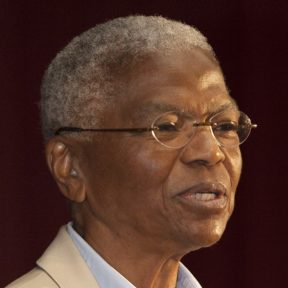
Mary Frances Berry
: Photo from Wikimedia Commons / Author of Photo: Kim Shiflett / Source of Photo: https://images.nasa.gov/#/details-KSC-2014-3149.htmlOverview
* Former chairwoman of U.S. Civil Rights Commission
* Supporter of racial preferences in employment and education
* Professor at the University of Pennsylvania
* Endorsed the practice of smearing conservative Tea Party political activists as racists
* Admirer of Mao Zedong
Born on February 17, 1938 in Nashville, Tennessee, Mary Frances Berry earned both her BA and MA degrees in History from Howard University (in 1961 and 1962, respectively,) and a Ph.D. in U.S. History from the University of Michigan (1966). Also in 1966 she was hired as an assistant professor of History at Central Michigan University, and four years later she earned a JD at the University of Michigan Law School. In 1970 as well, Berry became the acting director of the University of Maryland’s (UM) Department of Afro-American Studies. She was subsequently named interim chairperson of UM’s Division of Behavioral and Social Sciences, and served as provost for that division from 1974-76. In 1976 Berry became chancellor of the University of Colorado at Boulder. The following year, she accepted President Jimmy Carter‘s invitation to serve in the Department of Health, Education and Welfare. From 1977-80, Berry was the Assistant U.S. Secretary of Education.
Accustomed to carrying Mao Zedong’s Little Red Book in her purse wherever she went, Berry took a trip to Communist China in 1980. When she returned home, she stated publicly that Americans had no right to criticize China’s education system for requiring students to “develop what they call socialist consciousness and culture.” Somewhat embarrassed by Berry’s remarks, President Carter transferred her to the U.S. Commission on Civil Rights (USCCR), where she remained a member for the next 24 years — including 11 years (1993-2004) as the Commission’s chairwoman, an appointment made by President Bill Clinton.
From the earliest days of her career in government and academia, Berry has routinely denounced what she views as America’s systemic flaws while comparing the nation unfavorably to Communist states. In 1982, for instance, she complained that the U.S. media’s “massive barrage of propaganda” had made black Americans blind to the virtues of the Soviet Union, including its “safeguards for minorities,” its “equality of opportunity,” and its “equal provision of social services to its citizens.” Further, Berry characterized the 1960s as an era when blacks in America had lived under a perpetual “threat of genocide” that was “roughly comparable” to what Jews faced in Hitler’s Germany.
In 1983 President Ronald Reagan attempted to fire Berry from the USCCR, arguing that as a political appointee she served at the pleasure of the President. But Berry sued and eventually won in federal district court the right to keep her post. She later said: “I tell [my friends] the happiest day of my life was when Reagan fired me…. His firing me was like giving me an A and saying ‘Go to the head of the class’.”
In 1984 Berry was a co-founder of the Free South Africa Movement, which organized anti-apartheid protests at the South Africa Embassy in the United States. She was subsequently jailed several times for her activities in support of that cause.
In 1985 Berry and fellow USCCR commissioner Blandina Ramirez issued an official statement that said, “Civil rights laws were not passed to give civil rights protections to all Americans, as a majority of this Commission seems to believe. Instead, they were passed out of a recognition that some Americans already had protection because they belonged to a favored group; and others, including blacks, Hispanics, and women of all races, did not because they belonged to disfavored groups.”
In 1987 Berry was hired to teach at the University of Pennsylvania, where she continues to serve as the Geraldine R. Segal Professor of American Social Thought and Professor of History.
In 1990-91, Berry was president of the Organization of American Historians.
Berry has long considered America to be a nation awash in white racism:
- “The primary explanation for racially motivated violence against blacks,” she once said in the 1980s, “has been the need of a segment of the white population to preserve [its] belief in the inferiority of blacks, and to maintain the social and political subordination of an historically outcast group by any means, including violence.”[1]
- On another occasion, Berry described the placement of family-planning clinics in inner cities as part of an effort to inflict “genocide” on black people.
- A strong advocate of racial preferences in employment and education, Berry unapologetically supports racial quotas and makes no effort to euphemize them with terms like “affirmative action” or “diversity.” She has said that if not for such preferences, the student bodies of colleges and universities nationwide would be dominated by Jews and Asians.
- Favoring preferential treatment as a means of compensating people who presumably have been discriminated against in the past, Berry says that “where you have equal qualified people” applying for a particular job or position, “the people with less” should get the nod.
- During the George W. Bush presidency, Berry charged that when Bush appointed blacks like Clarence Thomas, Condoleezza Rice, and Colin Powell to some of the highest positions in his administration, he was merely using them as tokens for the purpose of fooling African Americans into complacency and a false sense of well-being. Said Berry: “The reason there is no agitation among blacks — I don’t see any — is because the symbolism is such that you could tell yourself — until something happens to you — that nothing is wrong. You could say, ‘Look at Colin Powell. Blacks are everywhere. We can just do anything.’”[2]
- In a 2010 interview with Politico, Berry endorsed the practice of smearing conservative Tea Party political activists as racists. “Tainting the Tea Party movement with the charge of racism is proving to be an effective strategy for Democrats,” she said. “There is no evidence that Tea Party adherents are any more racist than other Republicans, and indeed many other Americans. But getting them to spend their time purging their ranks and having candidates distance themselves should help Democrats win in November. Having one’s opponent rebut charges of racism is far better than discussing joblessness.”
Berry has little patience for blacks who do not share her political views and values. According to left-wing journalist Judith Coburn: “More than one African-American politician and journalist have suffered a tongue lashing from Berry and been called an ‘Uncle Tom’ just because they didn’t share her agenda.”
Berry views capitalism as an inherently unjust economic system that feeds American racism. In a 1991 article which she published in the Journal of American History, for instance, she wrote: “The legal system supports our capitalist economic system. Because capitalism requires inequality, the only real question is who will be the repositories of the inequality. To date, black people have disproportionately been those repositories.”
In 1996 Berry was one of the original 130 founders of the Campaign for America’s Future.
In June 1997, Berry was named chairwoman of the Pacifica Radio Foundation’s National Board, a post she held until July 2000. She continues, however, be a member of the National Board.
In 1997, the nonpartisan General Accounting Office (GAO) issued a report indicating that Berry’s USCCR was “an agency in disarray, with limited awareness how its resources are used … the Commission could not provide key cost information for individual aspects of its operations … significant agency records documenting Commission decision-making were reported lost, misplaced or nonexistent …”[3] When testifying to Congress about the findings of the 1997 GAO report, Berry said: “I will not respond to some of the comments that were made by the [congressional] members [of the subcommittee] since my years of working in Washington tells me that way lies peril and I will not take the time to do it.” And though she had been USCCR’s chairman for several years, Berry blamed Arthur Fletcher, her predecessor in that position, as well as current staffers, for the problems uncovered by the GAO. She also blamed cuts that had been made to the Commission’s budget more than a decade earlier (in 1986).
In 1999 Berry demanded that the progressive Berkeley, California radio station KPFA-FM — which was one of the Pacifica Radio Foundation’s network of community-based, “free-speech” stations — appoint more blacks to management positions. She said, with derision, that the station’s programmers and listeners consisted largely of “white male hippies over 50.” Salon.com reported in October 1999:
“When a rainbow of KPFA staff and supporters protested [Berry’s] moves, as well as Berry’s racial rationale, months of chaos ensued. Berry and Executive Director Lynn Chadwick fired the station manager, censored its public affairs programmers to keep them from talking about the controversy, had a broadcaster arrested — while he was on the air — for defying the ban, shut down the station and locked KPFA staffers out, had peaceful demonstrators arrested, and paid anti-union lawyers, armed security guards and a tony public relations firm over a half-million dollars to prevail…. Berry’s moves outraged even people who don’t listen to the station. The result is that in the last two months, she has been socked with complaints before her own Civil Rights Commission, accused of unfair labor practices before the National Labor Relations Board and investigated by a committee of the California Legislature; she has been attacked by a wide political spectrum of local Berkeley politicians, including the police chief, and sued by listeners and staffers challenging her actions in the KPFA struggle.”
In 2004, Linda Chavez, who served as the USCCR staff director when Berry a member of that Commission, recalled that Berry had frequently praised the superiority of China’s education system. Wrote Chavez: “Berry, then the government’s top-ranking official in higher education, nonetheless praised China’s education system as a model for the United States and publicly criticized the press for printing ‘false’ reports about the Chinese system.” “To describe Mary Frances Berry as a liberal, as she is frequently referred to in the media, is an insult to liberalism and Berry,” added Chavez. “She is a political radical well outside the mainstream of American politics.”
Chavez also has described Berry as an ill-tempered individual who “once bullied a member of the commission staff so badly — in words not fit to print in a family newspaper” — that Chavez subsequently told Berry in a memo: “Your use of intimidating curses and vile language as well as your overall abuse of a subordinate go far beyond permissible behavior. If you repeat such abusive behavior in the future, I will ask you to remove yourself from the premises and will seek to have you removed if you do not comply.”
Chavez was not alone in her assessment of Berry’s volatile temperament. Washington Monthly reports that when Berry was Assistant Secretary of Education from 1977-80, officials in the Department of Education cut her out of policy decisions because “she’d shatter consensus and jeopardize initiatives … she distrusted people [so] as to not be trustworthy herself …” As a former aide to President Carter told Salon News in 1999: “Oh, I remember Mary. She was a real loose cannon. We spent a lot of time smoothing over things after she’d opened her big mouth.”
In December 2004, President George W. Bush named Gerald Reynolds to replace Berry as chairman of the USCCR.
In a remarkably frank 2010 email to Politico, Berry candidly explained that it was good politics for Democrats to smear Republicans with unfounded charges of racism: “Tainting the tea party movement with the charge of racism is proving to be an effective strategy for Democrats. There is no evidence that tea party adherents are any more racist than other Republicans, and indeed many other Americans. But getting them to spend their time purging their ranks and having candidates distance themselves should help Democrats win in November. Having one’s opponent rebut charges of racism is far better than discussing joblessness.”
In 2010 Berry co-authored the book, Power in Words: The Stories Behind Barack Obama‘s Speeches.
Over the years, Berry has served variously as a Board of Directors member of the NAACP Legal Defense Fund and People for the American Way; a Fellow of the Society of American Historians and of the National Academy of Public Administration; and a Distinguished Fellow of the American Society for Legal History. She also has received 35 honorary doctoral degrees and many awards, including the NAACP’s Roy Wilkins Award, the Southern Christian Leadership Conference‘s Rosa Parks Award, Ebony magazine’s Black Achievement Award, and the Organization of American Historians‘ Roy Rosenzweig Distinguished Service Award.
Footnotes:
- Crime and the Black Community (Albany: The Governor’s Advisory Committee for Black Affairs, December 1987, p. 29).
- George E. Curry, “Mary Frances Berry: A Fearless Warrior for Civil Rights” (Chicago Standard Newspapers — Part of the BlackPressUSA Network; December 16, 2004).
- Salon.com further points out that:
- “The GAO report questioned why only 10 percent of the CRC’s money went to the anti-discrimination investigations and reports that are the agency’s mission. It found that CRC reports took so long to complete that in many cases they were outdated and irrelevant by the time they were issued.”
- “The GAO also reported that the commission filed few of the reports to Congress and other departments of the government that they were required to by law. At a July, 1997 hearing on the report, GAO investigators told congressmen that many of their questions about the commission couldn’t be answered because commission staff withheld information even after several requests from the GAO.”
- “Berry also refused to open Pacifica’s books or to testify during a recent California lawmakers’ probe of Pacifica until she was threatened with a subpoena.”
Additional Resources:
There’s Something About Mary
By Judith Coburn
October 12, 1999
Mary Frances Berry: Civil Rights Bully
By Linda Chavez
December 11, 2001
Bush Finally Fires Mary Frances Berry
By Linda Chavez
December 14, 2004
Mary Frances Berry: A Relic Whose Time Has Come
By George Will
December 17, 2001
Further Reading: “Mary Frances Berry” (YourDictionary.com, Britannica.com; UPenn.edu, Keywiki.org).