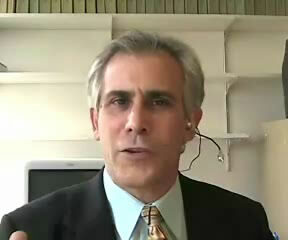
David Corn
: Photo from Wikimedia Commons / Author of Photo: The original uploader was Cardsplayer4life at English Wikipedia.Overview
* Washington bureau chief for Mother Jones magazine
* Former Washington editor of The Nation
* Former writer for Ralph Nader
* Said that the 9/11 terrorist attacks were logical “reactions to specific actions and policies … to which the United States has often been a party”
David Corn was born in New York City in February 1959 and graduated from Brown University in 1982. During his time at Brown, he worked a year as a writer for the activist Ralph Nader and his public interest groups. After a subsequent stint with Harper’s magazine, Corn was hired in 1987 as Washington editor at The Nation, where he would remain for twenty years. In October 2007 he became the Washington bureau chief for Mother Jones magazine, a position he still holds today. Corn writes on a variety of topics, with a special focus on politics and the national-security establishment.
In the immediate aftermath of September 11, 2001, Corn wrote that the terrorist attacks of that day were logical “reactions to specific actions and policies … to which the United States has often been a party.” Fundamentalist Islam, he added, posed a lesser threat to the West than did America’s own “national security cadre,” which, Corn predicted, was likely to exploit the 9/11 attacks as an excuse to “bolster the [U.S.] military and intelligence establishment.”
Corn was a major figure in the “Plamegate” controversy of 2003, which centered around media leaks about CIA analyst Valerie Plame. After Plame’s identity had been revealed in a July 14 column by Robert Novak, Corn was the first to report, four days later, that Plame theretofore had been working covertly for the CIA, and that Novak’s disclosure about her may thus have violated the Intelligence Identities Protection Act. Novak, in turn, disputed that Plame had been a covert operative, and said of Corn: “Nobody was more responsible [than Corn] for bloating this episode.” According to Novak, Corn’s objectivity was compromised by the latter’s close association with Plame’s husband, Ambassador Joseph Wilson.
In 2004, Corn, who was affiliated with Ralph Nader’s Center for Study of Responsive Law, spoke out against Nader’s independent presidential bid that year, a bid which Corn believed would siphon vital votes away from Democratic candidate John Kerry. “Ralph gave me my start [in independent journalism], and I am forever grateful,” said Corn. “It has saddened me to watch him destroy his legacy by mounting a fool’s errand of a campaign.”
In October 2006, Corn announced to his readers that he had recently come into possession of “The List,” a secret “roster of top-level Republican congressional aides who are gay.” Stating that he himself would not go public with the names contained therein, Corn said it was likely that someone else in the media would: “[T]here’s a good chance [The List] will be appearing soon on a website near everyone.” Moreover, he justified such an invasion of privacy by deriding homosexual Republicans for allying themselves with “a party that tries to limit the rights of gays and lesbians and that welcomes the support of those who demonize same-sexers.”
In July 2010, Corn revealed in Mother Jones that he had once been a member of Journolist, a secret association of approximately 400 left-wing reporters, academics, and political activists who collaborated through an online message board and secretly colluded to discredit and ignore stories that had the potential to harm Barack Obama’s bid for the White House in 2008. Downplaying the significance of Journolist’s activities, Corn wrote: “Journolist was a community, not a conspiracy. It did not issue directives. But some participants did see it as a mechanism for trying to increase the overall influence of this community … But there were no marching orders and no coordination.”
In September 2012, Corn triggered one of the most pivotal events of that year’s presidential campaign when he released a video of Republican candidate Mitt Romney telling supporters at a recent fundraiser that “47 percent of the people … will vote for the President [Obama] no matter what” because they are “dependent upon government” and “believe that they are victims [and] the government has a responsibility to care for them.” The video—which Corn obtained from James Carter IV, grandson of former president Jimmy Carter—ultimately proved very damaging to the Romney campaign and fed the Democrats’ portrayal of the Republican as an arrogant elitist. For his role in breaking the “47 percent” story, Corn received the George Polk Award for Political Reporting in 2012.
For additional information on David Corn, click here.