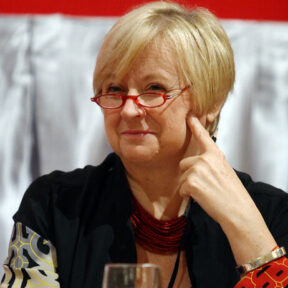
Frances Kissling
Overview
* President of Catholics for a Free Choice (now known as Catholics for Choice) from 1982 to 2007
* Former nun who is now an abortion-rights activist
* Co-founded the National Abortion Federation
* “The Catholic religion makes the fetus into an icon, a figure of religious veneration, which I think is sick, really sick.”
* Views the Catholic Church as an “unjust institution” with a highly “abusive nature” that victimizes children, nuns, homosexuals, independent thinkers, and women who have abortions
Born in 1943 and raised in a Polish working-class family in New York City, Frances Kissling attended Catholic school and, at age 19, joined a convent. She left after six months, however, due to disagreements she had with the Church’s prohibitions against divorce and birth control. Kissling then enrolled at the Manhattan-based New School, known for its progressive political orientation.
In the late 1960s, Kissling became an activist in the burgeoning women’s movement. Between 1970 and 1973, she directed two abortion clinics in New York State—the Pelham Medical Group (which performed some 250 abortions per week) and the Eastern Women’s Center (located in Manhattan).
Through a referral from Planned Parenthood, Kissling in 1973 received funding to promote access to abortion services for women overseas. Toward that end, she established and operated illegal abortion clinics in Mexico and Italy, majority-Catholic countries where abortion was still outlawed. Kissling also started the first legal abortion clinic in Austria.
In 1977 Kissling became the founding president of the National Abortion Federation (NAF), a position she would hold for three years. In 1982 she succeeded Patricia McMahon as president of Catholics For a Free Choice (now known as Catholics For Choice, or CFC), on whose board she had already served since 1978. At CFC, Kissling encouraged Catholic women to embrace abortion as a viable solution to the problem of unwanted pregnancies, and taught that Catholicism and abortion were not mutually exclusive.
Under Kissling’s leadership in 1984, CFC published a controversial full-page New York Times ad, avowing that “a diversity of opinions regarding abortion exists among committed Catholics.” “The ad had enormous impact,” said Kissling, in helping “the American people, particularly political leaders, to understand that the bishops did not speak for Catholics, and that Catholics could and did support the right to choose.” “I know with every ounce of my being,” Kissling said on a later occasion, “that you don’t have to agree with the positions of the Church on issues of abortion and contraception to be Catholic.”
According to Kissling, “The Catholic religion makes the fetus into an icon, a figure of religious veneration, which I think is sick, really sick.”1
Cognizant of the wide gulf between these positions and traditional Catholic teaching, Kissling said in 2002: “I spent 20 years looking for a government to overthrow without being thrown in jail. I finally found one in the Catholic Church.” That same year, Kissling launched a worldwide billboard campaign charging that the Catholic Church, because of its opposition to contraception, was partially to blame for Africa’s AIDS epidemic.
In 2007–08, Kissling was a fellow in the Radcliffe Institute Fellowship Program. During her residency there, she wrote the book, How to Think about Abortion: Pro-choice Reflections on Rights and Responsibility.
Resolutely committed to lobbying for laws that would permit public funding for abortion, Kissling, at an October 2010 Princeton University conference on abortion, said: “I don’t care how you accomplish it [the right to abortion], whether through a constitution, the UN, state laws or federal laws, or by the Taliban.”
In Kissling’s view, the Catholic Church has become, “in many ways,” an “unjust institution” with a highly “abusive nature” that victimizes children, nuns, homosexuals, independent thinkers, and women who have abortions. Notwithstanding her sharp differences with the Church, however, Kissling has no plans to leave the faith. “I’m so Catholic, I can’t get away from it,” she said in 2007. “How I construct concepts of life, of justice, it all comes out of being Catholic.”
Kissling is currently a visiting scholar at the University of Pennsylvania Center for Bioethics. She regularly contributes articles to The Nation and the Huffington Post.
For additional information on Frances Kissling, click here.
NOTE:
1 By Kissling’s reckoning, “If you carefully examine your conscience and then decide that an abortion is the most moral act you can do at this time, you are not committing a sin. Therefore, you are not excommunicated. Nor need you tell it in confession since, in your case, abortion is not a sin.”