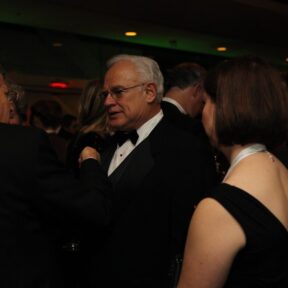
Larry Schweiger
: Photo from Wikimedia Commons / Author of Photo: nationalwildlife.federationOverview
* President of the National Wildlife Federation
* Board member of the Alliance for Climate Protection
* Emphasizes the urgent need for comprehensive energy legislation to address the “climate crisis” sparked by “unchecked global warming”
Larry Schweiger was born in Pittsburgh, Pennsylvania in 1950. After earning a degree in forestry from Penn State University, where he was a campus activist for a number of clean-air and clean-water campaigns, he spent ten years working for the Joint Legislative Air and Water Pollution Control and Conservation Committee — as a field representative from 1971-78, and as Executive Director from 1979-81.
From 1981-95, Schweiger held various positions — Regional Executive, VP for Affiliates, and Senior VP for Conservation — at the National Wildlife Federation (NWF); he also published the magazines that NWF produced during that period.
From June 1995 through June of ’96, Schweiger was the first Vice President of the newly formed Chesapeake Bay Foundation. Also in the Nineties, he served as Executive Secretary of the Joint House/Senate Conservation Committee for the Pennsylvania General Assembly. And from June 1996 to April 2004, he was President/CEO of the Western Pennsylvania Conservancy. Then, when Mark Van Putten resigned as President and CEO of the National Wildlife Federation in 2004, Schweiger succeeded him in both of those positions. He stayed with NWF until 2014. During part of that decade as well, Schweiger was a board member at both the Climate Reality Project and the Alliance for Climate Protection.
In 2009 Schweiger published Last Chance, a book examining the science behind “climate change,” which the author views as a by-product of the carbon emissions associated with human industrial activity, and calling for the establishment of a “clean energy economy.”
On March 25, 2009, Schweiger testified before the House Energy and Commerce Subcommittee on Energy and Environment, where he emphasized the urgent need to address the “climate crisis” that had been set in motion by “unchecked global warming.” Toward that end, he exhorted Congress to immediately “cap global warming pollution” by means of cap-and-trade legislation, and to continue mandating additional carbon reductions far into the future. On the premise that “reducing carbon pollution in the atmosphere is the only way to head off the worst impacts of climate change on people and on wildlife,” Schweiger suggested that the government revenues generated by cap-and-trade should be used “to carry out a program that is clean, green, and fair.” “Clean,” in Schweiger’s telling, meant “clean energy technologies” such as wind and solar; “green” referred to “large-scale dedicated funding to protect our nation’s wildlife and other natural resources from climate change”; and “fair” meant that the U.S. should “particularly help those who are most vulnerable around the world.” The latter point stemmed from the notion that the polluting activities of industrialized nations had contributed heavily to climate change, which in turn was affecting poor countries most adversely. Those impoverished populations, Schweiger reasoned, should be compensated in some way for the climate-related hardships they had been forced to endure. Moreover, he warned that “in the lifetime of a child born today, 20 to 30 percent of the world’s plant and animal species will be on the brink of extinction if we don’t take action now.”
After leaving NWF in 2014, Schweiger remained active as a writer and public speaker on environmental issues. In November 2016, for instance, he lauded the recently signed Paris Climate Accord as a measure that could effectively “reduce greenhouse emissions, help countries adapt to wrenching changes brought about by a warming climate, and finance projects in developing nations that repair [or] … avoid the vast damages caused by dangerous climate change.” But the newly elected U.S. President, Donald Trump, Schweiger lamented, “has vowed to pull the United States out of this historic agreement,” a move that “would be a tragedy for our country and our families.”
In a March 2017 piece titled “President Trump’s Real Environmental Agenda,” Schweiger complained that “the first Trump budget will cut the Environmental Protection Agency’s [budget] by more than 20 percent.” The President’s aim, said Schweiger, was to “systematically destroy” the EPA and other regulatory agencies for the purpose of “unleashing corporate predation with a wrecking ball” and “letting polluters do whatever they want, whenever and wherever they want, regardless of their impact on our environment or the direct harm it inflicts on American communities.” “[Trump is] plotting the elimination of the very rules that citizens need to constrain runaway greed or halt corporate and bank malfeasance that crashed our economy in 2008,” Schweiger added. “Little wonder that the stock market has been going wild since the election: the speculators and the barons of polluting industry will be free at last.”
In addition to his aforementioned affiliations, Schweiger has also been a Board of Directors member with the Blue Green Alliance, the National Wildlife Federation Action Fund, and the John Heinz Center for Science, Economics & the Environment. Further, he served on the Global Advisory Committee of the Earth Day Network.
For additional information on Larry Schweiger, click here.
Further Reading: “Larry Schweiger” (LinkedIn.com, NACWConference.com, Climate Reality Project, SunValleyInstitute.org, Sourcewatch.org); “Former Franklin Twp. Man Leads Life of Conservation” (Ellwood City Ledger, 6-26-2018); “The Paris Climate Accord: Too Little Too Late or an Important First Step?” (by Larry Schweiger, 11-16-2016); “President Trump’s Real Environmental Agenda” (by Larry Schweiger, 3-6-2017).