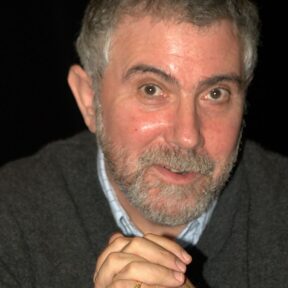
Paul Krugman
: Photo from Wikimedia Commons / Author of Photo: ShankboneOverview
* New York Times columnist
* Keynesian economist
* Former Princeton University economics professor
* Became a professor in the PhD program of economics at the City University of New York
Overview
Paul Robin Krugman was born on February 28, 1953 in Albany, New York and was raised in Nassau County. He graduated from Yale University in 1974 and went on to earn a Ph.D. in economics from the Massachusetts Institute of Technology (MIT) in 1977.
Krugman joined MIT’s faculty in 1979 and taught there until 1982, at which time he took a leave of absence in order to serve as a chief staffer for President Ronald Reagan’s Council of Economic Advisors. Unlike Reagan, however, Krugman believed (and continues to maintain) that free trade has more to do with ideology than with economic efficiency.
Indeed, Newsweek magazine once described Krugman as “a European Social Democrat” who was “brought up to worship the New Deal.” Krugman, for his part, identifies himself as an “unabashed defender of the welfare state” and “a Keynesian” economist. (Keynesian economic theory, named after the late British economist John Maynard Keynes, postulates that: [a] the federal government is best equipped to reverse or minimize economic downturns, either by increasing the overall money supply or bankrolling public-sector programs in order to stimulate money exchange; and [b] the Federal Reserve should keep interest rates as low as possible in order to provide low-cost funding for the government, even as the latter engages in deficit-spending and accumulates debt.)
Krugman returned to MIT as a full professor in 1984 and held that post for ten years. He subsequently taught at Stanford University (1994-96), Yale (briefly), and MIT (1996-2000) before joining the faculty of Princeton, where he was employed from 2000 until 2015 — at which time he attained the title of “Professor Emeritus.” After retiring from Princeton in 2015, Krugman became a professor in the PhD program of economics at the Graduate Center of the City University of New York, and a distinguished scholar at the Graduate Center’s Luxembourg Income Study Center.
Krugman also served as a Centenary Professor at the London School of Economics; he was president of the Eastern Economic Association in 2010; and he has authored or edited 23 books as well as 200-plus professional journal articles, many of them on international trade and finance. Krugman today is best known as an op-ed columnist for The New York Times, a job he has held since January 2000. As of December 2020, Krugman was the 37th-most-cited economist in the world. In recognition of his influence, The Washington Monthly has called him “the most important political columnist in America.”
Krugman ‘s Economics and Politics
As one of the founders of the “new trade theory” in international economics, Krugman won the American Economic Association’s 1991 John Bates Clark medal, a prize given to “that economist under forty who is adjudged to have made a significant contribution to economic knowledge.” His academic research at the time was focused on economic and currency crises.
During the 1990s, Krugman wrote books whose popularity reached beyond academe. In 1994, for instance, he published Peddling Prosperity: Economic Sense and Nonsense in the Age of Diminished Expectation—a book that, while unfriendly to conservative “supply-side” economics and its commitment to cutting taxes and regulation, nonetheless acknowledged its merits. Krugman conceded, for instance, that “conservatives” had “made a strong case that the distortions of incentives associated with taxes were larger than most economists had previously realized.” No friend of deregulation, Krugman nonetheless admitted that Democratic administrations, no less than their Republican counterparts, had made it a matter of policy – and moreover that the policy had its successes. Thus he noted that the “extensive deregulation of the oil, airline and trucking industry began under Jimmy Carter,” and that “[m]ost economists count these deregulations as a success.”
In the nineties as well, Krugman wrote: The Self-Organizing Economy (1995); Pop Internationalism (1996); and The Accidental Theorist: And Other Dispatches from the Dismal Science (1998).
By 1998 Krugman was also writing monthly columns for Fortune magazine and the online periodical Slate.
That same year, Krugman predicted that the Internet would be mostly a non-factor in America’s economic future, writing: “The growth of the Internet will slow drastically, as the flaw in ‘Metcalfe’s law’ becomes apparent: most people have nothing to say to each other! By 2005, it will become clear that the Internet’s impact on the economy has been no greater than the fax machine’s.”
When he first began writing for a non-academic audience, Krugman did not hesitate to argue with Democrats and their ideological allies. For instance, after having initially endorsed the Bill Clinton administration’s economic plan, Krugman later derided its “dominant ideology” as “foolish” for allegedly preferring “policy entrepreneurs to real experts”—a thinly veiled dig at future Clinton Labor Secretary Robert Reich. In Krugman’s own estimation, such candor cost him an opportunity to chair Clinton’s Council of Economic Advisors.
In 1999 Krugman was part of an Enron Corporation board that paid him $50,000. That same year, as journalist Andrew Sullivan reported, Krugman wrote an article praising Enron’s free-wheeling entrepreneurial structure. (Enron would later collapse amid scandal and charges of financial wrongdoing. Thereafter distancing himself from the disgraced company, Krugman in a 2001 column would describe the aforementioned board as “an advisory panel that had no function that I was aware of.”)
As noted above, in January 2000 Krugman became a columnist for the opinion pages of The New York Times. With the election of President George W. Bush that November, Krugman’s writing underwent a dramatic transformation. His Times columns now became bitter screeds against the Bush administration’s “hard right turn,” “America’s radical right-wing media,” and conservatives generally. “Yes, Virginia,” Krugman insisted, in all seriousness, “there is a right-wing conspiracy. It’s not even especially hidden: anyone with a modem and spare time can inform himself about the network of institutions that systematically harass prominent liberals and bully news sources that don’t toe the line.” Reveling in his new role as a scourge of conservatives, Krugman wrote in 2004: “If I have ended up more often than not writing pieces that attack the right wing, it’s because the right wing now rules—and rules badly.” Since the very start of the Bush administration, he had been blaming virtually every negative economic or political development on the President and Republicans.
During California’s energy crisis in 2001, for example, Krugman blasted the Bush administration for its failure to impose price caps through the Federal Energy Regulatory Commission (FERC). At no point did he see it fit to mention that the Clinton administration, under the influence of its own economic advisors, had similarly resisted doing so.
Three days after the 9/11/2001 terrorist attacks on the World Trade Center and the Pentagon, Krugman wrote: “Ghastly as it may seem to say this, the terror attack—like the original day of infamy, which brought an end to the Great Depression—could do some economic good.” To make this case, he explained that rebuilding the destruction in New York and Washington would stimulate the U.S. economy through business investment and job creation. As economist Walter E. Williams subsequently observed: “[E]xtending [Krugman’s] logic, the terrorists would have made an even larger contribution to our economic well-being had they been able to fly a plane into the White House and destroyed buildings in other cities.”
Throughout the 2000s, Krugman repeatedly criticized the Bush-era tax cuts, both before and after they were enacted, as measures predestined to enlarge America’s budget deficit, enrich the wealthy, increase income inequality, and do nothing to help the overall economy. He advocated more government spending on infrastructure and unemployment benefits, arguing that the stimulus effect of such policies would, unlike permanent tax cuts, increase the budget deficit only temporarily. “Slashing spending in the midst of a depression, which deepens that depression and paves the way for deflation, is actually self-defeating,” he wrote.
Krugman’s overt contempt for President Bush in the early 2000s was obvious to outsiders. For example, a November 13, 2003 article appearing in The Economist stated: “A glance through his past columns reveals a growing tendency to attribute all the world’s ills to George Bush…. Even his economics is sometimes stretched…. Overall, the effect is to give lay readers the illusion that Mr. Krugman’s perfectly respectable personal political beliefs can somehow be derived empirically from economic theory.”
In 2004 Krugman claimed that job projections by the Bush administration’s Council of Economic Advisors were exemplary of what happens when “political propaganda takes the place of professional analysis.” But in fact, as economist Alex Tabarrok showed, it was Krugman himself who had allowed politics to distort his analysis. So flagrant were Krugman’s distortions, that in May 2005, former Times ombudsman Daniel Okrent was moved to vent his exasperation in a farewell column for the paper. Warning that “Paul Krugman has the disturbing habit of shaping, slicing and selectively citing numbers in a fashion that pleases his acolytes but leaves him open to substantive assaults,” Okrent urged publisher Arthur Sulzberger, Jr. to “hold his columnists to higher standards.”
Krugman, in his own defense, claimed political neutrality, observing that he had critics on both sides of the ideological spectrum. “These days I often find myself accused of being a knee-jerk liberal, even a socialist,” he wrote in his 2003 book The Great Unraveling: Losing Our Way in the New Century. “But just a few years ago the real knee-jerk liberals didn’t like me at all—one magazine even devoted a cover story to an attack on me for my pro-capitalist views, and I still have the angry letter Ralph Nader sent me when I criticized his attacks on globalization.”
On numerous occasions in the early 2000s, Krugman advocated the creation of a housing bubble. Such bubbles are generally brought about by a combination of very low interest rates and a loosening of credit-underwriting standards — measures designed to bring borrowers into the market and thereby fuel demand. To view several examples of Krugman promoting such a strategy in 2001, click here. A 2002 editorial by Krugman put it bluntly: “To fight this recession, the Fed needs more than a snapback; it needs soaring household spending to offset moribund business investment. And to do that, as Paul McCulley of PIMCO Investment Management Company put it, Alan Greenspan needs to create a housing bubble to replace the Nasdaq bubble.”
When a housing bubble ultimately led to the 2008 financial crisis, the reflexive partisanship of Krugman’s response to the calamity was typical of his work during this period. While conceding that President Bush’s policies could not be held entirely responsible, he nonetheless assured his readers that much of the blame should be heaped on an “administration whose philosophy of government can be summed up as ‘private good, public bad,’ which must have made it hard to face up to the need for partial government ownership of the financial sector.” Krugman did not mention that one of the first steps taken by the ostensibly privatization-obsessed Bush administration was to announce the largest government bailout of the private sector in American history, complete with a government takeover of the mortgage giants Fannie Mae and Freddie Mac, at a price tag of over $700 billion.
Krugman’s penchant for blaming the Bush administration for the alleged horrors of deregulation was all the more curious given his previous recognition that similar policies had been implemented by Democratic presidents. Expunged from his columns during the Bush years was any mention of the deregulation that had taken place under the Carter administration, or the Clinton administration’s partial repeal of the 1933 Glass-Steagall Act, which deregulated the banking industry. “Whenever Democrats were in charge he [Krugman] thinks it was a golden age,” observed William Anderson, a professor of economics at Frostburg State University. “[Economists are] supposed to provide dispassionate analysis. What we get from Krugman is partisan shilling.”
In January 2008, economist Daniel Stein published a comprehensive critique of Krugman based on an analysis of his columns from 1997 to 2006. Stein found that Krugman, despite his professed admiration of the free-market, had routinely favored government intervention and increased regulation. Aside from a single column opposing rent-control and agricultural subsidies, Krugman’s support for the free market was nowhere in evidence. Beyond that, Klein found that Krugman now approached economics through a “liberal-versus-conservative” mentality, and there was no doubt about where Krugman’s allegiances lay.
A corollary of Krugman’s antipathy for free markets is his firm belief that the greenhouse-gas emissions produced by human industrial activity in capitalist economies contribute greatly to the potentially catastrophic phenomenon of climate change, about which, he says, “97 to 98 per cent of scientists” agree. “Serious people are and should be deeply worried, indeed horrified, by the lack of action on greenhouse gases,” says Krugman, because “each year [that] we fail to act” by cutting carbon-dioxide emissions “has more or less irreversible physical consequences.” The major problem, Krugman maintains, is that “people commit limited resources to the wrong technologies, especially coal-fired power plants instead of wind, solar, conservation, whatever.”
In 2007 Krugman published The Conscience of a Liberal, whose title referred to Barry Goldwater’s Conscience of a Conservative. Describing how the income gap between the rich and poor in America had declined greatly in middle of the 20th century and then widened in the 1990s and 2000s, Krugman’s book criticized the Bush administration for implementing policies that, by the author’s reckoning, had increased economic inequality. Despite advances in technology and medicine, wrote Krugman, most people were worse off in 2007 than they had been in the early 1970s: “[I]n some crucial ways, things have not made progress… People aren’t nearly as much better off as they would be if the gains from economic growth had been broadly distributed.”
To address the economic inequality that he abjured, Krugman proposed a “new New Deal” which called for greater expenditures on social and medical programs, and fewer outlays for national defense. Consistent with this objective, he lauded President Franklin Roosevelt’s original New Deal policies for creating “a more equitable distribution of income” and “a healthier climate for democracy” by, among other things, dictating wages to the private sector and imposing higher taxes on the wealthy. “The era of equality was also a time of unprecedented prosperity, which we have never been able to recapture,” wrote Krugman. “Middle-class societies don’t emerge automatically as an economy matures; they have to be created through political action.”
Krugman also argued that Republicans owed their electoral successes to their ability to promote racial divisions and thereby win political dominance of the South. This “Southern Strategy,” he said, was designed to “signal sympathy” for racism without saying anything overtly racist. Identifying former President Ronald Reagan as one of the most effective practitioners of the “strategy,” Krugman cited:
- Reagan’s 1980 assertion that the Voting Rights Act had been “humiliating to the South”;
- Reagan’s firing of three members of the U.S. Civil Rights Commission, a move that, by Krugman’s calculus, was “intended as a gesture of support to Southern whites”;
- Reagan’s use of the term “welfare queen,” allegedly to conjure images of unwed black mothers; and
- Reagan’s reference to a “strapping young buck”—a term which, according to Krugman, generally causes “whites in the South” to think of “a large black man”—using food stamps to buy T-bone steaks at a grocery store.
Wrote Krugman: “The changing politics of race made it possible for a revived conservative movement, whose ultimate goal was to reverse the achievements of the New Deal, to win national elections—even though it supported policies that favored the interests of a narrow elite over those of middle- and lower-income Americans.” [Note: The scholar and bestselling author Dinesh D’Souza has thoroughly debunked the notion that Nixon employed a “Southern Strategy” to get elected.]
In October 2008 Krugman won the Nobel Memorial Prize in Economic Sciences for his “analysis of trade patterns and location of economic activity.” Along with the honor came a monetary prize of $1.4 million.
Between approximately 2008 and 2010, Krugman was a member of JournoList, an online listserve consisting of some 400 self-described liberals—mostly journalists, but also some professors and political activists. Formed in 2007, JournoList functioned essentially as a secret society of email communications, where members could compare sources, share information, discuss their thoughts on current events, and coordinate the way they reported on certain stories. These were generally coordinated to cast Barack Obama and the Democrats in a favorable light, while portraying the Republican Party in unflattering tones.
When President Obama signed into law a $787 billion stimulus bill in February 2009, Krugman criticized the plan for being too small and “inadequate” given the size of the U.S. economy. “It just wasn’t big enough to do the job,” he later lamented.
In November 2009, Krugman, in anticipation of President Obama’s Jobs Summit the following month, said in an interview:
“This jobs summit can’t be an empty exercise…. He [Obama] can’t come out with a proposal for ten or twenty billion [dollars] of stuff because people will view that as a joke. There has to be a significant proposal. If I had my druthers, if there were no limits politically, I’d say let’s just have a really massive second stimulus plan to get the economy going … I have in mind something like $300 billion.”
A proponent of government-run, “universal health care system,” Krugman has condemned “conservative opposition to giving every child in this country access to health care” as being “indefensible” and, “in a fundamental sense, un-American.” During the debate about healthcare reform in 2009-10, he angrily denounced former Alaska Governor Sarah Palin for suggesting that under the provisions of the so-called “Obamacare” reforms which Democrats were pursuing, seriously ill patients “will have to stand in front of Obama’s ‘death panel’ so his bureaucrats can decide, based on a subjective judgment of their ‘level of productivity in society,’ whether they are worthy of health care.” But in a November 2010 interview on ABC’s This Week, Krugman himself actually endorsed the very policy that Palin had warned about. Indeed, Krugman lamented that a recent deficit-reduction panel had not been “brave enough” to promote the use of expert panels authorized to determine—on the basis of budgetary considerations—which patients were eligible (or ineligible) for various medical services. Added Krugman:
“Medicare is going to have to decide what it’s going to pay for,” “and at least for starters it’s going to have to decide which medical procedures are not effective at all and should not be paid for at all. Some years down the pike we’re going to get the real solution which is going to be a combination of death panels and sales taxes. It’s going to be that we’re actually going to take Medicare under control and we’re going to have to get some additional revenue, probably from a VAT [value-added tax].”
When addressing “the inequality of our current [economic] system,” Krugman’s solutions generally involve government intervention rather than the free market. Conservatives, he says, “seem to prefer a society in which your station in life is largely determined by that of your parents—and in which the children of the very rich get to inherit their estates tax-free.”
In early 2012, Krugman praised the anti-capitalist Occupy Wall Street movement for having “shifted” America’s national “conversation” to a discussion about economic inequality, and thus having “done a great service” for the country.
In June 2012 Krugman delivered a keynote speech at a Netroots Nation convention in Providence, Rhode Island.
Lucrative Job, with Few Responsibilities, at CUNY
In April 2014 the New York Post reported that starting in the 2015-16 academic year, the Luxembourg Income Study [LIS] Center at the City University of New York (CUNY) would be paying Krugman $25,000 per month to serve as a “distinguished scholar”—and that Krugman would not be required to teach any courses during that initial year. Said CUNY in a letter to Krugman: “As a distinguished professor in the Ph.D. program in economics, your nine-month salary will be $225,000. During year one (2015-2016), you will not be expected to teach or supervise students. Instead, you will be asked to contribute to our build-up of LIS and the inequality initiative and to play a modest role in our public events.” The letter then indicated that in year two and thereafter, Krugman would be expected to teach one seminar per year. The CUNY deal also provided Krugman with a graduate assistant, an annual research/travel fund of $10,000, and up to $10,000 in moving expenses.
Krugman’s Contempt for Republicans and Conservatives
Krugman’s view of Republicans and conservatives as hate mongers has been on display many times over the years. For instance, on January 9, 2011—the day after a gunman named Jared Loughner had killed six people and gravely wounded Congresswoman Gabrielle Giffords in Tucson, Arizona—Krugman wrote that “the rising tide of violence” in America was in large part a result of hate-filled, “toxic,” “eliminationist” rhetoric that was “coming, overwhelmingly, from the right.”
In March 2014, Krugman described House Budget Committee chairman Paul Ryan as “the G.O.P.’s de facto intellectual leader” and condemned his claim that persistent poverty was the result of a “culture, in our inner cities in particular, of men not working, and just generations of men not even thinking about working.” In Krugman’s estimation, Ryan’s statement was a “racial dog-whistle” designed to promote a “black-men-don’t-want-to-work theory of poverty.” Suggesting that Ryan’s opinions were emblematic of widespread conservative bigotry, Krugman wrote: “He [Ryan] said what he said because that’s the kind of thing conservatives say to each other all the time. And why do they say such things? Because American conservatism is still, after all these years, largely driven by claims that liberals are taking away your hard-earned money and giving it to Those People.”
On Election Night 2016, after Donald Trump had defeated Hillary Clinton for the U.S. presidency, a bitter Krugman characterized Trump’s supporters as racist misogynists: “We thought that the nation, while far from having transcended racial prejudice and misogyny, had become vastly more open and tolerant over time. It turns out that we were wrong. There turn out to be a huge number of people — white people, living mainly in rural areas — who don’t share at all our idea of what America is about. For them, it is about blood and soil, about traditional patriarchy and racial hierarchy.”
When Republicans in 2017 were proposing the so-called American Health Care Act as an alternative to Obamacare, Krugman described the “cruel and immoral” GOP bill as a “vampire policy” that would be remembered as “one of the worst, cruelest pieces of legislation in history.”
And amid Republican tax-reform efforts in November 2017, Krugman said: “This whole process involves a level of bad faith we haven’t seen in U.S. politics since the days when defenders of slavery physically assaulted their political foes on the Senate floor…. Just about every G.O.P. member of Congress, including the sainted John McCain, is willing to put partisan loyalty above principle, voting for what they have to know is terrible and irresponsible legislation.”
Krugman’s Contempt for Donald Trump
On January 16, 2017 — four days before Donald Trump’s inauguration as president — Krugman published a column titled “With All Due Disrespect,” in which he quoted, and agreed with, Democrat Rep. John Lewis‘ characterization of Trump as an illegitimate occupant of the Oval Office. Wrote Krugman: “But let’s not talk about Mr. Trump’s ravings. Instead, let’s ask whether Mr. Lewis was right to say what he said. Is it O.K., morally and politically, to declare the man about to move into the White House illegitimate? Yes, it is. In fact, it’s an act of patriotism…. [N]o previous U.S. president-elect has had less right to the title. So why shouldn’t we question his legitimacy?”
Predicting That a Trump Administration Will Lead America into Economic Recession
Just hours after Donald Trump’s victory in the 2016 presidential election, Krugman called the president-elect “the mother of all adverse effects,” writing:
“The disaster for America and the world has so many aspects that the economic ramifications are way down my list of things to fear. Still, I guess people want an answer: If the question is when markets will recover, a first-pass answer is never.
“Under any circumstances, putting an irresponsible, ignorant man who takes his advice from all the wrong people in charge of the nation with the world’s most important economy would be very bad news. What makes it especially bad right now, however, is the fundamentally fragile state much of the world is still in…. Now comes the mother of all adverse effects — and what it brings with it is a regime that will be ignorant of economic policy and hostile to any effort to make it work…. So we are very probably looking at a global recession, with no end in sight. I suppose we could get lucky somehow. But on economics, as on everything else, a terrible thing has just happened.”
“There Is No Immigration Crisis” in America
In a June 2018 article titled “The Return of the Blood Libel,” Krugman condemned President Trump’s effort to secure America’s southern border and stem the flow of illegal immigration. Charaterizing Trump’s policies as cruel and immoral, Krugman wrote:
- “The speed of America’s moral descent under Donald Trump is breathtaking. In a matter of months we’ve gone from a nation that stood for life, liberty and the pursuit of happiness to a nation that tears children from their parents and puts them in cages.”
- “The mass influx of murderers and rapists that Trump talks about, the wave of crime committed by immigrants here (and, in his mind, refugees in Germany), are things that simply aren’t happening. They’re just sick fantasies being used to justify real atrocities.”
- “[T]he important thing to understand is that the atrocities our nation [under Trump] is now committing at the border don’t represent an overreaction or poorly implemented response to some actual problem that needs solving. There is no immigration crisis.”
Krugman Falsely Claims That Democrats Did Not Call Trump an “Illegitimate” President After His 2016 Election
On November 30, 2020, Krugman wrote: “When Joe Biden is inaugurated, he will immediately be confronted with an unprecedented challenge — and I don’t mean the pandemic, although Covid-19 will almost surely be killing thousands of Americans every day. I mean, instead, that he’ll be the first modern U.S. president trying to govern in the face of an opposition that refuses to accept his legitimacy. And no, Democrats never said Donald Trump was illegitimate, just that he was incompetent and dangerous.”
Krugman’s claim was demonstrably false. Among the high-profile Democrats who openly and brazenly had called Trump “illegitimate” were John Lewis, Hillary Clinton, Jimmy Carter, Jerrold Nadler, and Joe Biden.[1]
Krugman Likens Trumpism to Nazism, & Calls for “De-MAGAfication”
On May 31, 2026, Krugman released a six-minute video in which he said “everybody knows that” President Trump was a “mentally ill,” “horrifying person” and “lunatic” who had “lost his mind” and was akin to a Nazi. “We need to obviously … defang Trump as much as possible and make sure that neither he nor anybody who follows in his footsteps has power after the next two elections,” Krugman declared. “But beyond that, we really need to do a thorough purging of the United States. We need a de-MAGAfication, and I am not going over the top by using a word that is very similar to the denazification that we pursued successfully after World War II in Germany.”
“If we don’t do something beyond just getting rid of Trump, it’s gonna happen again,” he concluded.
Additional Information
After retiring from Princeton in 2015, Krugman became a professor in the PhD program of economics at the Graduate Center of the City University of New York, and a distinguished scholar at the Graduate Center’s Luxembourg Income Study Center.
In addition to his professorial and literary pursuits, Paul Krugman is a fellow at the Econometric Society; a research associate at the National Bureau of Economic Research; and a member of the Group of Thirty — a private, nonprofit, international body composed of senior representatives of the private and public sectors and academia who seek to “deepen understanding of international economic and financial issues.”
Moreover, Krugman has served as a consultant to the Federal Reserve Bank of New York, the World Bank, the International Monetary Fund, the United Nations, and several countries including Portugal and the Philippines.
Further Reading: “Paul R. Krugman” (Pr.Princeton.edu); “Biography of Paul Krugman” (Pr.Princeton.edu); “About Paul Krugman” (KrugmanOnline.com).
Footnotes:
- Click on each name to view a source documenting the fact that the individual referrred to President Trump as “illegitimate”: John Lewis, Hillary Clinton, Jimmy Carter, Jerrold Nadler, and Joe Biden. To see videos of these individuals claiming that Trump was “illegitimate,” click here,