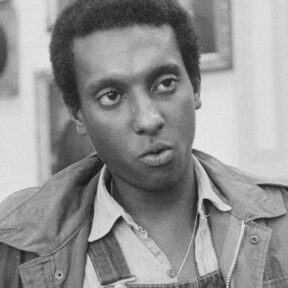
Stokely Carmichael (a.k.a. Kwame Ture)
: Photo from Wikimedia Commons / Author of Photo: unknownOverview
* Anti-Semitic, anti-white, black separatist
* Committed communist
* Leader of the Student Non-Violent Coordinating Committee in the 1960s
* Served as “prime minister” of the Black Panther Party from 1967-1969
* Popularized the slogan “Black Power”
* Advocated violence and bloodshed as methods for promoting black progress
* Identified Malcolm X, Che Guevara, and Mao Zedong as his three greatest heroes
* “The only good Zionist is a dead Zionist.”
* Died on November 15, 1998
Stokely Carmichael was born on June 29, 1941 in Port of Spain, Trinidad. He moved to New York when he was 11. In 1960 Carmichael enrolled at Howard University and became a leader of the school’s Non-Violent Action Group, a civil-rights organization. In 1961 he participated in a number of anti-segregation initiatives in the Deep South, including “freedom rides” organized by the Congress of Racial Equality. Carmichael graduated from Howard University in 1964, with a degree in philosophy. In the spring of 1966 he replaced the integrationist John Lewis as chairman of the Student Nonviolent Coordinating Committee (SNCC).
In June of that year, Carmichael made an impassioned speech on the topic of “Black Power” — a term that he greatly popularized, though it was not original to him. In that address, Carmichael railed against advocates of racial harmony, calling instead for black rage and militancy. He urged African Americans to “reject the old slogans and meaningless rhetoric” of “progress, non-violence, integration, [and] fear of ‘white backlash.’” He asserted that “the old language” of the civil-rights movement, which counseled “patience” and celebrated incremental “progress,” had become “irrelevant” in “this racist society.” Calls for “integration,” Carmichael added, were nothing more than “a subterfuge for the maintenance of white supremacy.” Ultimately, he defined Black Power as “a movement that will smash everything Western civilization has created.”[1]
In the mid-Sixties, Carmichael helped promote the slogan “Black is Beautiful” and the word “honkie” (as a derogatory term for whites, to parallel the epithet “ni**er”).
In 1966 Carmichael and SNCC expelled all of the organization’s white staff and volunteers, and they denounced those whites who had supported their cause in the past.
Increasingly a committed racial separatist, Carmichael claimed that blacks should pursue their own “national liberation” from the rest of the United States. He derided the integrationist Martin Luther King as an “Uncle Tom” (also “Uncle Martin“) and began advocating armed violence as his preferred means of promoting social justice. Carmichael’s speeches and public statements made frequent reference to “offing the pigs” and “killing the honkies.” In June 1966, he stated, “The Negro is going to take what he deserves from the white man.”[2]
Also in 1966, Carmichael organized the all-black Lowndes County Freedom Organization (in Alabama), which put him in contact with future members of the Black Panther Party. In 1967 he collaborated with Charles Hamilton to write the book Black Power.
In 1966 and 1967, Carmichael lectured on college campuses across the United States and traveled abroad to several countries, including North Vietnam, China, and Cuba. He told an audience in Havana: ”We are preparing groups of urban guerrillas for our defense in the cities. It is going to be a fight to the death.”[3]
During his tenure as SNCC chairman, Carmichael urged blacks to riot and thereby give white society “a little taste of chaos”; encouraged the use of dynamite to blow up business establishments; and expressed his hope that black U.S. soldiers stationed in Vietnam would someday return home and “kill in the streets” of America.[4]
In 1967 Carmichael revealed the deception that SNCC’s founders had used when deciding upon a name for their nascent organization seven years earlier:
“We used the name ‘nonviolent’ because at that time Martin Luther King was the central figure of the black struggle and he was still preaching nonviolence, and anyone who talked about violence at that time was considered treasonable—amounting—to treason, so we decided that we would use the name nonviolent, but in the meantime we knew our struggle was not about to be nonviolent, but we would just wait until the time was right for the actual [word indistinct] name.”[5]
In 1967 a Senate subcommittee asked Carmichael whether he had any knowledge of Communist Party USA attempts to infiltrate SNCC. He replied, “I will plead the Fifth [Amendment] on that.”[6]
In 1967 Carmichael asserted that “the [communist] system we like best is the Cuban,” and he identified his three greatest heroes as Malcolm X, Che Guevara, and Mao Zedong. Calling Guevara “an inspiration not only to black people inside the United States, but to the liberation struggle around the world,” Carmichael approvingly quoted the Cuban guerrilla leader’s declaration that “hatred is an element of the struggle, transforming [man] into an effective, violent, selective, and cold killing machine.”[7]
Carmichael had contempt for the U.S. Constitution. Derisively referencing the famous three-fifths compromise — which the Northern states supported for the purpose of minimizing the number of of Southern, pro-slavery legislators serving in Congress — he commonly said: “Constitu-, constitu — I can only say three-fifths of the word.”[8]
In 1967, Carmichael was succeeded as SNCC chairman by H. Rap Brown.
From 1967-1969, Carmichael served as prime minister of the Black Panther Party (BPP). He tried to persuade the Panthers to sever all their alliances with whites but failed; this tactical disagreement led to Carmichael’s expulsion from the party and a ritual beating by his former BPP comrades.
After Martin Luther King was killed in 1968, Carmichael told black Americans: “Go home and get your guns. When the white man comes he is coming to kill you. I don’t want any black blood in the street.”[9]
Some leaders of established civil-rights groups such as the NAACP, the National Urban League, and the Southern Christian Leadership Conference rejected Carmichael’s militant rhetoric in the 1960s as counterproductive.
In 1969 Carmichael moved (with his wife, Miriam Makeba) to the West African nation of Guinea, where he changed his name to Kwame Ture — in honor of Ghana’s former dictator Kwame Nkrumah and Guinea’s then-president Ahmed Sekou Toure — both of whom were communists. While in Guinea, Ture became President Toure’s aide and personal guest, living like a prince among the nation’s impoverished masses.
From his home base in Guinea, Ture traveled widely to promote the anti-American, socialist ideals of the All-African Peoples’ Revolutionary Party; he visited numerous American college campuses in an effort to recruit new members for the organization. ”Black power,” he said, ”can only be realized when there exists a unified socialist Africa.”[10]
Ture’s hatred for America was mirrored in his contempt for Jews and the State of Israel. In 1971, for instance, he wrote that “the only good Zionist is a dead Zionist.” He would repeat this phrase many times in ensuing years. In 1990 he told a University of Maryland audience that “Zionist pigs have been harassing us everywhere.” On another occasion, Ture said: “I’ve never admired a white man, but the greatest of them, to my mind, was Hitler.”[11]
In 1971 Ture published the book Stokely Speaks: Black Power Back to Pan-Africanism.
Ture had high regard for Black Panther Mark Essex, who in January 1973 went on a racially motivated shooting rampage that left nine people dead and thirteen others wounded. “We should study and learn from the actions of Brother Essex,” said Ture. “We should understand that Brother Essex carried our struggle to its next quantitative level, the level of science.”[12]
Two years after President Toure’s 1984 death, Ture was arrested by the new military regime and was charged with trying to overthrow the government. He spent three days in prison before being released.
Ture temporarily returned to the U.S. in the late 1980s to travel the country and lecture to college audiences on the allegedly ineradicable evils of whites, Jews, and American society at large. During this period, he rekindled his friendly affiliation with Louis Farrakhan and the Nation of Islam.
In April 1996, Ture referred to capitalism as “the enemy” of black Americans. This was a continuation of the position Ture had staked out three decades earlier, when he said: “We want to economically destroy capitalism because capitalism goes hand in hand with racism and exploitation.”[13]
In 1998, Ture was diagnosed with terminal prostate cancer — an illness he believed “was given to me by forces of American imperialism and others who conspired with them.” “In 1967,” said Ture, “U.S. imperialism was seriously planning to assassinate me. It still is, this time by an FBI-induced cancer, the latest in the white man’s arsenal of chemical and biological warfare …”[14]
On November 3, 1998, Ture reminisced, with pride, on his days as an antiwar activist in the 1960s — an era when, as he put it, blacks had said “‘Hell No, we won’t go’ to Vietnam, to fight against a people who never called us a nigger, and we didn’t go.” Ture further expressed his delight over the fact that “the heroic Vietnamese People, under the sterling example and leadership of the eternal Ho Chi Minh,” had been able to “defeat U.S. imperialism.” Finally, he predicted that “the people of Cuba and Libya, under the steadfast leadership of Fidel Castro and [Libyan President] [Muammar Qadhafi][47], will [likewise] be victorious.”[15]
Until the end of his life, Ture invariably answered his telephone with the greeting he had used for more than two decades: ”Ready for the revolution!”[16]
Ture died Conakry, Guinea on November 15, 1998 at the age of 57. He was mourned by many American leftists, including Louis Farrakhan, Maxine Waters and Jesse Jackson. “He was one of our generation who was determined to give his life to transforming America and Africa,” Jackson eulogized; “he rang the freedom bell in this century.”
Further Reading: “Stokely Carmichael” (African American Lives – pp. 141–142, Spartacus Educational); “Stokely Carmichael, A Philosopher Behind The Black Power Movement” (NPR.org, 3-10-2014); “Stokely Carmichael … Dies at 57” (NY Times, 11-16-1998); “Stokely Carmichael and SNCC” (AAVW.org).
Footnotes:
- “Stokely Carmichael” (African American Lives – pp. 141–142).
- Years of Discord: American Politics and Society, 1961-1974 (by John Morton Blum, p. 258); “Stokely Carmichael” (African American Lives – pp. 141–142).
- “‘We Must Destroy the Capitalistic System Which Enslaves Us’: Stokely Carmichael Advocates Black Revolution” (History Matters).
- “Stokely Carmichael and SNCC” (AAVW.org).
- “‘We Must Destroy the Capitalistic System Which Enslaves Us’: Stokely Carmichael Advocates Black Revolution” (History Matters).
- Ibid.
- Ibid.
- “Senator Cory Booker Talks up Farrakhan” (by Daniel Greenfield, 6-23-2019).
- “Senator Booker Quotes Violent Racist Who Urged Murder of Jews, White People” (by Daniel Greenfield, 9-28-2018).
- “Stokely Carmichael … Dies at 57” (NY Times, 11-16-1998)
- “Stokely Carmichael” (African American Lives – pp. 141–142,); “Anti-Zionism As Anti-Semitism” (Jewish Virtual Library); “Senator Cory Booker and ‘The Only Good Zionist is a Dead Zionist’” (by Daniel Greenfield, 9-16-2018); “Senator Cory Booker Talks up Farrakhan” (by Daniel Greenfield, 6-23-2019).
- “Senator Booker Quotes Violent Racist Who Urged Murder of Jews, White People” (by Daniel Greenfield, 9-28-2018).
- “Conversations/Kwame Ture; Formerly Stokely Carmichael And Still Ready for the Revolution” (NY Times, 4-14-1996); “‘We Must Destroy the Capitalistic System Which Enslaves Us’: Stokely Carmichael Advocates Black Revolution” (History Matters).
- “Stokely Carmichael … Dies at 57” (NY Times, 11-16-1998); “Kwame Ture, 1941-1998” (BlackPast, 8-15-2018).
- “Stokely Carmichael aka Kwame Ture” (NewBlackPantherParty.blogspot.com).
- “Stokely Carmichael … Dies at 57” (NY Times, 11-16-1998).
Additional Resources:
Stokely Carmichael, Rights Leader Who Coined ‘Black Power,’ Dies at 57
By November 16, 1998