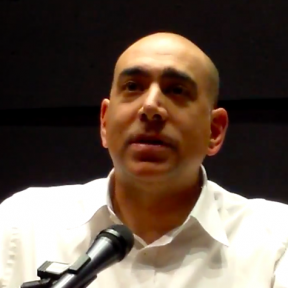
Ali Abunimah
: Photo from Wikimedia Commons / Author of Photo: Northampton Community TelevisionOverview
* Former board member of the Arab American Action Network
* Anti-Israeli activist
* Co-founder of the website Electronic Intifada
Born in Washington, D.C. on December 29, 1971, Ali Abunimah is a Palestinian-American graduate of Princeton University and the University of Chicago. A former board-of-directors member (and vice president) of the Arab American Action Network, he co-founded the Electronic Intifada website in 2001. Abunimah’s writings are fiercely hostile toward Israel and the United States. Indeed, he has accused Israel of harvesting the organs of Palestinian children and has openly advocated violent attacks against Israelis.
In a February 2002 article titled “U.S. Approach Hurts All Parties,” Abunimah wrote that Palestinian terrorism was merely a reaction to Israel’s “land confiscation,” its “ongoing orgy of violence,” and its “routine human-rights abuses” that have “made [Palestinian] life under a seemingly endless occupation so intolerable.” He characterized “Israel’s humiliation and virtual imprisonment of [Yasser] Arafat” — after the Palestinian leader had failed to prevent a host of recent suicide bombings against Israeli civilians — as confirmation that then-Israeli Prime Minister Ariel Sharon and his supporters had “never given up the dream of a Greater Israel stretching from the Mediterrannean to the Jordan River and perhaps beyond.”
In a March 2003 piece titled “We Almost Stopped the War,” Abunimah condemned America’s invasion of Iraq as a “massive assault on a small, defenseless country by an uncontrollable superpower” whose armed forces were “disproportionately composed of the economically and socially disenfranchised, people who, denied a slice of the ‘American dream’ at home by failing schools, racism, the prison industry, and growing economic inequality, must seek to escape by joining the military.”
In 2006 Abunimah authored the book One Country: A Bold Proposal to End the Israeli-Palestinian Conflict, which rejects a two-state solution for the Mideast conflict and proposes instead the creation of a single, united, Arab-majority state for Israelis and Palestinians alike. He has echoed this theme many times since then. For example:
- Asserting that “coercion is necessary” for the implementation of his one-state solution, Abunimah, in a November 2009 article titled “Israeli Jews and the One-State Solution,” dismissed Jewish concerns about living under an Arab majority as “irrational, racist fears of black and brown hordes (in this case, Arab Muslims) stoked by decades of colonial, racist demonization.” “Without indulging Israeli racism or preserving undue privilege,” he added, “the legitimate concerns of ordinary Israeli Jews can be addressed directly in any negotiated transition to ensure that the shift to democracy is orderly, and essential redistributive policies are carried out fairly.”
- Nine years later, at the annual conference of the Washington, D.C.-based Palestine Center in November 2018, Abunimah called on those in attendance to “stop this sterile discourse of a Palestinian state and two-state solution, and peace process and all of this kind of nonsense.” “Our peace plan,” he explained, would mean the “end of Zionist colonialism.”
In a January 2009 piece titled “Why Israel Won’t Survive,” Abunimah accused Israel of practicing “apartheid,” “ethnic cleansing,” and “attempted genocide” against the Palestinians. “Israel’s problem,” he wrote, “is not, as its propaganda insists, ‘terrorism’ to be defeated by sufficient application of high explosives.” Rather, “its problem is legitimacy, or rather a profound and irreversible lack of it.… Israel simply cannot bomb its way to legitimacy.” In the same article, Abunimah characterized Gaza as a “giant concentration camp,” and he asserted that “the Nazi Holocaust” had been “long deployed by Zionists to silence Israel’s critics.”
In a series of tweets in 2010, Abunimah characterized Gaza as a “ghetto for surplus non-Jews,” likened the Israeli press to the Nazi propaganda publication Der Sturmer, and claimed that “supporting Zionism” represents the Holocaust’s “continuation in spirit.”
In January 2012 he tweeted, “Isn’t it the time for a popular Palestinian revolution in the form of a third intifada?”
A strong supporter of the Hamas-inspired Boycott, Divestment and Sanctions (BDS) movement, Abunimah was the keynote speaker at a BDS conference at the University of Pennsylvania in 2012.
Charging that Israel was “using snipers to murder children in cold blood,” Abunimah condemned Israeli self-defense measures against Gaza-based Palestinians terrorists who attempted to breach Israel’s security barrier during the so-called “March of Return” in the spring of 2018. The purpose of that “March” was to promote the “right of return” for the millions of Palestinian people descended from the nearly 750,000 Arab refugees from Israel’s 1948 war of independence.[1]
Abunimah has a history of significant ties to Barack Obama, whom he first met in the late 1990s when Obama was an Illinois state senator. All told, Abunimah claimed in 2007 to have met Obama “about half a dozen times” over the years, “often at Palestinian and Arab-American community events in Chicago,” which Obama used to attend “all the time.” For instance, Abunimah crossed paths with Obama at a May 1998 community fundraiser at which Edward Said was the keynote speaker; at a 1999 fundraiser for a West Bank community center where Abunimah himself personally introduced Obama; and at a 2000 congressional campaign fundraiser (for Obama) at the home of pro-PLO professor Rashid Khalidi.[2]
At these events, says Abunimah, Obama was “forthright in his criticism of U.S. policy and his call for an even-handed approach to the Palestinian-Israeli conflict”; “critical of U.S. bias toward Israel and lack of sensitivity to Arabs”; “very supportive of U.S. pressure on Israel”; “very comfortable speaking up for and being associated with Palestinian rights and opposing the Israeli occupation”; and “quite frank that the U.S. needed to be more evenhanded, that it leaned too much toward Israel.” By Abunimah’s reckoning, Obama’s comments “were the kind of statements I’d never heard from a U.S. politician who seemed like he was going somewhere, rather than at the end of his career.” “He [Obama] impressed me as progressive, intelligent and charismatic,” Abunimah recalls. “I distinctly remember thinking, ‘if only a man of this caliber could become president one day.’”[3]
In 2001 and 2002, Abunimah’s Arab American Action Network received $75,000 in grants from the Woods Fund of Chicago, on whose board of directors Obama sat.
In a March 2007 article titled “How Barack Obama learned to love Israel,” Abunimah reported that the last time he had spoken to Obama was at a gathering in Chicago’s Hyde Park neighborhood three years earlier, when Obama was in the midst of a primary campaign to secure the Democratic nomination for a U.S. Senate seat. Wrote Abunimah: “I went up to greet him. He responded warmly, and volunteered, ‘Hey, I’m sorry I haven’t said more about Palestine right now, but we are in a tough primary race. I’m hoping when things calm down I can be more up front.’ He referred to my activism, including columns I was contributing to the The Chicago Tribune critical of Israeli and U.S. policy, ‘Keep up the good work!’” In the same piece, however, Abunimah alleged, with displeasure, that Obama’s rhetoric had become less overtly critical of Israel in recent years: “If disappointing, given his historically close relations to Palestinian-Americans, Obama’s about-face is not surprising. He is merely doing what he thinks is necessary to get elected [president] and he will continue doing it as long as it keeps him in power.”
Further Reading: “Ali Abunimah” (AFSC.org); “U.S. Approach Hurts All Parties” (by Ali Abunimah, 2-3-2002); “We Almost Stopped the War” (by Ali Abunimah, 3-22-2003); “Israeli Jews and the One-State Solution” (by Ali Abunimah, 11-10-2009); “DC [Palestine Center] Conference Declares Eternal War on Israel” (Jihad Watch, 11-28-2018); “Why Israel Won’t Survive” (by Ali Abunimah, 1-19-2009); “BDS Conference at Penn Met My Worst Expectations” (JWeekly.com, 2-10-2012); How Barack Obama Learned to Love Israel” (by Ali Abunimah, 3-4-2007).
Footnotes:
- “DC Conference Declares Eternal War on Israel” (Jihad Watch, 11-28-2018); “Exposed: More Palestinian ‘Victims’ Identified as Terror Org Members” (HonestReporting.com, 4-5-2018); “How Gaza Protesters Attempted to Breach the Border Fence” (Jerusalem Post, 5-15-2018).
- “How Barack Obama Learned to Love Israel” (by Ali Abunimah, 3-4-2007); “Where Do the Presidential Contenders Stand on the Israeli-Palestinian Conflict?” (Democracy Now!, 1-24-2008); “Pro-Palestinian-in-Chief” (National Review, 5-26-2011).
- “How Barack Obama Learned to Love Israel” (by Ali Abunimah, 3-4-2007); “Pro-Palestinian-in-Chief” (National Review, 5-26-2011); “Where Do the Presidential Contenders Stand on the Israeli-Palestinian Conflict?” (Democracy Now!, 1-24-2008); “Obama Raised Funds for Islamic Causes” (WND.com, 2-25-2008).